Microsoft has listed CVE-2026-57992 as a Microsoft Edge Chromium-based remote code execution vulnerability in the Security Update Guide, with Edge Stable version 150.0.4078.48 released on July 2, 2026, to incorporate the latest Chromium security updates. The important fact is not that Edge has another CVE; it is that the browser patch pipeline is again moving faster than the public explanation of what was fixed. For Windows users and administrators, that gap between patch availability and technical disclosure is now part of the security model, not an exception to it.
The entry lands in a familiar place for modern browser security: a terse Microsoft Security Response Center record, an Edge release note that points back to the Security Update Guide, and very little public engineering detail at first publication. Microsoft’s own Edge security release notes say the July 2 Stable build, version 150.0.4078.48, incorporates the latest security updates from the Chromium project, while noting that CVEs would be added as available. That timing matters because it tells administrators where the operational priority sits: update the browser first, wait for the forensic write-up later.
Edge’s security rhythm is no longer organized around the old Windows Patch Tuesday mental model. Chromium-based browsers ship on a faster cadence, and Microsoft inherits both the benefits and the messiness of that model. When a vulnerability appears in Edge’s Security Update Guide, the public record often begins as a thin slice of metadata rather than a satisfying explanation of the bug.
That frustrates defenders who want to know exactly which component failed, how reachable the bug is, and whether existing mitigations change the risk. But the browser world has largely decided that detailed disclosure should trail patch availability, especially for memory-safety and rendering bugs that can be weaponized quickly. A remote code execution label attached to a mainstream browser is enough to justify urgency even when exploit mechanics remain undisclosed.
CVE-2026-57992 fits that pattern. The name tells us the affected product family: Microsoft Edge, Chromium-based. The impact category tells us the concern: remote code execution. The absence of deeper public detail does not make the vulnerability imaginary; it simply means the public has not yet been handed the attacker’s map.
Microsoft’s release notes are also careful to distinguish between Edge-specific fixes and fixes inherited from Chromium. That distinction can become crucial later, especially if Google, Chromium maintainers, or third-party researchers publish more detail about the underlying issue. At launch, however, enterprise defenders rarely get the luxury of waiting for a tidy taxonomy.
For CVE-2026-57992, the most important confidence signal is vendor acknowledgment. A Microsoft Security Response Center entry is not rumor, chatter, or a speculative scanner finding. It is Microsoft saying that the vulnerability belongs in the official update pipeline.
That does not mean every detail is public. In fact, early CVE records often avoid specifics by design. If the vulnerable subsystem, trigger condition, or exploit primitive is disclosed too soon, the public advisory can become a construction kit for exploit developers. The defensive community may want precision, but vendors often choose ambiguity until a larger share of the install base has moved.
This creates a strange but necessary bargain. Administrators are asked to act on a high-confidence claim without receiving a full technical narrative. That is uncomfortable, but it is also how browser patching has worked for years: the proof arrives in the update channel before it arrives in the write-up.
Every web page is untrusted content. Every advertisement, embedded script, compromised site, malicious redirect, and phishing landing page is part of the browser’s threat surface. When the vulnerable application is Edge, the exposure is not limited to users who install obscure software or open unusual files. It can involve normal browsing.
That is why browser RCE advisories are operationally different from many desktop application bugs. They sit at the junction of user behavior, web content, identity sessions, password managers, cloud apps, and endpoint security tooling. A successful exploit chain might need additional vulnerabilities to escape the sandbox or persist on the system, but the first step can begin with something as ordinary as a visit to a page.
Microsoft’s move to Chromium improved Edge’s standards compatibility and security inheritance, but it also tied Edge to the same broad class of web platform risks that affect the Chromium ecosystem. When Chromium moves fast, Edge moves with it. When Chromium’s attack surface produces another dangerous bug, Edge administrators cannot treat it as someone else’s problem.
That gives IT teams a concrete audit target. Consumer Edge generally updates itself, but managed environments are more complicated. Update deferrals, application compatibility testing, network controls, virtual desktop images, kiosks, and offline systems can all leave browsers behind the public release channel.
Edge is sometimes treated as part of Windows rather than as a high-velocity application in its own right. That mental model is dangerous. The browser may be preinstalled, integrated, and policy-managed through Microsoft tooling, but its security posture depends on timely browser updates, not just monthly operating system patch compliance.
The harder cases are the ones administrators do not see every day. Shared machines, lab systems, remote users, point-of-sale workstations, and persistent VDI images can drift from the current channel. A vulnerability like CVE-2026-57992 is a reminder that browser version inventory belongs in the same conversation as endpoint detection and Windows servicing rings.
Microsoft’s Edge notes have historically called out cases where the Chromium team reported active exploitation. That kind of language is absent from the limited public material available here, which matters. There is a difference between “this is an RCE vulnerability” and “this RCE vulnerability is already being exploited.” The former still demands patching; the latter demands incident-response urgency.
The problem is that the absence of an exploitation note is not proof of safety. It may mean no exploitation is known, no exploitation has been confirmed publicly, or no exploitation detail is being disclosed yet. Security teams should avoid both extremes: panic on one side, complacency on the other.
A reasonable posture is to treat CVE-2026-57992 as a prompt for accelerated browser update verification rather than an automatic breach assumption. If an organization discovers a significant population of outdated Edge clients, especially on systems exposed to high-risk browsing, that becomes a remediation issue. If every client is already on the fixed build, the story shifts to documentation and monitoring.
But shared code also means shared urgency. A vulnerability in a common rendering, JavaScript, media, or browser platform component can ripple across multiple browsers and operating systems. Edge is not merely a Microsoft product in these moments; it is Microsoft’s distribution of a vast upstream project.
That is why Microsoft’s release notes so often use the phrase “incorporates the latest Security Updates of the Chromium project.” It is an understated sentence doing a lot of work. It tells defenders that the fix may not originate in a uniquely Microsoft component, but Microsoft’s customers still need Microsoft’s patched build.
This is also where enterprise browser diversity can become less protective than it appears. Running Edge and Chrome side by side may reduce dependency on one vendor’s user interface or policy stack, but it does not eliminate common Chromium engine exposure. If both browsers inherit the same upstream bug, the asset inventory problem doubles rather than disappears.
But mitigations are not patches. They can reduce exploitability, complicate attack chains, or protect particular browsing patterns, but they do not erase the underlying vulnerable code from the environment. Administrators who lean too heavily on mitigations risk turning a temporary shield into a permanent excuse.
The right use of enhanced security mode is strategic. It belongs in profiles for executives, administrators, developers with privileged access, journalists, finance staff, and anyone whose browser sessions represent unusually valuable targets. It also belongs in conversations about managed Edge baselines, not as a one-off checkbox after every CVE.
Still, CVE-2026-57992 should not become a referendum on one Edge feature. The first-order control is to update Edge. Everything else is defense in depth.
A browser update can be available globally while still missing from thousands of managed endpoints. Some users postpone restarts. Some devices stay offline. Some images are stale. Some security products slow or block update services. Some administrators assume Windows Update compliance includes the browser when their actual channel configuration says otherwise.
This is why “we patched” is no longer a sufficient answer. The better answer is “we verified the fixed Edge version across the fleet.” That shift sounds bureaucratic, but it is the difference between policy and control.
For CVE-2026-57992, the operational work is straightforward in concept: identify Edge versions, compare them with the fixed Stable release, remediate lagging systems, and keep watching for advisory updates. The difficulty is scale, not theory. Large Windows environments do not fail because nobody knows what to do; they fail because exceptions accumulate quietly.
The home-user risk picture is also different. A consumer machine may not have enterprise EDR, managed browser policy, or centralized logging. It may, however, have password sessions, banking access, personal files, and saved credentials. Browser vulnerabilities matter precisely because the browser is where those assets are most often exposed.
Users who rely on Edge should also be careful about leaving the browser open for weeks. Chromium-based browsers can download updates in the background, but the new version does not fully take over until the browser restarts. “I never close my browser” is not a productivity hack when the thing waiting behind the relaunch is a security fix.
There is no need for theatrical steps unless exploitation is later confirmed or a user has reason to believe they were targeted. Update the browser, restart it, and avoid treating the lack of public exploit detail as a reason to delay.
That distinction is especially important for scoring systems and vulnerability-management dashboards. A metric that measures confidence in the vulnerability’s existence is not asking whether Reddit has a proof of concept or whether a researcher has published a root-cause analysis. It is asking whether the claim is credible enough to act on.
Here, the answer is yes. Microsoft has placed CVE-2026-57992 in its Security Update Guide, and Microsoft’s Edge release channel has moved. That is enough to justify remediation even if the public record lacks the satisfying anatomy of the bug.
Security teams should resist the temptation to over-narrate what is not known. We should not invent a JavaScript engine flaw, a media parser bug, or a sandbox escape because the phrase “remote code execution” makes those possibilities plausible. The honest reading is narrower: Microsoft has acknowledged an Edge Chromium-based RCE vulnerability, and the patch process is the actionable fact.
The entry lands in a familiar place for modern browser security: a terse Microsoft Security Response Center record, an Edge release note that points back to the Security Update Guide, and very little public engineering detail at first publication. Microsoft’s own Edge security release notes say the July 2 Stable build, version 150.0.4078.48, incorporates the latest security updates from the Chromium project, while noting that CVEs would be added as available. That timing matters because it tells administrators where the operational priority sits: update the browser first, wait for the forensic write-up later.
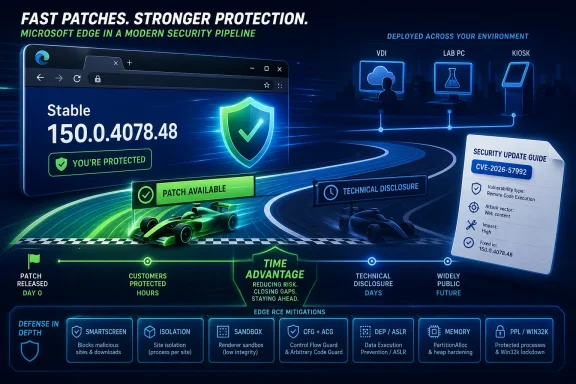 Microsoft’s Browser Patch Machine Is Built for Speed, Not Storytelling
Edge’s security rhythm is no longer organized around the old Windows Patch Tuesday mental model. Chromium-based browsers ship on a faster cadence, and Microsoft inherits both the benefits and the messiness of that model. When a vulnerability appears in Edge’s Security Update Guide, the public record often begins as a thin slice of metadata rather than a satisfying explanation of the bug.That frustrates defenders who want to know exactly which component failed, how reachable the bug is, and whether existing mitigations change the risk. But the browser world has largely decided that detailed disclosure should trail patch availability, especially for memory-safety and rendering bugs that can be weaponized quickly. A remote code execution label attached to a mainstream browser is enough to justify urgency even when exploit mechanics remain undisclosed.
CVE-2026-57992 fits that pattern. The name tells us the affected product family: Microsoft Edge, Chromium-based. The impact category tells us the concern: remote code execution. The absence of deeper public detail does not make the vulnerability imaginary; it simply means the public has not yet been handed the attacker’s map.
Microsoft’s release notes are also careful to distinguish between Edge-specific fixes and fixes inherited from Chromium. That distinction can become crucial later, especially if Google, Chromium maintainers, or third-party researchers publish more detail about the underlying issue. At launch, however, enterprise defenders rarely get the luxury of waiting for a tidy taxonomy.
Report Confidence Is the Metric That Explains the Silence
The user-supplied description is essentially about report confidence: how sure the ecosystem is that a vulnerability exists and how credible the known technical details are. That is not the same thing as severity. A bug can be severe but poorly described, or well documented but low impact.For CVE-2026-57992, the most important confidence signal is vendor acknowledgment. A Microsoft Security Response Center entry is not rumor, chatter, or a speculative scanner finding. It is Microsoft saying that the vulnerability belongs in the official update pipeline.
That does not mean every detail is public. In fact, early CVE records often avoid specifics by design. If the vulnerable subsystem, trigger condition, or exploit primitive is disclosed too soon, the public advisory can become a construction kit for exploit developers. The defensive community may want precision, but vendors often choose ambiguity until a larger share of the install base has moved.
This creates a strange but necessary bargain. Administrators are asked to act on a high-confidence claim without receiving a full technical narrative. That is uncomfortable, but it is also how browser patching has worked for years: the proof arrives in the update channel before it arrives in the write-up.
Remote Code Execution Still Means the Browser Is the Front Door
Remote code execution in a browser context does not automatically mean an attacker gets full control of a Windows machine. Modern Chromium-based browsers run with sandboxing, site isolation, process separation, exploit mitigations, and layers of platform hardening. But RCE remains the category defenders treat with special seriousness because the browser is where hostile input becomes routine.Every web page is untrusted content. Every advertisement, embedded script, compromised site, malicious redirect, and phishing landing page is part of the browser’s threat surface. When the vulnerable application is Edge, the exposure is not limited to users who install obscure software or open unusual files. It can involve normal browsing.
That is why browser RCE advisories are operationally different from many desktop application bugs. They sit at the junction of user behavior, web content, identity sessions, password managers, cloud apps, and endpoint security tooling. A successful exploit chain might need additional vulnerabilities to escape the sandbox or persist on the system, but the first step can begin with something as ordinary as a visit to a page.
Microsoft’s move to Chromium improved Edge’s standards compatibility and security inheritance, but it also tied Edge to the same broad class of web platform risks that affect the Chromium ecosystem. When Chromium moves fast, Edge moves with it. When Chromium’s attack surface produces another dangerous bug, Edge administrators cannot treat it as someone else’s problem.
The Version Number Is the Practical Line in the Sand
For administrators, the useful question is not whether CVE-2026-57992 has a dramatic write-up. It is whether deployed Edge clients are at or beyond the fixed release. Microsoft’s Edge security release notes identify July 2, 2026, Edge Stable version 150.0.4078.48 as the latest Stable release incorporating Chromium security updates.That gives IT teams a concrete audit target. Consumer Edge generally updates itself, but managed environments are more complicated. Update deferrals, application compatibility testing, network controls, virtual desktop images, kiosks, and offline systems can all leave browsers behind the public release channel.
Edge is sometimes treated as part of Windows rather than as a high-velocity application in its own right. That mental model is dangerous. The browser may be preinstalled, integrated, and policy-managed through Microsoft tooling, but its security posture depends on timely browser updates, not just monthly operating system patch compliance.
The harder cases are the ones administrators do not see every day. Shared machines, lab systems, remote users, point-of-sale workstations, and persistent VDI images can drift from the current channel. A vulnerability like CVE-2026-57992 is a reminder that browser version inventory belongs in the same conversation as endpoint detection and Windows servicing rings.
Sparse Advisories Put More Weight on Enterprise Telemetry
When advisories are thin, defenders lean on telemetry. That means checking Edge versions across the fleet, watching for failed update attempts, confirming policy configuration, and reviewing whether security controls interfere with browser self-update. It also means paying attention to whether the vulnerability later receives additional labels, such as exploitation detected in the wild.Microsoft’s Edge notes have historically called out cases where the Chromium team reported active exploitation. That kind of language is absent from the limited public material available here, which matters. There is a difference between “this is an RCE vulnerability” and “this RCE vulnerability is already being exploited.” The former still demands patching; the latter demands incident-response urgency.
The problem is that the absence of an exploitation note is not proof of safety. It may mean no exploitation is known, no exploitation has been confirmed publicly, or no exploitation detail is being disclosed yet. Security teams should avoid both extremes: panic on one side, complacency on the other.
A reasonable posture is to treat CVE-2026-57992 as a prompt for accelerated browser update verification rather than an automatic breach assumption. If an organization discovers a significant population of outdated Edge clients, especially on systems exposed to high-risk browsing, that becomes a remediation issue. If every client is already on the fixed build, the story shifts to documentation and monitoring.
The Chromium Dependency Cuts Both Ways
Microsoft’s Chromium-based Edge strategy gives users the advantage of a large, heavily scrutinized browser engine. Chromium vulnerabilities are found by Google, Microsoft, independent researchers, security firms, bug bounty participants, and attackers. That density of attention is one reason patches arrive frequently.But shared code also means shared urgency. A vulnerability in a common rendering, JavaScript, media, or browser platform component can ripple across multiple browsers and operating systems. Edge is not merely a Microsoft product in these moments; it is Microsoft’s distribution of a vast upstream project.
That is why Microsoft’s release notes so often use the phrase “incorporates the latest Security Updates of the Chromium project.” It is an understated sentence doing a lot of work. It tells defenders that the fix may not originate in a uniquely Microsoft component, but Microsoft’s customers still need Microsoft’s patched build.
This is also where enterprise browser diversity can become less protective than it appears. Running Edge and Chrome side by side may reduce dependency on one vendor’s user interface or policy stack, but it does not eliminate common Chromium engine exposure. If both browsers inherit the same upstream bug, the asset inventory problem doubles rather than disappears.
Enhanced Security Mode Is Helpful, But Patching Remains the Control That Counts
Microsoft has previously highlighted Edge’s enhanced security mode as a mitigation for some exploited Chromium vulnerabilities. That feature can reduce attack surface by applying stricter protections on unfamiliar sites and, depending on configuration, changing how just-in-time JavaScript compilation and other risky behaviors are handled. For high-risk users, it is worth considering.But mitigations are not patches. They can reduce exploitability, complicate attack chains, or protect particular browsing patterns, but they do not erase the underlying vulnerable code from the environment. Administrators who lean too heavily on mitigations risk turning a temporary shield into a permanent excuse.
The right use of enhanced security mode is strategic. It belongs in profiles for executives, administrators, developers with privileged access, journalists, finance staff, and anyone whose browser sessions represent unusually valuable targets. It also belongs in conversations about managed Edge baselines, not as a one-off checkbox after every CVE.
Still, CVE-2026-57992 should not become a referendum on one Edge feature. The first-order control is to update Edge. Everything else is defense in depth.
The Real Risk Is the Patch Gap Between Release and Verification
Browser vendors have become very good at shipping fixes. Enterprises are often less good at proving that fixes landed everywhere. That is the gap attackers care about.A browser update can be available globally while still missing from thousands of managed endpoints. Some users postpone restarts. Some devices stay offline. Some images are stale. Some security products slow or block update services. Some administrators assume Windows Update compliance includes the browser when their actual channel configuration says otherwise.
This is why “we patched” is no longer a sufficient answer. The better answer is “we verified the fixed Edge version across the fleet.” That shift sounds bureaucratic, but it is the difference between policy and control.
For CVE-2026-57992, the operational work is straightforward in concept: identify Edge versions, compare them with the fixed Stable release, remediate lagging systems, and keep watching for advisory updates. The difficulty is scale, not theory. Large Windows environments do not fail because nobody knows what to do; they fail because exceptions accumulate quietly.
Home Users Get the Same Advice, With Fewer Tools
For individual Windows users, the answer is simpler. Edge should update automatically, but users can force a check from the browser’s About page. If the browser downloads an update and asks for a restart, the restart is part of the patch.The home-user risk picture is also different. A consumer machine may not have enterprise EDR, managed browser policy, or centralized logging. It may, however, have password sessions, banking access, personal files, and saved credentials. Browser vulnerabilities matter precisely because the browser is where those assets are most often exposed.
Users who rely on Edge should also be careful about leaving the browser open for weeks. Chromium-based browsers can download updates in the background, but the new version does not fully take over until the browser restarts. “I never close my browser” is not a productivity hack when the thing waiting behind the relaunch is a security fix.
There is no need for theatrical steps unless exploitation is later confirmed or a user has reason to believe they were targeted. Update the browser, restart it, and avoid treating the lack of public exploit detail as a reason to delay.
The Advisory Is Thin, But the Signal Is Not
The central misunderstanding with sparse CVE entries is that people equate lack of detail with lack of confidence. That is backwards. Vendor acknowledgment gives defenders confidence that the vulnerability exists; the missing details mostly constrain our ability to speculate about exploit mechanics.That distinction is especially important for scoring systems and vulnerability-management dashboards. A metric that measures confidence in the vulnerability’s existence is not asking whether Reddit has a proof of concept or whether a researcher has published a root-cause analysis. It is asking whether the claim is credible enough to act on.
Here, the answer is yes. Microsoft has placed CVE-2026-57992 in its Security Update Guide, and Microsoft’s Edge release channel has moved. That is enough to justify remediation even if the public record lacks the satisfying anatomy of the bug.
Security teams should resist the temptation to over-narrate what is not known. We should not invent a JavaScript engine flaw, a media parser bug, or a sandbox escape because the phrase “remote code execution” makes those possibilities plausible. The honest reading is narrower: Microsoft has acknowledged an Edge Chromium-based RCE vulnerability, and the patch process is the actionable fact.
The July Edge Fix Leaves Administrators With a Short Checklist
The practical story of CVE-2026-57992 is less dramatic than the phrase “remote code execution” but more urgent than a routine version bump. Microsoft’s public material gives defenders enough to act, not enough to write a root-cause paper. That is increasingly the normal state of browser security.- Organizations should verify that managed Windows endpoints are running Microsoft Edge Stable version 150.0.4078.48 or a later fixed build.
- Administrators should check update rings, deferral policies, and browser restart behavior rather than assuming Edge patched itself everywhere.
- Security teams should monitor Microsoft’s Security Update Guide and Edge release notes for later additions, especially any change indicating known exploitation.
- Home users should open Edge’s About page, allow the browser to update, and restart it when prompted.
- Enhanced security mode may be useful for high-risk users, but it should supplement patching rather than replace it.
References
- Primary source: MSRC
Published: 2026-07-03T07:00:00-07:00
Security Update Guide - Microsoft Security Response Center
 msrc.microsoft.com
- Official source: microsoft.com
MSRC - Microsoft Security Response Center
The Microsoft Security Response Center is part of the defender community and on the front line of security response evolution. For over twenty years, we have been engaged with security researchers working to protect customers and the broader ecosystem.www.microsoft.com
- Related coverage: sentinelone.com
CVE-2026-45495: Microsoft Edge Chromium RCE Vulnerability
CVE-2026-45495 is a remote code execution vulnerability in Microsoft Edge Chromium. Learn about its impact, affected versions, and mitigation methods.www.sentinelone.com
- Related coverage: cve.circl.lu
Vulnerability-Lookup
Vulnerability-Lookup - Fast vulnerability lookup correlation from different sources.cve.circl.lu - Related coverage: dbugs.ptsecurity.com
CVE-2026-45495 — Remote Code Execution in Microsoft Edge | dbugs
Details on CVE-2026-45495: Remote Code Execution in Microsoft Edge. Includes CVSS score, affected versions, and references.dbugs.ptsecurity.com - Related coverage: hkcert.org
Microsoft Edge Multiple Vulnerabilities
Multiple vulnerabilities were identified in Microsoft Edge. A remote attacker could exploit some of these vulnerabilities to trigger remote code execution, denial of service condition, security restriction bypass and sensitive information disclosure on thwww.hkcert.org
- Related coverage: threats.kaspersky.com
Kaspersky Threats — KLA90999
threats.kaspersky.com
- Related coverage: stack.watch
- Related coverage: aha.org
h isac tlp white microsoft edge addresses exploited zero day vulnerability cve 2024 7971 8 23 2024
PDF documentwww.aha.org
- Related coverage: www2.gov.bc.ca