

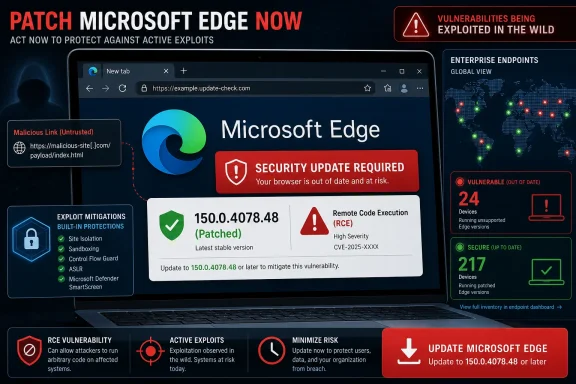
Microsoft published CVE-2026-58292 on July 3, 2026, as a high-severity remote code execution vulnerability in Chromium-based Microsoft Edge, with Edge Stable 150.0.4078.48 identified as the patched release for Windows and other desktop channels. The advisory is thin on exploit detail, but that thinness is itself the story: this is a browser bug with enough vendor confirmation to demand action, not enough public anatomy to reward speculation. For administrators, the practical answer is blunt: treat any Edge build below 150.0.4078.48 as behind the security line and move quickly.
The vulnerability lands in a familiar but uncomfortable place for Microsoft’s browser strategy. Edge is not merely “the browser” on many Windows systems; it is also an enterprise surface, an identity front end, a PDF handler, a SharePoint companion, and the close cousin of WebView2 runtimes embedded inside line-of-business applications. That makes a high-severity Edge RCE less like a consumer-app patch and more like a platform hygiene test.
Microsoft’s Security Response Center lists CVE-2026-58292 as a Microsoft Edge Chromium-based remote code execution vulnerability. Third-party mirrors of the MSRC record, including SecurityVulnerability.io and CVEFeed, show a July 3, 2026 publication date and a CVSS 3.1 score of 7.5, placing the bug in the “High” bucket rather than the truly catastrophic “Critical” tier.
The available scoring details matter. The vulnerability is described as network-reachable, requiring no privileges, but also requiring user interaction and carrying high attack complexity. That combination usually means this is not a wormable, point-and-shoot remote compromise. It is closer to the browser world’s usual danger zone: a crafted page, a malicious document-like workflow, or an attacker-controlled web interaction that needs a victim to do something ordinary enough to be plausible.
The phrase attached to the record — remote code execution — is still the part that should focus attention. Browser RCE is the class of bug defenders do not get to ignore, even when exploitability is constrained. If the exploit chain can cross a renderer boundary, abuse a browser component, or combine with a sandbox escape, “requires user interaction” can shrink to “the user clicked a link.”
Microsoft has not published a root-cause narrative in the visible advisory material. SecurityVulnerability.io characterizes the issue as involving improper input validation, but the primary vendor record is the load-bearing source here, and it does not offer the kind of component-level detail that would let defenders map the bug neatly to JavaScript, PDF handling, media parsing, WebUI, WebView, or another browser subsystem.
That absence is not unusual. Browser vendors often stage disclosure so patches arrive before researchers and attackers can triangulate the fix. But it creates a confidence gap for security teams: the existence of the vulnerability is vendor-confirmed, while the exploit mechanics remain opaque.
In this case, the vulnerability’s existence is not rumor. Microsoft has assigned and published the CVE through its Security Update Guide, and the patched Edge version is visible in Microsoft Learn’s Edge release notes. The uncertainty is narrower: exactly where the bug lives, how practical exploitation is, and whether attackers already had any private knowledge before the advisory appeared.
That distinction matters because vulnerability management tools often flatten nuance into a red row in a dashboard. A scanner may report “Microsoft Edge RCE,” but the decision a sysadmin has to make is more specific: how fast should the update be forced, which channels should be checked, and whether mitigations beyond patching are justified.
The confidence metric also points in the other direction. When public technical detail is sparse, attackers have less of a recipe, but they also have a fixed patch target. Once a patched build ships, exploit developers can diff code, compare Chromium and Edge branches, and hunt for the corrected behavior. The clock does not start when a blog publishes a proof of concept. It starts when the update is available.
That is the uncomfortable middle ground for CVE-2026-58292. The details are not public enough to panic over a known exploit chain, but the vendor confirmation is strong enough that waiting for more detail is the wrong operational instinct.
For home users, the advice is simple enough to be boring. Open Edge, check the About page, and let the browser update itself. The danger is not that Microsoft lacks an update mechanism; the danger is that people close the browser, defer restarts, run old portable builds, or use systems that have quietly fallen out of normal update habits.
For enterprises, the boundary is more complicated. Edge has Stable, Extended Stable, Beta, Dev, and Canary channels, and organizations often pin versions or stage updates to avoid breaking business-critical sites. That is rational until the browser becomes the patch that cannot wait.
The patched build number gives administrators a concrete audit target. Anything below 150.0.4078.48 should be treated as needing attention unless Microsoft’s channel-specific documentation says otherwise. The fact that the advisory is high severity rather than critical does not turn it into a leisurely maintenance task.
A browser RCE should be prioritized differently from a cosmetic UI regression or a policy deprecation. Users spend their day feeding browsers untrusted content from mail, chat, search, SaaS portals, and vendor sites. That makes Edge one of the most exposed applications on a Windows endpoint, even when users think of it as “just” the thing that opens links.
The headache is that Edge is not just Chrome with a different logo. Microsoft layers enterprise policies, account integration, PDF behavior, sidebar experiences, shopping features, Defender SmartScreen, Workspaces, WebView2 relationships, and Microsoft 365 hooks on top of Chromium. Some vulnerabilities are inherited from Chromium; others are Microsoft-specific.
The July 2 Edge security release note says the build incorporates the latest Chromium project security updates. The CVE title, however, names Microsoft Edge Chromium-based rather than Google Chrome. Without fuller vendor detail, defenders should avoid pretending they know exactly which bucket CVE-2026-58292 falls into.
That uncertainty is not academic. If a bug is in shared Chromium code, Chrome, Brave, Vivaldi, Opera, and Electron-based software may face adjacent risk depending on branch timing. If it is in Edge-specific code, the patching conversation narrows to Microsoft’s browser and possibly Microsoft-integrated components. The difference determines how broad an enterprise hunt should be.
The safest operational posture is to patch Edge first and keep an eye on Chromium advisories around the same release window. Security teams should not assume every Chromium-derived browser is vulnerable to this exact CVE, but they should recognize the recurring pattern: browser monoculture compresses the time between disclosure and weaponization.
That is why CVE-2026-58292’s scoring matters. User interaction required and high attack complexity suggest an exploit that may need careful shaping. The scope change in the CVSS vector, as reported by third-party CVE mirrors, suggests the vulnerable behavior may cross a security boundary, which is exactly the kind of thing browser defenders worry about.
None of that makes the vulnerability harmless. High-complexity browser exploits still get built when the target is valuable enough. A bug that is too expensive for commodity malware may still be well within reach for targeted intrusion operators, exploit brokers, and teams that specialize in chaining client-side vulnerabilities.
The modern browser exploit economy also rewards partial information. Attackers do not need Microsoft to publish a tutorial. They need a patched binary, an unpatched binary, and enough time to isolate the meaningful delta. The more widely deployed the software, the more attractive that exercise becomes.
Edge’s reach in business environments raises the stakes. A successful browser compromise can become credential theft, session hijacking, malicious extension installation, data access through already-authenticated SaaS sessions, or a beachhead for further endpoint compromise. The first code execution primitive is rarely the end of the story.
Managed Windows fleets are full of exceptions. Some devices are offline. Some are shared kiosks. Some have update services disabled by policy or broken by image drift. Some are VDI templates that get refreshed from stale gold images. Some run Edge only as a dependency of another workflow, so no user ever notices the browser’s About page nagging for a restart.
WebView2 adds another layer. CVE-2026-58292 is titled as an Edge vulnerability, and the public material available here does not establish that WebView2 is affected. But any Edge security event should prompt administrators to verify WebView2 runtime update health because Evergreen WebView2 is how Chromium-derived rendering reaches desktop applications outside the browser frame.
Microsoft’s Edge 150 release notes also introduce an enterprise WebView2 downgrade policy for managed devices. That is a useful regression-mitigation tool, but it underscores the governance problem. The more control organizations gain over browser and WebView runtime versions, the more responsibility they assume for not pinning themselves below a security floor.
A good response to CVE-2026-58292 is therefore not just “deploy Edge 150.0.4078.48.” It is “prove that Edge 150.0.4078.48 or later is present where expected, prove that update services are working, and prove that application teams have not frozen adjacent runtime components for convenience.”
That mix is classic modern Edge. The browser is simultaneously a security surface, a Microsoft 365 client, a policy-controlled enterprise application, and a consumer product that keeps changing shape. Security teams want a quiet patch. Product teams ship a moving platform.
The macOS support cutoff is especially relevant for mixed fleets. Edge 150 is the end of the road for macOS 12 Monterey, with Edge 151 and later requiring macOS 13 Ventura or newer. That means organizations using older Macs cannot treat browser patching as an isolated task for much longer; OS lifecycle becomes browser lifecycle.
The Workspaces migration is another example of security and manageability blending into product direction. Microsoft says saved Workspaces are moving from OneDrive and SharePoint storage to Edge Sync service, while collaboration and sharing functionality are being removed. For organizations that disable Sync, Microsoft says existing v1 Workspace data will still migrate, but new v2 Workspaces will remain local to each device.
The release also updates the “View in File Explorer” feature for SharePoint document libraries with additional validation and restrictions when triggered by webpages. That is the sort of change administrators may notice only when a legacy workflow breaks, but it points to the same theme as the CVE: browsers are increasingly asked to bridge cloud content, local files, identity, and enterprise policy, and every bridge is a place where validation matters.
That makes browser security a policy problem as much as a patch problem. Enterprises that treat Edge as an unmanaged default app are leaving too much to chance. Enterprises that manage it only for homepage settings and search defaults are missing the more important controls.
Microsoft has been adding knobs that reflect this reality. Edge management service security update alerts, described in Microsoft’s release notes as a public preview capability, let administrators choose severity thresholds for update notifications, including zero-day fixes. That is exactly the sort of feature that exists because “the browser will update itself eventually” is not an adequate answer for regulated or high-risk environments.
But alerting is not remediation. A dashboard can tell you that a high-severity browser fix exists; it cannot force a user to restart a browser with 47 tabs, resolve a broken updater, or negotiate with an application owner who has pinned a runtime to avoid a regression. The hard part of browser security is human and operational.
There is also a cultural lag. Many organizations have strong rituals around monthly Windows Patch Tuesday updates, but browsers follow a faster and less ceremonious cadence. Edge security releases can arrive out of band, and the correct response may be measured in hours or days rather than the next monthly window.
Defenders should expect scanning vendors to move faster than their explanations. Some tools will flag version ranges based on MSRC data and Microsoft Learn release notes. Others may lag until NVD enrichment or CPE mapping catches up. That lag can produce both false confidence and false alarms.
The right source hierarchy is important. For Microsoft products, MSRC and Microsoft Learn should sit above generic CVE mirrors when version applicability is disputed. Third-party databases are useful for aggregation and triage, but they sometimes compress channel distinctions, platform applicability, or affected-version logic into a form that creates noise.
This is especially true for Edge because Windows, macOS, Linux, Android, iOS, Stable, Extended Stable, and WebView2 do not always move in lockstep. A CVE that applies to one channel or platform may be irrelevant to another, and a scanner that treats “Microsoft Edge” as a single blob can send administrators chasing ghosts.
CVE-2026-58292’s currently sparse detail should therefore push teams toward version verification rather than exploit-theory debates. If the build is patched, the most important risk-reduction step is done. If the build is not patched, no amount of uncertainty about root cause makes the exposure acceptable.
The vulnerability lands in a familiar but uncomfortable place for Microsoft’s browser strategy. Edge is not merely “the browser” on many Windows systems; it is also an enterprise surface, an identity front end, a PDF handler, a SharePoint companion, and the close cousin of WebView2 runtimes embedded inside line-of-business applications. That makes a high-severity Edge RCE less like a consumer-app patch and more like a platform hygiene test.
 Microsoft’s Advisory Says Enough, and Withholds the Rest
Microsoft’s Security Response Center lists CVE-2026-58292 as a Microsoft Edge Chromium-based remote code execution vulnerability. Third-party mirrors of the MSRC record, including SecurityVulnerability.io and CVEFeed, show a July 3, 2026 publication date and a CVSS 3.1 score of 7.5, placing the bug in the “High” bucket rather than the truly catastrophic “Critical” tier.The available scoring details matter. The vulnerability is described as network-reachable, requiring no privileges, but also requiring user interaction and carrying high attack complexity. That combination usually means this is not a wormable, point-and-shoot remote compromise. It is closer to the browser world’s usual danger zone: a crafted page, a malicious document-like workflow, or an attacker-controlled web interaction that needs a victim to do something ordinary enough to be plausible.
The phrase attached to the record — remote code execution — is still the part that should focus attention. Browser RCE is the class of bug defenders do not get to ignore, even when exploitability is constrained. If the exploit chain can cross a renderer boundary, abuse a browser component, or combine with a sandbox escape, “requires user interaction” can shrink to “the user clicked a link.”
Microsoft has not published a root-cause narrative in the visible advisory material. SecurityVulnerability.io characterizes the issue as involving improper input validation, but the primary vendor record is the load-bearing source here, and it does not offer the kind of component-level detail that would let defenders map the bug neatly to JavaScript, PDF handling, media parsing, WebUI, WebView, or another browser subsystem.
That absence is not unusual. Browser vendors often stage disclosure so patches arrive before researchers and attackers can triangulate the fix. But it creates a confidence gap for security teams: the existence of the vulnerability is vendor-confirmed, while the exploit mechanics remain opaque.
The Confidence Metric Is Doing Quiet Work
The user-supplied MSRC text describes a metric that measures confidence in the existence of a vulnerability and the credibility of the known technical details. That is not boilerplate decoration. It is a reminder that a CVE record can be simultaneously real, urgent, and technically incomplete.In this case, the vulnerability’s existence is not rumor. Microsoft has assigned and published the CVE through its Security Update Guide, and the patched Edge version is visible in Microsoft Learn’s Edge release notes. The uncertainty is narrower: exactly where the bug lives, how practical exploitation is, and whether attackers already had any private knowledge before the advisory appeared.
That distinction matters because vulnerability management tools often flatten nuance into a red row in a dashboard. A scanner may report “Microsoft Edge RCE,” but the decision a sysadmin has to make is more specific: how fast should the update be forced, which channels should be checked, and whether mitigations beyond patching are justified.
The confidence metric also points in the other direction. When public technical detail is sparse, attackers have less of a recipe, but they also have a fixed patch target. Once a patched build ships, exploit developers can diff code, compare Chromium and Edge branches, and hunt for the corrected behavior. The clock does not start when a blog publishes a proof of concept. It starts when the update is available.
That is the uncomfortable middle ground for CVE-2026-58292. The details are not public enough to panic over a known exploit chain, but the vendor confirmation is strong enough that waiting for more detail is the wrong operational instinct.
Edge 150.0.4078.48 Is the Security Boundary
Microsoft Learn lists Edge Stable version 150.0.4078.48 as the July 2, 2026 Stable release, and Microsoft’s Edge security release notes say that build incorporates the latest security updates from the Chromium project. The CVE appeared publicly the next day, which is a common rhythm for browser security: ship the bits, then fill in the advisory surface as the ecosystem catches up.For home users, the advice is simple enough to be boring. Open Edge, check the About page, and let the browser update itself. The danger is not that Microsoft lacks an update mechanism; the danger is that people close the browser, defer restarts, run old portable builds, or use systems that have quietly fallen out of normal update habits.
For enterprises, the boundary is more complicated. Edge has Stable, Extended Stable, Beta, Dev, and Canary channels, and organizations often pin versions or stage updates to avoid breaking business-critical sites. That is rational until the browser becomes the patch that cannot wait.
The patched build number gives administrators a concrete audit target. Anything below 150.0.4078.48 should be treated as needing attention unless Microsoft’s channel-specific documentation says otherwise. The fact that the advisory is high severity rather than critical does not turn it into a leisurely maintenance task.
A browser RCE should be prioritized differently from a cosmetic UI regression or a policy deprecation. Users spend their day feeding browsers untrusted content from mail, chat, search, SaaS portals, and vendor sites. That makes Edge one of the most exposed applications on a Windows endpoint, even when users think of it as “just” the thing that opens links.
The Chromium Dependency Cuts Both Ways
Edge’s Chromium base is both Microsoft’s security advantage and its disclosure headache. The advantage is obvious: Edge benefits from the massive engineering, fuzzing, and vulnerability response machinery around Chromium. When the underlying project fixes a class of bug, Microsoft can pull that work into Edge rather than defending a wholly separate browser engine.The headache is that Edge is not just Chrome with a different logo. Microsoft layers enterprise policies, account integration, PDF behavior, sidebar experiences, shopping features, Defender SmartScreen, Workspaces, WebView2 relationships, and Microsoft 365 hooks on top of Chromium. Some vulnerabilities are inherited from Chromium; others are Microsoft-specific.
The July 2 Edge security release note says the build incorporates the latest Chromium project security updates. The CVE title, however, names Microsoft Edge Chromium-based rather than Google Chrome. Without fuller vendor detail, defenders should avoid pretending they know exactly which bucket CVE-2026-58292 falls into.
That uncertainty is not academic. If a bug is in shared Chromium code, Chrome, Brave, Vivaldi, Opera, and Electron-based software may face adjacent risk depending on branch timing. If it is in Edge-specific code, the patching conversation narrows to Microsoft’s browser and possibly Microsoft-integrated components. The difference determines how broad an enterprise hunt should be.
The safest operational posture is to patch Edge first and keep an eye on Chromium advisories around the same release window. Security teams should not assume every Chromium-derived browser is vulnerable to this exact CVE, but they should recognize the recurring pattern: browser monoculture compresses the time between disclosure and weaponization.
Remote Code Execution No Longer Means What It Meant in 2006
A remote code execution label used to conjure a direct path from packet to shell. In modern browsers, the phrase is messier. There are sandboxes, site isolation, broker processes, JIT hardening, memory allocators, exploit mitigations, and operating-system defenses layered across the attack path.That is why CVE-2026-58292’s scoring matters. User interaction required and high attack complexity suggest an exploit that may need careful shaping. The scope change in the CVSS vector, as reported by third-party CVE mirrors, suggests the vulnerable behavior may cross a security boundary, which is exactly the kind of thing browser defenders worry about.
None of that makes the vulnerability harmless. High-complexity browser exploits still get built when the target is valuable enough. A bug that is too expensive for commodity malware may still be well within reach for targeted intrusion operators, exploit brokers, and teams that specialize in chaining client-side vulnerabilities.
The modern browser exploit economy also rewards partial information. Attackers do not need Microsoft to publish a tutorial. They need a patched binary, an unpatched binary, and enough time to isolate the meaningful delta. The more widely deployed the software, the more attractive that exercise becomes.
Edge’s reach in business environments raises the stakes. A successful browser compromise can become credential theft, session hijacking, malicious extension installation, data access through already-authenticated SaaS sessions, or a beachhead for further endpoint compromise. The first code execution primitive is rarely the end of the story.
The Patch Is Easy; Proving Coverage Is Not
Microsoft’s automatic update system is one of the reasons browser security is less grim than it was in the Internet Explorer era. Most consumer Edge installations will eventually reach the patched build without anyone reading CVE details. The enterprise problem is not update availability; it is confidence that the update reached every place Edge-shaped code is running.Managed Windows fleets are full of exceptions. Some devices are offline. Some are shared kiosks. Some have update services disabled by policy or broken by image drift. Some are VDI templates that get refreshed from stale gold images. Some run Edge only as a dependency of another workflow, so no user ever notices the browser’s About page nagging for a restart.
WebView2 adds another layer. CVE-2026-58292 is titled as an Edge vulnerability, and the public material available here does not establish that WebView2 is affected. But any Edge security event should prompt administrators to verify WebView2 runtime update health because Evergreen WebView2 is how Chromium-derived rendering reaches desktop applications outside the browser frame.
Microsoft’s Edge 150 release notes also introduce an enterprise WebView2 downgrade policy for managed devices. That is a useful regression-mitigation tool, but it underscores the governance problem. The more control organizations gain over browser and WebView runtime versions, the more responsibility they assume for not pinning themselves below a security floor.
A good response to CVE-2026-58292 is therefore not just “deploy Edge 150.0.4078.48.” It is “prove that Edge 150.0.4078.48 or later is present where expected, prove that update services are working, and prove that application teams have not frozen adjacent runtime components for convenience.”
Microsoft’s July Edge Release Is a Security Patch Wrapped in Product Churn
The July 2 Edge 150 release is not only a security release. Microsoft Learn’s release notes describe a set of product changes that will matter to administrators: Edge version 150 is the last release supporting macOS 12 Monterey, Workspaces migration continues, the sidebar app list is being retired, Google-account sign-in is rolling out on Windows and macOS, and new policies arrive for proxy socket pool randomization, non-Microsoft account sign-in, and strict MIME type checking for worker scripts.That mix is classic modern Edge. The browser is simultaneously a security surface, a Microsoft 365 client, a policy-controlled enterprise application, and a consumer product that keeps changing shape. Security teams want a quiet patch. Product teams ship a moving platform.
The macOS support cutoff is especially relevant for mixed fleets. Edge 150 is the end of the road for macOS 12 Monterey, with Edge 151 and later requiring macOS 13 Ventura or newer. That means organizations using older Macs cannot treat browser patching as an isolated task for much longer; OS lifecycle becomes browser lifecycle.
The Workspaces migration is another example of security and manageability blending into product direction. Microsoft says saved Workspaces are moving from OneDrive and SharePoint storage to Edge Sync service, while collaboration and sharing functionality are being removed. For organizations that disable Sync, Microsoft says existing v1 Workspace data will still migrate, but new v2 Workspaces will remain local to each device.
The release also updates the “View in File Explorer” feature for SharePoint document libraries with additional validation and restrictions when triggered by webpages. That is the sort of change administrators may notice only when a legacy workflow breaks, but it points to the same theme as the CVE: browsers are increasingly asked to bridge cloud content, local files, identity, and enterprise policy, and every bridge is a place where validation matters.
The Browser Has Become the Enterprise’s Soft Perimeter
CVE-2026-58292 is not just a reminder to patch Edge. It is a reminder that the browser has quietly become the place where old perimeter assumptions go to die. Users authenticate into SaaS platforms, open attachments in web viewers, approve device prompts, download files, run extensions, and move between personal and corporate contexts inside the same application shell.That makes browser security a policy problem as much as a patch problem. Enterprises that treat Edge as an unmanaged default app are leaving too much to chance. Enterprises that manage it only for homepage settings and search defaults are missing the more important controls.
Microsoft has been adding knobs that reflect this reality. Edge management service security update alerts, described in Microsoft’s release notes as a public preview capability, let administrators choose severity thresholds for update notifications, including zero-day fixes. That is exactly the sort of feature that exists because “the browser will update itself eventually” is not an adequate answer for regulated or high-risk environments.
But alerting is not remediation. A dashboard can tell you that a high-severity browser fix exists; it cannot force a user to restart a browser with 47 tabs, resolve a broken updater, or negotiate with an application owner who has pinned a runtime to avoid a regression. The hard part of browser security is human and operational.
There is also a cultural lag. Many organizations have strong rituals around monthly Windows Patch Tuesday updates, but browsers follow a faster and less ceremonious cadence. Edge security releases can arrive out of band, and the correct response may be measured in hours or days rather than the next monthly window.
Where Attackers Will Look Next
The lack of public exploit detail for CVE-2026-58292 is good news for defenders, but only temporarily. Attackers who care about Edge will look at the patched build, compare it with the previous version, and search for the change that maps to a remote code execution condition. If the patch touches a parser, validation layer, IPC boundary, or Edge-specific web feature, that diff becomes the first draft of an exploit hypothesis.Defenders should expect scanning vendors to move faster than their explanations. Some tools will flag version ranges based on MSRC data and Microsoft Learn release notes. Others may lag until NVD enrichment or CPE mapping catches up. That lag can produce both false confidence and false alarms.
The right source hierarchy is important. For Microsoft products, MSRC and Microsoft Learn should sit above generic CVE mirrors when version applicability is disputed. Third-party databases are useful for aggregation and triage, but they sometimes compress channel distinctions, platform applicability, or affected-version logic into a form that creates noise.
This is especially true for Edge because Windows, macOS, Linux, Android, iOS, Stable, Extended Stable, and WebView2 do not always move in lockstep. A CVE that applies to one channel or platform may be irrelevant to another, and a scanner that treats “Microsoft Edge” as a single blob can send administrators chasing ghosts.
CVE-2026-58292’s currently sparse detail should therefore push teams toward version verification rather than exploit-theory debates. If the build is patched, the most important risk-reduction step is done. If the build is not patched, no amount of uncertainty about root cause makes the exposure acceptable.
The Practical Reading of a Sparse Edge RCE
The operational story around CVE-2026-58292 is sharper than the advisory text. Microsoft has acknowledged the vulnerability, the patched Edge Stable build is identifiable, and the public technical record is not yet rich enough to justify elaborate compensating controls over simply updating. This is the kind of browser CVE that rewards disciplined fleet hygiene more than clever analysis.- Organizations should verify that Microsoft Edge Stable is updated to version 150.0.4078.48 or later wherever Stable is deployed.
- Administrators should investigate devices that have Edge Update disabled, broken, or deferred by policy because those exceptions become the long tail of exposure.
- Security teams should treat the absence of public exploit details as a temporary advantage, not as evidence that the vulnerability is theoretical.
- Mixed-platform fleets should note that Edge 150 is the final Edge release for macOS 12 Monterey, making OS upgrades part of the next browser-security conversation.
- Enterprises using WebView2 should separately confirm runtime update health, even though the currently available CVE material does not prove WebView2 exposure for this specific vulnerability.
- Vulnerability-management teams should prefer MSRC and Microsoft Learn over generic CVE mirrors when channel, version, or platform applicability conflicts.
References
- Primary source: MSRC
Published: 2026-07-03T07:00:00-07:00
Security Update Guide - Microsoft Security Response Center
 msrc.microsoft.com
- Related coverage: securityvulnerability.io
CVE-2026-58292 : Remote Code Execution Vulnerability in Microsoft Edge by Microsoft
Learn about the vulnerability in Microsoft Edge affecting code execution via improper input validation. Stay protected with CVE-2026-58292.securityvulnerability.io - Related coverage: hkcert.org
Microsoft Edge Multiple Vulnerabilities
Multiple vulnerabilities were identified in Microsoft Edge. A remote attacker could exploit some of these vulnerabilities to trigger remote code execution, denial of service condition, security restriction bypass, data manipulation, sensitive informationwww.hkcert.org - Related coverage: sentinelone.com
CVE-2026-45495: Microsoft Edge Chromium RCE Vulnerability
CVE-2026-45495 is a remote code execution vulnerability in Microsoft Edge Chromium. Learn about its impact, affected versions, and mitigation methods.www.sentinelone.com
- Related coverage: cve.circl.lu
Vulnerability-Lookup
Vulnerability-Lookup - Fast vulnerability lookup correlation from different sources.cve.circl.lu - Related coverage: threats.kaspersky.com
Kaspersky Threats — KLA90999
threats.kaspersky.com
- Related coverage: www2.gov.bc.ca
- Related coverage: aha.org
h isac tlp white microsoft edge addresses exploited zero day vulnerability cve 2024 7971 8 23 2024
PDF documentwww.aha.org
- Related coverage: mphasis.com
- Related coverage: ws.buildingsbt.stage.honeywell.com
- Official source: learn.microsoft.com
Microsoft Edge release notes for Stable Channel | Microsoft Learn
Microsoft Edge release note for the Stable Channellearn.microsoft.com - Related coverage: techspot.com
Microsoft Edge Download Free - 150.0.4078.48 | TechSpot
Download Microsoft Edge - Edge browser lets you enjoy extended battery life and get to what you are looking for quickly.www.techspot.com - Official source: developer.microsoft.com

Microsoft Edge WebDriver | Microsoft Edge Developer
developer.microsoft.com
- Related coverage: softexia.com
Microsoft Edge 150.0.4078.48 | Download Free
Discover the browsing experience across all your devices with Microsoft Edge - the advanced AI web browser for Windows, macOS, Android, iOS.www.softexia.com
- Related coverage: windowsforum.com
CVE-2026-57992: Edge Stable 150.0.4078.48 RCE Patch Gap for Windows | Windows Forum
Microsoft has listed CVE-2026-57992 as a Microsoft Edge Chromium-based remote code execution vulnerability in the Security Update Guide, with Edge Stable...windowsforum.com - Related coverage: windowscentral.com
Microsoft Edge removes several features in latest update | Windows Central
Microsoft is getting rid of Collections and forcing new password rules but also finally fixed a major annoyance with clearing your history.www.windowscentral.com
