

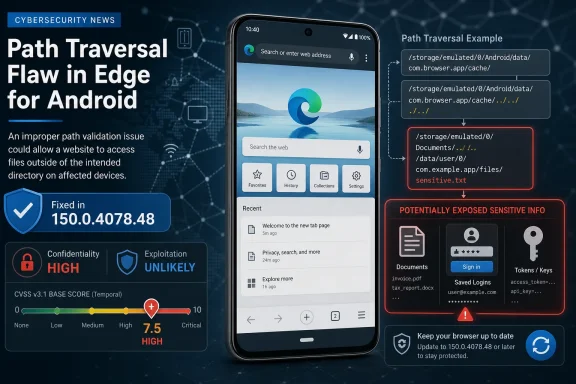
Microsoft disclosed CVE-2026-58300 on July 3, 2026, as an Important-rated information disclosure vulnerability in Microsoft Edge for Android, fixed in Edge version 150.0.4078.48 and attributed by MSRC to absolute path traversal that could let an unauthenticated local attacker expose sensitive information. The awkward part is not that Edge for Android has a security flaw; mobile browsers are high-value, fast-moving software. The awkward part is that Microsoft’s own scoring tells a more interesting story than the headline severity: exploitation is considered unlikely, yet the report confidence is confirmed and the confidentiality impact is high. That combination should put this bug in the category every serious Windows and mobile administrator knows too well — not a fire alarm, but absolutely not background noise.
The Microsoft Security Response Center describes the vulnerability in deliberately narrow language: absolute path traversal in Microsoft Edge for Android allows an unauthorized attacker to disclose information locally. That sentence does not sound like a breach movie. It sounds like a filing-cabinet problem.
But on Android, the filing cabinet is the user’s pocket. Edge is not merely a rendering surface for web pages; it is a broker for Microsoft accounts, enterprise identity flows, synced browsing data, downloads, password-adjacent experiences, cloud documents, and app-to-app handoffs. Even when a vulnerability is “local” rather than network-exploitable, the local device is where modern identity lives.
MSRC rates the flaw as Important, not Critical, and assigns it a CVSS 3.1 base score of 6.2, with a temporal score of 5.4. That is precisely the kind of middle-weight number that tends to be misread. It is not low enough to dismiss, but not dramatic enough to dominate a patch meeting unless someone explains why confidentiality-only bugs can matter disproportionately on mobile.
The strongest signal is Microsoft’s own vector string. Attack vector is local, attack complexity is low, privileges required are none, user interaction is none, scope is unchanged, confidentiality impact is high, and integrity and availability impacts are none. In plainer English: this is not a remote takeover bug, but Microsoft believes exploitation could expose sensitive information without needing prior privileges or victim interaction, assuming an attacker can operate in the local attack context.
Android devices are crowded neighborhoods. Apps exchange files, intents, links, documents, previews, permissions, and temporary storage artifacts. A bug does not need to be reachable from the public internet to become useful if another app, a malicious file workflow, a compromised device state, or a physical-access scenario can put pressure on it.
That does not mean CVE-2026-58300 is known to be exploited in such a chain. Microsoft says it was not publicly disclosed and not exploited at the time of publication, and the company’s exploitability assessment is “Exploitation Unlikely.” Those are important constraints, and they should prevent the usual doom-scroll inflation that attaches itself to every CVE number.
Still, “local” is not a synonym for “irrelevant.” On managed Android fleets, local exposure can be the difference between a contained app bug and a compliance incident. On personal phones, it can mean data a user assumed was walled off by app sandboxing becomes observable through a path handling mistake.
Absolute path traversal is especially uncomfortable because it is an old class of error in a modern setting. The basic shape is familiar: software mishandles a path and allows access outside the intended location. The operating system, browser sandbox, and app permissions are all supposed to narrow the blast radius, but the vulnerability class itself is about crossing a boundary the developer thought was fixed.
That matters because defenders frequently triage by severity labels and exploit headlines. “Important,” “not exploited,” and “exploitation unlikely” can become a three-word lullaby. But “confirmed,” “low attack complexity,” and “high confidentiality impact” tell a different story, especially for environments where mobile browsers are part of the authentication surface.
There is also a temporal asymmetry at work. Microsoft says no public exploit code is known and marks exploit code maturity as unproven. That is good news on July 3, 2026. It is not a lifetime guarantee.
Once a vendor ships a fix and describes the weakness class, the patch itself becomes a map. Reverse engineering a mobile browser update is not trivial, but it is a familiar discipline. The window between advisory publication and device update adoption is where many “unlikely” bugs become useful to a narrower, more capable set of attackers.
For users, that means tabs, profiles, passwords, history, downloads, and sign-in state may travel across platforms. For administrators, it means Edge can be a managed app in a mobile device management policy, a conditional access participant, and a preferred browser for corporate links. The Android version is not some detached sidecar; it is a client endpoint in Microsoft’s broader enterprise story.
That is why an information disclosure bug can carry more operational weight than its score suggests. The advisory does not say the flaw exposes tokens, passwords, files, or browsing data specifically; it says sensitive information could be disclosed. That restraint is important. But it also leaves administrators with a familiar problem: they must act on risk without having a complete public root-cause narrative.
This is where mature patch operations separate themselves from checkbox compliance. The right question is not whether this flaw is terrifying. It is whether Edge for Android is in your managed estate, whether version 150.0.4078.48 has reached those devices, and whether your mobile policy can prove it.
For unmanaged users, the fix path is mundane: update Edge from the app store and verify the installed version. For managed environments, the problem is less mundane. Android app update behavior can be shaped by store rollout timing, device policy, user settings, network conditions, and whether the device is personally owned or corporate-owned.
The MSRC entry points to Microsoft Edge security release notes rather than a Windows Update package. That is another reminder that Edge’s update model is no longer purely Windows-centric, and mobile app security does not wait for a familiar Patch Tuesday cadence. The browser is now a distributed product line with platform-specific fixes landing when they are ready.
There is a quiet advantage here. The vulnerability was published with an official fix available, and Microsoft’s temporal scoring reflects that. For administrators, the operational task is therefore not mitigation design but update assurance. That is simpler, but it still requires visibility.
That “if” does a lot of work. Some users disable automatic updates. Some enterprise devices sit behind restrictive store policies. Some ruggedized or shared devices are treated as appliances and updated only when something visibly breaks. A browser vulnerability with an official fix available is only fixed where the new browser build actually lands.
This is where Microsoft’s advisory format can understate the practical burden. The existence of a fix reduces exploitability urgency in the scoring model, but it does not prove deployment. In the enterprise world, the gap between “vendor released” and “fleet remediated” is where risk lives.
Mobile device management tools should be able to inventory app versions, enforce minimum app builds, and nudge or require updates. If Edge for Android is approved for work use, CVE-2026-58300 is a good excuse to test whether those controls are real or merely documented.
Browsers are particularly exposed to this complexity. They download, preview, cache, sync, render, store, isolate, and hand data to other applications. They must handle untrusted web content while integrating deeply with trusted local capabilities. Every boundary between those jobs is a place where a path can become more powerful than intended.
On Android, those boundaries include app-private storage, shared storage, content providers, document providers, intents, temporary files, and scoped storage rules. Microsoft’s advisory does not publish a proof-of-concept, and responsible disclosure norms often require that restraint. But the weakness category alone gives defenders enough to understand the shape of the risk.
The lesson is not that Edge is uniquely careless. Chrome, Firefox, WebView-based browsers, and embedded app browsers all live with similar complexity. The more useful conclusion is that mobile browsers are now operating-system-scale software, and their security updates deserve operating-system-scale attention.
The same applies to “not publicly disclosed.” The absence of prior public disclosure lowers immediate attacker awareness, but the advisory itself changes the information environment. After publication, the CVE number, vulnerability class, affected product, fixed version, and impact category are public.
This is why good security teams do not wait for active exploitation to patch browser bugs. The exploitability label helps prioritize emergency response, not justify indefinite delay. A vulnerability can be unlikely to exploit and still worth closing promptly, particularly when the fix is a standard app update.
There is a broader cultural problem here. The security industry has trained people to chase zero-days and ignore quiet fixes. But many intrusions are built from dull components: known bugs, weak update hygiene, exposed secrets, reused credentials, and devices no one inventoried. CVE-2026-58300 is exactly the kind of dull component that should not become available through neglect.
That matters for WindowsForum readers because the Windows endpoint is no longer the only place a Windows user’s work identity lives. A user may authenticate on Windows Hello, approve sign-ins on a phone, open corporate links in Edge on Android, and sync browsing context back to a PC. The user experience is continuous; the risk model must be continuous too.
If an organization standardizes on Edge for policy reasons, it inherits Edge’s mobile patch cadence. If it allows any mobile browser, it inherits a different problem: fragmented visibility. Either way, mobile browser security cannot be left to the hope that users update apps eventually.
The practical response does not require panic. It requires the same discipline administrators already apply to desktop browsers: know what is installed, know what version is safe, enforce updates where possible, and verify after rollout. The novelty is not the process. The novelty is admitting that Android app versions now belong in the same conversation as Windows build numbers.
For security researchers and administrators trying to understand exposure, it is not enough to fully model the vulnerable path. Microsoft does not identify the exact component, file-handling workflow, storage boundary, trigger mechanism, or class of sensitive information beyond the broad label. That is normal for advisories, but it leaves room for both underreaction and overreaction.
The right editorial posture is to keep those two errors apart. Overreaction would be to describe this as a known remote attack against Edge users. Microsoft has not said that, and its own metrics point away from that conclusion. Underreaction would be to treat the flaw as harmless because exploitation is unlikely and the attack vector is local.
The honest reading is narrower and sharper: Microsoft confirmed a real path traversal bug in Edge for Android, says it could disclose sensitive information, says no exploitation or public disclosure was known at release, and shipped a fixed version. That should be boring in the best possible way — a confirmed issue, fixed before a public exploit wave, with a clear version target.
For individual users, checking the app store and ensuring Edge is current is enough. Users who rely on Edge for work accounts, password sync, or sensitive browsing should treat this as a prompt to confirm automatic updates are enabled. The risk is not theatrical, but browser updates are one of the cheapest security wins available.
For administrators, the patch should move through mobile app management rather than email reminders. If Edge is a managed app, set a minimum acceptable version and report on devices below it. If it is not managed but is used for corporate access, this advisory is a useful reason to revisit that gap.
Security teams should also resist the urge to isolate this as an Android-only curiosity. It is a mobile browser issue, yes, but it touches the same users, accounts, and workflows that Windows teams protect every day. The endpoint has multiplied; the identity perimeter has not.
 Microsoft’s Mobile Browser Bug Is Small Only If You Ignore the Phone
The Microsoft Security Response Center describes the vulnerability in deliberately narrow language: absolute path traversal in Microsoft Edge for Android allows an unauthorized attacker to disclose information locally. That sentence does not sound like a breach movie. It sounds like a filing-cabinet problem.But on Android, the filing cabinet is the user’s pocket. Edge is not merely a rendering surface for web pages; it is a broker for Microsoft accounts, enterprise identity flows, synced browsing data, downloads, password-adjacent experiences, cloud documents, and app-to-app handoffs. Even when a vulnerability is “local” rather than network-exploitable, the local device is where modern identity lives.
MSRC rates the flaw as Important, not Critical, and assigns it a CVSS 3.1 base score of 6.2, with a temporal score of 5.4. That is precisely the kind of middle-weight number that tends to be misread. It is not low enough to dismiss, but not dramatic enough to dominate a patch meeting unless someone explains why confidentiality-only bugs can matter disproportionately on mobile.
The strongest signal is Microsoft’s own vector string. Attack vector is local, attack complexity is low, privileges required are none, user interaction is none, scope is unchanged, confidentiality impact is high, and integrity and availability impacts are none. In plainer English: this is not a remote takeover bug, but Microsoft believes exploitation could expose sensitive information without needing prior privileges or victim interaction, assuming an attacker can operate in the local attack context.
“Local” Is No Longer a Comforting Word
Security teams often breathe easier when a vulnerability is scored as local. In server-land, “local” usually means an attacker already has a foothold. In mobile-land, that word deserves more skepticism.Android devices are crowded neighborhoods. Apps exchange files, intents, links, documents, previews, permissions, and temporary storage artifacts. A bug does not need to be reachable from the public internet to become useful if another app, a malicious file workflow, a compromised device state, or a physical-access scenario can put pressure on it.
That does not mean CVE-2026-58300 is known to be exploited in such a chain. Microsoft says it was not publicly disclosed and not exploited at the time of publication, and the company’s exploitability assessment is “Exploitation Unlikely.” Those are important constraints, and they should prevent the usual doom-scroll inflation that attaches itself to every CVE number.
Still, “local” is not a synonym for “irrelevant.” On managed Android fleets, local exposure can be the difference between a contained app bug and a compliance incident. On personal phones, it can mean data a user assumed was walled off by app sandboxing becomes observable through a path handling mistake.
Absolute path traversal is especially uncomfortable because it is an old class of error in a modern setting. The basic shape is familiar: software mishandles a path and allows access outside the intended location. The operating system, browser sandbox, and app permissions are all supposed to narrow the blast radius, but the vulnerability class itself is about crossing a boundary the developer thought was fixed.
The Severity Score Hides the Real Priority Signal
The CVSS score of 6.2 is useful, but it is not the most revealing part of the advisory. The more interesting metric is “Report Confidence: Confirmed.” Microsoft’s Security Update Guide explains this category as measuring confidence in the vulnerability’s existence and the credibility of the technical details. For CVE-2026-58300, Microsoft is not flagging rumor, theoretical suspicion, or ambiguous behavior.That matters because defenders frequently triage by severity labels and exploit headlines. “Important,” “not exploited,” and “exploitation unlikely” can become a three-word lullaby. But “confirmed,” “low attack complexity,” and “high confidentiality impact” tell a different story, especially for environments where mobile browsers are part of the authentication surface.
There is also a temporal asymmetry at work. Microsoft says no public exploit code is known and marks exploit code maturity as unproven. That is good news on July 3, 2026. It is not a lifetime guarantee.
Once a vendor ships a fix and describes the weakness class, the patch itself becomes a map. Reverse engineering a mobile browser update is not trivial, but it is a familiar discipline. The window between advisory publication and device update adoption is where many “unlikely” bugs become useful to a narrower, more capable set of attackers.
Edge for Android Lives in Microsoft’s Identity Weather System
It is tempting to treat Edge for Android as a consumer app that happens to carry the Microsoft logo. That would miss why WindowsForum readers should care. Edge on Android is part of the same cross-device identity and productivity mesh that many organizations now rely on to make Microsoft 365 feel continuous from desktop to phone.For users, that means tabs, profiles, passwords, history, downloads, and sign-in state may travel across platforms. For administrators, it means Edge can be a managed app in a mobile device management policy, a conditional access participant, and a preferred browser for corporate links. The Android version is not some detached sidecar; it is a client endpoint in Microsoft’s broader enterprise story.
That is why an information disclosure bug can carry more operational weight than its score suggests. The advisory does not say the flaw exposes tokens, passwords, files, or browsing data specifically; it says sensitive information could be disclosed. That restraint is important. But it also leaves administrators with a familiar problem: they must act on risk without having a complete public root-cause narrative.
This is where mature patch operations separate themselves from checkbox compliance. The right question is not whether this flaw is terrifying. It is whether Edge for Android is in your managed estate, whether version 150.0.4078.48 has reached those devices, and whether your mobile policy can prove it.
The Fix Arrived Before the Drama
Microsoft lists the fixed Edge for Android release as version 150.0.4078.48, released July 3, 2026, based on Chromium version 150.0.7871.47. That detail matters because browser security advisories are often consumed as abstract vulnerability notices, while the real remediation is a very concrete version number.For unmanaged users, the fix path is mundane: update Edge from the app store and verify the installed version. For managed environments, the problem is less mundane. Android app update behavior can be shaped by store rollout timing, device policy, user settings, network conditions, and whether the device is personally owned or corporate-owned.
The MSRC entry points to Microsoft Edge security release notes rather than a Windows Update package. That is another reminder that Edge’s update model is no longer purely Windows-centric, and mobile app security does not wait for a familiar Patch Tuesday cadence. The browser is now a distributed product line with platform-specific fixes landing when they are ready.
There is a quiet advantage here. The vulnerability was published with an official fix available, and Microsoft’s temporal scoring reflects that. For administrators, the operational task is therefore not mitigation design but update assurance. That is simpler, but it still requires visibility.
Android’s Patch Problem Is Also an App Patch Problem
Android security conversations often focus on monthly platform bulletins, OEM delays, and carrier bottlenecks. Browser flaws cut across that model. Edge is updated as an app, which can make remediation faster than waiting for a full OS update — if the app update channel is healthy.That “if” does a lot of work. Some users disable automatic updates. Some enterprise devices sit behind restrictive store policies. Some ruggedized or shared devices are treated as appliances and updated only when something visibly breaks. A browser vulnerability with an official fix available is only fixed where the new browser build actually lands.
This is where Microsoft’s advisory format can understate the practical burden. The existence of a fix reduces exploitability urgency in the scoring model, but it does not prove deployment. In the enterprise world, the gap between “vendor released” and “fleet remediated” is where risk lives.
Mobile device management tools should be able to inventory app versions, enforce minimum app builds, and nudge or require updates. If Edge for Android is approved for work use, CVE-2026-58300 is a good excuse to test whether those controls are real or merely documented.
The Bug Class Is Ancient, the Context Is Modern
CWE-36, absolute path traversal, is not a glamorous weakness. It belongs to the family of bugs that generations of developers have been told to avoid: normalize paths, constrain roots, reject unexpected separators, distrust input, and do not assume a filename is just a filename. The persistence of this class is not evidence that engineers have learned nothing; it is evidence that path handling remains deceptively hard when software grows across platforms, frameworks, sandboxes, and compatibility layers.Browsers are particularly exposed to this complexity. They download, preview, cache, sync, render, store, isolate, and hand data to other applications. They must handle untrusted web content while integrating deeply with trusted local capabilities. Every boundary between those jobs is a place where a path can become more powerful than intended.
On Android, those boundaries include app-private storage, shared storage, content providers, document providers, intents, temporary files, and scoped storage rules. Microsoft’s advisory does not publish a proof-of-concept, and responsible disclosure norms often require that restraint. But the weakness category alone gives defenders enough to understand the shape of the risk.
The lesson is not that Edge is uniquely careless. Chrome, Firefox, WebView-based browsers, and embedded app browsers all live with similar complexity. The more useful conclusion is that mobile browsers are now operating-system-scale software, and their security updates deserve operating-system-scale attention.
The “Not Exploited” Line Should Be Read Precisely
Microsoft says CVE-2026-58300 was not exploited at the time of original publication. That is reassuring, but it is also a very specific claim. It means Microsoft had no evidence of exploitation when the advisory was published, not that exploitation is impossible, not that no one will reverse the fix, and not that every vulnerable copy of Edge is safe indefinitely.The same applies to “not publicly disclosed.” The absence of prior public disclosure lowers immediate attacker awareness, but the advisory itself changes the information environment. After publication, the CVE number, vulnerability class, affected product, fixed version, and impact category are public.
This is why good security teams do not wait for active exploitation to patch browser bugs. The exploitability label helps prioritize emergency response, not justify indefinite delay. A vulnerability can be unlikely to exploit and still worth closing promptly, particularly when the fix is a standard app update.
There is a broader cultural problem here. The security industry has trained people to chase zero-days and ignore quiet fixes. But many intrusions are built from dull components: known bugs, weak update hygiene, exposed secrets, reused credentials, and devices no one inventoried. CVE-2026-58300 is exactly the kind of dull component that should not become available through neglect.
For Windows Shops, the Android Edge Case Is Now Mainstream
Windows administrators used to be able to draw a mental boundary around Microsoft security work: Windows, Office, Exchange, SQL Server, maybe Azure and Active Directory. That map is obsolete. Microsoft’s client surface now stretches through Android and iOS apps that participate in the same identity and productivity ecosystem as the Windows desktop.That matters for WindowsForum readers because the Windows endpoint is no longer the only place a Windows user’s work identity lives. A user may authenticate on Windows Hello, approve sign-ins on a phone, open corporate links in Edge on Android, and sync browsing context back to a PC. The user experience is continuous; the risk model must be continuous too.
If an organization standardizes on Edge for policy reasons, it inherits Edge’s mobile patch cadence. If it allows any mobile browser, it inherits a different problem: fragmented visibility. Either way, mobile browser security cannot be left to the hope that users update apps eventually.
The practical response does not require panic. It requires the same discipline administrators already apply to desktop browsers: know what is installed, know what version is safe, enforce updates where possible, and verify after rollout. The novelty is not the process. The novelty is admitting that Android app versions now belong in the same conversation as Windows build numbers.
Microsoft’s Advisory Says Enough — and Not Quite Enough
MSRC’s entry is efficient, machine-readable, and operationally useful. It provides the release date, affected product, severity, CVSS vector, weakness classification, exploitability status, fixed build, and a short FAQ confirming that sensitive information is the disclosure category. For defenders, that is enough to prioritize and patch.For security researchers and administrators trying to understand exposure, it is not enough to fully model the vulnerable path. Microsoft does not identify the exact component, file-handling workflow, storage boundary, trigger mechanism, or class of sensitive information beyond the broad label. That is normal for advisories, but it leaves room for both underreaction and overreaction.
The right editorial posture is to keep those two errors apart. Overreaction would be to describe this as a known remote attack against Edge users. Microsoft has not said that, and its own metrics point away from that conclusion. Underreaction would be to treat the flaw as harmless because exploitation is unlikely and the attack vector is local.
The honest reading is narrower and sharper: Microsoft confirmed a real path traversal bug in Edge for Android, says it could disclose sensitive information, says no exploitation or public disclosure was known at release, and shipped a fixed version. That should be boring in the best possible way — a confirmed issue, fixed before a public exploit wave, with a clear version target.
The Patch Is the Policy Test
The easiest recommendation is “update Edge.” The more useful recommendation is to ask whether your environment can prove Edge updated. A security program that cannot answer that question for Android browsers is not ready for the way Microsoft’s client ecosystem now works.For individual users, checking the app store and ensuring Edge is current is enough. Users who rely on Edge for work accounts, password sync, or sensitive browsing should treat this as a prompt to confirm automatic updates are enabled. The risk is not theatrical, but browser updates are one of the cheapest security wins available.
For administrators, the patch should move through mobile app management rather than email reminders. If Edge is a managed app, set a minimum acceptable version and report on devices below it. If it is not managed but is used for corporate access, this advisory is a useful reason to revisit that gap.
Security teams should also resist the urge to isolate this as an Android-only curiosity. It is a mobile browser issue, yes, but it touches the same users, accounts, and workflows that Windows teams protect every day. The endpoint has multiplied; the identity perimeter has not.
The Edge-for-Android Advisory Leaves Five Concrete Jobs
CVE-2026-58300 is not a crisis story, but it is a useful maintenance story with a security edge. The fixed version exists, the weakness is confirmed, and the exposure is bounded enough to act without waiting for drama.- Microsoft published CVE-2026-58300 on July 3, 2026, as an Important information disclosure vulnerability in Microsoft Edge for Android.
- Microsoft says the flaw is an absolute path traversal issue that could allow an unauthenticated local attacker to disclose sensitive information.
- Microsoft’s CVSS vector rates confidentiality impact as high while leaving integrity and availability unaffected.
- Microsoft says the vulnerability was not publicly disclosed and not exploited at the time of publication, with exploitation assessed as unlikely.
- The fixed Edge for Android version is 150.0.4078.48, and administrators should verify deployment rather than assume app stores have completed the job.
- The advisory is a reminder that mobile browser versions now belong in the same operational patch inventory as desktop browsers and Windows builds.
References
- Primary source: MSRC
Published: 2026-07-03T07:00:00-07:00
Security Update Guide - Microsoft Security Response Center
 msrc.microsoft.com
