

Schneider Electric and CISA are warning that CVE-2026-6865 affects EasyLogic T150 firmware version 11.06.31 and earlier and Saitel DP firmware version 11.06.36 and earlier, allowing authenticated users to access sensitive files through a path traversal flaw in server-side file handling. The fix is straightforward on paper: upgrade EasyLogic T150 to 11.06.32 and Saitel DP to 11.06.37. The operational reality is less tidy, because these are remote terminal units sitting in the nervous system of power, rail, generation, distribution, and substation environments. A bug that looks like a familiar web-app mistake becomes more consequential when the “server” is part of industrial control infrastructure.
Path traversal is one of the oldest classes of software vulnerability. A system expects a user to request a file from an approved directory, but the input is not constrained tightly enough, allowing the request to escape that boundary and reach files it should never see. In ordinary enterprise software, that can mean exposed configuration files, logs, keys, credentials, or application internals.
In an RTU, the same pattern carries a different weight. Remote terminal units are not glamorous targets in the way ransomware portals or VPN gateways are, but they sit closer to physical operations. They gather signals, communicate with control systems, integrate intelligent electronic devices, and help automate field equipment that was never meant to behave like a public-facing web service.
That distinction matters because CVE-2026-6865 is not described as a theoretical defect in an obscure component. Schneider’s own advisory frames the failure mode plainly: improperly handled user-supplied input during server-side file path processing could allow unauthorized access to sensitive files. The attacker needs low privileges, but not physical proximity or user interaction, and the CVSS 4.0 score has been listed as high.
The phrase low privileges should not be reassuring in industrial networks. Low-privilege accounts are often treated as operational conveniences: shared among maintenance staff, left in place for vendor access, or granted to systems that are assumed to be safely tucked behind perimeter controls. When a flaw turns such an account into a file-access primitive, the boundary between “authorized user” and “meaningful compromise” becomes thinner than administrators would like.
That last sentence is where the industrial-security story begins. In IT, rebooting a vulnerable server is a scheduling problem. In operational technology, rebooting an RTU can become a coordination exercise involving control rooms, field engineers, safety procedures, redundancy checks, and sometimes regulatory visibility. The patch may be technically small, but the change window is not.
This is why advisories for ICS equipment so often read like two documents stapled together. One half says “install the fixed version.” The other half says “if you cannot install the fixed version, isolate the asset, tighten credentials, and follow product security guidance.” Vendors know that many customers cannot move with the cadence expected in cloud services or office IT.
That does not make delay harmless. It means the risk has to be managed explicitly rather than hand-waved into the next maintenance cycle. A path traversal vulnerability with authenticated network access is exactly the sort of defect that can sit quietly in an environment until an attacker has already obtained a foothold elsewhere.
An authenticated vulnerability assumes the attacker already has some level of access. In a well-run environment, that is a meaningful barrier. In a messy one, it may be a cracked password, an old vendor account, a reused credential, a low-privilege operator login, or an account captured from a workstation that had no business reaching control equipment in the first place.
Schneider’s mitigations point directly at that reality. The company urges strict credential controls, even for low-privilege users, and isolation consistent with the product’s security recommendations. That is not boilerplate. It is an admission that the vulnerability’s practical severity depends heavily on whether customers have allowed weak identities and broad reachability to accumulate around devices that should be treated as sensitive infrastructure.
The uncomfortable truth is that many industrial environments still rely on inherited trust. A device is considered safe because it is on the “inside,” because only a few people know the address, or because the network diagram says it is isolated. Attackers have spent the last decade proving that these assumptions age badly.
Configuration files may reveal network topology, service settings, account names, internal paths, certificates, keys, or integration details. Logs may reveal operator behavior and system relationships. Device-specific files may expose enough operational context to make later actions more precise. Even when a single file does not contain a password, it can reduce the attacker’s uncertainty.
For defenders, that means CVE-2026-6865 should be treated less like a “read-only” inconvenience and more like an information-disclosure risk with lateral-movement value. In enterprise IT, stolen configuration data often helps attackers pivot. In OT, it may also help attackers understand how the control environment is structured, which systems matter, and which alarms or workflows might be triggered by a change.
That is especially relevant because EasyLogic T150 and Saitel DP are not consumer gadgets. Schneider describes the T150 as a modular platform for data acquisition, communication, automation, and integration in distribution and transmission networks, generation, and railway environments. Saitel DP is positioned for medium-voltage and high-voltage public distribution and transmission substation control. These are devices whose context is valuable even when the vulnerability does not directly manipulate a breaker or relay.
That matters during vulnerability response. If the security team searches only for “EasyLogic T150,” it may miss assets still tracked internally as Saitel DR. If the OT team recognizes “Saitel DR” but not the newer EasyLogic name, the advisory may not land with the right urgency. A naming mismatch can turn a published fix into an unpatched field population.
This is one of the quiet weaknesses of industrial security operations. Vulnerability management assumes clean asset identity; industrial environments often have legacy naming, long-lived deployments, spare units, swapped modules, and documentation that reflects the last major project rather than the current state. A vendor advisory can be accurate and still fail operationally if customers cannot map the affected product names to installed equipment.
The fix is mundane but important. Operators should search inventories, maintenance records, engineering workstations, configuration backups, and procurement databases for both names. The vulnerable population is not just “new” EasyLogic T150 deployments; it includes the Saitel DR lineage now living under that name.
That calendar is crowded. Utilities, manufacturers, transportation operators, and integrators are already triaging VPN flaws, Windows vulnerabilities, hypervisor bugs, firewall zero-days, and identity-platform compromises. An RTU path traversal issue can easily be dismissed as less urgent than whatever is burning in the enterprise SOC that week.
The argument for paying attention is not that this CVE is the worst vulnerability of the year. It is that it affects equipment whose failure domains are not purely digital. A compromised workstation can be rebuilt; a compromised field environment can create operational uncertainty that takes much longer to unwind. Even a limited disclosure bug can force engineers to ask what files were read, what configuration details were exposed, and whether the attacker learned enough to plan something more disruptive.
CISA’s involvement also helps smaller operators that do not have dedicated OT security teams. Many organizations depend on federal advisories to translate vendor notices into actionable priority. In that sense, ICSA-26-169-04 is less a revelation than a nudge: do not let this become another industrial firmware issue that stays unfixed because it was never spectacular enough to dominate a weekly patch meeting.
Credential controls should start with account discovery. Administrators need to know which users and systems can authenticate to the affected devices, whether default or shared accounts exist, whether vendor-maintenance credentials are active, and whether logs can tie access to a person or service. “Low privilege” is only low risk when it is bounded, monitored, and revocable.
Isolation requires the same honesty. An RTU management interface should not be reachable just because a routed path exists. Access should be limited to defined engineering stations, jump hosts, or management networks, with monitoring that treats unexpected authentication attempts as security events rather than operational noise. The goal is not to pretend segmentation is a patch; it is to make exploitation harder and more visible while the patch is tested and scheduled.
The reboot requirement should also be folded into resilience planning. If an operator cannot reboot an affected device safely, that is useful information beyond this vulnerability. It may indicate missing redundancy, inadequate testing infrastructure, brittle change-management processes, or an asset that has become too critical to maintain normally. Security advisories often reveal maintenance risk hiding in plain sight.
Engineering workstations run Windows. Jump boxes run Windows. Vendor tools often run on Windows laptops. Domain accounts, remote-access platforms, file shares, backup systems, and patch-management processes can all become bridges between enterprise compromise and industrial exposure. A vulnerability requiring authenticated access to an RTU becomes more reachable if the surrounding Windows environment leaks credentials or permits sloppy lateral movement.
That does not mean every Windows admin suddenly owns substation security. It does mean Windows teams should understand when their systems are part of the OT access path. If an engineering workstation can authenticate to EasyLogic T150 or Saitel DP equipment, then endpoint detection, credential protection, local admin control, and remote-access policy are part of the mitigation story.
Active Directory deserves particular scrutiny. Many OT environments either integrate with enterprise identity systems or maintain parallel identity arrangements that are less mature. In both cases, low-privilege access can become dangerous if account scope is not carefully limited. A user who can log into a workstation, retrieve saved credentials, and reach an RTU management interface may have more effective power than their job title suggests.
This is where IT and OT teams should resist the temptation to trade blame. The vendor has issued fixed firmware. The OT team owns the device maintenance process. The IT team often owns the identity and endpoint surfaces that determine whether an authenticated bug is easy to exploit. The realistic response crosses all three boundaries.
Industrial operators care about more than the affected component’s abstract confidentiality, integrity, and availability. They care about what exposed information enables next, whether incident response can verify what happened, whether device rebooting creates downtime, and whether a field asset is reachable from places it should not be. Environmental context can push a “high” issue toward urgent action or make it manageable under tight compensating controls.
This is one reason Schneider recommends customers score environmental metrics for their own organizations. A lab device on an isolated bench and a production RTU reachable through a poorly governed maintenance network do not carry the same risk. The CVE is the same; the blast radius is not.
Security teams sometimes dislike that ambiguity because it complicates dashboards. But ambiguity is honest. A path traversal flaw on a device with no sensitive local files and strictly limited access is one thing. The same flaw on an operationally critical RTU with broad authenticated reach and weak account discipline is another.
The version thresholds are specific. EasyLogic T150 firmware 11.06.31 and earlier is affected; 11.06.32 is fixed. Saitel DP firmware 11.06.36 and earlier is affected; 11.06.37 is fixed. Anything less precise than that invites mistakes, especially where spare equipment or offline devices are rotated into service later.
Asset discovery should not become reckless scanning. OT networks can be sensitive to aggressive probes, and unsupported enumeration can create its own operational risks. The better path is to combine passive inventory, configuration-management records, vendor tooling, engineering documentation, and controlled validation through established maintenance channels.
Organizations should also verify whether backups and golden images contain vulnerable firmware. Patching production equipment while leaving vulnerable images in the recovery workflow creates a future regression. The day after an incident, nobody wants to discover that the “known good” replacement process quietly reintroduced the affected version.
There are good reasons for that caution. Industrial firmware updates can carry hardware dependencies, certification implications, deployment sequencing requirements, and site-specific considerations. A universal “click to update” model would be dangerous for many control systems.
But manual distribution also slows security response. If a fix requires contacting support, verifying entitlement, obtaining the right package, reading advisory documentation, staging a test, scheduling downtime, and coordinating field work, then the vulnerability’s exposure window is measured in weeks or months, not hours. Attackers do not need the process to be irrational; they only need it to be slower than their reconnaissance.
The industry has not solved this tension. Vendors need to preserve safety and reliability, while customers need faster, clearer, and more auditable patch pipelines. CVE-2026-6865 is a small example of a larger problem: industrial devices are increasingly judged by IT-security timelines while still maintained through OT-change processes.
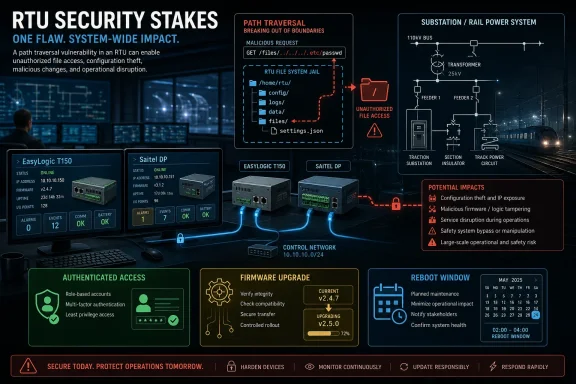 A Boring Bug Lands in a Very Unboring Place
Path traversal is one of the oldest classes of software vulnerability. A system expects a user to request a file from an approved directory, but the input is not constrained tightly enough, allowing the request to escape that boundary and reach files it should never see. In ordinary enterprise software, that can mean exposed configuration files, logs, keys, credentials, or application internals.In an RTU, the same pattern carries a different weight. Remote terminal units are not glamorous targets in the way ransomware portals or VPN gateways are, but they sit closer to physical operations. They gather signals, communicate with control systems, integrate intelligent electronic devices, and help automate field equipment that was never meant to behave like a public-facing web service.
That distinction matters because CVE-2026-6865 is not described as a theoretical defect in an obscure component. Schneider’s own advisory frames the failure mode plainly: improperly handled user-supplied input during server-side file path processing could allow unauthorized access to sensitive files. The attacker needs low privileges, but not physical proximity or user interaction, and the CVSS 4.0 score has been listed as high.
The phrase low privileges should not be reassuring in industrial networks. Low-privilege accounts are often treated as operational conveniences: shared among maintenance staff, left in place for vendor access, or granted to systems that are assumed to be safely tucked behind perimeter controls. When a flaw turns such an account into a file-access primitive, the boundary between “authorized user” and “meaningful compromise” becomes thinner than administrators would like.
The Patch Exists, but the Patch Window Is the Hard Part
Schneider Electric’s remediation guidance is clear. EasyLogic T150, formerly Saitel DR, is fixed in firmware version 11.06.32. Saitel DP is fixed in firmware version 11.06.37. In both cases, Schneider directs customers to contact its Customer Care Center to obtain the firmware, and both updates require a reboot.That last sentence is where the industrial-security story begins. In IT, rebooting a vulnerable server is a scheduling problem. In operational technology, rebooting an RTU can become a coordination exercise involving control rooms, field engineers, safety procedures, redundancy checks, and sometimes regulatory visibility. The patch may be technically small, but the change window is not.
This is why advisories for ICS equipment so often read like two documents stapled together. One half says “install the fixed version.” The other half says “if you cannot install the fixed version, isolate the asset, tighten credentials, and follow product security guidance.” Vendors know that many customers cannot move with the cadence expected in cloud services or office IT.
That does not make delay harmless. It means the risk has to be managed explicitly rather than hand-waved into the next maintenance cycle. A path traversal vulnerability with authenticated network access is exactly the sort of defect that can sit quietly in an environment until an attacker has already obtained a foothold elsewhere.
Authentication Is Not a Moat When Accounts Are Cheap
CVE-2026-6865 is not described as an unauthenticated remote-code-execution bug, and that matters. There is no reason to inflate it into something it is not. But authentication requirements can be misunderstood, especially in OT environments where identity hygiene often lags behind network engineering.An authenticated vulnerability assumes the attacker already has some level of access. In a well-run environment, that is a meaningful barrier. In a messy one, it may be a cracked password, an old vendor account, a reused credential, a low-privilege operator login, or an account captured from a workstation that had no business reaching control equipment in the first place.
Schneider’s mitigations point directly at that reality. The company urges strict credential controls, even for low-privilege users, and isolation consistent with the product’s security recommendations. That is not boilerplate. It is an admission that the vulnerability’s practical severity depends heavily on whether customers have allowed weak identities and broad reachability to accumulate around devices that should be treated as sensitive infrastructure.
The uncomfortable truth is that many industrial environments still rely on inherited trust. A device is considered safe because it is on the “inside,” because only a few people know the address, or because the network diagram says it is isolated. Attackers have spent the last decade proving that these assumptions age badly.
File Disclosure Can Be the First Domino
It is tempting to rank vulnerabilities by whether they immediately execute code. That habit is understandable, but it misses how intrusions actually unfold. Sensitive-file exposure is often not the end of an attack; it is the reconnaissance phase becoming useful.Configuration files may reveal network topology, service settings, account names, internal paths, certificates, keys, or integration details. Logs may reveal operator behavior and system relationships. Device-specific files may expose enough operational context to make later actions more precise. Even when a single file does not contain a password, it can reduce the attacker’s uncertainty.
For defenders, that means CVE-2026-6865 should be treated less like a “read-only” inconvenience and more like an information-disclosure risk with lateral-movement value. In enterprise IT, stolen configuration data often helps attackers pivot. In OT, it may also help attackers understand how the control environment is structured, which systems matter, and which alarms or workflows might be triggered by a change.
That is especially relevant because EasyLogic T150 and Saitel DP are not consumer gadgets. Schneider describes the T150 as a modular platform for data acquisition, communication, automation, and integration in distribution and transmission networks, generation, and railway environments. Saitel DP is positioned for medium-voltage and high-voltage public distribution and transmission substation control. These are devices whose context is valuable even when the vulnerability does not directly manipulate a breaker or relay.
The Rebrand Does Not Reduce the Risk
The EasyLogic T150’s former name, Saitel DR, is more than a parenthetical detail. Asset inventories frequently lag product branding. A plant or utility may have one naming convention in procurement records, another in engineering drawings, another in monitoring tools, and another in the heads of the people who maintain the equipment.That matters during vulnerability response. If the security team searches only for “EasyLogic T150,” it may miss assets still tracked internally as Saitel DR. If the OT team recognizes “Saitel DR” but not the newer EasyLogic name, the advisory may not land with the right urgency. A naming mismatch can turn a published fix into an unpatched field population.
This is one of the quiet weaknesses of industrial security operations. Vulnerability management assumes clean asset identity; industrial environments often have legacy naming, long-lived deployments, spare units, swapped modules, and documentation that reflects the last major project rather than the current state. A vendor advisory can be accurate and still fail operationally if customers cannot map the affected product names to installed equipment.
The fix is mundane but important. Operators should search inventories, maintenance records, engineering workstations, configuration backups, and procurement databases for both names. The vulnerable population is not just “new” EasyLogic T150 deployments; it includes the Saitel DR lineage now living under that name.
CISA’s Advisory Turns a Vendor Notice Into an Operational Signal
CISA’s ICS advisory does not make Schneider’s bug more severe by itself. What it does is raise the priority and normalize the response for U.S. critical-infrastructure operators and the vendors that support them. When CISA republishes or amplifies an industrial advisory, it becomes part of the broader defensive calendar.That calendar is crowded. Utilities, manufacturers, transportation operators, and integrators are already triaging VPN flaws, Windows vulnerabilities, hypervisor bugs, firewall zero-days, and identity-platform compromises. An RTU path traversal issue can easily be dismissed as less urgent than whatever is burning in the enterprise SOC that week.
The argument for paying attention is not that this CVE is the worst vulnerability of the year. It is that it affects equipment whose failure domains are not purely digital. A compromised workstation can be rebuilt; a compromised field environment can create operational uncertainty that takes much longer to unwind. Even a limited disclosure bug can force engineers to ask what files were read, what configuration details were exposed, and whether the attacker learned enough to plan something more disruptive.
CISA’s involvement also helps smaller operators that do not have dedicated OT security teams. Many organizations depend on federal advisories to translate vendor notices into actionable priority. In that sense, ICSA-26-169-04 is less a revelation than a nudge: do not let this become another industrial firmware issue that stays unfixed because it was never spectacular enough to dominate a weekly patch meeting.
The Mitigation Advice Is Really an Architecture Audit
Schneider’s fallback advice is familiar: enforce strict credential controls, isolate affected products, and follow security recommendations. The words are simple, but implementing them seriously can expose years of architectural debt. If low-privilege users can reach RTU management interfaces from broad network segments, the problem is not just this CVE.Credential controls should start with account discovery. Administrators need to know which users and systems can authenticate to the affected devices, whether default or shared accounts exist, whether vendor-maintenance credentials are active, and whether logs can tie access to a person or service. “Low privilege” is only low risk when it is bounded, monitored, and revocable.
Isolation requires the same honesty. An RTU management interface should not be reachable just because a routed path exists. Access should be limited to defined engineering stations, jump hosts, or management networks, with monitoring that treats unexpected authentication attempts as security events rather than operational noise. The goal is not to pretend segmentation is a patch; it is to make exploitation harder and more visible while the patch is tested and scheduled.
The reboot requirement should also be folded into resilience planning. If an operator cannot reboot an affected device safely, that is useful information beyond this vulnerability. It may indicate missing redundancy, inadequate testing infrastructure, brittle change-management processes, or an asset that has become too critical to maintain normally. Security advisories often reveal maintenance risk hiding in plain sight.
Windows Shops Should Not Treat OT as Somebody Else’s Problem
WindowsForum readers may wonder why an industrial RTU advisory belongs in the same conversation as Windows patching, endpoint hardening, and Active Directory hygiene. The answer is that attackers rarely respect the org chart. The path into OT often runs through ordinary IT.Engineering workstations run Windows. Jump boxes run Windows. Vendor tools often run on Windows laptops. Domain accounts, remote-access platforms, file shares, backup systems, and patch-management processes can all become bridges between enterprise compromise and industrial exposure. A vulnerability requiring authenticated access to an RTU becomes more reachable if the surrounding Windows environment leaks credentials or permits sloppy lateral movement.
That does not mean every Windows admin suddenly owns substation security. It does mean Windows teams should understand when their systems are part of the OT access path. If an engineering workstation can authenticate to EasyLogic T150 or Saitel DP equipment, then endpoint detection, credential protection, local admin control, and remote-access policy are part of the mitigation story.
Active Directory deserves particular scrutiny. Many OT environments either integrate with enterprise identity systems or maintain parallel identity arrangements that are less mature. In both cases, low-privilege access can become dangerous if account scope is not carefully limited. A user who can log into a workstation, retrieve saved credentials, and reach an RTU management interface may have more effective power than their job title suggests.
This is where IT and OT teams should resist the temptation to trade blame. The vendor has issued fixed firmware. The OT team owns the device maintenance process. The IT team often owns the identity and endpoint surfaces that determine whether an authenticated bug is easy to exploit. The realistic response crosses all three boundaries.
CVSS Scores Do Not Capture Operational Asymmetry
The listed CVSS 4.0 vector for CVE-2026-6865 reflects network attackability, low complexity, low privileges, no user interaction, high impact to vulnerable-system confidentiality, low impact to integrity, and no vulnerable-system availability impact. That is a useful standardized description. It is not the whole risk model.Industrial operators care about more than the affected component’s abstract confidentiality, integrity, and availability. They care about what exposed information enables next, whether incident response can verify what happened, whether device rebooting creates downtime, and whether a field asset is reachable from places it should not be. Environmental context can push a “high” issue toward urgent action or make it manageable under tight compensating controls.
This is one reason Schneider recommends customers score environmental metrics for their own organizations. A lab device on an isolated bench and a production RTU reachable through a poorly governed maintenance network do not carry the same risk. The CVE is the same; the blast radius is not.
Security teams sometimes dislike that ambiguity because it complicates dashboards. But ambiguity is honest. A path traversal flaw on a device with no sensitive local files and strictly limited access is one thing. The same flaw on an operationally critical RTU with broad authenticated reach and weak account discipline is another.
The Real Test Is Whether Operators Can Find the Boxes
Before anyone downloads firmware or schedules a reboot, they must answer the oldest vulnerability-management question: where is the affected software? For EasyLogic T150 and Saitel DP, that is not necessarily trivial. These devices may sit in substations, field cabinets, generation environments, rail-related deployments, test racks, training labs, or integrator-managed installations.The version thresholds are specific. EasyLogic T150 firmware 11.06.31 and earlier is affected; 11.06.32 is fixed. Saitel DP firmware 11.06.36 and earlier is affected; 11.06.37 is fixed. Anything less precise than that invites mistakes, especially where spare equipment or offline devices are rotated into service later.
Asset discovery should not become reckless scanning. OT networks can be sensitive to aggressive probes, and unsupported enumeration can create its own operational risks. The better path is to combine passive inventory, configuration-management records, vendor tooling, engineering documentation, and controlled validation through established maintenance channels.
Organizations should also verify whether backups and golden images contain vulnerable firmware. Patching production equipment while leaving vulnerable images in the recovery workflow creates a future regression. The day after an incident, nobody wants to discover that the “known good” replacement process quietly reintroduced the affected version.
Firmware Distribution Still Feels Too Manual for Modern Risk
Schneider’s instruction to contact Customer Care for firmware is common in industrial environments, but it contrasts sharply with the update expectations of mainstream IT. Windows administrators expect catalog entries, package metadata, cryptographic validation, release channels, and automation hooks. OT firmware still often moves through vendor portals, support relationships, and carefully controlled handoffs.There are good reasons for that caution. Industrial firmware updates can carry hardware dependencies, certification implications, deployment sequencing requirements, and site-specific considerations. A universal “click to update” model would be dangerous for many control systems.
But manual distribution also slows security response. If a fix requires contacting support, verifying entitlement, obtaining the right package, reading advisory documentation, staging a test, scheduling downtime, and coordinating field work, then the vulnerability’s exposure window is measured in weeks or months, not hours. Attackers do not need the process to be irrational; they only need it to be slower than their reconnaissance.
The industry has not solved this tension. Vendors need to preserve safety and reliability, while customers need faster, clearer, and more auditable patch pipelines. CVE-2026-6865 is a small example of a larger problem: industrial devices are increasingly judged by IT-security timelines while still maintained through OT-change processes.
The Quiet Lesson in This Schneider Advisory
The practical response to CVE-2026-6865 is not mysterious, but it does demand discipline. The organizations that handle this well will be the ones that already know which devices they run, who can authenticate to them, and how to schedule firmware work without improvisation.- EasyLogic T150 systems running firmware 11.06.31 or earlier should be treated as affected until upgraded to version 11.06.32.
- Saitel DP systems running firmware 11.06.36 or earlier should be treated as affected until upgraded to version 11.06.37.
- The vulnerability requires authentication, so credential hygiene and account review are central mitigations rather than secondary paperwork.
- Network isolation should limit RTU access to trusted engineering and management paths, not merely rely on the assumption that OT is separate.
- The required reboot should be planned as an operational change, tested where possible, and documented so recovery images do not roll devices back to vulnerable firmware.
- Asset inventories should include both EasyLogic T150 and the former Saitel DR name so rebranded equipment is not missed.
References
- Primary source: CISA
Published: 2026-06-18T12:00:00+00:00
- Related coverage: app.opencve.io
Schneider-electric CVEs and Security Vulnerabilities - OpenCVE
Explore the latest vulnerabilities and security issues of Schneider-electric in the CVE databaseapp.opencve.io - Related coverage: radar.offseq.com
Multiple Vulnerabilities on EasyLogic T150 and Saitel DP RTU - Live Threat Intelligence - Threat Radar | OffSeq.com
Detailed information about Multiple Vulnerabilities on EasyLogic T150 and Saitel DP RTU affecting Schneider Electric CPCERT Schneider Electric. Get real-time upradar.offseq.com - Related coverage: cyber.gc.ca
[Control systems] Schneider Electric security advisory (AV26-449) - Canadian Centre for Cyber Security
[Control systems] Schneider Electric security advisory (AV26-449)www.cyber.gc.ca - Related coverage: cve.imfht.com
CVE Database & AI Vulnerability Analysis - Vulnerability Platform
Free CVE database with AI-powered vulnerability analysis, daily intelligence, and AI-generated PoC analyses. Search 340K+ CVEs across vendors, products, and CWE categories. cve.imfht.com
- Related coverage: 365trust.me
Vulnerability in Schneider Electric products (AL05/260512/CSIRT-ITA) - 365TRUST.ME
Summary Multiple vulnerabilities, including five rated as ‘high’ severity, have been resolved in certain Schneider Electric products. If exploited, these vulnerabilities could allow a malicious user to bypass authentication mechanisms, read arbitrary files on the filesystem and elevate their...365trust.me

- Related coverage: download.schneider-electric.com
