

Schneider Electric and CISA are warning that CVE-2026-9650 affects EasyLogic T150 firmware 11.06.30 and earlier and Saitel DP firmware 11.06.35 and earlier, exposing insufficiently protected credentials in firmware or system files that could later enable device compromise when an attacker has physical access. The immediate fix is not a Windows Update-style click-and-forget patch, but a vendor-controlled firmware upgrade: EasyLogic T150 to 11.06.32 and Saitel DP to 11.06.38. That distinction matters because this is not merely a vulnerability in a product line; it is a reminder that operational technology still carries secrets in places defenders cannot easily inspect. For WindowsForum readers who live between enterprise IT and industrial networks, the story is less about one CVE than about how credentials, firmware, and field access keep colliding in critical infrastructure.
CVE-2026-9650 is classified as CWE-522, Insufficiently Protected Credentials, which sounds almost polite for a class of bug that can turn device internals into a treasure map. The reported condition allows an unauthenticated attacker to access credentials stored within firmware or system files. Schneider Electric’s advisory language narrows the exploitation path by noting that the credential could subsequently be used to compromise the device if the attacker has physical access.
That combination is important. This is not described as a drive-by internet worm, and defenders should resist the temptation to overstate it as one. But it is also not harmless simply because physical access is part of the later compromise scenario. In industrial environments, “physical access” can mean a maintenance cabinet, a substation visit, a depot, a borrowed engineering laptop, a discarded unit, or a contractor workflow that nobody has reviewed in years.
Remote Terminal Units sit in precisely the places where trust tends to become procedural rather than technical. They collect signals, mediate control, and communicate with higher-level systems in power distribution, transmission, generation, railway, and substation contexts. A credential exposure flaw in that layer is not just a password problem; it is an identity problem embedded in machinery that may run longer than the security assumptions around it.
The most dangerous part of any stored-credential flaw is the gap between discovery and operational impact. A credential copied from firmware today may be used tomorrow, next month, or after the next maintenance window when the attacker can get near the device. That makes remediation feel less urgent than a crash bug, even though the attacker’s advantage may already be accumulating quietly.
That sounds simple until it meets the reality of operational technology. A firmware update on a field controller is rarely a casual administrative action. The device may be part of a live control environment, governed by change-management windows, availability commitments, safety procedures, and vendor support rules that look nothing like the monthly rhythm of Patch Tuesday.
This is where Windows administrators and OT engineers often talk past each other. In the Windows world, the argument is usually about deployment rings, restart timing, regression risk, and whether Microsoft has broken printing again. In OT, the same conversation starts with whether a remote site can be accessed safely, whether the controller state has been backed up, whether the update affects communications, and whether a reboot interrupts telemetry or control.
The vendor-controlled distribution model also changes the security tempo. Because customers must contact Schneider Electric to obtain the firmware, defenders cannot simply point an automated scanner at a public package repository and call the problem solved. Asset owners need to identify the affected devices, confirm current firmware, open the support channel, stage the update, schedule downtime, and document the reboot.
That friction does not make the fix inadequate. It makes the fix operational. The organizations that handle this well will be the ones that already know where their RTUs are, who owns them, what firmware they run, and how to change them without improvising under pressure.
That gap matters because it hints at adjacent maintenance history. These product lines have also appeared in nearby advisories involving related RTU firmware lines and other vulnerability classes, including sensitive-file access and permission issues. For administrators, the practical lesson is not to chase a single CVE in isolation. The safe question is not “Are we vulnerable to CVE-2026-9650?” but “Which exact firmware trains are deployed, and which Schneider advisories apply to each?”
The product naming adds another small trap. EasyLogic T150 was formerly known as Saitel DR, and many inventories will still reflect the older name. Asset databases, rack labels, maintenance spreadsheets, procurement records, and monitoring platforms may disagree with one another. In a vulnerability response, that naming drift can become a delay.
This is where boring hygiene becomes strategic. If the same device can appear as EasyLogic T150 in a vendor advisory, Saitel DR in a legacy asset list, and an anonymous RTU in a network scan, the organization’s first job is translation. Without that translation layer, patch management becomes a scavenger hunt.
A remote terminal unit may live in a substation, trackside cabinet, plant floor enclosure, or remote facility where access is shared across vendors, maintenance crews, inspectors, and emergency responders. Even when physical security is strong, the number of legitimate hands near the equipment can be larger than the number of people who understand the cyber risk.
The reported CVE does not say that an attacker can remotely seize control of every affected device. But it does say that credentials may be obtainable from firmware or system files, and that those credentials can matter later. In other words, the attack path may be staged. One phase extracts the secret; another phase uses it when physical proximity or maintenance access becomes available.
That is a familiar pattern in serious intrusions. Attackers do not need every step to be remote if the environment provides windows of opportunity. They need credentials, timing, and a path that defenders have not modeled. Stored secrets in field equipment help with all three.
For utilities and industrial operators, this means physical security and cybersecurity cannot be treated as separate audit checkboxes. A badge reader may reduce the number of people who can touch a cabinet, but it does not protect a credential already extracted from firmware. Conversely, a firmware update may close the credential issue, but it does not fix weak site-access procedures or shared maintenance accounts.
That makes Windows infrastructure part of the blast radius even when Windows is not the vulnerable product. If credentials extracted from an RTU can be paired with engineering tools, project files, VPN access, or remote maintenance workflows, the boundary between OT firmware and IT endpoint security gets thin. The device vulnerability becomes one node in a larger operational chain.
This is why defenders should avoid treating OT advisories as someone else’s inbox. The Windows estate often holds the documentation, backups, configuration utilities, scripts, and remote access pathways that make field devices manageable. If that estate is compromised, an attacker may gain the context needed to turn a device-level weakness into an operational incident.
The inverse is also true. Weaknesses in OT devices can complicate Windows incident response. If credentials are shared, stored in files, or reused across tooling, a firmware-level credential exposure can force teams to review account use beyond the device itself. The right response may involve changing device credentials, rotating related accounts, auditing engineering workstations, and checking whether sensitive files have been copied or staged elsewhere.
This is the uncomfortable convergence story behind many industrial advisories. Windows systems are not always the vulnerable asset, but they are frequently the place where remediation is planned, credentials are stored, and attackers look for leverage.
Those choices can survive for years. Industrial products are built for long deployment cycles, and the economic incentives reward stability, compatibility, and field durability. Security expectations, meanwhile, change faster than hardware refresh plans. What looked acceptable when a firmware branch was designed may look reckless after modern attackers have spent a decade mining embedded images for secrets.
The issue is not unique to Schneider Electric. Embedded and industrial systems have long struggled with hardcoded credentials, poorly protected private keys, recoverable secrets, default accounts, and sensitive files packaged into images. The difference in OT is consequence and cadence. The affected systems may sit in operationally sensitive places, and the update process may lag behind disclosure for entirely practical reasons.
That is why firmware security has become a governance issue, not only an engineering issue. Buyers increasingly need to ask how vendors store secrets, how updates are signed, how credentials are provisioned, and how device identity changes over the product lifecycle. The answer cannot be “trust us, it is in the image.”
For existing deployments, those questions arrive late. Asset owners have to work with the devices they have, the contracts they signed, and the outage windows they can negotiate. CVE-2026-9650 is a reminder that long-lived infrastructure inherits not only hardware wear but also design debt.
That standardization is useful because it gives organizations a common language: CVE identifier, affected versions, severity framing, mitigations, and update guidance. But it can also flatten the nuance. A high-severity credential exposure in an RTU does not behave like a high-severity browser bug, and a required reboot on a controller is not the same as rebooting a laptop.
The best readers of ICS advisories know how to restore that context. They ask where the device is deployed, whether it is reachable from untrusted networks, who can access it physically, whether credentials are unique, whether engineering workstations are hardened, and whether monitoring would notice suspicious device interaction. Severity is a starting point, not a schedule.
CISA’s broader industrial-control guidance tends to emphasize segmentation, minimizing exposure, firewalls between business and control networks, secure remote access, and physical protections. Those recommendations can sound repetitive because they are. The repetition exists because the same architectural weaknesses keep turning product vulnerabilities into operational risks.
In this case, the vendor fix is the central remediation. But the compensating controls still matter because firmware updates do not happen instantly in the field. A team that needs two weeks to stage an RTU upgrade should spend those two weeks reducing exposure, validating access paths, and making sure the device is not easier to reach than everyone assumed.
A reboot can interrupt communication, temporarily remove a control point, trigger alarms, or require operators to verify that a device returns to the expected state. None of that means the update should be postponed indefinitely. It means the security team needs to speak the language of operations before demanding action.
The right approach is to pair the firmware update with a controlled maintenance plan. Teams should back up configurations, verify device models and versions, confirm rollback procedures, coordinate with operations, and document both the pre-update and post-update state. If a reboot is required, the organization should decide when that reboot is safest rather than discovering the answer during a rushed incident response.
This is also where executive pressure can help or hurt. A mandate to “patch everything immediately” may be unrealistic in a live OT environment. A mandate to “produce a risk-based remediation plan by close of business” is more useful. It forces asset owners to identify exposure, sequence the riskiest deployments first, and explain where compensating controls are being used.
The worst outcome is bureaucratic limbo: security flags the advisory, operations says downtime is difficult, and nobody owns the decision. Credential exposure flaws reward that paralysis because the absence of visible exploitation can be mistaken for the absence of risk.
An accurate inventory must capture more than a product family. It needs model, firmware version, site, network zone, function, owner, maintenance vendor, remote access method, and update history. Without firmware-level detail, a device list is only a rough map. CVE-2026-9650 turns that roughness into risk.
The renamed EasyLogic T150 line makes the point. If an organization searches only for “EasyLogic T150,” it may miss assets recorded as Saitel DR. If it searches only for “Saitel,” it may conflate DP and DR lineage. If it relies only on passive network discovery, it may miss isolated devices that still matter operationally.
This is not a glamorous security task, but it is the one that determines whether the rest of the response is real. A team with a mature inventory can sort affected assets in hours. A team without one begins with meetings, screenshots, remote calls, and guesses.
The irony is that many industrial vulnerabilities are disclosed with exact version ranges while many asset owners cannot answer exact version questions quickly. That mismatch is where attackers and auditors both find leverage.
Access review should happen in parallel. If device credentials are shared, reused, stored in engineering folders, or known broadly among contractors, the organization should assume that remediation includes credential rotation and account cleanup. Firmware fixes close a software defect; they do not erase years of credential sprawl.
Engineering workstations deserve particular attention. Administrators should check whether project files, device backups, scripts, or vendor tools contain credentials or connection profiles. They should also verify that remote access to OT environments is mediated through hardened jump hosts, monitored sessions, and least-privilege accounts rather than informal VPN habits.
Network segmentation should be revisited with skepticism. Many organizations have diagrams showing OT separated from IT, but exceptions accumulate: historian links, vendor support tunnels, temporary firewall rules, dual-homed workstations, and remote desktop shortcuts that outlive the project that created them. A credential exposure flaw is exactly the kind of advisory that should trigger a hunt for those exceptions.
Finally, teams should preserve evidence of action. Industrial security is regulated, audited, and operationally sensitive. Documenting firmware versions, mitigation decisions, maintenance windows, and completed upgrades is not paperwork for its own sake. It is how the organization proves that it understood the risk and managed it deliberately.
The broader lesson is that industrial environments still depend on devices whose secrets may be harder to rotate than anyone wants to admit. A Windows password can be changed by policy, a certificate can be reissued by automation, and a cloud token can be revoked from a console. A credential embedded in firmware or exposed through system files on a field device belongs to a slower world.
That slower world is now connected to the faster one. Security advisories arrive quickly, exploit knowledge spreads quickly, and attackers can spend time correlating device models, firmware images, internet exposure, contractor access, and maintenance practices. The defender’s operating model has to bridge that gap.
For Schneider Electric customers, the narrow instruction is clear: move EasyLogic T150 to firmware 11.06.32 and Saitel DP to firmware 11.06.38, with a planned reboot and vendor support. For everyone else, the advisory should trigger a broader review of how credentials are stored, discovered, rotated, and protected across embedded and industrial assets.
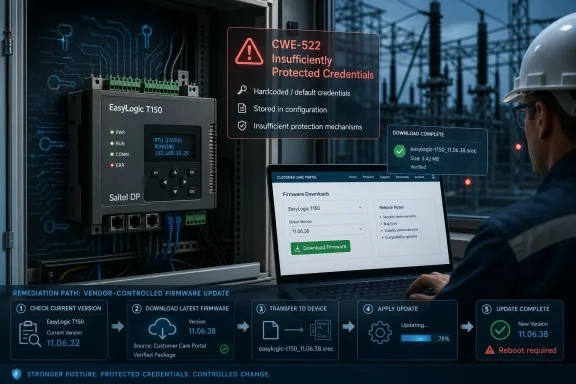 The Credential Was the Vulnerability Before the Intruder Arrived
CVE-2026-9650 is classified as CWE-522, Insufficiently Protected Credentials, which sounds almost polite for a class of bug that can turn device internals into a treasure map. The reported condition allows an unauthenticated attacker to access credentials stored within firmware or system files. Schneider Electric’s advisory language narrows the exploitation path by noting that the credential could subsequently be used to compromise the device if the attacker has physical access.That combination is important. This is not described as a drive-by internet worm, and defenders should resist the temptation to overstate it as one. But it is also not harmless simply because physical access is part of the later compromise scenario. In industrial environments, “physical access” can mean a maintenance cabinet, a substation visit, a depot, a borrowed engineering laptop, a discarded unit, or a contractor workflow that nobody has reviewed in years.
Remote Terminal Units sit in precisely the places where trust tends to become procedural rather than technical. They collect signals, mediate control, and communicate with higher-level systems in power distribution, transmission, generation, railway, and substation contexts. A credential exposure flaw in that layer is not just a password problem; it is an identity problem embedded in machinery that may run longer than the security assumptions around it.
The most dangerous part of any stored-credential flaw is the gap between discovery and operational impact. A credential copied from firmware today may be used tomorrow, next month, or after the next maintenance window when the attacker can get near the device. That makes remediation feel less urgent than a crash bug, even though the attacker’s advantage may already be accumulating quietly.
Schneider’s Fix Is Straightforward, but the Path to It Is Not
Schneider Electric says EasyLogic T150 devices affected by CVE-2026-9650 are fixed by firmware version 11.06.32. Saitel DP devices affected by the same CVE are fixed by firmware version 11.06.38. In both cases, users are directed to contact Schneider Electric’s Customer Care Center to obtain the firmware, and a reboot is required.That sounds simple until it meets the reality of operational technology. A firmware update on a field controller is rarely a casual administrative action. The device may be part of a live control environment, governed by change-management windows, availability commitments, safety procedures, and vendor support rules that look nothing like the monthly rhythm of Patch Tuesday.
This is where Windows administrators and OT engineers often talk past each other. In the Windows world, the argument is usually about deployment rings, restart timing, regression risk, and whether Microsoft has broken printing again. In OT, the same conversation starts with whether a remote site can be accessed safely, whether the controller state has been backed up, whether the update affects communications, and whether a reboot interrupts telemetry or control.
The vendor-controlled distribution model also changes the security tempo. Because customers must contact Schneider Electric to obtain the firmware, defenders cannot simply point an automated scanner at a public package repository and call the problem solved. Asset owners need to identify the affected devices, confirm current firmware, open the support channel, stage the update, schedule downtime, and document the reboot.
That friction does not make the fix inadequate. It makes the fix operational. The organizations that handle this well will be the ones that already know where their RTUs are, who owns them, what firmware they run, and how to change them without improvising under pressure.
Version Numbers Tell a Messier Story Than the CVE Headline
The clean headline is CVE-2026-9650, but the affected-version details deserve careful reading. EasyLogic T150 firmware 11.06.30 and earlier is listed as affected for the credential-protection flaw. Saitel DP firmware 11.06.35 and earlier is affected for the same issue. The fixed versions are 11.06.32 for EasyLogic T150 and 11.06.38 for Saitel DP.That gap matters because it hints at adjacent maintenance history. These product lines have also appeared in nearby advisories involving related RTU firmware lines and other vulnerability classes, including sensitive-file access and permission issues. For administrators, the practical lesson is not to chase a single CVE in isolation. The safe question is not “Are we vulnerable to CVE-2026-9650?” but “Which exact firmware trains are deployed, and which Schneider advisories apply to each?”
The product naming adds another small trap. EasyLogic T150 was formerly known as Saitel DR, and many inventories will still reflect the older name. Asset databases, rack labels, maintenance spreadsheets, procurement records, and monitoring platforms may disagree with one another. In a vulnerability response, that naming drift can become a delay.
This is where boring hygiene becomes strategic. If the same device can appear as EasyLogic T150 in a vendor advisory, Saitel DR in a legacy asset list, and an anonymous RTU in a network scan, the organization’s first job is translation. Without that translation layer, patch management becomes a scavenger hunt.
Physical Access Is Not the Comfort Blanket It Used to Be
Security teams often downgrade their emotional response when they see physical access in an exploit chain. That instinct comes from traditional IT, where a locked office, a sealed laptop, or a data-center badge system can be a reasonable boundary. Industrial environments are less tidy.A remote terminal unit may live in a substation, trackside cabinet, plant floor enclosure, or remote facility where access is shared across vendors, maintenance crews, inspectors, and emergency responders. Even when physical security is strong, the number of legitimate hands near the equipment can be larger than the number of people who understand the cyber risk.
The reported CVE does not say that an attacker can remotely seize control of every affected device. But it does say that credentials may be obtainable from firmware or system files, and that those credentials can matter later. In other words, the attack path may be staged. One phase extracts the secret; another phase uses it when physical proximity or maintenance access becomes available.
That is a familiar pattern in serious intrusions. Attackers do not need every step to be remote if the environment provides windows of opportunity. They need credentials, timing, and a path that defenders have not modeled. Stored secrets in field equipment help with all three.
For utilities and industrial operators, this means physical security and cybersecurity cannot be treated as separate audit checkboxes. A badge reader may reduce the number of people who can touch a cabinet, but it does not protect a credential already extracted from firmware. Conversely, a firmware update may close the credential issue, but it does not fix weak site-access procedures or shared maintenance accounts.
The Windows Angle Is the Engineering Workstation
At first glance, this advisory is not a Windows story. The vulnerable devices are Schneider Electric RTUs, not Windows PCs. But in many real environments, the practical control plane still runs through Windows engineering workstations, Windows jump servers, Windows-based remote access tooling, and Windows endpoints used by contractors.That makes Windows infrastructure part of the blast radius even when Windows is not the vulnerable product. If credentials extracted from an RTU can be paired with engineering tools, project files, VPN access, or remote maintenance workflows, the boundary between OT firmware and IT endpoint security gets thin. The device vulnerability becomes one node in a larger operational chain.
This is why defenders should avoid treating OT advisories as someone else’s inbox. The Windows estate often holds the documentation, backups, configuration utilities, scripts, and remote access pathways that make field devices manageable. If that estate is compromised, an attacker may gain the context needed to turn a device-level weakness into an operational incident.
The inverse is also true. Weaknesses in OT devices can complicate Windows incident response. If credentials are shared, stored in files, or reused across tooling, a firmware-level credential exposure can force teams to review account use beyond the device itself. The right response may involve changing device credentials, rotating related accounts, auditing engineering workstations, and checking whether sensitive files have been copied or staged elsewhere.
This is the uncomfortable convergence story behind many industrial advisories. Windows systems are not always the vulnerable asset, but they are frequently the place where remediation is planned, credentials are stored, and attackers look for leverage.
Firmware Secrets Are a Supply-Chain Memory Problem
The phrase “credentials stored within firmware or system files” should make every defender think about persistence of assumptions. Firmware is often treated as a sealed artifact, a vendor-supplied image that arrives with implied trust. But when credentials inside that image are insufficiently protected, the artifact becomes a memory of past design choices.Those choices can survive for years. Industrial products are built for long deployment cycles, and the economic incentives reward stability, compatibility, and field durability. Security expectations, meanwhile, change faster than hardware refresh plans. What looked acceptable when a firmware branch was designed may look reckless after modern attackers have spent a decade mining embedded images for secrets.
The issue is not unique to Schneider Electric. Embedded and industrial systems have long struggled with hardcoded credentials, poorly protected private keys, recoverable secrets, default accounts, and sensitive files packaged into images. The difference in OT is consequence and cadence. The affected systems may sit in operationally sensitive places, and the update process may lag behind disclosure for entirely practical reasons.
That is why firmware security has become a governance issue, not only an engineering issue. Buyers increasingly need to ask how vendors store secrets, how updates are signed, how credentials are provisioned, and how device identity changes over the product lifecycle. The answer cannot be “trust us, it is in the image.”
For existing deployments, those questions arrive late. Asset owners have to work with the devices they have, the contracts they signed, and the outage windows they can negotiate. CVE-2026-9650 is a reminder that long-lived infrastructure inherits not only hardware wear but also design debt.
CISA’s Role Is to Translate Vendor Risk Into Operational Urgency
CISA’s ICS advisories occupy a peculiar middle ground. They are not exploit write-ups for researchers, and they are not full vendor manuals for asset owners. Their job is to turn vendor-reported industrial risk into a standardized warning that security teams can triage.That standardization is useful because it gives organizations a common language: CVE identifier, affected versions, severity framing, mitigations, and update guidance. But it can also flatten the nuance. A high-severity credential exposure in an RTU does not behave like a high-severity browser bug, and a required reboot on a controller is not the same as rebooting a laptop.
The best readers of ICS advisories know how to restore that context. They ask where the device is deployed, whether it is reachable from untrusted networks, who can access it physically, whether credentials are unique, whether engineering workstations are hardened, and whether monitoring would notice suspicious device interaction. Severity is a starting point, not a schedule.
CISA’s broader industrial-control guidance tends to emphasize segmentation, minimizing exposure, firewalls between business and control networks, secure remote access, and physical protections. Those recommendations can sound repetitive because they are. The repetition exists because the same architectural weaknesses keep turning product vulnerabilities into operational risks.
In this case, the vendor fix is the central remediation. But the compensating controls still matter because firmware updates do not happen instantly in the field. A team that needs two weeks to stage an RTU upgrade should spend those two weeks reducing exposure, validating access paths, and making sure the device is not easier to reach than everyone assumed.
The Reboot Requirement Is a Governance Test
“Reboot needed: Yes” is a small line with large implications. In consumer software, a reboot is an annoyance. In operational technology, it is a coordination event.A reboot can interrupt communication, temporarily remove a control point, trigger alarms, or require operators to verify that a device returns to the expected state. None of that means the update should be postponed indefinitely. It means the security team needs to speak the language of operations before demanding action.
The right approach is to pair the firmware update with a controlled maintenance plan. Teams should back up configurations, verify device models and versions, confirm rollback procedures, coordinate with operations, and document both the pre-update and post-update state. If a reboot is required, the organization should decide when that reboot is safest rather than discovering the answer during a rushed incident response.
This is also where executive pressure can help or hurt. A mandate to “patch everything immediately” may be unrealistic in a live OT environment. A mandate to “produce a risk-based remediation plan by close of business” is more useful. It forces asset owners to identify exposure, sequence the riskiest deployments first, and explain where compensating controls are being used.
The worst outcome is bureaucratic limbo: security flags the advisory, operations says downtime is difficult, and nobody owns the decision. Credential exposure flaws reward that paralysis because the absence of visible exploitation can be mistaken for the absence of risk.
Inventory Is the Difference Between Patch Management and Hope
For many organizations, the hardest part of responding to this advisory will not be downloading firmware. It will be knowing whether the affected devices exist in their environment. That is especially true for distributed infrastructure, acquired facilities, and older substations where documentation has accumulated in layers.An accurate inventory must capture more than a product family. It needs model, firmware version, site, network zone, function, owner, maintenance vendor, remote access method, and update history. Without firmware-level detail, a device list is only a rough map. CVE-2026-9650 turns that roughness into risk.
The renamed EasyLogic T150 line makes the point. If an organization searches only for “EasyLogic T150,” it may miss assets recorded as Saitel DR. If it searches only for “Saitel,” it may conflate DP and DR lineage. If it relies only on passive network discovery, it may miss isolated devices that still matter operationally.
This is not a glamorous security task, but it is the one that determines whether the rest of the response is real. A team with a mature inventory can sort affected assets in hours. A team without one begins with meetings, screenshots, remote calls, and guesses.
The irony is that many industrial vulnerabilities are disclosed with exact version ranges while many asset owners cannot answer exact version questions quickly. That mismatch is where attackers and auditors both find leverage.
The Practical Response Starts Before the Firmware Arrives
The vendor fix should be pursued, but waiting for the firmware package is not the same as waiting to act. The first step is to identify every EasyLogic T150, Saitel DR, and Saitel DP deployment and map each one to its firmware version. The second is to determine which devices are exposed to networks, workflows, or physical locations that raise the likelihood of credential access or later misuse.Access review should happen in parallel. If device credentials are shared, reused, stored in engineering folders, or known broadly among contractors, the organization should assume that remediation includes credential rotation and account cleanup. Firmware fixes close a software defect; they do not erase years of credential sprawl.
Engineering workstations deserve particular attention. Administrators should check whether project files, device backups, scripts, or vendor tools contain credentials or connection profiles. They should also verify that remote access to OT environments is mediated through hardened jump hosts, monitored sessions, and least-privilege accounts rather than informal VPN habits.
Network segmentation should be revisited with skepticism. Many organizations have diagrams showing OT separated from IT, but exceptions accumulate: historian links, vendor support tunnels, temporary firewall rules, dual-homed workstations, and remote desktop shortcuts that outlive the project that created them. A credential exposure flaw is exactly the kind of advisory that should trigger a hunt for those exceptions.
Finally, teams should preserve evidence of action. Industrial security is regulated, audited, and operationally sensitive. Documenting firmware versions, mitigation decisions, maintenance windows, and completed upgrades is not paperwork for its own sake. It is how the organization proves that it understood the risk and managed it deliberately.
This Advisory Is Small Enough to Patch and Big Enough to Learn From
There is a temptation to treat CVE-2026-9650 as a narrow product notice: two Schneider Electric RTU families, two fixed firmware versions, one credential-protection weakness. That is the efficient reading, and it is not wrong. But it is incomplete.The broader lesson is that industrial environments still depend on devices whose secrets may be harder to rotate than anyone wants to admit. A Windows password can be changed by policy, a certificate can be reissued by automation, and a cloud token can be revoked from a console. A credential embedded in firmware or exposed through system files on a field device belongs to a slower world.
That slower world is now connected to the faster one. Security advisories arrive quickly, exploit knowledge spreads quickly, and attackers can spend time correlating device models, firmware images, internet exposure, contractor access, and maintenance practices. The defender’s operating model has to bridge that gap.
For Schneider Electric customers, the narrow instruction is clear: move EasyLogic T150 to firmware 11.06.32 and Saitel DP to firmware 11.06.38, with a planned reboot and vendor support. For everyone else, the advisory should trigger a broader review of how credentials are stored, discovered, rotated, and protected across embedded and industrial assets.
The Firmware Numbers That Should Drive the Maintenance Window
The most concrete value in this advisory is that it gives defenders something specific to verify. The risk is real, but it is not shapeless. Asset owners can translate the notice into a finite set of checks and changes.- EasyLogic T150 devices running firmware 11.06.30 or earlier should be treated as affected by CVE-2026-9650 until upgraded.
- Saitel DP devices running firmware 11.06.35 or earlier should be treated as affected by CVE-2026-9650 until upgraded.
- EasyLogic T150 firmware 11.06.32 is the fixed version identified for this credential-protection vulnerability.
- Saitel DP firmware 11.06.38 is the fixed version identified for this credential-protection vulnerability.
- The firmware must be obtained through Schneider Electric Customer Care, and the upgrade requires a reboot.
- Asset inventories should include both EasyLogic T150 and the older Saitel DR naming so affected devices are not missed.
References
- Primary source: CISA
Published: 2026-06-30T12:00:00+00:00
- Related coverage: radar.offseq.com
Multiple Vulnerabilities on EasyLogic T150 and Saitel DP RTU - Live Threat Intelligence - Threat Radar | OffSeq.com
Detailed information about Multiple Vulnerabilities on EasyLogic T150 and Saitel DP RTU affecting Schneider Electric CPCERT Schneider Electric. Get real-time upradar.offseq.com - Related coverage: vulners.com
Schneider Electric EasyLogic T150 and Saitel DP - vulnerability database | Vulners.com
1. GENERAL SECURITY RECOMMENDATIONS We strongly recommend the following industry cybersecurity best practices. Locate control and safety system networks and remote devices behind firewalls and isolate them from the business network. Install physic...vulners.com - Related coverage: incibe.es
Múltiples vulnerabilidades en productos de Schneider Electric | INCIBE-CERT | INCIBE
Schneider Electric ha publicado 6 vulnerabilidades: 4 de severidad alta y 2 medias que, en caso de serwww.incibe.es
- Related coverage: otwarden.com
Schneider Electric ICS Security Advisories — 151 Vulnerabilities | OTWarden
Schneider Electric has 151 CISA ICS security advisories: 33 critical, 68 high severity. Track Schneider Electric OT/SCADA vulnerabilities with OTWarden.otwarden.com
- Related coverage: itsecuritynews.info
Schneider Electric EasyLogic T150 and Saitel DP - IT Security News
View CSAF Summary Successful exploitation this vulnerability could allow an attacker to gain unauthorized access to sensitive files The following versions of Schneider Electric EasyLogic T150 and Saitel DP are affected: Schneider Electric EasyLogic T150 (formerly Saitel DR) Remote... www.itsecuritynews.info

- Related coverage: cyber.gc.ca
[Control systems] CISA ICS security advisories (AV26–620) - Canadian Centre for Cyber Security
[Control systems] CISA ICS security advisories (AV26–620)www.cyber.gc.ca - Related coverage: identitygatekeepers.com
Schneider Electric IAM Security Threats & Vulnerabilities | Identity Gatekeepers – IAM Gatekeepers
IAM threat intelligence for Schneider Electric. 5 identity and access management threats tracked over the last 30 days including credential theft, authenticatio identitygatekeepers.com
- Related coverage: windowsforum.com
CVE-2026-6865 RTU Path Traversal: Patch EasyLogic T150 & Saitel DP | Windows Forum
Schneider Electric and CISA are warning that CVE-2026-6865 affects EasyLogic T150 firmware version 11.06.31 and earlier and Saitel DP firmware version...windowsforum.com - Related coverage: productinfo.schneider-electric.com
