

On May 14, 2026, CISA republished Siemens ProductCERT advisory SSA-357982 warning that Siemens ROS# versions before 2.2.2 contain a critical path traversal flaw in the
ROS# occupies a useful niche in the robotics stack. It connects the Robot Operating System world to .NET and Unity, giving simulation, visualization, and engineering workflows a bridge between software that was not originally built to live together. That is exactly the kind of glue code modern industrial environments depend on, and exactly the kind of glue code that can become dangerous when its assumptions age badly.
The vulnerable component is not the whole ROS# ecosystem in the abstract. Siemens’ advisory points specifically to a ROS service called
The flaw is classified as CWE-23, relative path traversal. That means user-controlled input was not properly sanitized, allowing a request to escape the directory the service was supposed to operate within. If an attacker can reach the service over the network, the advisory says the attacker may access arbitrary files on the host system — including reading and writing files — subject to the permissions of the account running the service.
That last clause is doing a lot of work. If the service runs under a tightly constrained user with access only to a staging directory, the blast radius is limited. If it runs as a broad engineering account, a privileged service account, or on a workstation with lax local permissions, the vulnerability becomes much more serious in practice.
The absence of an availability impact can make this kind of issue sound less dramatic than remote code execution or a crash bug. That is the wrong reading. Arbitrary file read and write is often the middle step between initial access and control: read a configuration file, recover secrets, alter a startup script, modify application data, plant a file where another process will later consume it, or corrupt the assumptions of a deployment pipeline.
Path traversal vulnerabilities also tend to be easy to understand and easy to test once the vulnerable endpoint is known. They are not necessarily easy to exploit into full compromise in every environment, but the basic idea is decades old. Attackers try to move “up” out of an intended directory and then into a file they were never meant to touch.
In a robotics or industrial engineering environment, the stakes are not limited to one developer laptop. Simulation assets, robot descriptions, calibration data, deployment scripts, and integration tools often flow between engineering workstations, lab machines, and operational networks. A file-write primitive in that flow is a supply-chain flavored risk, even when the vulnerable component is a small service rather than a marquee industrial controller.
That advice is not just a workaround; it is a diagnosis. The service appears to have been designed as a convenience tool for a narrow transfer workflow, but convenience tools have a habit of becoming permanent infrastructure. Once something “just works,” it gets scripted, scheduled, containerized, or left open on a lab subnet because nobody wants to revisit the workflow before the next demo.
This is a familiar pattern for Windows administrators and developers. A local web server for testing becomes reachable from the LAN. A file share created for one project survives for three years. A dev tool bound to all interfaces is treated as harmless because it is “inside the network.” The vulnerability in ROS# is another version of that same story, only set in robotics.
Trusted networks are also less trustworthy than the phrase implies. Engineering labs are full of mixed-trust devices: vendor laptops, contractor machines, test rigs, old Windows boxes, Linux hosts, PLC-adjacent equipment, and Wi-Fi bridges no one wants to admit still exist. If a service can read and write files without authentication, “trusted network only” should be viewed as a temporary risk reduction measure, not a fix.
That mixed environment changes the practical response. The vulnerable service may run on a ROS host, but the assets it moves can originate on Windows workstations, pass through shared folders, or land in repositories and build directories used by Windows-based engineers. A weak file-transfer service in that chain can become a pivot point between development and deployment.
There is also a cultural problem. Industrial and robotics teams often draw bright lines between “IT security” and “engineering tooling,” but attackers do not honor those categories. A vulnerable file server attached to a robotics workflow is not safer because it has a specialized purpose. If it accepts network input and modifies files, it belongs in the same inventory and patch process as any other network-exposed service.
For sysadmins, the immediate question is not whether every Windows endpoint has ROS# installed. It is whether engineering teams have quietly deployed ROS# components in labs, simulation rigs, CI environments, Unity workstations, or shared development hosts. The answer may not be visible in a conventional enterprise software inventory unless someone knows what to ask.
Administrators should assume there may be multiple copies. A developer may have a Git checkout. A Unity project may include a package copy. A lab machine may have an older ROS# deployment because it was pinned for compatibility. A test bench may be running a service manually from a directory that never appears in normal software asset tools.
The version boundary matters: all versions before 2.2.2 are listed as affected. That gives teams a clean condition to test against, but it does not automatically identify where the code is running. The more bespoke the robotics workflow, the more likely it is that institutional knowledge lives with a small group of engineers rather than in central configuration management.
This is where Windows shops can borrow from incident-response muscle memory. Search source repositories, Unity projects, build scripts, service definitions, scheduled tasks, containers, and lab documentation for ROS# and
In Windows terms, this means no local administrator account, no domain account with broad share access, and no reuse of a developer’s interactive credentials for service execution. In Linux terms, it means the same principle with different plumbing: a dedicated low-privilege user, limited directory access, and no write permissions outside the intended transfer area. The operating system is less important than the permission model.
A file-transfer service should have a tiny world. It should see the directory it needs and little else. It should not see SSH keys, deployment secrets, source repositories, home directories, system configuration, or shared project archives. If that sounds operationally inconvenient, that inconvenience is a signal that the service has been given a broader role than it should have.
Least privilege also makes exploitation less useful and detection easier. If a service account tries to touch files outside its narrow working directory, that should stand out. If the service account can touch half the engineering environment, there is no clean signal — just a long list of actions that might be normal until it is too late.
The reason is reachability. CVE-2026-41551 is network exploitable. If an attacker cannot reach the vulnerable
But segmentation is not a substitute for patching or service hardening. VPNs have vulnerabilities. Flat lab networks are common. Jump hosts are shared. Contractors need access. Engineering exceptions accumulate faster than firewall diagrams get updated. A control that depends on perfect network boundaries is fragile in exactly the environments where robotics and industrial development happen.
The better stance is layered. Patch to ROS# 2.2.2 or later, restrict the service to trusted hosts, avoid continuous background operation, run it with minimal privileges, and monitor for unexpected file access. Any one of those controls can fail. The point is to make failure less catastrophic.
That timing is important for defenders. This is not a months-old bug resurfacing in a vulnerability database. It is a fresh advisory with a fixed version available and a clear affected-version range. The practical window between disclosure, patch availability, and opportunistic scanning is where good asset management pays off.
The advisory does not state that the vulnerability is being actively exploited in the wild. It also does not list a public proof of concept in the material provided. That should temper panic, but not urgency. For a path traversal flaw with a critical score and no authentication requirement, waiting for confirmed exploitation is a poor strategy.
CISA’s boilerplate disclaimer also deserves a sober reading. The agency says the republished CSAF advisory is provided as-is and that Siemens remains the technical authority for questions about the advisory. In other words, organizations should use CISA for visibility and Siemens for product-specific guidance. That distinction matters when a security team is trying to decide whether a particular deployment pattern is exposed.
ROS# is a bridge technology, and bridge technologies inherit risk from both sides. They speak to robotics systems, but they also live in application development environments. They are used by engineers who may not think of themselves as running production services. They often sit adjacent to valuable intellectual property and operational know-how.
For Windows-heavy organizations, this is an argument for expanding what counts as managed software. Unity packages, .NET robotics libraries, ROS bridges, Python tooling, simulation middleware, and lab services should not be invisible simply because they are not deployed through the same channel as Microsoft 365 Apps or endpoint agents. The attack surface has already moved; inventory practices have to follow.
It is also an argument for security teams to meet engineering teams halfway. A blanket demand to shut down every unusual service will fail. A practical conversation about when
Those paths can outlive their original purpose. The service remains because the next test might need it. The firewall rule remains because nobody wants to break the lab. The elevated account remains because permissions were painful during setup. Over time, a temporary convenience becomes a permanent exposure.
This is why the remediation should not end at “install 2.2.2.” The same review should look for adjacent file-transfer mechanisms with similar properties: unauthenticated access, weak path validation, broad write permissions, and network exposure beyond the hosts that actually need them. The Siemens advisory gives teams a concrete reason to ask those questions now.
The most mature organizations will turn the patch into a control improvement. They will define how engineering file-transfer services are approved, how long they can run, what identities they use, and how they are logged. That may sound bureaucratic, but it is less painful than discovering during an incident that a forgotten lab utility could overwrite files across a shared project tree.
The strongest version of that guidance is to treat
For administrators, the obvious near-term move is to combine patching with verification. Confirm the installed ROS# version. Confirm that
For developers, the lesson is input validation with consequences. File paths are hostile input unless proven otherwise. Safe file handling means canonicalizing paths, enforcing an allowed base directory, rejecting traversal sequences, and making authorization decisions after normalization rather than before it. That is not glamorous engineering, but it is the difference between a helper service and a vulnerability advisory.
The concrete actions are not complicated, but they require ownership.
Source: CISA Siemens Siemens ROS# | CISA
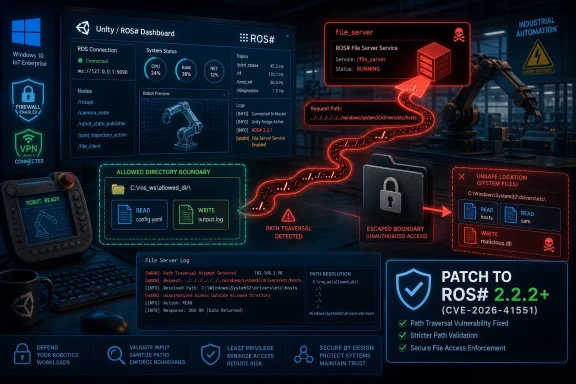
file_server ROS service that can let a remote, unauthenticated attacker read and write arbitrary files with the service user’s privileges. The vulnerability, tracked as CVE-2026-41551, is not a Windows bug, but it belongs squarely in the WindowsForum orbit because ROS#, Unity, .NET, and industrial engineering workstations often meet on the same developer and operations machines. The uncomfortable lesson is simple: a small helper service built to move robot-description files can become a file-system door if it is left running like infrastructure. Siemens has shipped ROS# 2.2.2, and the smart move is to treat this as both a patching task and a design review.
 A Robotics Helper Became an Industrial File-System Risk
ROS# occupies a useful niche in the robotics stack. It connects the Robot Operating System world to .NET and Unity, giving simulation, visualization, and engineering workflows a bridge between software that was not originally built to live together. That is exactly the kind of glue code modern industrial environments depend on, and exactly the kind of glue code that can become dangerous when its assumptions age badly.The vulnerable component is not the whole ROS# ecosystem in the abstract. Siemens’ advisory points specifically to a ROS service called
file_server, used for transferring URDF files from a ROS host to a target system. In normal engineering language, that sounds mundane; in security language, a service that accepts path-like input and touches files is a boundary that deserves suspicion.The flaw is classified as CWE-23, relative path traversal. That means user-controlled input was not properly sanitized, allowing a request to escape the directory the service was supposed to operate within. If an attacker can reach the service over the network, the advisory says the attacker may access arbitrary files on the host system — including reading and writing files — subject to the permissions of the account running the service.
That last clause is doing a lot of work. If the service runs under a tightly constrained user with access only to a staging directory, the blast radius is limited. If it runs as a broad engineering account, a privileged service account, or on a workstation with lax local permissions, the vulnerability becomes much more serious in practice.
CVSS 9.1 Is Not Hype When the Primitive Is Read and Write
Siemens and CISA list the CVSS 3.1 base score as 9.1, with a vector that tells the story: network attack, low complexity, no privileges required, no user interaction, high confidentiality impact, high integrity impact, and no availability impact. In plainer English, an attacker does not need to log in, trick a user, or win a race condition to make the bug matter. They need network reachability and a vulnerable service.The absence of an availability impact can make this kind of issue sound less dramatic than remote code execution or a crash bug. That is the wrong reading. Arbitrary file read and write is often the middle step between initial access and control: read a configuration file, recover secrets, alter a startup script, modify application data, plant a file where another process will later consume it, or corrupt the assumptions of a deployment pipeline.
Path traversal vulnerabilities also tend to be easy to understand and easy to test once the vulnerable endpoint is known. They are not necessarily easy to exploit into full compromise in every environment, but the basic idea is decades old. Attackers try to move “up” out of an intended directory and then into a file they were never meant to touch.
In a robotics or industrial engineering environment, the stakes are not limited to one developer laptop. Simulation assets, robot descriptions, calibration data, deployment scripts, and integration tools often flow between engineering workstations, lab machines, and operational networks. A file-write primitive in that flow is a supply-chain flavored risk, even when the vulnerable component is a small service rather than a marquee industrial controller.
The Real Mistake Is Leaving a Task Tool Running Like a Platform Service
Siemens’ mitigation language is unusually revealing because it describes howfile_server should be treated. The company recommends running it only on a trusted network, with appropriate user rights, only for the task it was designed for, and not as a background service running continuously. It also recommends using it only when manual file transfer is not possible.That advice is not just a workaround; it is a diagnosis. The service appears to have been designed as a convenience tool for a narrow transfer workflow, but convenience tools have a habit of becoming permanent infrastructure. Once something “just works,” it gets scripted, scheduled, containerized, or left open on a lab subnet because nobody wants to revisit the workflow before the next demo.
This is a familiar pattern for Windows administrators and developers. A local web server for testing becomes reachable from the LAN. A file share created for one project survives for three years. A dev tool bound to all interfaces is treated as harmless because it is “inside the network.” The vulnerability in ROS# is another version of that same story, only set in robotics.
Trusted networks are also less trustworthy than the phrase implies. Engineering labs are full of mixed-trust devices: vendor laptops, contractor machines, test rigs, old Windows boxes, Linux hosts, PLC-adjacent equipment, and Wi-Fi bridges no one wants to admit still exist. If a service can read and write files without authentication, “trusted network only” should be viewed as a temporary risk reduction measure, not a fix.
ROS# Sits Where Windows, Unity, and Industrial Automation Collide
WindowsForum readers should resist the urge to mentally file this under “Linux robotics problem.” ROS itself has deep roots in Unix-like environments, but ROS# exists precisely because robotics workflows do not live in a single operating-system silo. Unity development is common on Windows. .NET development is common on Windows. Engineering workstations running simulation, visualization, and build tooling are often Windows machines even when the robot runtime is not.That mixed environment changes the practical response. The vulnerable service may run on a ROS host, but the assets it moves can originate on Windows workstations, pass through shared folders, or land in repositories and build directories used by Windows-based engineers. A weak file-transfer service in that chain can become a pivot point between development and deployment.
There is also a cultural problem. Industrial and robotics teams often draw bright lines between “IT security” and “engineering tooling,” but attackers do not honor those categories. A vulnerable file server attached to a robotics workflow is not safer because it has a specialized purpose. If it accepts network input and modifies files, it belongs in the same inventory and patch process as any other network-exposed service.
For sysadmins, the immediate question is not whether every Windows endpoint has ROS# installed. It is whether engineering teams have quietly deployed ROS# components in labs, simulation rigs, CI environments, Unity workstations, or shared development hosts. The answer may not be visible in a conventional enterprise software inventory unless someone knows what to ask.
The Patch Is Straightforward, but Discovery May Not Be
Siemens’ vendor fix is direct: update ROS# to version 2.2.2 or later. That is the easy sentence in the advisory and often the hardest sentence in the real environment. Open-source engineering tools are frequently cloned, vendored, customized, and forgotten inside project directories rather than installed as centrally managed applications.Administrators should assume there may be multiple copies. A developer may have a Git checkout. A Unity project may include a package copy. A lab machine may have an older ROS# deployment because it was pinned for compatibility. A test bench may be running a service manually from a directory that never appears in normal software asset tools.
The version boundary matters: all versions before 2.2.2 are listed as affected. That gives teams a clean condition to test against, but it does not automatically identify where the code is running. The more bespoke the robotics workflow, the more likely it is that institutional knowledge lives with a small group of engineers rather than in central configuration management.
This is where Windows shops can borrow from incident-response muscle memory. Search source repositories, Unity projects, build scripts, service definitions, scheduled tasks, containers, and lab documentation for ROS# and
file_server. Ask engineering teams whether any ROS# file-transfer service is exposed beyond localhost. Treat “we only run it sometimes” as a lead to verify, not a reason to close the ticket.Least Privilege Is the Difference Between a Bad Bug and a Bad Week
The advisory’s permission caveat is not boilerplate. The attacker’s reach is bounded by the rights of the account runningfile_server, which makes service identity the most important compensating control after patching. If the service runs under an overpowered user, the vulnerability inherits that power.In Windows terms, this means no local administrator account, no domain account with broad share access, and no reuse of a developer’s interactive credentials for service execution. In Linux terms, it means the same principle with different plumbing: a dedicated low-privilege user, limited directory access, and no write permissions outside the intended transfer area. The operating system is less important than the permission model.
A file-transfer service should have a tiny world. It should see the directory it needs and little else. It should not see SSH keys, deployment secrets, source repositories, home directories, system configuration, or shared project archives. If that sounds operationally inconvenient, that inconvenience is a signal that the service has been given a broader role than it should have.
Least privilege also makes exploitation less useful and detection easier. If a service account tries to touch files outside its narrow working directory, that should stand out. If the service account can touch half the engineering environment, there is no clean signal — just a long list of actions that might be normal until it is too late.
Network Segmentation Still Matters, but It Cannot Carry the Whole Load
CISA’s recommended practices are familiar: minimize network exposure, keep control-system devices and systems off the public internet, isolate control networks from business networks, use firewalls, and prefer secure remote access methods such as VPNs when remote access is required. These recommendations can sound generic because they appear in many ICS advisories. They are still relevant here.The reason is reachability. CVE-2026-41551 is network exploitable. If an attacker cannot reach the vulnerable
file_server, the immediate path to exploitation is blocked. That makes segmentation a real control, not a checkbox.But segmentation is not a substitute for patching or service hardening. VPNs have vulnerabilities. Flat lab networks are common. Jump hosts are shared. Contractors need access. Engineering exceptions accumulate faster than firewall diagrams get updated. A control that depends on perfect network boundaries is fragile in exactly the environments where robotics and industrial development happen.
The better stance is layered. Patch to ROS# 2.2.2 or later, restrict the service to trusted hosts, avoid continuous background operation, run it with minimal privileges, and monitor for unexpected file access. Any one of those controls can fail. The point is to make failure less catastrophic.
CISA’s Republishing Pipeline Makes This More Visible, Not More Severe
The CISA page is a republication of Siemens ProductCERT’s advisory through the Common Security Advisory Framework process. That matters because the CISA advisory is not adding a new technical finding so much as amplifying the vendor’s disclosure to a broader ICS audience. The underlying release date from Siemens was May 12, 2026, with CISA’s republication following on May 14, 2026.That timing is important for defenders. This is not a months-old bug resurfacing in a vulnerability database. It is a fresh advisory with a fixed version available and a clear affected-version range. The practical window between disclosure, patch availability, and opportunistic scanning is where good asset management pays off.
The advisory does not state that the vulnerability is being actively exploited in the wild. It also does not list a public proof of concept in the material provided. That should temper panic, but not urgency. For a path traversal flaw with a critical score and no authentication requirement, waiting for confirmed exploitation is a poor strategy.
CISA’s boilerplate disclaimer also deserves a sober reading. The agency says the republished CSAF advisory is provided as-is and that Siemens remains the technical authority for questions about the advisory. In other words, organizations should use CISA for visibility and Siemens for product-specific guidance. That distinction matters when a security team is trying to decide whether a particular deployment pattern is exposed.
Robotics Security Is Becoming Ordinary IT Security
The most interesting part of this advisory is not that a path traversal bug exists. It is that a robotics integration library now receives the same advisory treatment as traditional industrial equipment. That is where the field is going: robots, simulations, digital twins, engineering workstations, and industrial software stacks are becoming normal targets in normal vulnerability management.ROS# is a bridge technology, and bridge technologies inherit risk from both sides. They speak to robotics systems, but they also live in application development environments. They are used by engineers who may not think of themselves as running production services. They often sit adjacent to valuable intellectual property and operational know-how.
For Windows-heavy organizations, this is an argument for expanding what counts as managed software. Unity packages, .NET robotics libraries, ROS bridges, Python tooling, simulation middleware, and lab services should not be invisible simply because they are not deployed through the same channel as Microsoft 365 Apps or endpoint agents. The attack surface has already moved; inventory practices have to follow.
It is also an argument for security teams to meet engineering teams halfway. A blanket demand to shut down every unusual service will fail. A practical conversation about when
file_server is needed, where it runs, who can reach it, and what account it uses is more likely to produce a safer system without breaking the work.The Fix Should Trigger a Search for Other Quiet File Services
CVE-2026-41551 is specific, but the pattern is broader. File movement is one of the most common chores in engineering environments, and therefore one of the most common places where informal services appear. A team needs to move a URDF, a model, a calibration file, a firmware image, a log bundle, or a generated artifact, and someone builds or enables the fastest path.Those paths can outlive their original purpose. The service remains because the next test might need it. The firewall rule remains because nobody wants to break the lab. The elevated account remains because permissions were painful during setup. Over time, a temporary convenience becomes a permanent exposure.
This is why the remediation should not end at “install 2.2.2.” The same review should look for adjacent file-transfer mechanisms with similar properties: unauthenticated access, weak path validation, broad write permissions, and network exposure beyond the hosts that actually need them. The Siemens advisory gives teams a concrete reason to ask those questions now.
The most mature organizations will turn the patch into a control improvement. They will define how engineering file-transfer services are approved, how long they can run, what identities they use, and how they are logged. That may sound bureaucratic, but it is less painful than discovering during an incident that a forgotten lab utility could overwrite files across a shared project tree.
Siemens’ Mitigations Draw a Map for Immediate Action
The advisory’s temporary mitigations are unusually practical because they describe both technical limits and operational discipline. Run the service only on trusted networks. Run it with appropriate user rights. Use it only for its intended URDF transfer workflow. Do not leave it running continuously. Prefer manual transfer when that is feasible.The strongest version of that guidance is to treat
file_server as an on-demand tool rather than a resident service. Start it when a transfer is needed, stop it afterward, and keep its network exposure narrow. That does not eliminate the need to update, but it reduces the time during which a vulnerable or misconfigured service can be reached.For administrators, the obvious near-term move is to combine patching with verification. Confirm the installed ROS# version. Confirm that
file_server is not exposed to untrusted segments. Confirm that the runtime account is constrained. Confirm that logs or host telemetry would show suspicious file access attempts.For developers, the lesson is input validation with consequences. File paths are hostile input unless proven otherwise. Safe file handling means canonicalizing paths, enforcing an allowed base directory, rejecting traversal sequences, and making authorization decisions after normalization rather than before it. That is not glamorous engineering, but it is the difference between a helper service and a vulnerability advisory.
The Narrow Advisory With the Broad Lesson
This is a small-component advisory with a big operational message: industrial and robotics security failures often begin at the seams. ROS# is not the robot, not the PLC, not the Windows domain controller, and not the production line. It is connective tissue. Attackers like connective tissue because defenders underestimate it.The concrete actions are not complicated, but they require ownership.
- Organizations using Siemens ROS# should update all deployments to version 2.2.2 or later, because every version before 2.2.2 is listed as affected.
- Teams should identify where
file_serveris running, including lab hosts, Unity projects, ROS workstations, CI systems, and copied project directories. - Administrators should ensure the service is reachable only from systems that genuinely need it, not from broad engineering or business networks.
- The service should run under a dedicated low-privilege account with access limited to the intended transfer directory.
- Engineering teams should stop treating the service as a continuously running background daemon unless they have a documented, secured reason to do so.
- Security teams should use this advisory as a prompt to review other informal file-transfer tools in robotics and industrial development environments.
Source: CISA Siemens Siemens ROS# | CISA
