

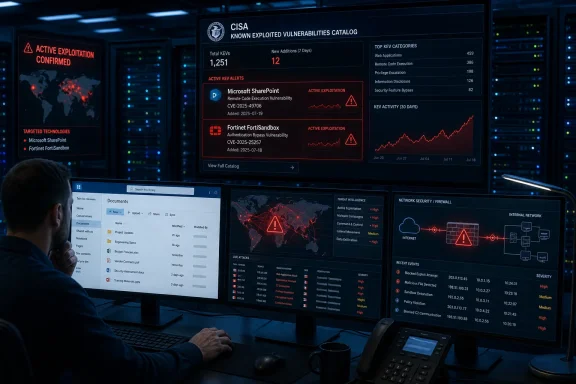
The additions, published by CISA on July 16, put CVE-2026-25089, CVE-2026-39808, and CVE-2026-58644 into the U.S. government’s most urgent remediation queue. CISA’s notice does not describe a specific campaign, affected versions, or a public exploit chain, but KEV inclusion itself means the agency has evidence that exploitation has occurred in the wild.
That distinction matters. A newly disclosed CVE can be a planning item; a KEV entry should be treated as an incident-response and patch-management event.
SharePoint Moves From Patch Queue to Exposure Hunt
CVE-2026-58644 is described as a Microsoft SharePoint deserialization of untrusted data vulnerability. Deserialization bugs occur when software rebuilds objects from supplied data without adequately restricting what that data can instruct the application to do. In server software, the worst cases can allow an attacker to execute code, alter application behavior, or pivot deeper into an environment.
CISA’s inclusion of the SharePoint flaw in KEV means organizations should not stop at applying Microsoft’s security update or workaround. They should first establish where SharePoint is deployed, whether any instance is internet-facing, and whether edge controls such as reverse proxies or web application firewalls are actually reducing exposure.
For many enterprises, SharePoint risk is not limited to a standalone web server. SharePoint farms often run under highly privileged service accounts, communicate with SQL Server, index documents, access Exchange or Microsoft 365-connected services, and serve as a trusted destination for user-uploaded content. A compromise can therefore create a route toward sensitive files, credentials, service tokens, and other infrastructure.
Administrators should treat internet-facing SharePoint servers as the first remediation tier, including systems believed to be “internal” but reachable through VPN portals, publishing gateways, legacy remote-access arrangements, or misconfigured proxy rules. Asset inventories frequently miss development, migration, disaster-recovery, and departmental SharePoint installations that remain online after a central migration.
Microsoft’s security guidance for CVE-2026-58644 should be the controlling source for affected product versions, update availability, and any required configuration changes. CISA’s advisory establishes the urgency; Microsoft’s advisory should determine the precise remediation path.
Two FortiSandbox Bugs Raise the Same Control-Plane Concern
The other additions, CVE-2026-25089 and CVE-2026-39808, are both identified by CISA as Fortinet FortiSandbox OS command injection vulnerabilities. Command injection flaws can allow attacker-controlled input to be interpreted as operating-system commands, creating a potentially direct path from an appliance interface or workflow into the underlying system.
FortiSandbox is built to analyze suspicious files and URLs, which makes it a particularly important security control rather than a routine application server. A compromised sandbox can create several problems at once: an attacker may gain access to malware samples, intelligence feeds, administrative settings, network credentials, or integrations with Fortinet products and third-party security platforms.
The practical question for security teams is not only whether FortiSandbox is exposed to the public internet. They should also examine management-plane exposure from internal networks, administrator jump boxes, SIEM and SOAR integrations, automated sample-submission workflows, and API connections. Security appliances are often treated as trusted infrastructure and can retain broad network visibility long after ordinary server systems have been segmented more tightly.
CISA did not publish exploit details in its July 16 notice. That is no reason to defer action. Once a vulnerability reaches KEV, public technical analysis, proof-of-concept material, or wider attacker adoption can follow quickly, especially where affected products are widely deployed.
BOD 26-04 Changes the Federal Operating Model
The additions arrive under CISA’s Binding Operational Directive 26-04, which shifts federal civilian agencies toward a more explicitly risk-based vulnerability-management model. According to CISA, the directive prioritizes KEV-listed vulnerabilities on publicly exposed assets that could give an attacker total control after exploitation, while allowing lower-risk issues to be handled differently.
The directive also sets expectations for determining whether a system was compromised before a patch was installed. That is an important operational change. In an actively exploited vulnerability, successful patching removes one known entry point, but it does not evict an attacker who already used it.
Federal Civilian Executive Branch agencies are subject to BOD 26-04, but the underlying logic applies broadly. Enterprise patch teams have long faced backlogs measured in thousands of CVEs; the KEV catalog is designed to identify the smaller set that has crossed from theoretical risk into observed attacker activity.
For private-sector organizations, that means these three entries deserve an accelerated workflow:
- Identify every Microsoft SharePoint and Fortinet FortiSandbox deployment, including appliances and servers outside the standard asset-management baseline.
- Confirm whether the systems are exposed directly or indirectly to untrusted networks and prioritize those paths first.
- Apply vendor-provided updates, mitigations, or configuration changes after validating maintenance dependencies and high-availability arrangements.
- Preserve and review relevant logs before and after remediation, looking for anomalous requests, unexpected processes, administrative changes, new accounts, and unusual outbound traffic.
- Reset or rotate credentials, API keys, and service secrets if evidence suggests that a system may have been accessed before remediation.
The checklist is deliberately broader than “install the patch.” Organizations that patch an exploited SharePoint server without examining its logs, service accounts, scheduled tasks, and downstream connections may close the vulnerability while leaving a foothold intact.
The Absence of Public Detail Is Not a Downgrade
CISA’s notice is concise, and the available announcement does not specify affected FortiSandbox versions, exploit techniques, exploitation dates, or victim sectors. Administrators should resist filling those gaps with assumptions. A KEV listing is not proof that every deployment is compromised, nor does it establish that an exposed system was necessarily the original target of a particular campaign.
But it does justify a higher level of scrutiny. Teams should preserve evidence before making disruptive changes where possible, particularly on SharePoint systems with unusual recent activity. That includes web-server logs, Windows event logs, endpoint telemetry, SharePoint Unified Logging Service records where available, task and service inventories, and authentication data from identity providers and domain controllers.
The same discipline applies to FortiSandbox. Configuration backups and diagnostic exports can be valuable, but they should be collected carefully and handled as potentially sensitive material. Security devices may contain sample metadata, network mappings, credentials, and other information that should not be copied casually into general-purpose collaboration platforms.
The Next Measure Is Remediation, Not Awareness
CISA’s July 16 additions are a clear signal that CVE-2026-25089, CVE-2026-39808, and CVE-2026-58644 should be elevated above the normal monthly vulnerability backlog. Microsoft SharePoint operators should verify patch status and search for signs of prior access; Fortinet FortiSandbox administrators should do the same for appliance exposure and management interfaces.
The key milestone is not merely that a ticket has been opened. It is that every affected instance has been located, remediated according to vendor guidance, and assessed for compromise before the organization concludes the risk has passed.
References
- CISA Adds Three Known Exploited Vulnerabilities to Catalog CISA · 2026-07-16T12:00:00+00:00