

Chromium’s newly published CVE-2026-5881 is the kind of browser issue that rarely makes headlines outside security circles, yet it matters because it strikes at a subtle layer of trust: navigation restrictions inside LocalNetworkAccess. Microsoft’s Security Update Guide records the flaw as a policy bypass affecting Google Chrome prior to 147.0.7727.55, with a crafted HTML page enabling a remote attacker to sidestep those restrictions. The entry was received on April 8, 2026, and the underlying Chrome release note plus Chromium issue tracker are now the key public references for defenders trying to understand exposure.
Browser security stories often get simplified into one of two categories: either a dramatic remote code execution flaw, or a minor annoyance with little operational impact. CVE-2026-5881 sits in neither bucket cleanly. A policy bypass in a browser’s local-network controls is not as flashy as a memory-corruption exploit, but it can still be strategically important because it can expand what a web page is allowed to reach, probe, or influence on a victim’s network.
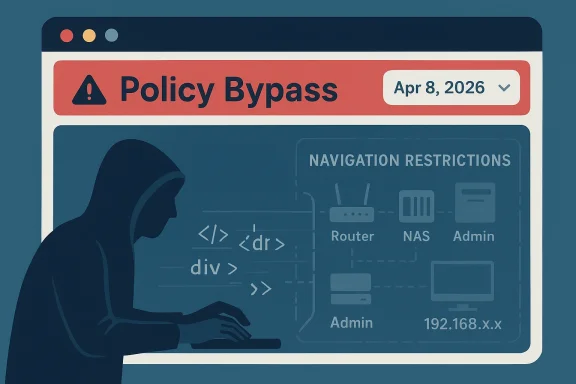
The affected component, LocalNetworkAccess, is part of Chromium’s effort to constrain how web content interacts with resources on private or local network ranges. Those controls matter because modern browsers are now a primary gateway between the open internet and sensitive services such as routers, printers, NAS devices, internal admin consoles, and developer tools. If those boundaries can be weakened, even without code execution, the result can be a meaningful increase in attack surface.
This is also a good example of the modern Chromium patch ecosystem in practice. Google publishes the upstream Chrome fix, and Microsoft then lists the same CVE in its Security Update Guide when the issue is relevant to Microsoft Edge or other Chromium-derived products. That downstream tracking model is why administrators should pay attention even when the vendor entry looks like a Chrome issue rather than a Microsoft-created bug. The metadata in the MSRC record confirms the issue’s Chromium origin and points defenders back to Google’s stable-channel update note.
What makes this particular advisory worth watching is the combination of remote reachability, crafted HTML, and a component explicitly designed to enforce network boundaries. In other words, the exploit narrative does not depend on malware already living on the machine. It depends on ordinary browser interaction, which is exactly why browser policy mistakes can become so valuable to attackers. The moment a security boundary is even partially softened, the web becomes a more effective trampoline into trusted local environments.
The published severity is listed by Chromium as Medium, which is consistent with the fact that this is not a classic privilege escalation or sandbox escape. But severity labels can understate operational value. Attackers do not always need RCE to create damage; sometimes they need a way to discover local services, trigger internal actions, or prepare the ground for a second-stage attack. That is why policy-bypass bugs deserve close attention even when their labels appear moderate.
The idea behind LocalNetworkAccess is straightforward: a web page should not be able to freely reach devices and services that live behind the user’s router or inside a corporate network unless there is a legitimate, policy-approved path. That is important because many local services were never designed with hostile web traffic in mind. They may assume that only a person on the trusted network can talk to them, and that assumption is increasingly unsafe.
Browser vendors have spent years tightening these boundaries after repeated waves of attacks that leveraged local services for discovery, fingerprinting, command triggering, or cross-origin abuse. As a result, the browser has evolved from a relatively permissive client into a carefully fenced platform. Any flaw that weakens those fences deserves attention because it can resurrect attack paths defenders thought they had already closed.
The significance of policy bypass bugs is often underestimated. They do not necessarily let an attacker run arbitrary code, but they can let malicious content behave as though it were more trusted than it really is. In the browser world, that can be enough to expose internal endpoints, manipulate flows intended only for same-origin content, or make a browser-based attack substantially more reliable.
Microsoft’s inclusion of the Chromium CVE in its Security Update Guide reflects the reality that Edge inherits Chromium’s core engine behavior. The MSRC entry is not a separate Microsoft-originating vulnerability note; it is a downstream exposure marker. In practice, that means anyone managing fleets of Edge browsers, or even hybrid environments where Chromium-based browsers are used alongside Chrome, should treat upstream Chromium CVEs as part of their patch workflow.
Attackers value local-network access because it can reveal services that never appear on the public internet. Those services might include administration portals, media devices, industrial interfaces, development servers, or even poorly protected cloud control panels exposed only to “trusted” internal traffic. If a browser bug weakens the gatekeeping rules, the attacker gains a reconnaissance and interaction channel that is much richer than the ordinary web.
That downstream mapping also helps explain why a vulnerability can appear “twice” in public tracking systems. Google documents the original browser-engine defect, while Microsoft documents the impact on Edge consumers. For defenders, both references are useful: one explains the technical flaw, and the other clarifies whether the downstream product they actually deploy has already absorbed the patch.
The public description does not suggest a full sandbox escape or arbitrary code execution. Instead, it suggests an attacker can make the browser behave in a way the policy did not intend. That kind of flaw often becomes an enabling bug: it may not be the first step in the chain, but it can make later steps possible. In browser exploitation, enabling bugs are often as important as headline-grabbing ones.
The phrase crafted HTML page is also significant because it points to a remote, web-delivered attack surface. No local installation is required, no extension is necessarily needed, and the attacker may only need the victim to visit a page. That lowers the barrier to exploitation and broadens the pool of possible victims, especially in organizations where browsers are the first and most common application launch point.
It is also worth remembering that browser attacks often work in stages. One flaw may reveal internal hostnames, another may trigger a state change, and a third may deliver the final payload. A policy bypass like CVE-2026-5881 can serve as the connective tissue between those stages. That makes it more valuable than its medium label might suggest.
Security teams should think of navigation controls as part of the browser’s traffic law system. When those laws are poorly enforced, malicious content can behave more like a local client than a remote webpage. That distinction is crucial because a browser is not supposed to become a general-purpose network pivot simply by rendering HTML.
Chromium’s recent security history has increasingly featured bugs that are not all memory corruption. Policy enforcement failures, UI trust issues, side-channel risks, and access-control mistakes have been recurring themes. That reflects the reality that browsers have become complex platforms with many sub-systems, and attackers no longer need a single dramatic flaw to cause damage. Sometimes they only need a mistake in how the browser decides what a page may do.
This matters for defenders because a medium-severity policy bug should not be dismissed as merely theoretical. The economics of exploitation often favor bugs that are reliable, easy to trigger, and compatible with social engineering. A crafted HTML page can be distributed broadly, and if the bug weakens a local-network boundary, the payoff can be attractive even without full system compromise.
This is why experienced defenders look at exploit chains, not just single CVEs. A browser that no longer enforces local-network boundaries as intended can become a bridge into otherwise protected systems. That bridge may not be dramatic, but it can be strategically useful to attackers.
Organizations should therefore judge CVE-2026-5881 through the lens of exposure, not just the score. If users routinely browse the web while connected to internal networks, or if local services exist that were never hardened against hostile browser traffic, the patch priority should rise quickly.
For enterprises, this is more than a browser maintenance issue. Browsers are now one of the main execution surfaces on Windows endpoints, and they often sit beside identity providers, SaaS portals, internal dashboards, and remote access tools. A browser flaw that lets a web page reach into local network territory can have consequences for corporate segmentation assumptions, especially in environments that rely on network perimeter logic rather than zero-trust controls.
Consumers may feel the impact differently, but they are not exempt. Home routers, smart-home hubs, NAS appliances, printers, and personal developer services can all become interesting targets if a malicious page can bypass local-network navigation constraints. The average home user may not think of those devices as sensitive, but attackers often do because they are weakly defended and highly reachable.
The safest approach is to verify Edge versioning, confirm the Chromium base has moved beyond the vulnerable build, and ensure standard update mechanisms are functioning. If patching is delayed by policy, image management, or deferred rollout rings, the browser-side risk can persist longer than expected.
A second scenario involves chained exploitation. A policy bypass might be used to reach an internal web interface, where a separate credential weakness or service misconfiguration enables deeper compromise. In that sense, CVE-2026-5881 may act like a force multiplier for other vulnerabilities rather than a standalone catastrophic bug. Security teams should not underestimate that multiplier effect.
A third scenario is targeted phishing or spear phishing that uses the bypass as part of a more tailored attack. If the attacker knows the victim’s internal environment, the crafted HTML page can be specialized to query or influence services that matter most to that organization. That makes the flaw more attractive in corporate espionage, credential theft, or pre-ransomware staging.
This is one reason browser policy bugs deserve more attention than they sometimes get. If exploitation can begin with a simple page load, the attacker’s infrastructure needs are modest and the victim pool is huge. That combination is often what turns a medium-class issue into a practical security problem.
Second, organizations should inventory where local-network access matters in practice. Not every workstation is equally exposed. Systems used by administrators, developers, remote workers, and power users often have more local services and broader connectivity than locked-down frontline devices. That means risk concentration may be higher than a broad severity label implies.
Third, security teams should think beyond browser patching and review local web services themselves. If a service on the LAN assumes browser-originated traffic is trustworthy, it may be overly permissive even after CVE-2026-5881 is fixed. This is a useful reminder that browser vulnerabilities often reveal a larger architectural weakness in the endpoints and devices they can reach.
The broader implication is that browser vendors are now being asked to secure an environment where the browser is effectively a local network client, an identity broker, an application runtime, and a gateway to enterprise services. Every time one of those boundaries fails, attackers get a little more room to maneuver. That is why seemingly modest CVEs can have outsized operational consequences.
It also reinforces a persistent truth in platform security: the weakest boundary is often the one that was assumed to be obvious. Local network traffic feels familiar and safe to many users, but browsers no longer get to make that assumption. The web is hostile by default, and browser policy enforcement has to be equally hostile to abuse.
The immediate watch items are simple. Administrators should confirm that Chrome and Edge are on the fixed release line, verify that browser updates have actually been applied, and review any internal services that assume the browser is a safe client. If this advisory prompts teams to audit local endpoints, tighten browser-based trust assumptions, and accelerate update discipline, then a medium-severity bug may end up producing an outsized defensive benefit.
Source: NVD / Chromium Security Update Guide - Microsoft Security Response Center
 Overview
Browser security stories often get simplified into one of two categories: either a dramatic remote code execution flaw, or a minor annoyance with little operational impact. CVE-2026-5881 sits in neither bucket cleanly. A policy bypass in a browser’s local-network controls is not as flashy as a memory-corruption exploit, but it can still be strategically important because it can expand what a web page is allowed to reach, probe, or influence on a victim’s network.The affected component, LocalNetworkAccess, is part of Chromium’s effort to constrain how web content interacts with resources on private or local network ranges. Those controls matter because modern browsers are now a primary gateway between the open internet and sensitive services such as routers, printers, NAS devices, internal admin consoles, and developer tools. If those boundaries can be weakened, even without code execution, the result can be a meaningful increase in attack surface.
This is also a good example of the modern Chromium patch ecosystem in practice. Google publishes the upstream Chrome fix, and Microsoft then lists the same CVE in its Security Update Guide when the issue is relevant to Microsoft Edge or other Chromium-derived products. That downstream tracking model is why administrators should pay attention even when the vendor entry looks like a Chrome issue rather than a Microsoft-created bug. The metadata in the MSRC record confirms the issue’s Chromium origin and points defenders back to Google’s stable-channel update note.
What makes this particular advisory worth watching is the combination of remote reachability, crafted HTML, and a component explicitly designed to enforce network boundaries. In other words, the exploit narrative does not depend on malware already living on the machine. It depends on ordinary browser interaction, which is exactly why browser policy mistakes can become so valuable to attackers. The moment a security boundary is even partially softened, the web becomes a more effective trampoline into trusted local environments.
The published severity is listed by Chromium as Medium, which is consistent with the fact that this is not a classic privilege escalation or sandbox escape. But severity labels can understate operational value. Attackers do not always need RCE to create damage; sometimes they need a way to discover local services, trigger internal actions, or prepare the ground for a second-stage attack. That is why policy-bypass bugs deserve close attention even when their labels appear moderate.
Background
Chromium’s security model has always depended on layered restrictions. Sites are isolated from one another, dangerous APIs are gated, and privileged browser behaviors are constrained by policy decisions intended to preserve user trust. Local network access has become one of the newer frontiers in that model because the browser is no longer just a web viewer; it is a network client that can interact with services on the same LAN as the user.The idea behind LocalNetworkAccess is straightforward: a web page should not be able to freely reach devices and services that live behind the user’s router or inside a corporate network unless there is a legitimate, policy-approved path. That is important because many local services were never designed with hostile web traffic in mind. They may assume that only a person on the trusted network can talk to them, and that assumption is increasingly unsafe.
Browser vendors have spent years tightening these boundaries after repeated waves of attacks that leveraged local services for discovery, fingerprinting, command triggering, or cross-origin abuse. As a result, the browser has evolved from a relatively permissive client into a carefully fenced platform. Any flaw that weakens those fences deserves attention because it can resurrect attack paths defenders thought they had already closed.
The significance of policy bypass bugs is often underestimated. They do not necessarily let an attacker run arbitrary code, but they can let malicious content behave as though it were more trusted than it really is. In the browser world, that can be enough to expose internal endpoints, manipulate flows intended only for same-origin content, or make a browser-based attack substantially more reliable.
Microsoft’s inclusion of the Chromium CVE in its Security Update Guide reflects the reality that Edge inherits Chromium’s core engine behavior. The MSRC entry is not a separate Microsoft-originating vulnerability note; it is a downstream exposure marker. In practice, that means anyone managing fleets of Edge browsers, or even hybrid environments where Chromium-based browsers are used alongside Chrome, should treat upstream Chromium CVEs as part of their patch workflow.
Why local-network controls matter now
Local-network restrictions have become more important because the browser sits at the intersection of the public internet and the private enterprise perimeter. A user can open a hostile page in one tab while sitting on a corporate VPN, at home behind a consumer router, or on a mesh network with dozens of connected devices. A policy mistake in that environment can have consequences far beyond the browser window.Attackers value local-network access because it can reveal services that never appear on the public internet. Those services might include administration portals, media devices, industrial interfaces, development servers, or even poorly protected cloud control panels exposed only to “trusted” internal traffic. If a browser bug weakens the gatekeeping rules, the attacker gains a reconnaissance and interaction channel that is much richer than the ordinary web.
Why Microsoft tracks Chromium CVEs
Microsoft’s Security Update Guide often lists Chromium vulnerabilities because Edge ships Chromium code and must ingest upstream fixes on Microsoft’s schedule. This is an important operational signal, not merely a paperwork exercise. It tells administrators when a known Chromium issue has become relevant to Microsoft’s browser stack and when the fix is available through the Edge update pipeline.That downstream mapping also helps explain why a vulnerability can appear “twice” in public tracking systems. Google documents the original browser-engine defect, while Microsoft documents the impact on Edge consumers. For defenders, both references are useful: one explains the technical flaw, and the other clarifies whether the downstream product they actually deploy has already absorbed the patch.
What CVE-2026-5881 Actually Changes
At the core of this advisory is a bypass of navigation restrictions. That phrasing matters because it indicates the browser failed to enforce a rule that should have governed how a page moved from one context to another, or how it accessed a network target that was supposed to be constrained. A crafted HTML page can be deceptively powerful when it is used to manipulate browser policy rather than trigger a memory crash.The public description does not suggest a full sandbox escape or arbitrary code execution. Instead, it suggests an attacker can make the browser behave in a way the policy did not intend. That kind of flaw often becomes an enabling bug: it may not be the first step in the chain, but it can make later steps possible. In browser exploitation, enabling bugs are often as important as headline-grabbing ones.
The phrase crafted HTML page is also significant because it points to a remote, web-delivered attack surface. No local installation is required, no extension is necessarily needed, and the attacker may only need the victim to visit a page. That lowers the barrier to exploitation and broadens the pool of possible victims, especially in organizations where browsers are the first and most common application launch point.
The practical impact of a policy bypass
A policy bypass in local network access can matter in several ways. It can allow a page to reach endpoints that should have been off limits, reveal whether specific services are present, or interact with internal browser-visible resources in a way the user never intended. Even where data exposure is limited, the mere act of probing local services can aid attacker reconnaissance.It is also worth remembering that browser attacks often work in stages. One flaw may reveal internal hostnames, another may trigger a state change, and a third may deliver the final payload. A policy bypass like CVE-2026-5881 can serve as the connective tissue between those stages. That makes it more valuable than its medium label might suggest.
Why “navigation restrictions” is not a trivial phrase
The word navigation in browser security usually sounds harmless, but in practice it defines what contexts can be reached, how transitions are allowed, and which boundaries remain intact. If those rules are bypassed, the browser may be tricked into visiting or embedding a resource in a way that defeats the original policy intent. That can alter same-origin assumptions, local-access limits, and user-visible trust indicators.Security teams should think of navigation controls as part of the browser’s traffic law system. When those laws are poorly enforced, malicious content can behave more like a local client than a remote webpage. That distinction is crucial because a browser is not supposed to become a general-purpose network pivot simply by rendering HTML.
- Remote trigger: the attacker only needs a crafted page.
- Policy failure: the bug weakens a defensive boundary, not just a cosmetic control.
- Potential chaining value: the flaw may amplify other vulnerabilities.
- Local-network relevance: exposure is tied to internal services, not just public web content.
- Low-friction delivery: social engineering or drive-by browsing can be enough.
How It Fits Chromium’s Security Pattern
CVE-2026-5881 is part of a familiar Chromium pattern: a targeted fix is made upstream, then downstream browser vendors and consumers absorb it through their own release channels. That pattern is not unique to this CVE, but it helps explain why browser security should be monitored as a continuous stream rather than a sequence of isolated incidents. The record shows the issue was added to the CVE list and linked to Google’s release note and Chromium issue tracker on the same day it appeared in NVD and MSRC tracking.Chromium’s recent security history has increasingly featured bugs that are not all memory corruption. Policy enforcement failures, UI trust issues, side-channel risks, and access-control mistakes have been recurring themes. That reflects the reality that browsers have become complex platforms with many sub-systems, and attackers no longer need a single dramatic flaw to cause damage. Sometimes they only need a mistake in how the browser decides what a page may do.
This matters for defenders because a medium-severity policy bug should not be dismissed as merely theoretical. The economics of exploitation often favor bugs that are reliable, easy to trigger, and compatible with social engineering. A crafted HTML page can be distributed broadly, and if the bug weakens a local-network boundary, the payoff can be attractive even without full system compromise.
The difference between code execution and boundary erosion
A use-after-free bug or an out-of-bounds read usually gets immediate attention because those flaws may lead directly to compromise. A policy bypass is quieter. But quiet does not mean harmless. Boundary erosion can be enough to unlock internal resources, facilitate reconnaissance, or create conditions that let a later bug have impact.This is why experienced defenders look at exploit chains, not just single CVEs. A browser that no longer enforces local-network boundaries as intended can become a bridge into otherwise protected systems. That bridge may not be dramatic, but it can be strategically useful to attackers.
Why medium severity can still demand urgent patching
Severity scores are useful but incomplete. They summarize impact, not context. A medium-severity browser issue may be low risk on a kiosk with no internal services, but much more consequential on a developer workstation, a helpdesk laptop, or a machine connected to sensitive private infrastructure.Organizations should therefore judge CVE-2026-5881 through the lens of exposure, not just the score. If users routinely browse the web while connected to internal networks, or if local services exist that were never hardened against hostile browser traffic, the patch priority should rise quickly.
Implications for Microsoft Edge and Windows Environments
Microsoft’s inclusion of the CVE in its Security Update Guide is the practical clue that many Windows administrators need. It means Edge is part of the exposure story, and that patch state should be checked as part of regular browser management. In Chromium-based ecosystems, a fix in Chrome upstream does not automatically mean every downstream deployment is protected at the same moment.For enterprises, this is more than a browser maintenance issue. Browsers are now one of the main execution surfaces on Windows endpoints, and they often sit beside identity providers, SaaS portals, internal dashboards, and remote access tools. A browser flaw that lets a web page reach into local network territory can have consequences for corporate segmentation assumptions, especially in environments that rely on network perimeter logic rather than zero-trust controls.
Consumers may feel the impact differently, but they are not exempt. Home routers, smart-home hubs, NAS appliances, printers, and personal developer services can all become interesting targets if a malicious page can bypass local-network navigation constraints. The average home user may not think of those devices as sensitive, but attackers often do because they are weakly defended and highly reachable.
Edge’s downstream patch model
Edge typically absorbs Chromium fixes through Microsoft’s update cadence, which is why the MSRC entry is operationally useful even if the underlying defect was authored and fixed by Google. In practical terms, the question for administrators is not who wrote the bug; it is whether the deployed Edge build has the patched Chromium code. That is the difference between a known issue and a manageable issue.The safest approach is to verify Edge versioning, confirm the Chromium base has moved beyond the vulnerable build, and ensure standard update mechanisms are functioning. If patching is delayed by policy, image management, or deferred rollout rings, the browser-side risk can persist longer than expected.
Windows-specific exposure considerations
Windows environments often have a dense collection of local services and integrated device support. That makes a browser-side local-network bypass especially relevant. Even when the browser itself is not the final target, it can be used to query, enumerate, or interact with services that were supposed to remain local and trusted.- Edge fleets should be checked against the fixed version.
- VPN-connected devices may be more exposed than they appear.
- Home users with smart devices should not assume low risk.
- Developer machines often expose more local services than standard endpoints.
- Shared endpoints increase the chance of drive-by exposure.
Attack Scenarios and Real-World Abuse Potential
The most obvious attack scenario is a user visiting a malicious HTML page that silently probes or interacts with a local-network target the browser should have blocked. That could be enough to learn about internal infrastructure, confirm the presence of sensitive services, or assist later exploitation. The attacker does not need to win the entire system in one go; they only need to gain a foothold in the trust boundary.A second scenario involves chained exploitation. A policy bypass might be used to reach an internal web interface, where a separate credential weakness or service misconfiguration enables deeper compromise. In that sense, CVE-2026-5881 may act like a force multiplier for other vulnerabilities rather than a standalone catastrophic bug. Security teams should not underestimate that multiplier effect.
A third scenario is targeted phishing or spear phishing that uses the bypass as part of a more tailored attack. If the attacker knows the victim’s internal environment, the crafted HTML page can be specialized to query or influence services that matter most to that organization. That makes the flaw more attractive in corporate espionage, credential theft, or pre-ransomware staging.
Why crafted HTML pages are a serious delivery mechanism
HTML is not exotic. It is everywhere, easy to host, easy to disguise, and easy to distribute. That ubiquity makes a browser-based flaw especially dangerous because the attacker’s payload can be small, portable, and resilient. A malicious page can also be embedded into a larger lure, such as a fake document portal or a compromised ad network.This is one reason browser policy bugs deserve more attention than they sometimes get. If exploitation can begin with a simple page load, the attacker’s infrastructure needs are modest and the victim pool is huge. That combination is often what turns a medium-class issue into a practical security problem.
Why local network targets remain attractive
Local network services are still attractive because they often assume the browser is honest, the user is trusted, or the network itself is a firewall. Those assumptions are increasingly out of date. Browsers now handle untrusted content constantly, and local services increasingly expose web interfaces that were designed for convenience rather than threat resistance.- Routers and gateways may expose admin endpoints.
- Printers and scanners often rely on weak web UIs.
- NAS devices can expose file and management interfaces.
- Smart-home hubs frequently trust local-origin traffic too much.
- Developer stacks often leave ports open for convenience.
Patch Prioritization and Defensive Response
The first defensive response should be simple: make sure Google Chrome is updated to at least 147.0.7727.55 or later, and confirm that any Chromium-based downstream browser, especially Microsoft Edge, has the equivalent fix in its current release channel. Because this is a browser policy flaw with remote attack potential, delayed patching is hard to justify in environments where users browse while connected to sensitive networks.Second, organizations should inventory where local-network access matters in practice. Not every workstation is equally exposed. Systems used by administrators, developers, remote workers, and power users often have more local services and broader connectivity than locked-down frontline devices. That means risk concentration may be higher than a broad severity label implies.
Third, security teams should think beyond browser patching and review local web services themselves. If a service on the LAN assumes browser-originated traffic is trustworthy, it may be overly permissive even after CVE-2026-5881 is fixed. This is a useful reminder that browser vulnerabilities often reveal a larger architectural weakness in the endpoints and devices they can reach.
Practical response checklist
- Verify browser version and channel status on managed endpoints.
- Confirm Edge has ingested the Chromium fix path.
- Review whether users browse while connected to VPN or internal networks.
- Audit local services that accept browser-accessible requests.
- Increase monitoring for unusual traffic to private IP ranges.
- Treat suspicious HTML lures as potentially more dangerous than ordinary phishing.
- Push emergency updates where browser management is deferred or inconsistent.
Enterprise vs. consumer response
For enterprises, the fix belongs in the normal urgent browser patch cycle, especially for mobile staff and teams with access to internal dashboards or device management consoles. For consumers, automatic update behavior is the main protection, but users should still restart browsers and devices promptly so the patched build actually loads. In both cases, the goal is the same: eliminate the browser state that still allows the bypass.Why This Matters Beyond One CVE
CVE-2026-5881 is important not because it is the most severe browser flaw in the cycle, but because it highlights where browser security is heading. The fight is increasingly about policy correctness, boundary enforcement, and contextual trust, not just memory safety. Those are harder problems to explain, but they are central to how modern browsers defend users.The broader implication is that browser vendors are now being asked to secure an environment where the browser is effectively a local network client, an identity broker, an application runtime, and a gateway to enterprise services. Every time one of those boundaries fails, attackers get a little more room to maneuver. That is why seemingly modest CVEs can have outsized operational consequences.
It also reinforces a persistent truth in platform security: the weakest boundary is often the one that was assumed to be obvious. Local network traffic feels familiar and safe to many users, but browsers no longer get to make that assumption. The web is hostile by default, and browser policy enforcement has to be equally hostile to abuse.
The lesson for browser governance
Security teams should not separate “browser bugs” from “network access bugs” too cleanly. In a modern endpoint estate, the browser is one of the biggest network clients on the machine. If it can be manipulated into talking to local services it should have avoided, then the security implications extend beyond the browser process itself.- Policy bugs are infrastructure bugs in disguise.
- Medium severity does not mean low operational relevance.
- Local-network access is a high-value trust boundary.
- Upstream Chromium fixes must be tracked downstream.
- Browser patching is now part of network defense.
Strengths and Opportunities
The good news is that this kind of issue is usually straightforward to remediate once it is identified, and browser vendors have mature release channels for fast distribution. Organizations that already maintain disciplined browser patching can close the exposure quickly, and the downstream Microsoft tracking helps Edge administrators validate their status without reverse-engineering Chromium release notes. More broadly, incidents like this create an opportunity to tighten local-service exposure and improve the way browser trust boundaries are managed.- Fast vendor remediation is available through normal update channels.
- Clear downstream tracking helps Edge administrators verify coverage.
- Security teams can improve local-service hygiene while fixing the browser issue.
- Policy review may uncover other overpermissive network assumptions.
- User awareness can reduce the success of crafted-HTML lures.
- Zero-trust alignment becomes easier when browser boundaries are treated seriously.
- Continuous patch discipline lowers the impact of future Chromium CVEs.
Risks and Concerns
The main concern is that policy-bypass bugs are easy to dismiss because they do not look dramatic on paper. That is dangerous in environments where users browse while connected to sensitive internal resources, because a seemingly moderate flaw can still expose internal services or help attackers chain together a more damaging compromise. The other worry is patch drift: if Chrome or Edge updates are delayed, the exposure window can persist longer than many teams realize.- Underestimation risk due to a medium severity label.
- Patch lag in managed environments can prolong exposure.
- Local network services may be weaker than the browser itself.
- Chaining potential can turn a bypass into a serious intrusion enabler.
- User behavior such as VPN browsing expands the attack surface.
- Inconsistent Edge deployment can leave gaps in enterprise fleets.
- Vendor confusion between upstream and downstream fixes can slow response.
Looking Ahead
Browser security is likely to keep moving toward finer-grained control over what pages can see and reach, especially as local-network access, private-network requests, and embedded device interfaces become more important to everyday computing. That means we should expect more advisories in the same family as CVE-2026-5881: issues that are not necessarily spectacular, but that reshape the trust boundaries between web content and local resources. For defenders, the lesson is to treat browser policy as part of network security, not just application hygiene.The immediate watch items are simple. Administrators should confirm that Chrome and Edge are on the fixed release line, verify that browser updates have actually been applied, and review any internal services that assume the browser is a safe client. If this advisory prompts teams to audit local endpoints, tighten browser-based trust assumptions, and accelerate update discipline, then a medium-severity bug may end up producing an outsized defensive benefit.
- Confirm Chrome 147.0.7727.55 or later where applicable.
- Verify Edge has ingested the Chromium fix across managed channels.
- Audit local-network-facing services for browser-origin abuse resistance.
- Review VPN and remote-work browsing patterns for exposure.
- Watch for chained exploitation involving local services and phishing pages.
Source: NVD / Chromium Security Update Guide - Microsoft Security Response Center
