

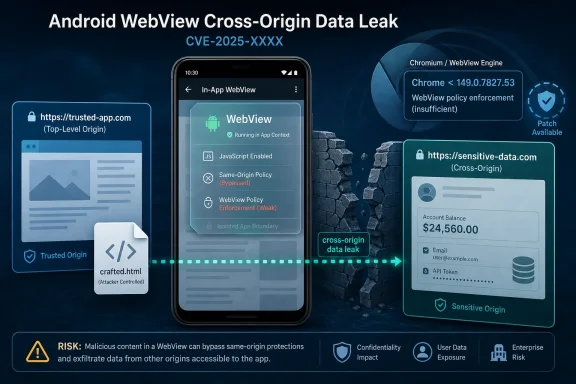
CVE-2026-11178 is a medium-severity Chromium WebView policy-bypass vulnerability, published by NVD on June 4, 2026, affecting Google Chrome on Android before version 149.0.7827.53 and potentially allowing a remote attacker to leak cross-origin data through a crafted HTML page. The bug is not the scariest item in Chrome 149’s unusually large security haul, but it is the kind of flaw that administrators ignore at their peril because it lives in the plumbing. WebView is where browser security becomes application security, and application security becomes device fleet risk. That is why a modest CVSS score should not be mistaken for a modest operational footprint.
The phrase “policy bypass in WebView” sounds almost bureaucratic, as if the issue were a paperwork problem rather than a boundary failure. In browser security, however, policy is the wall between one origin and another, between content an app meant to expose and content an attacker should never be able to read. When that wall is enforced inconsistently, the damage does not need to be dramatic to be useful.
CVE-2026-11178 is described as insufficient policy enforcement in WebView in Google Chrome on Android before 149.0.7827.53. The reported impact is cross-origin data leakage via a crafted HTML page. The attacker model matters: network-accessible, low complexity, no privileges required, but requiring user interaction.
That is the classic middle band of browser vulnerability: not a wormable catastrophe, not a purely theoretical footnote. Someone has to get a user or an embedded browser surface to load hostile content, but the web has spent three decades proving that this is not a high bar.
The practical question for WindowsForum readers is not whether this specific bug turns every Android phone into an open book. It is whether your organization treats WebView as a browser-grade component with browser-grade urgency. Too many fleets still do not.
That is the uncomfortable bargain of modern app development. WebView lets developers ship hybrid interfaces quickly, reuse web infrastructure, and embed authenticated workflows without pushing users out to another app. But the more apps depend on embedded web content, the more a WebView vulnerability becomes a platform vulnerability by proxy.
Cross-origin protections are among the web’s core security promises. A page from one site should not be able to read data from another site merely because both are reachable through the same rendering engine. Same-origin policy, Cross-Origin Resource Sharing, site isolation, opaque response blocking, and adjacent defenses all exist because browsers routinely handle mutually hostile content side by side.
A policy-bypass bug in this area does not need arbitrary code execution to matter. Data leakage can be enough: session-adjacent information, embedded responses, fragments of content, authentication-state hints, or application-specific data exposed through a rendering edge case. The public description does not give exploit mechanics, and Google’s issue tracker entry is permission-restricted, which is normal while fixes are still rolling out. But the category itself is familiar enough to demand attention.
Chrome 149.0.7827.53 shipped for Linux, while Windows and macOS received 149.0.7827.53/54. The advisory was for desktop Chrome, but the CVE text specifically names Chrome on Android and WebView before 149.0.7827.53. That mismatch is not necessarily a contradiction; Chromium security advisories often cover shared engine components whose exposure varies by platform and packaging.
For administrators, the important point is that Chromium vulnerabilities do not always respect the clean lines drawn by inventory tools. A bug may be discovered in one component, fixed in a shared branch, described against Chrome, and later surface in scanners through CPE logic that tries to map a browser, an operating system, and an embedded runtime into one machine-readable shape. That is where the confusion starts.
The NVD change history is revealing. NIST added a configuration that combines Google Chrome versions before 149.0.7827.53 with Google Android, while CISA-ADP provided the CVSS 3.1 vector and CWE mapping. The CPE presentation may look odd if you are expecting a standalone WebView product entry, but it reflects the underlying reality: WebView is not just “an app” in the way a desktop browser is an app.
A clean CPE for Google Chrome alone is not enough if the affected exposure is Android WebView. A clean CPE for Android alone is not enough if the fix is tied to a Chromium/WebView package version rather than an Android platform release. A clean CPE for a separate Android System WebView package may be desirable, but the public NVD entry as modified on June 8 presents the configuration as Chrome versions before 149.0.7827.53 in conjunction with Android.
That “AND” construction is easy to miss. It tells scanners that the vulnerability applies when the vulnerable Chrome version condition and the Android operating-system condition are both true. It is a way of narrowing exposure to Chrome-on-Android rather than every desktop Chrome install below the version threshold.
The problem is that many enterprise asset systems do not model mobile browser components with that precision. They may know the Android OS version, the device model, the installed Chrome package, and the managed-app list, but not the effective WebView provider used by every app. The CVE record can be technically defensible and still be operationally frustrating.
If your scanner flags Linux Chromium packages, Debian Chromium builds, Android Chrome installs, and mobile WebView dependencies under the same CVE umbrella, that is not necessarily evidence that the vulnerability applies identically everywhere. It is evidence that Chromium’s shared codebase and downstream packaging have outgrown the tidy mental model of one CVE, one executable, one patch.
But CVSS is deliberately generic. It does not know whether the exposed WebView is used for an internal single sign-on flow, an HR portal, a customer support console, a payment confirmation screen, or a low-value marketing page. It does not know whether your users are running fully managed Android Enterprise devices with enforced Chrome updates or unmanaged BYOD phones that connect to sensitive SaaS apps.
The score also does not capture the compounding effect of embedded browsing. In a normal browser, users at least understand they are browsing the web. In WebView, hostile content can appear in a context that feels like a trusted application. That does not magically bypass user-interaction requirements, but it can make the required interaction more likely.
Security teams should resist both extremes. This is not a public, critical, exploited-in-the-wild emergency based on the currently available record. It is also not “just medium” in environments where mobile apps routinely embed sensitive authenticated web content. Context turns medium into urgent faster than any CVSS calculator can.
CVE-2026-11178’s description points to a failure in that enforcement. The phrase “leak cross-origin data” is important because confidentiality, not code execution, is the stated impact. The attacker is not described as taking over the device; the attacker is described as extracting information that the policy model should have protected.
For many desktop administrators, that sounds less frightening than memory corruption in V8 or a GPU sandbox escape. That instinct is understandable but incomplete. Browser memory-corruption bugs often dominate headlines because they can lead to full compromise chains. Cross-origin leaks, by contrast, can be quieter and more targeted: they may disclose what account is logged in, what resource exists, what content was returned, or what state a protected endpoint is in.
The value of such leakage depends heavily on the application. A fragment of cross-origin data from a public news page may be worthless. The same class of leak inside a WebView used for a corporate identity workflow is a different matter.
That lag matters because the vulnerable-version threshold is clear: before 149.0.7827.53. A device is not meaningfully remediated because it has a recent Android security patch level if the relevant WebView or Chrome package remains behind. Conversely, an Android device may receive the necessary WebView/Chrome update without waiting for a full operating-system update.
This is where mobile-device management should earn its keep. Administrators should be able to query installed Chrome and WebView versions, enforce managed Play updates, and block or warn on devices that fall below a minimum browser runtime version. If your MDM can tell you battery health but cannot confidently tell you the WebView provider and version, it is missing a security primitive.
There is also a developer angle. App teams that embed WebView should not assume the platform layer fully absorbs this class of risk. They should avoid loading untrusted content into privileged app contexts, separate sensitive flows where possible, and treat injected bridges, custom URL handlers, and relaxed origin checks as high-risk decisions. WebView makes web content feel native; it does not make it safe by inheritance.
Windows-heavy organizations increasingly manage mixed fleets where the same identity stack spans Windows laptops, Android phones, iOS devices, SaaS portals, embedded admin consoles, and Electron-style desktop apps. A Chromium bug in one place may not map directly to another, but the operational lesson often does. Browser components are infrastructure, and infrastructure needs inventory.
The Chrome 149 release also included many other high- and critical-severity fixes, including memory-safety issues across ANGLE, Network, GPU, Ozone, Passwords, Cast, and other components. CVE-2026-11178 is not the biggest item in the bundle, but it is a useful reminder that the attack surface is broader than JavaScript engines and renderer escapes.
Microsoft Edge administrators should avoid false equivalence. This CVE, as described, concerns Chrome on Android WebView prior to 149.0.7827.53, not necessarily every Chromium-derived product in the same way. But Edge, Chrome, WebView2, Android WebView, and downstream Chromium packages all participate in the same ecosystem of shared code, staggered fixes, and scanner ambiguity. The lesson is not panic; it is disciplined version governance.
NVD adds structure after the fact: descriptions, CVSS vectors, CWE mappings, references, and CPE configurations. In this case, NVD had not provided its own CVSS assessment at the time reflected in the record, while CISA-ADP supplied the 4.3 medium vector and CWE-346, an origin validation error. That is normal in the current vulnerability-data pipeline, where enrichment is staged and sometimes incomplete during the first days after publication.
The gap between advisory and operational response is where security teams have to think rather than merely ingest. “Policy bypass in WebView” is enough to trigger patching, but not enough to infer exploitability against a particular app. “Cross-origin data leak” is enough to prioritize confidentiality-sensitive workflows, but not enough to claim device compromise.
Good vulnerability management lives in that middle ground. It treats public records as evidence, not gospel. It patches quickly where the affected component is widely deployed, but it also documents uncertainty instead of pretending every scanner result is equally meaningful.
Administrators should first separate desktop Chrome from Android Chrome and WebView exposure. Desktop Chrome still needs Chrome 149’s security update because the release contains hundreds of fixes, but this specific WebView CVE is described in Android terms. Treating the WebView issue as a desktop-only Chrome problem would miss the point.
Next, teams should identify whether managed Android devices have Chrome or Android System WebView below 149.0.7827.53. That means checking the package actually serving as WebView provider, not just the OS build. On modern Android, users and policies may influence whether Chrome or Android System WebView acts as the provider, depending on device configuration and version.
Finally, developers should inventory WebView usage in in-house apps. The riskiest pattern is not merely “we use WebView.” It is “we use WebView to show sensitive authenticated content while also allowing attacker-influenced navigation, relaxed origin rules, or native bridges.” A browser-engine patch reduces platform risk, but it does not excuse risky embedding design.
For enterprises, the advice is more procedural. Set a minimum allowed Chrome/WebView version at or above 149.0.7827.53, monitor compliance, and use managed Play controls where available. If a device cannot receive the update, it should lose access to sensitive workflows until the exposure is resolved or mitigated.
The harder part is exceptions. Some regulated environments freeze app versions for compatibility testing. Some ruggedized Android devices lag behind mainstream update channels. Some kiosk deployments pin WebView behavior because the app was built around a brittle embedded flow. These are precisely the environments where “medium” vulnerabilities can linger long enough to become meaningful.
Security teams should also remember that WebView updates can break applications that relied on nonstandard behavior. That is not an argument against updating. It is an argument for testing embedded web workflows continuously, not only when a CVE forces the issue.
 A Medium Bug Lands in the Least Convenient Layer of Android
The phrase “policy bypass in WebView” sounds almost bureaucratic, as if the issue were a paperwork problem rather than a boundary failure. In browser security, however, policy is the wall between one origin and another, between content an app meant to expose and content an attacker should never be able to read. When that wall is enforced inconsistently, the damage does not need to be dramatic to be useful.CVE-2026-11178 is described as insufficient policy enforcement in WebView in Google Chrome on Android before 149.0.7827.53. The reported impact is cross-origin data leakage via a crafted HTML page. The attacker model matters: network-accessible, low complexity, no privileges required, but requiring user interaction.
That is the classic middle band of browser vulnerability: not a wormable catastrophe, not a purely theoretical footnote. Someone has to get a user or an embedded browser surface to load hostile content, but the web has spent three decades proving that this is not a high bar.
The practical question for WindowsForum readers is not whether this specific bug turns every Android phone into an open book. It is whether your organization treats WebView as a browser-grade component with browser-grade urgency. Too many fleets still do not.
WebView Is Chrome’s Shadow Browser
Android System WebView and Chrome are easy to underappreciate because they are not always visible as browsers. A user sees a login form in a banking app, a support page inside a managed app, a payment flow, a helpdesk portal, or a terms-of-service screen. Underneath, WebView may be rendering complex web content with many of the same assumptions and attack surfaces as a full browser tab.That is the uncomfortable bargain of modern app development. WebView lets developers ship hybrid interfaces quickly, reuse web infrastructure, and embed authenticated workflows without pushing users out to another app. But the more apps depend on embedded web content, the more a WebView vulnerability becomes a platform vulnerability by proxy.
Cross-origin protections are among the web’s core security promises. A page from one site should not be able to read data from another site merely because both are reachable through the same rendering engine. Same-origin policy, Cross-Origin Resource Sharing, site isolation, opaque response blocking, and adjacent defenses all exist because browsers routinely handle mutually hostile content side by side.
A policy-bypass bug in this area does not need arbitrary code execution to matter. Data leakage can be enough: session-adjacent information, embedded responses, fragments of content, authentication-state hints, or application-specific data exposed through a rendering edge case. The public description does not give exploit mechanics, and Google’s issue tracker entry is permission-restricted, which is normal while fixes are still rolling out. But the category itself is familiar enough to demand attention.
Chrome 149 Was Not a Quiet Security Release
CVE-2026-11178 arrived as part of Chrome 149’s stable-channel update, a release that Google said included 429 security fixes. That number alone changes the framing. This was not a single-vulnerability patch where defenders can neatly isolate one product surface and declare victory after checking a version string.Chrome 149.0.7827.53 shipped for Linux, while Windows and macOS received 149.0.7827.53/54. The advisory was for desktop Chrome, but the CVE text specifically names Chrome on Android and WebView before 149.0.7827.53. That mismatch is not necessarily a contradiction; Chromium security advisories often cover shared engine components whose exposure varies by platform and packaging.
For administrators, the important point is that Chromium vulnerabilities do not always respect the clean lines drawn by inventory tools. A bug may be discovered in one component, fixed in a shared branch, described against Chrome, and later surface in scanners through CPE logic that tries to map a browser, an operating system, and an embedded runtime into one machine-readable shape. That is where the confusion starts.
The NVD change history is revealing. NIST added a configuration that combines Google Chrome versions before 149.0.7827.53 with Google Android, while CISA-ADP provided the CVSS 3.1 vector and CWE mapping. The CPE presentation may look odd if you are expecting a standalone WebView product entry, but it reflects the underlying reality: WebView is not just “an app” in the way a desktop browser is an app.
The CPE Question Is Really an Inventory Question
The user-facing question — “Are we missing a CPE here?” — gets to the heart of vulnerability management’s least glamorous problem. CPEs are supposed to make affected products machine-readable, but modern software supply chains make that increasingly hard. WebView sits at an intersection of Chrome, Android, OEM update channels, app behavior, and managed-device policy.A clean CPE for Google Chrome alone is not enough if the affected exposure is Android WebView. A clean CPE for Android alone is not enough if the fix is tied to a Chromium/WebView package version rather than an Android platform release. A clean CPE for a separate Android System WebView package may be desirable, but the public NVD entry as modified on June 8 presents the configuration as Chrome versions before 149.0.7827.53 in conjunction with Android.
That “AND” construction is easy to miss. It tells scanners that the vulnerability applies when the vulnerable Chrome version condition and the Android operating-system condition are both true. It is a way of narrowing exposure to Chrome-on-Android rather than every desktop Chrome install below the version threshold.
The problem is that many enterprise asset systems do not model mobile browser components with that precision. They may know the Android OS version, the device model, the installed Chrome package, and the managed-app list, but not the effective WebView provider used by every app. The CVE record can be technically defensible and still be operationally frustrating.
If your scanner flags Linux Chromium packages, Debian Chromium builds, Android Chrome installs, and mobile WebView dependencies under the same CVE umbrella, that is not necessarily evidence that the vulnerability applies identically everywhere. It is evidence that Chromium’s shared codebase and downstream packaging have outgrown the tidy mental model of one CVE, one executable, one patch.
CVSS 4.3 Is a Starting Point, Not a Risk Decision
CISA-ADP scores CVE-2026-11178 at 4.3 under CVSS 3.1: network attack vector, low attack complexity, no privileges required, user interaction required, unchanged scope, low confidentiality impact, and no integrity or availability impact. That is a reasonable medium score for a described cross-origin data leak.But CVSS is deliberately generic. It does not know whether the exposed WebView is used for an internal single sign-on flow, an HR portal, a customer support console, a payment confirmation screen, or a low-value marketing page. It does not know whether your users are running fully managed Android Enterprise devices with enforced Chrome updates or unmanaged BYOD phones that connect to sensitive SaaS apps.
The score also does not capture the compounding effect of embedded browsing. In a normal browser, users at least understand they are browsing the web. In WebView, hostile content can appear in a context that feels like a trusted application. That does not magically bypass user-interaction requirements, but it can make the required interaction more likely.
Security teams should resist both extremes. This is not a public, critical, exploited-in-the-wild emergency based on the currently available record. It is also not “just medium” in environments where mobile apps routinely embed sensitive authenticated web content. Context turns medium into urgent faster than any CVSS calculator can.
The Real Boundary Is Cross-Origin Trust
The web’s origin model is a quiet miracle when it works. A browser can load email, payroll, advertising, analytics, documentation, and a hostile proof-of-concept page without letting each one casually rifle through the others. Every exception to that rule is supposed to be explicit, negotiated, and narrowly scoped.CVE-2026-11178’s description points to a failure in that enforcement. The phrase “leak cross-origin data” is important because confidentiality, not code execution, is the stated impact. The attacker is not described as taking over the device; the attacker is described as extracting information that the policy model should have protected.
For many desktop administrators, that sounds less frightening than memory corruption in V8 or a GPU sandbox escape. That instinct is understandable but incomplete. Browser memory-corruption bugs often dominate headlines because they can lead to full compromise chains. Cross-origin leaks, by contrast, can be quieter and more targeted: they may disclose what account is logged in, what resource exists, what content was returned, or what state a protected endpoint is in.
The value of such leakage depends heavily on the application. A fragment of cross-origin data from a public news page may be worthless. The same class of leak inside a WebView used for a corporate identity workflow is a different matter.
Android Patch Reality Is Still Uneven
On desktop Windows, Chrome’s auto-update machinery is mature, highly visible to administrators, and easy to verify. On Android, the story is better than it was a decade ago, but it remains more fragmented. Chrome and Android System WebView are generally updated through Google Play on supported devices, while OEM policies, enterprise controls, regional builds, and user behavior can still introduce lag.That lag matters because the vulnerable-version threshold is clear: before 149.0.7827.53. A device is not meaningfully remediated because it has a recent Android security patch level if the relevant WebView or Chrome package remains behind. Conversely, an Android device may receive the necessary WebView/Chrome update without waiting for a full operating-system update.
This is where mobile-device management should earn its keep. Administrators should be able to query installed Chrome and WebView versions, enforce managed Play updates, and block or warn on devices that fall below a minimum browser runtime version. If your MDM can tell you battery health but cannot confidently tell you the WebView provider and version, it is missing a security primitive.
There is also a developer angle. App teams that embed WebView should not assume the platform layer fully absorbs this class of risk. They should avoid loading untrusted content into privileged app contexts, separate sensitive flows where possible, and treat injected bridges, custom URL handlers, and relaxed origin checks as high-risk decisions. WebView makes web content feel native; it does not make it safe by inheritance.
Windows Shops Should Care Because Chromium Is Infrastructure Now
At first glance, an Android WebView CVE may seem outside the WindowsForum center of gravity. But Chromium is no longer just a browser engine used by people who choose Chrome. It is an application platform, a runtime dependency, a desktop wrapper, a mobile embedding layer, and the foundation beneath Microsoft Edge.Windows-heavy organizations increasingly manage mixed fleets where the same identity stack spans Windows laptops, Android phones, iOS devices, SaaS portals, embedded admin consoles, and Electron-style desktop apps. A Chromium bug in one place may not map directly to another, but the operational lesson often does. Browser components are infrastructure, and infrastructure needs inventory.
The Chrome 149 release also included many other high- and critical-severity fixes, including memory-safety issues across ANGLE, Network, GPU, Ozone, Passwords, Cast, and other components. CVE-2026-11178 is not the biggest item in the bundle, but it is a useful reminder that the attack surface is broader than JavaScript engines and renderer escapes.
Microsoft Edge administrators should avoid false equivalence. This CVE, as described, concerns Chrome on Android WebView prior to 149.0.7827.53, not necessarily every Chromium-derived product in the same way. But Edge, Chrome, WebView2, Android WebView, and downstream Chromium packages all participate in the same ecosystem of shared code, staggered fixes, and scanner ambiguity. The lesson is not panic; it is disciplined version governance.
Vendor Advisories Tell Only Half the Story
Google’s advisory model is intentionally terse. It lists versions, severities, CVEs, researchers, and sometimes bounty amounts, while keeping bug details restricted until enough users have updated. That policy reduces exploit copycatting, but it leaves defenders making risk decisions from sparse public text.NVD adds structure after the fact: descriptions, CVSS vectors, CWE mappings, references, and CPE configurations. In this case, NVD had not provided its own CVSS assessment at the time reflected in the record, while CISA-ADP supplied the 4.3 medium vector and CWE-346, an origin validation error. That is normal in the current vulnerability-data pipeline, where enrichment is staged and sometimes incomplete during the first days after publication.
The gap between advisory and operational response is where security teams have to think rather than merely ingest. “Policy bypass in WebView” is enough to trigger patching, but not enough to infer exploitability against a particular app. “Cross-origin data leak” is enough to prioritize confidentiality-sensitive workflows, but not enough to claim device compromise.
Good vulnerability management lives in that middle ground. It treats public records as evidence, not gospel. It patches quickly where the affected component is widely deployed, but it also documents uncertainty instead of pretending every scanner result is equally meaningful.
The Scanner Alert Is the Beginning, Not the Decision
When CVE-2026-11178 appears in a vulnerability dashboard, the first temptation is to debate whether the scanner is “right.” That debate is useful only if it leads to better asset understanding. The presence of an Android CPE combined with a Chrome version threshold means a generic Chrome finding may need refinement before it becomes an actionable ticket.Administrators should first separate desktop Chrome from Android Chrome and WebView exposure. Desktop Chrome still needs Chrome 149’s security update because the release contains hundreds of fixes, but this specific WebView CVE is described in Android terms. Treating the WebView issue as a desktop-only Chrome problem would miss the point.
Next, teams should identify whether managed Android devices have Chrome or Android System WebView below 149.0.7827.53. That means checking the package actually serving as WebView provider, not just the OS build. On modern Android, users and policies may influence whether Chrome or Android System WebView acts as the provider, depending on device configuration and version.
Finally, developers should inventory WebView usage in in-house apps. The riskiest pattern is not merely “we use WebView.” It is “we use WebView to show sensitive authenticated content while also allowing attacker-influenced navigation, relaxed origin rules, or native bridges.” A browser-engine patch reduces platform risk, but it does not excuse risky embedding design.
The Patch Path Is Straightforward, the Governance Path Is Not
For individual users, the advice is simple: update Chrome on Android and ensure Android System WebView is current through Google Play. If automatic updates are enabled and the device is supported, the fix should arrive through the normal app-update channel. Users can verify the installed version from app settings or the Play Store listing.For enterprises, the advice is more procedural. Set a minimum allowed Chrome/WebView version at or above 149.0.7827.53, monitor compliance, and use managed Play controls where available. If a device cannot receive the update, it should lose access to sensitive workflows until the exposure is resolved or mitigated.
The harder part is exceptions. Some regulated environments freeze app versions for compatibility testing. Some ruggedized Android devices lag behind mainstream update channels. Some kiosk deployments pin WebView behavior because the app was built around a brittle embedded flow. These are precisely the environments where “medium” vulnerabilities can linger long enough to become meaningful.
Security teams should also remember that WebView updates can break applications that relied on nonstandard behavior. That is not an argument against updating. It is an argument for testing embedded web workflows continuously, not only when a CVE forces the issue.
The Small Android CVE That Exposes a Bigger Patch Habit
CVE-2026-11178 is not a banner-grabbing zero-day, but it is a useful audit trigger because it touches WebView, Chrome versioning, CPE interpretation, and cross-origin data protection in one compact record. The concrete response is not complicated, but it does require knowing where Chromium lives in your environment.- Organizations should treat Chrome and WebView versions on Android as managed security baselines, not as user-maintained app details.
- Vulnerability teams should read the NVD configuration carefully because the Android condition changes how the Chrome version threshold should be interpreted.
- Desktop Chrome still deserves prompt updating to Chrome 149 because the same release carries a large set of unrelated security fixes.
- App developers should review WebView usage for sensitive flows, especially where untrusted navigation, native bridges, or relaxed origin handling are present.
- A CVSS 4.3 score should not prevent prioritization in fleets where embedded web content handles authentication, customer data, or internal portals.
References
- Primary source: NVD / Chromium
Published: 2026-06-09T07:00:35-07:00
NVD - CVE-2026-11178
 nvd.nist.gov
- Security advisory: MSRC
Published: 2026-06-09T07:00:35-07:00
Original feed URL
Security Update Guide - Microsoft Security Response Center
 msrc.microsoft.com
- Related coverage: security.snyk.io

