

The “Medium” Chrome Bug That Looks Critical in the Database
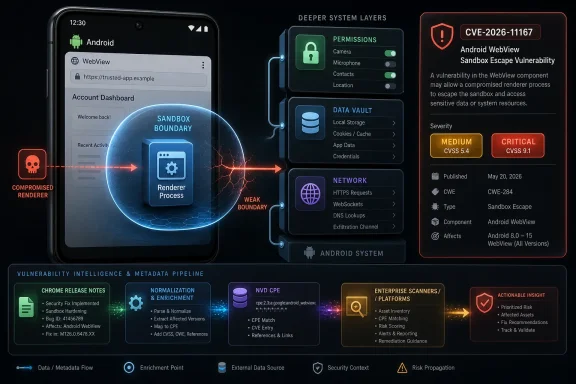
Google’s own Chromium severity for CVE-2026-11167 is listed as Medium, which sounds modest until you read the mechanics. The bug involves WebView in Chrome on Android, and exploitation requires that an attacker has already compromised the renderer process. From there, a crafted HTML page could potentially help cross the boundary that is supposed to keep renderer code confined.
That prerequisite matters. A sandbox escape is rarely the first step in an attack chain; it is usually the second act, paired with a renderer exploit, logic bug, or content-processing flaw that gets attacker-controlled code into the browser’s least-trusted compartment. That is why Chrome can rate this as Medium while CISA’s enrichment gives it a CVSS 3.1 score of 9.6 Critical: the local Chromium triage is weighing exploit chain assumptions, while the generic scoring model is measuring what happens once the conditions are met.
This is not a contradiction so much as a warning about severity labels. Browser vendors think in exploit chains, mitigations, bug classes, and field telemetry. Vulnerability databases think in normalized vectors that procurement tools, scanners, dashboards, and compliance reports can digest. The same bug can be “Medium” to the engineering team that understands the preconditions and “Critical” to a risk register that sees network reachability, low attack complexity, changed scope, and high confidentiality, integrity, and availability impact.
For administrators, the practical answer is not to adjudicate who is “right.” A sandbox escape in a mainstream browser component deserves patch urgency, especially when it lands in the same release train as hundreds of other Chrome fixes. The severity label tells you how to prioritize; the bug class tells you why you should not ignore it.
WebView Is the Part of Chrome Users Don’t Know They Use
The word WebView is doing a lot of work here. On Android, WebView is the embedded browser engine used by apps to display web content without sending the user into a full browser session. That makes it a quiet dependency for banking apps, messaging apps, identity flows, captive portals, enterprise sign-in screens, device management agents, and a long tail of software that “just shows a web page.”
That is also why WebView vulnerabilities are uncomfortable for enterprise teams. A user may never intentionally open Chrome to a malicious site, but they may interact with web content inside another app that relies on the same underlying browser machinery. In many organizations, the patch conversation therefore spans Chrome, Android System WebView, managed app stores, mobile device management policies, and the update behavior of OEM-controlled Android builds.
CVE-2026-11167’s description specifically says “Google Chrome on Android,” not Windows, macOS, or Linux. That distinction matters. Windows administrators should not misread this as a direct Chrome-on-Windows WebView2 issue. Microsoft Edge WebView2 is a different deployment and servicing story, even though the broader Chromium family resemblance can make these names blur together in scanners and headlines.
Still, Windows shops should care because most enterprise environments are no longer purely Windows environments. The same identity provider, the same conditional access policy, and the same corporate data may be reachable from managed Android devices. A Chrome Android sandbox escape is not a Windows patch, but it can still be an enterprise security problem.
The CPE Entry Shows How Vulnerability Metadata Gets Messy
The NVD change history is unusually instructive. NIST’s initial analysis added a CPE configuration that combines Google Chrome versions up to, but excluding, 149.0.7827.53 with Android as an operating-system condition. In plain English, the record is trying to say this is Chrome on Android, not every Chrome install everywhere.
That modeling is sensible, but it is also fragile. CPEs were built to identify products in a way machines can compare, yet browser reality now cuts across application package names, embedded components, mobile OS servicing, and vendor-specific distribution channels. The question “Are we missing a CPE here?” is not merely a form prompt; it reflects a recurring weakness in how vulnerability records describe componentized software.
If a scanner only sees google:chrome less than 149.0.7827.53, it may over-alert desktop Chrome deployments even though the CVE text says Android WebView. If it only keys on Android and ignores Chrome package versions, it may miss devices where the browser component is stale but the OS build looks acceptable. If it treats WebView as a separate product without understanding the vendor’s packaging model, it may generate both false positives and false negatives.
This is the hidden labor of vulnerability management. Security teams do not just patch CVEs; they interpret records, normalize product names, validate scanner logic, and decide which findings map to real exposure. CVE-2026-11167 is a small case study in why that interpretation step cannot be fully outsourced to a dashboard.
Google Fixed It in a Release That Was Already Too Large to Ignore
Chrome 149 was promoted to the stable channel for Windows, Mac, and Linux on June 2, 2026, with version 149.0.7827.53 for Linux and 149.0.7827.53/54 for Windows and Mac. Google’s release notes said the update included 429 security fixes, an unusually large number that makes any individual CVE easy to miss.
CVE-2026-11167 was published two days later, on June 4, and NVD’s record was last modified on June 8. That staggered chronology is typical of Chrome security disclosures. Release notes, CVE publication, restricted bug trackers, third-party enrichment, and scanner signatures often arrive in waves rather than as a single clean packet.
That matters operationally because patch windows are usually negotiated around visible risk. A Chrome release with hundreds of fixes should not be treated as routine background noise, even when a particular CVE is not known to be exploited in the wild. The size of the release is itself a signal that the browser attack surface has moved significantly.
At the same time, the referenced Google release note is a desktop stable-channel post, while the CVE description is Android-specific. That mismatch is not necessarily wrong; Chrome release posts often collect fixes across platforms and components, and bug details may remain restricted until users are updated. But it does mean administrators should read the CVE text and platform qualifiers carefully instead of assuming the advisory title tells the whole story.
The Sandbox Is the Browser’s Most Important Lie
Every modern browser asks users and administrators to accept a comforting fiction: hostile web content can run locally, parse complex formats, execute JavaScript, touch GPU pipelines, trigger media stacks, and still remain safely contained. The sandbox is the mechanism that makes that fiction mostly true. It is also why sandbox escapes draw attention disproportionate to their one-line descriptions.
A renderer compromise by itself is dangerous, but constrained. The attacker may control a process designed to be disposable, low-privilege, and separated from sensitive system resources. A sandbox escape changes the meaning of that first compromise by offering a path toward broader privileges, deeper persistence, or access to data that the browser architecture was supposed to shield.
CVE-2026-11167 is described as “inappropriate implementation,” a category that tends to conceal more than it reveals. It could mean a policy check in the wrong place, an overly privileged interface, a missing boundary condition, or a confused trust relationship between WebView and the surrounding app environment. The attached CWE, Execution with Unnecessary Privileges, points toward the same general theme: code had access to something it should not have needed.
For defenders, that is enough. You do not need exploit code to understand the risk pattern. WebView is a bridge between arbitrary web content and native application context, and any implementation flaw that weakens privilege separation deserves fast remediation.
Android Patch Reality Is Still Uneven
On paper, the fix threshold is clean: Chrome on Android before 149.0.7827.53 is affected. In practice, Android fleets are rarely that tidy. Some users update Chrome from the Play Store quickly; some defer updates; some devices are pinned by enterprise policy; some are out of support; and some regional or OEM configurations make component versions harder to reason about than they should be.
The user-facing advice is simple: update Chrome and WebView components, then verify the installed version. The enterprise advice is more demanding: inventory Android browser and WebView versions, check mobile management compliance rules, and avoid assuming that an OS patch level automatically implies the right browser component level. The CVE’s own CPE structure hints at this complexity by tying Chrome and Android together rather than treating the flaw as a generic desktop browser issue.
This is where mobile security policy often lags behind desktop patch discipline. Windows administrators are accustomed to monthly cumulative updates, browser auto-updates, WSUS or Intune reporting, and emergency out-of-band decisions. Android fleets can be more fragmented, especially when corporate data is allowed on bring-your-own devices.
The browser has become the application runtime, the identity broker, and the document viewer. That makes stale WebView code a first-class enterprise risk, not a consumer-device footnote.
Scanner Noise Will Be the First Symptom
The first place many IT teams encounter CVE-2026-11167 will not be Google’s release notes or NVD’s prose. It will be a scanner finding, a software composition dashboard, a mobile threat defense alert, or a vulnerability management ticket that says Chrome is below 149.0.7827.53. Whether that ticket is useful depends on how well the tool understands platform context.
A Windows desktop running Chrome 149.0.7827.54 is not the same exposure as an Android device running an older Chrome build. A Linux distribution package may show up in trackers with its own fixed and vulnerable states, even though the original CVE language calls out Android WebView. A Debian tracker, for example, may map Chromium source packages against distribution versions because downstream packagers track the broader Chromium codebase differently from Google’s Chrome product line.
That is not “wrong,” but it is easy to misread. Source package vulnerability tracking often follows code ancestry. Product vulnerability tracking follows shipped artifacts. Enterprise exposure management has to reconcile both, and Chromium’s cross-platform sprawl makes that reconciliation harder than it looks.
The worst response is to dismiss the finding because the labels are confusing. The better response is to split the population: managed Android devices, unmanaged Android devices with corporate access, desktop Chrome installs, Chromium-derived browsers, and Linux distribution packages. Each category needs a different verification path.
The Real Risk Is the Chain, Not the Single CVE
CVE-2026-11167 requires renderer compromise, which means it is most dangerous when paired with another bug. That is not a comfort; that is how high-end browser exploitation normally works. Attackers chain a renderer execution primitive with a sandbox escape, then use a privilege or logic flaw to move deeper into the device or data environment.
Chrome 149’s release notes make that context hard to ignore. The same release train contained critical memory-safety bugs, high-severity use-after-free issues, validation problems, and other browser-engine fixes. Even if CVE-2026-11167 is not known to be exploited, it sits in a neighborhood of bugs that collectively describe a large and active attack surface.
This is why security teams should resist CVE-by-CVE myopia. A medium-severity sandbox escape may be less urgent in isolation than a remotely exploitable V8 zero-day, but it may be the missing second stage in a chain. Conversely, a scary CVSS score may overstate real-world exploitability if the preconditions are rare. The correct unit of analysis is the attack path, not the row in a spreadsheet.
For WindowsForum’s audience, this is also a reminder that browser updates are infrastructure updates. Chrome, Edge, WebView2, Android WebView, Electron applications, and embedded Chromium runtimes have turned browser-engine maintenance into a distributed systems problem. The security boundary is no longer one executable with one version number.
Enterprises Should Treat Mobile Browsers Like Managed Endpoints
The least defensible posture in 2026 is to manage Windows browsers tightly while letting Android browser components update whenever users happen to notice. If corporate mail, files, SSO, SaaS dashboards, or privileged admin portals are reachable from mobile devices, the mobile browser stack is part of the enterprise perimeter. CVE-2026-11167 reinforces that point because the vulnerable component is exactly the kind that hides under app workflows.
A useful policy starts with visibility. Administrators need to know which Android devices can access corporate resources, which Chrome and WebView versions are installed, whether Play Store auto-updates are functioning, and whether unsupported devices are still enrolled. Conditional access can then make browser freshness a gate rather than an after-the-fact report.
The second step is exception discipline. If a business unit needs older Android devices, older embedded WebView behavior, or pinned app versions, that exception should be documented as risk, not treated as an invisible compatibility footnote. Browser component drift is not harmless merely because the device still boots and the app still opens.
The third step is communication. Users understand “update Chrome” better than they understand “renderer process sandbox escape.” Security teams should use the simple message externally while preserving the deeper technical rationale internally. The goal is not to make everyone fluent in Chromium internals; it is to make delayed browser updates feel as unacceptable as delayed operating-system patches.
The 149.0.7827.53 Line Is the One to Draw
The concrete remediation line for this CVE is Chrome on Android 149.0.7827.53 or later. Anything before that should be treated as exposed for CVE-2026-11167 if it is in the affected Android context. Because Google’s desktop release numbering around Chrome 149 includes adjacent builds for Windows, Mac, and Linux, administrators should avoid casually mapping one platform’s version suffix to another without checking the relevant channel and package.
For personal users, the action is mundane but important: update Chrome from the Play Store, update Android System WebView if it appears separately, and restart apps that embed web content. On many devices, this will already have happened automatically. On some, it will not.
For enterprise teams, the version number should become a compliance check. Mobile device management policies can often report app versions, enforce update behavior, or block access from devices that fall behind. Where that is not possible, access to sensitive applications should be constrained by device trust, OS support status, and browser posture.
This is also a good moment to review whether vulnerability scanners and asset inventories understand mobile browser components at all. A clean Windows vulnerability report does not mean an organization is clean. It may simply mean the Android surface is not being measured.
The Small WebView Bug That Exposes the Bigger Browser Patch Problem
CVE-2026-11167 is not the loudest Chrome vulnerability of the week, but it is a useful stress test for how organizations read browser advisories. The details point to Android WebView, the reference trail points through a Chrome release, the CPE record tries to bind application and operating system context, and third-party scoring raises the temperature with a Critical rating. That mix is exactly where patch programs either show maturity or generate noise.
- CVE-2026-11167 affects Google Chrome on Android before 149.0.7827.53 and describes a potential WebView sandbox escape after renderer compromise.
- Google labels the Chromium security severity as Medium, while CISA’s CVSS 3.1 enrichment rates the issue Critical because of the modeled impact once exploited.
- The NVD CPE configuration attempts to scope the vulnerability to Chrome in an Android context, which means scanners may need tuning to avoid platform confusion.
- Windows desktops are not the directly described target, but Windows-centric enterprises should still care if Android devices can reach corporate data or identity systems.
- The right operational response is to verify Chrome and WebView versions on Android fleets, not merely to assume desktop Chrome patching has addressed the issue.
- The broader lesson is that browser security now spans apps, embedded runtimes, mobile OS components, and vendor packaging systems that do not fit neatly into one CVE row.
CVE-2026-11167 will probably not be remembered as the defining Chrome vulnerability of 2026, and that is precisely why it matters. The bugs that reshape security programs are not always the ones with the loudest headlines; sometimes they are the ones that reveal where inventory, metadata, mobile management, and patch assumptions quietly diverge. Browser vendors will keep tightening sandboxes, attackers will keep chaining around them, and administrators will have to get better at treating every embedded browser component as part of the real endpoint estate.