

On May 20, 2026, Internet Systems Consortium disclosed CVE-2026-5947, a high-severity BIND 9 flaw in which SIG(0)-signed DNS traffic arriving during a query flood can trigger a race condition, use freed memory, and crash DNS service. The bug is not a flashy remote-code-execution headline, but for the people who operate DNS it lands in the category that matters most: availability. If a resolver or authoritative server can be pushed into aborting under load, the difference between a software flaw and an outage becomes academic. For Windows shops, the lesson is not that Microsoft DNS suddenly became BIND; it is that hybrid infrastructure often depends on Unix-rooted plumbing that Windows administrators still have to track, patch, and defend.
CVE-2026-5947 is, at its core, a timing bug. BIND begins validating an incoming DNS message signed with SIG(0), but if the server hits its
The resulting behavior is undefined, which is a polite engineering phrase for “the software contract has already been broken.” ISC’s advisory describes the likely operational result as a BIND process aborting with a segmentation violation or similar crash. It also says code execution is unlikely, which is important, but it should not lull administrators into treating this as harmless.
Availability bugs in DNS have a way of punching above their CVSS category. A web server outage may break a site; a DNS outage can make many sites, services, mail flows, VPN endpoints, identity systems, and management tools appear broken at once. That is why the supplied MSRC language about “total loss of availability” is the right frame for defenders, even if the bug itself lives in BIND rather than in a Windows component.
The uncomfortable part is that this bug does not require an attacker to own credentials, trick a user, or sit inside the network. It is remotely exploitable and rated CVSS 7.5, with the entire score driven by availability impact. In infrastructure terms, that is exactly the kind of issue that gets underestimated until a resolver falls over during a noisy afternoon.
The vulnerability does not require SIG(0) to be part of a normal enterprise workflow. The dangerous path begins when BIND receives a DNS message signed with SIG(0), starts validation, and then collides with resource exhaustion behavior under load. The attack story is therefore less “someone abuses your intended SIG(0) deployment” and more “someone finds a reachable parser and validator path that behaves badly when the server is already under pressure.”
That is what makes the query-flood condition so relevant. Many denial-of-service bugs are clean, deterministic switches: send malformed input, service crashes. This one is more conditional. The attacker needs the right signed message behavior and the right load condition, but query floods are hardly exotic in DNS operations.
Race conditions are also maddening for defenders because they can look intermittent. A server may survive test traffic, survive a scan, and then die when traffic volume and timing line up. That can produce the worst kind of incident response: logs full of symptoms, few obvious root causes, and a service that appears unstable only when customers most need it.
That matters because 9.20 is a current stable line, while 9.21 is a development branch used by operators who track newer features and testing paths. This is not a case where the answer is simply “stop running software from a decade ago.” Fully modern deployments can be exposed if they sit on the wrong point release.
ISC also lists BIND 9.18.28 through 9.18.49, and the corresponding 9.18 Supported Preview Edition builds, as not affected. Versions before 9.18.28 were not assessed, which is a small but important sentence. “Not assessed” is not the same thing as safe, and organizations running older untracked packages should resist the temptation to interpret silence as immunity.
The release timing adds another wrinkle. ISC published a cluster of BIND security fixes on May 20, including other CVEs affecting resolver and server behavior. That bundling is efficient for maintainers but demanding for operations teams, because the right question is not merely whether CVE-2026-5947 applies. It is whether the entire BIND estate is on a branch and package stream that can absorb the May security releases quickly.
Still, MSRC tracking is meaningful. Microsoft’s ecosystem is full of products, images, appliances, Linux workloads on Azure, containers, developer environments, and customer deployments where third-party infrastructure software matters. A vulnerability does not have to originate in Windows to become relevant to Windows administrators.
That distinction is especially important in mixed estates. Many organizations run Active Directory-integrated DNS on Windows Server for internal zones, while using BIND for public authoritative DNS, split-horizon views, lab networks, security tooling, DNS forwarding, or cloud-hosted resolver roles. In those environments, the Windows team may discover the impact only after authentication, name resolution, or application routing starts failing.
The lesson is broader than this one CVE. Security programs built around “Microsoft Patch Tuesday” alone are too narrow for modern infrastructure. DNS resolvers may be Linux packages, container images, managed appliances, or embedded services inside larger products. The operational dependency is Windows-facing even when the vulnerable daemon is not.
The most obvious scenario is a recursive resolver serving internal clients. If it aborts under flood conditions, clients may fail over to secondary resolvers if they are configured correctly and reachable. If they are not, users experience the outage as “the internet is down,” while application teams see timeouts, failed dependency calls, and authentication delays.
Authoritative DNS is just as sensitive. If a public authoritative server can be repeatedly crashed, the practical impact depends on redundancy, anycast, secondary providers, TTLs, and how aggressively the attacker can keep pressure on exposed nodes. A well-designed DNS architecture can absorb the loss of a single server; a thin one can turn a process abort into a customer-visible incident.
There is also the problem of cascading noise. DNS failures tend to trigger retries, fallback behavior, monitoring storms, and human troubleshooting across unrelated teams. A narrowly scoped BIND bug can therefore consume help desks, network engineers, identity administrators, and application owners at the same time.
The
The involvement of the
That does not mean administrators should disable or wildly raise limits in panic. Resource limits are still essential, especially for resolvers exposed to untrusted traffic. The point is subtler: defensive controls are code paths too, and when they interact with parsing, validation, and cleanup logic under load, they can expose bugs that ordinary traffic never reaches.
For operators, this is a reminder that denial-of-service resilience is not just a firewall policy. It is capacity planning, sane resolver exposure, rate limiting, version hygiene, process supervision, redundancy, logging, and rehearsed failover. A patched BIND is the immediate answer, but architecture decides whether the next crash-class bug becomes an incident.
This is also where Windows administrators should look beyond their familiar consoles. If DHCP hands out a pair of internal recursive resolvers, are both healthy and independently patched? If branch offices use local DNS forwarders, are they running vendor firmware with embedded BIND? If Azure or hybrid environments use custom DNS appliances, who owns their update cadence?
Package naming can make inventory harder. On Debian and Ubuntu systems, administrators may be looking for
That is why version checking should not stop at a single command copied into a change ticket. Teams need to map where DNS service is actually provided, whether the instance is authoritative, recursive, forwarding, or mixed, and whether it is reachable from untrusted networks. The highest-priority systems are the ones both exposed and essential.
Containers deserve special attention. A base image with BIND baked in will not patch itself because the host is current. If the organization deploys DNS functions through Kubernetes, lab automation, CI environments, or security sandboxes, the fix may require rebuilding images as well as updating running nodes.
The harder work is proving that every relevant resolver and authoritative server made the jump. DNS infrastructure is often decentralized because it predates current platform teams, mergers, cloud migrations, or zero-trust projects. There may be a public DNS provider, a registrar-hosted secondary, an on-prem pair of resolvers, a DMZ forwarder, a lab BIND server, and a cloud VNet DNS appliance all serving different slices of the same organization.
Testing should be conservative. Because the bug involves race timing and query flooding, defenders should not try to reproduce a crash in production to “validate” exposure. Version and package provenance are the safer indicators, backed by staging tests where appropriate.
Process supervision also matters. A service manager that restarts
For internet-facing DNS servers, that is enough. A remote unauthenticated denial-of-service condition against name resolution infrastructure should be patched on an accelerated schedule, especially when fixed versions are already available. The absence of known exploitation should influence incident assumptions, not justify delay.
There is a second reason to move quickly: public advisories compress attacker learning time. Once the vulnerable versions, trigger conditions, and fixed releases are public, defenders should assume that researchers and adversaries can diff code and reason about the crash path. Not every CVE becomes weaponized, but DNS denial-of-service bugs are attractive because the operational payoff can be large.
Enterprises should also be careful with compensating controls. Network filtering helps if a vulnerable BIND instance should not be reachable from the internet in the first place. Rate limiting and DDoS protection can reduce flood conditions. But neither is a substitute for applying the corrected BIND build when the vulnerable parser and validator path remains present.
The maintenance burden is growing because DNS servers sit at the intersection of legacy protocol complexity, modern cryptographic validation, adversarial traffic, and high uptime expectations. Features like DNSSEC, SIG(0), catalog zones, dynamic updates, and resolver policy controls all add code paths. Each path is defensible on its own; together, they expand the testing matrix.
For IT pros, the practical response is to make DNS patching boring. That means scheduled maintenance windows, secondary capacity, documented rollback paths, configuration validation before reloads, and monitoring that distinguishes a clean restart from an unexpected abort. The organizations that struggle most with CVEs like this are not necessarily the ones with the most DNS servers, but the ones with the least ownership clarity.
WindowsForum readers know this pattern from Windows servicing. The hardest part of patch management is rarely clicking “install”; it is knowing which systems exist, what they run, who can approve downtime, and what breaks if the update behaves badly. BIND is no different, except the blast radius of a mistake can be hidden behind every hostname lookup.
That is why the right incident question is not “Do we run BIND on Windows?” It is “Do any of our Windows services depend on a vulnerable BIND instance?” Active Directory, Exchange, SQL Server, RDP gateways, certificate enrollment, endpoint management, and line-of-business applications all assume DNS is boringly reliable.
The answer may cross organizational lines. Network teams own recursive resolvers, Linux teams own packages, identity teams own AD DNS zones, cloud teams own private DNS, and security teams own vulnerability dashboards. CVE-2026-5947 is precisely the kind of flaw that falls between those teams unless someone explicitly follows the dependency chain.
A useful response starts with inventory and ends with accountability. Identify BIND instances, determine branch and patch status, classify exposure, confirm redundancy, and record the owner. If a provider runs the service, ask for confirmation that affected versions have been upgraded or that the provider’s package stream includes the fix.
The most important details are the ones likely to survive the news cycle:
The bigger story in CVE-2026-5947 is not that SIG(0) validation has a race condition, but that the internet’s most essential services still fail in deeply ordinary ways: memory lifetime, load pressure, edge-case protocol handling, and uneven patch coverage. Microsoft’s advisory trail brings the issue into the Windows admin’s field of view, but the fix requires thinking like an infrastructure operator rather than a product loyalist. DNS will keep accumulating complexity because networks keep asking it to do more; the organizations that fare best will be the ones that patch quickly, design for failure, and know exactly which quiet servers keep everything else reachable.
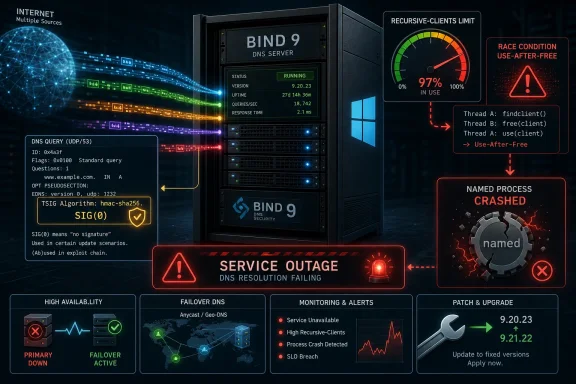 A DNS Bug Becomes Serious When It Needs Only Traffic and Timing
CVE-2026-5947 is, at its core, a timing bug. BIND begins validating an incoming DNS message signed with SIG(0), but if the server hits its recursive-clients limit during that work — the kind of pressure seen during a query flood — the message can be discarded while validation code still has a path to read it. That is the classic shape of a use-after-free: one part of the program believes an object is gone, while another part still behaves as if it exists.The resulting behavior is undefined, which is a polite engineering phrase for “the software contract has already been broken.” ISC’s advisory describes the likely operational result as a BIND process aborting with a segmentation violation or similar crash. It also says code execution is unlikely, which is important, but it should not lull administrators into treating this as harmless.
Availability bugs in DNS have a way of punching above their CVSS category. A web server outage may break a site; a DNS outage can make many sites, services, mail flows, VPN endpoints, identity systems, and management tools appear broken at once. That is why the supplied MSRC language about “total loss of availability” is the right frame for defenders, even if the bug itself lives in BIND rather than in a Windows component.
The uncomfortable part is that this bug does not require an attacker to own credentials, trick a user, or sit inside the network. It is remotely exploitable and rated CVSS 7.5, with the entire score driven by availability impact. In infrastructure terms, that is exactly the kind of issue that gets underestimated until a resolver falls over during a noisy afternoon.
SIG(0) Is Obscure, but the Failure Mode Is Not
SIG(0) is not a feature most administrators think about every week. It is a mechanism for signing individual DNS messages, distinct from the broader DNSSEC model most people associate with signed zones and chain-of-trust validation. That obscurity matters because obscure protocol corners tend to receive less operational scrutiny while still remaining reachable over the network.The vulnerability does not require SIG(0) to be part of a normal enterprise workflow. The dangerous path begins when BIND receives a DNS message signed with SIG(0), starts validation, and then collides with resource exhaustion behavior under load. The attack story is therefore less “someone abuses your intended SIG(0) deployment” and more “someone finds a reachable parser and validator path that behaves badly when the server is already under pressure.”
That is what makes the query-flood condition so relevant. Many denial-of-service bugs are clean, deterministic switches: send malformed input, service crashes. This one is more conditional. The attacker needs the right signed message behavior and the right load condition, but query floods are hardly exotic in DNS operations.
Race conditions are also maddening for defenders because they can look intermittent. A server may survive test traffic, survive a scan, and then die when traffic volume and timing line up. That can produce the worst kind of incident response: logs full of symptoms, few obvious root causes, and a service that appears unstable only when customers most need it.
The Affected Versions Put Modern BIND Deployments in the Blast Radius
The affected branches are not ancient abandonware. ISC says BIND 9.20.0 through 9.20.22 and BIND 9.21.0 through 9.21.21 are affected, along with BIND Supported Preview Edition 9.20.9-S1 through 9.20.22-S1. The fixed releases are 9.20.23 and 9.21.22.That matters because 9.20 is a current stable line, while 9.21 is a development branch used by operators who track newer features and testing paths. This is not a case where the answer is simply “stop running software from a decade ago.” Fully modern deployments can be exposed if they sit on the wrong point release.
ISC also lists BIND 9.18.28 through 9.18.49, and the corresponding 9.18 Supported Preview Edition builds, as not affected. Versions before 9.18.28 were not assessed, which is a small but important sentence. “Not assessed” is not the same thing as safe, and organizations running older untracked packages should resist the temptation to interpret silence as immunity.
The release timing adds another wrinkle. ISC published a cluster of BIND security fixes on May 20, including other CVEs affecting resolver and server behavior. That bundling is efficient for maintainers but demanding for operations teams, because the right question is not merely whether CVE-2026-5947 applies. It is whether the entire BIND estate is on a branch and package stream that can absorb the May security releases quickly.
Microsoft’s Presence in the Advisory Is a Supply-Chain Signal
The user-supplied source points to Microsoft’s Security Update Guide, which can make this look at first glance like a Windows DNS Server vulnerability. It is not, based on the public ISC details. The impacted program is BIND 9, the widely deployed open-source DNS implementation maintained by Internet Systems Consortium.Still, MSRC tracking is meaningful. Microsoft’s ecosystem is full of products, images, appliances, Linux workloads on Azure, containers, developer environments, and customer deployments where third-party infrastructure software matters. A vulnerability does not have to originate in Windows to become relevant to Windows administrators.
That distinction is especially important in mixed estates. Many organizations run Active Directory-integrated DNS on Windows Server for internal zones, while using BIND for public authoritative DNS, split-horizon views, lab networks, security tooling, DNS forwarding, or cloud-hosted resolver roles. In those environments, the Windows team may discover the impact only after authentication, name resolution, or application routing starts failing.
The lesson is broader than this one CVE. Security programs built around “Microsoft Patch Tuesday” alone are too narrow for modern infrastructure. DNS resolvers may be Linux packages, container images, managed appliances, or embedded services inside larger products. The operational dependency is Windows-facing even when the vulnerable daemon is not.
A Crash-Only Bug Can Still Be an Outage Multiplier
It is tempting to downgrade any advisory that says code execution is unlikely. In workstation security, that instinct often makes sense: a crash without compromise is annoying, but less catastrophic than arbitrary execution. In DNS infrastructure, a crash can be the compromise of availability.The most obvious scenario is a recursive resolver serving internal clients. If it aborts under flood conditions, clients may fail over to secondary resolvers if they are configured correctly and reachable. If they are not, users experience the outage as “the internet is down,” while application teams see timeouts, failed dependency calls, and authentication delays.
Authoritative DNS is just as sensitive. If a public authoritative server can be repeatedly crashed, the practical impact depends on redundancy, anycast, secondary providers, TTLs, and how aggressively the attacker can keep pressure on exposed nodes. A well-designed DNS architecture can absorb the loss of a single server; a thin one can turn a process abort into a customer-visible incident.
There is also the problem of cascading noise. DNS failures tend to trigger retries, fallback behavior, monitoring storms, and human troubleshooting across unrelated teams. A narrowly scoped BIND bug can therefore consume help desks, network engineers, identity administrators, and application owners at the same time.
The recursive-clients Limit Is a Guardrail, Not a Cure
The involvement of the recursive-clients limit is one of the more interesting details in the advisory. That limit exists to keep recursive service from being overwhelmed by too many simultaneous clients or queries. In this bug, the defensive pressure valve becomes part of the race window.That does not mean administrators should disable or wildly raise limits in panic. Resource limits are still essential, especially for resolvers exposed to untrusted traffic. The point is subtler: defensive controls are code paths too, and when they interact with parsing, validation, and cleanup logic under load, they can expose bugs that ordinary traffic never reaches.
For operators, this is a reminder that denial-of-service resilience is not just a firewall policy. It is capacity planning, sane resolver exposure, rate limiting, version hygiene, process supervision, redundancy, logging, and rehearsed failover. A patched BIND is the immediate answer, but architecture decides whether the next crash-class bug becomes an incident.
This is also where Windows administrators should look beyond their familiar consoles. If DHCP hands out a pair of internal recursive resolvers, are both healthy and independently patched? If branch offices use local DNS forwarders, are they running vendor firmware with embedded BIND? If Azure or hybrid environments use custom DNS appliances, who owns their update cadence?
The Real Risk Is the Server You Forgot Was Running BIND
BIND often lives in places that do not announce themselves loudly. It may be the authoritative service for a domain, the recursive resolver in a network segment, the DNS layer inside a security distribution, or the named process in a container that someone built years ago and stopped thinking about. Those forgotten instances are where high-severity availability bugs become durable risk.Package naming can make inventory harder. On Debian and Ubuntu systems, administrators may be looking for
bind9; on other platforms, package streams and vendor backports can obscure the upstream version number. A distribution package may contain a backported fix without reporting itself as 9.20.23, while a manually installed upstream build may show the vulnerable version plainly.That is why version checking should not stop at a single command copied into a change ticket. Teams need to map where DNS service is actually provided, whether the instance is authoritative, recursive, forwarding, or mixed, and whether it is reachable from untrusted networks. The highest-priority systems are the ones both exposed and essential.
Containers deserve special attention. A base image with BIND baked in will not patch itself because the host is current. If the organization deploys DNS functions through Kubernetes, lab automation, CI environments, or security sandboxes, the fix may require rebuilding images as well as updating running nodes.
Patching Is Simple; Proving Coverage Is the Hard Part
The remediation is straightforward on paper: upgrade affected BIND installations to the nearest fixed branch, specifically 9.20.23 or 9.21.22 where applicable. For supported distribution packages, the right action may be applying the vendor’s security update rather than replacing packages with ISC upstream binaries. Either way, the operational goal is the same: remove vulnerable SIG(0) validation behavior from exposed DNS service.The harder work is proving that every relevant resolver and authoritative server made the jump. DNS infrastructure is often decentralized because it predates current platform teams, mergers, cloud migrations, or zero-trust projects. There may be a public DNS provider, a registrar-hosted secondary, an on-prem pair of resolvers, a DMZ forwarder, a lab BIND server, and a cloud VNet DNS appliance all serving different slices of the same organization.
Testing should be conservative. Because the bug involves race timing and query flooding, defenders should not try to reproduce a crash in production to “validate” exposure. Version and package provenance are the safer indicators, backed by staging tests where appropriate.
Process supervision also matters. A service manager that restarts
named after a crash can reduce outage duration, but it does not fix the vulnerability. If an attacker can repeatedly trigger the condition, automatic restart becomes a metronome for instability rather than a mitigation.Do Not Mistake “Unlikely Code Execution” for “Low Priority”
The advisory’s note that code execution is unlikely is welcome. Use-after-free bugs can sometimes wander into darker territory, so clarity about expected impact helps prioritize response. But the CVSS vector already tells administrators what matters here: network reachable, low attack complexity, no privileges, no user interaction, high availability impact.For internet-facing DNS servers, that is enough. A remote unauthenticated denial-of-service condition against name resolution infrastructure should be patched on an accelerated schedule, especially when fixed versions are already available. The absence of known exploitation should influence incident assumptions, not justify delay.
There is a second reason to move quickly: public advisories compress attacker learning time. Once the vulnerable versions, trigger conditions, and fixed releases are public, defenders should assume that researchers and adversaries can diff code and reason about the crash path. Not every CVE becomes weaponized, but DNS denial-of-service bugs are attractive because the operational payoff can be large.
Enterprises should also be careful with compensating controls. Network filtering helps if a vulnerable BIND instance should not be reachable from the internet in the first place. Rate limiting and DDoS protection can reduce flood conditions. But neither is a substitute for applying the corrected BIND build when the vulnerable parser and validator path remains present.
The May 2026 BIND Drop Is a Warning About Maintenance Tempo
ISC had already warned operators to expect more frequent BIND security updates during 2026, and CVE-2026-5947 arrived as part of a broader May batch. That matters for planning. DNS software is not a “set it and forget it” layer, even though it often gets treated like one because the protocol is old and the service is foundational.The maintenance burden is growing because DNS servers sit at the intersection of legacy protocol complexity, modern cryptographic validation, adversarial traffic, and high uptime expectations. Features like DNSSEC, SIG(0), catalog zones, dynamic updates, and resolver policy controls all add code paths. Each path is defensible on its own; together, they expand the testing matrix.
For IT pros, the practical response is to make DNS patching boring. That means scheduled maintenance windows, secondary capacity, documented rollback paths, configuration validation before reloads, and monitoring that distinguishes a clean restart from an unexpected abort. The organizations that struggle most with CVEs like this are not necessarily the ones with the most DNS servers, but the ones with the least ownership clarity.
WindowsForum readers know this pattern from Windows servicing. The hardest part of patch management is rarely clicking “install”; it is knowing which systems exist, what they run, who can approve downtime, and what breaks if the update behaves badly. BIND is no different, except the blast radius of a mistake can be hidden behind every hostname lookup.
The Windows Admin’s Job Is to Trace the Dependency, Not the Brand
A Windows-first environment can still be exposed through BIND in several common ways. Public authoritative DNS may be outsourced to a provider that runs BIND. Internal Linux resolvers may forward requests for Windows clients. Security appliances may embed BIND. Development teams may run BIND containers for testing split DNS or service discovery. Cloud networks may point Windows workloads at custom DNS forwarders maintained by a platform team.That is why the right incident question is not “Do we run BIND on Windows?” It is “Do any of our Windows services depend on a vulnerable BIND instance?” Active Directory, Exchange, SQL Server, RDP gateways, certificate enrollment, endpoint management, and line-of-business applications all assume DNS is boringly reliable.
The answer may cross organizational lines. Network teams own recursive resolvers, Linux teams own packages, identity teams own AD DNS zones, cloud teams own private DNS, and security teams own vulnerability dashboards. CVE-2026-5947 is precisely the kind of flaw that falls between those teams unless someone explicitly follows the dependency chain.
A useful response starts with inventory and ends with accountability. Identify BIND instances, determine branch and patch status, classify exposure, confirm redundancy, and record the owner. If a provider runs the service, ask for confirmation that affected versions have been upgraded or that the provider’s package stream includes the fix.
The Concrete Work Starts With Version, Exposure, and Failover
The good news is that administrators do not need to solve DNS security in the abstract to respond well to this CVE. The immediate work is specific, measurable, and bounded. Find affected BIND versions, patch them, and make sure a crash of one node does not become a failure of name resolution.The most important details are the ones likely to survive the news cycle:
- BIND 9.20.0 through 9.20.22 and 9.21.0 through 9.21.21 are affected by CVE-2026-5947.
- BIND Supported Preview Edition 9.20.9-S1 through 9.20.22-S1 is also affected.
- ISC lists BIND 9.18.28 through 9.18.49 as not affected, while earlier 9.18 builds were not assessed.
- The fixed upstream releases are BIND 9.20.23 and BIND 9.21.22.
- The practical impact is denial of service through a potential BIND process crash, not a confirmed path to remote code execution.
- Windows environments should treat the issue as a dependency risk wherever BIND supports internal resolution, public authoritative DNS, forwarding, appliances, containers, or cloud DNS paths.
The bigger story in CVE-2026-5947 is not that SIG(0) validation has a race condition, but that the internet’s most essential services still fail in deeply ordinary ways: memory lifetime, load pressure, edge-case protocol handling, and uneven patch coverage. Microsoft’s advisory trail brings the issue into the Windows admin’s field of view, but the fix requires thinking like an infrastructure operator rather than a product loyalist. DNS will keep accumulating complexity because networks keep asking it to do more; the organizations that fare best will be the ones that patch quickly, design for failure, and know exactly which quiet servers keep everything else reachable.
References
- Primary source: MSRC
Published: 2026-05-23T01:01:45-07:00
Security Update Guide - Microsoft Security Response Center
 msrc.microsoft.com
- Related coverage: dbugs.ptsecurity.com
CVE-2026-5947 — Remote Code Execution in Isc+3 Bind 9+3 | dbugs
Details on CVE-2026-5947: Remote Code Execution in Isc+3 Bind 9+3. Includes CVSS score, affected versions, and references.dbugs.ptsecurity.com - Official source: microsoft.com
MSRC - Microsoft Security Response Center
The Microsoft Security Response Center is part of the defender community and on the front line of security response evolution. For over twenty years, we have been engaged with security researchers working to protect customers and the broader ecosystem.www.microsoft.com
- Related coverage: sentinelone.com
CVE-2026-3591: BIND 9 Privilege Escalation Vulnerability
CVE-2026-3591 is a privilege escalation vulnerability in BIND 9. Learn about its impact, affected versions, and mitigation methods for DNS servers.www.sentinelone.com
