

CVE-2026-5946 is a high-severity denial-of-service vulnerability disclosed on May 20, 2026, in ISC BIND 9’s
The headline problem in CVE-2026-5946 is not that an attacker gets a shell, steals a credential, or pivots into Active Directory. The issue is simpler and in some environments more immediately operational: an unauthenticated remote attacker can send crafted DNS traffic to an affected BIND instance and cause
That puts the vulnerability squarely in the category many organizations still underrate. Denial of service often receives less urgency than privilege escalation or data theft because it does not produce the same cinematic compromise narrative. But infrastructure teams know that a down DNS resolver can become the root cause for failures that appear everywhere except DNS.
The affected software is BIND 9, the long-running DNS implementation used across service providers, enterprises, appliances, labs, and hybrid environments. Even Microsoft-centric networks may depend on it indirectly through upstream resolvers, network appliances, Linux-based edge services, containerized infrastructure, or outsourced authoritative DNS platforms.
The severity rating reflects that reality. The CVSS vector describes a network-accessible, low-complexity, no-authentication attack with no user interaction required and a high availability impact. In plain English: if the vulnerable path is reachable, the attacker does not need much help.
The advisory describes invalid handling of
The vulnerable paths are more varied than a casual reading might suggest. Crafted messages may hit recursion, dynamic updates, zone change notifications, or processing for Internet-specific record types embedded in non-Internet-class data. In several cases, the result is an assertion failure: the program reaches a state its developers believed should not happen, and it exits rather than continuing in an inconsistent condition.
Assertions are useful engineering tools. They catch impossible states before they mutate into corruption, silent data damage, or worse. But when externally supplied packets can reliably trip them in a network daemon, the assertion becomes an attacker’s stop button.
The fix is not a single universal build but a set of patched releases aligned with current branches: 9.18.49, 9.20.23, and 9.21.22, with preview-edition fixes for supported customers. That distinction matters because many production DNS deployments lag far behind the latest BIND branch for reasons that are understandable but increasingly risky.
DNS servers are often treated as “stable infrastructure,” which in practice can mean “forgotten unless they fail.” Appliances may bundle BIND under a vendor firmware layer. Linux distributions may backport fixes under version numbers that do not obviously match upstream ISC releases. Custom builds may live in places no vulnerability scanner sees cleanly.
For administrators, the work is not simply to compare one version string. It is to identify every place BIND is running, determine whether the distributor has shipped the fix, and confirm that the running daemon has actually been restarted into the patched code. In the DNS world, a package update that leaves an old process in memory is a very expensive placebo.
Modern Windows estates are hybrid by default. Active Directory may rely on Microsoft DNS internally while cloud connectors, VPN platforms, branch routers, Kubernetes clusters, CI systems, security appliances, and secondary authoritative services use BIND somewhere else. A single failing resolver can break the Windows experience without running on Windows.
The risk also extends through dependencies. If a company’s public domain is served by a provider running affected BIND infrastructure, the local Windows team will feel the outage as failed application access, certificate validation problems, mail-routing delays, and identity-provider weirdness. The root cause may sit outside the Windows admin console, but the tickets will still land in the Windows queue.
That is why CVE-2026-5946 belongs on the radar of WindowsForum readers. The platform boundary is less important than the name-resolution dependency. Windows is excellent at surfacing DNS trouble as something else.
The attacker model is straightforward. If the service accepts the relevant traffic from the attacker’s network position, a crafted DNS message can crash the daemon. Depending on watchdogs, service managers, clustering, and rate of attack, the outage may be brief, repeated, or sustained.
A single crash is a nuisance. A crash loop against an exposed resolver or authoritative server is a disruption. A targeted attack during business hours, an incident response effort, a migration, or a patch window can become leverage out of proportion to the elegance of the bug.
This is also where security scoring can mislead non-specialists. A 7.5 CVSS score can sound like “important but not emergency.” For a public recursive resolver, a critical authoritative DNS role, or a brittle single-node deployment, the environmental score may feel much higher.
Most organizations do not intentionally configure non-
Dynamic update exposure deserves special scrutiny. Secure dynamic update has legitimate uses inside controlled environments, especially around Windows-adjacent name registration patterns and automated infrastructure. Exposing update-capable DNS services broadly, however, has long been a dangerous convenience masquerading as flexibility.
The deeper mitigation is architectural. Recursors should be limited to clients that need them. Authoritative servers should be separated from recursive service. Management and update paths should be fenced. Monitoring should notice not only whether port 53 responds, but whether the right daemon version is alive and whether restart frequency has changed.
That messiness is where denial-of-service vulnerabilities thrive. The attacker does not need to understand the entire environment if one fragile dependency is reachable. The defender, unfortunately, does need to understand enough of the environment to know whether the dependency exists.
Inventory remains the least glamorous control and the one most likely to determine the outcome. If a team can answer where BIND runs, who owns it, what version it is on, which clients use it, and what happens when it dies, CVE-2026-5946 is a patch-management event. If the team cannot answer those questions, it is a discovery exercise under pressure.
For Windows administrators, the quickest practical check may not start with BIND at all. It may start with DNS client configuration, DHCP scopes, resolver forwarding chains, firewall rules, and monitoring data. Follow the queries, and the hidden BIND systems usually reveal themselves.
If a managed provider runs the affected code, the customer may not patch anything directly. The right action is to confirm provider remediation and understand whether any customer-facing controls or incident notices apply. If self-managed BIND runs in cloud virtual machines or containers, the responsibility remains with the tenant.
Containers add another wrinkle. A vulnerable BIND image may be patched upstream while an old image remains pinned in a deployment manifest. A rolling restart may update one replica set while a forgotten namespace keeps answering traffic. The DNS server is still DNS, but the maintenance model has moved from package management into supply-chain hygiene.
This is where infrastructure-as-code can either help or hurt. A well-maintained manifest makes it easy to find and update BIND. A copied example from three years ago can preserve a vulnerable build with machine-like loyalty.
A single resolver may serve a branch office. A pair of servers may exist, but both run the same vulnerable version and sit behind the same reachable path. A service manager may restart
High availability changes the economics of this vulnerability. Anycast, redundant resolvers, split authoritative infrastructure, and strict access controls do not make the bug irrelevant, but they make exploitation less decisive. The difference between a crash and an outage is often design.
The Windows lesson is familiar from domain controller planning. Redundancy is not achieved by drawing two boxes in a diagram if both boxes share the same failure mode. CVE-2026-5946 is a reminder to test whether DNS failover works under active failure, not merely whether it exists on paper.
There is also a communications challenge. “Invalid handling of CLASS != IN” sounds like a protocol trivia item. “A remote packet can crash a DNS server” is the version that gets change windows approved.
The patching priority should follow exposure and role. Public authoritative servers, public or semi-public recursive resolvers, update-enabled DNS services, and infrastructure shared across many applications deserve early attention. Internal-only systems still matter, especially in flat networks where a compromised endpoint could become the attacker.
Security teams should also resist the temptation to equate “no known active exploits” with “low urgency.” Exploit development for denial-of-service flaws can be quick once enough detail is public. More importantly, defenders cannot assume that every actor wants stealth; sometimes making a service fall over is the goal.
For Windows-heavy environments, DNS forwarding chains deserve special attention. A domain controller may forward to a BIND resolver. A remote office may use a firewall appliance that embeds BIND. A developer platform may run its own resolver for service discovery. The vulnerable system may be upstream from the Windows machines rather than installed on them.
Logging and monitoring should be adjusted for crash patterns while the patch campaign is underway. Unexpected
This is also a good moment to review whether dynamic update is exposed more widely than intended. The right audience for DNS update capability is narrow. If the Internet can reach it, the configuration deserves immediate skepticism.
CVE-2026-5946 is not evidence that BIND is uniquely careless. It is evidence that mature network software carries a long tail of behaviors, compatibility requirements, and assumptions. The attack surface is not only the feature an organization uses every day; it is also the feature the daemon must reject safely at line rate.
That is why “we do not use that” is a dangerous phrase in vulnerability response. You may not use non-Internet DNS classes. Your server still has to survive seeing them.
The healthier framing is resilience over purity. Assume malformed, obsolete, rare, or hostile protocol inputs will arrive. Then ask whether the service rejects them, logs them, rate-limits them, isolates them, or dies.
named DNS server, where specially crafted non-Internet-class DNS messages can trigger assertion failures and crash affected authoritative or recursive DNS services. The bug is not glamorous in the way remote-code-execution flaws are glamorous, but DNS outages are rarely polite. A Windows shop may not think of BIND as part of its Microsoft estate until a resolver falls over and authentication, patching, mail flow, SaaS access, and monitoring all begin to look mysteriously broken. This is the kind of vulnerability that reminds administrators that availability is not a second-tier security property; it is the floor under everything else.
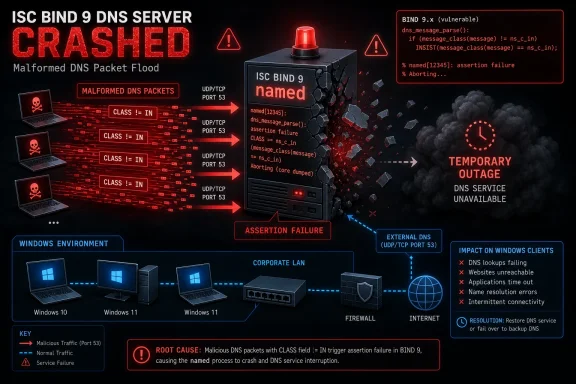 A DNS Crash Bug Is Still a Security Story
The headline problem in CVE-2026-5946 is not that an attacker gets a shell, steals a credential, or pivots into Active Directory. The issue is simpler and in some environments more immediately operational: an unauthenticated remote attacker can send crafted DNS traffic to an affected BIND instance and cause named to terminate unexpectedly.That puts the vulnerability squarely in the category many organizations still underrate. Denial of service often receives less urgency than privilege escalation or data theft because it does not produce the same cinematic compromise narrative. But infrastructure teams know that a down DNS resolver can become the root cause for failures that appear everywhere except DNS.
The affected software is BIND 9, the long-running DNS implementation used across service providers, enterprises, appliances, labs, and hybrid environments. Even Microsoft-centric networks may depend on it indirectly through upstream resolvers, network appliances, Linux-based edge services, containerized infrastructure, or outsourced authoritative DNS platforms.
The severity rating reflects that reality. The CVSS vector describes a network-accessible, low-complexity, no-authentication attack with no user interaction required and a high availability impact. In plain English: if the vulnerable path is reachable, the attacker does not need much help.
The Strange Little Field That Still Matters
The technical center of the bug is DNS message handling when the DNS class is notIN, the familiar Internet class used by ordinary production DNS. DNS classes are an old part of the protocol’s design, and most administrators spend entire careers without thinking about anything beyond IN. That obscurity is part of the lesson.The advisory describes invalid handling of
CLASS != IN, including classes such as CHAOS and HESIOD, as well as meta-classes like ANY and NONE in the question section. These are not exotic exploit payloads in the Hollywood sense. They are protocol features and edge cases that software still has to parse correctly.The vulnerable paths are more varied than a casual reading might suggest. Crafted messages may hit recursion, dynamic updates, zone change notifications, or processing for Internet-specific record types embedded in non-Internet-class data. In several cases, the result is an assertion failure: the program reaches a state its developers believed should not happen, and it exits rather than continuing in an inconsistent condition.
Assertions are useful engineering tools. They catch impossible states before they mutate into corruption, silent data damage, or worse. But when externally supplied packets can reliably trip them in a network daemon, the assertion becomes an attacker’s stop button.
The Patch Window Is Narrower Than the Version List Looks
The affected version range is broad enough to get attention. ISC lists BIND 9.11.0 through 9.16.50, 9.18.0 through 9.18.48, 9.20.0 through 9.20.22, and 9.21.0 through 9.21.21 as affected. Supported Preview Edition builds in the corresponding trains are also affected.The fix is not a single universal build but a set of patched releases aligned with current branches: 9.18.49, 9.20.23, and 9.21.22, with preview-edition fixes for supported customers. That distinction matters because many production DNS deployments lag far behind the latest BIND branch for reasons that are understandable but increasingly risky.
DNS servers are often treated as “stable infrastructure,” which in practice can mean “forgotten unless they fail.” Appliances may bundle BIND under a vendor firmware layer. Linux distributions may backport fixes under version numbers that do not obviously match upstream ISC releases. Custom builds may live in places no vulnerability scanner sees cleanly.
For administrators, the work is not simply to compare one version string. It is to identify every place BIND is running, determine whether the distributor has shipped the fix, and confirm that the running daemon has actually been restarted into the patched code. In the DNS world, a package update that leaves an old process in memory is a very expensive placebo.
Microsoft Shops Should Not File This Under “Not Windows”
The user-facing source for many Windows administrators may be Microsoft’s Security Update Guide, but the vulnerable component here is BIND rather than Windows DNS Server. That makes the vulnerability easy to misclassify in a Microsoft-first environment. It should not be ignored merely because the fix is not a Windows cumulative update.Modern Windows estates are hybrid by default. Active Directory may rely on Microsoft DNS internally while cloud connectors, VPN platforms, branch routers, Kubernetes clusters, CI systems, security appliances, and secondary authoritative services use BIND somewhere else. A single failing resolver can break the Windows experience without running on Windows.
The risk also extends through dependencies. If a company’s public domain is served by a provider running affected BIND infrastructure, the local Windows team will feel the outage as failed application access, certificate validation problems, mail-routing delays, and identity-provider weirdness. The root cause may sit outside the Windows admin console, but the tickets will still land in the Windows queue.
That is why CVE-2026-5946 belongs on the radar of WindowsForum readers. The platform boundary is less important than the name-resolution dependency. Windows is excellent at surfacing DNS trouble as something else.
The Exploitability Is Ordinary, Which Is the Point
There is no public indication from ISC that active exploitation was known at disclosure. That is useful context, but it should not lull operators into slow-walking the update. A denial-of-service bug in a packet-facing DNS daemon does not need a complex kill chain to become operationally meaningful.The attacker model is straightforward. If the service accepts the relevant traffic from the attacker’s network position, a crafted DNS message can crash the daemon. Depending on watchdogs, service managers, clustering, and rate of attack, the outage may be brief, repeated, or sustained.
A single crash is a nuisance. A crash loop against an exposed resolver or authoritative server is a disruption. A targeted attack during business hours, an incident response effort, a migration, or a patch window can become leverage out of proportion to the elegance of the bug.
This is also where security scoring can mislead non-specialists. A 7.5 CVSS score can sound like “important but not emergency.” For a public recursive resolver, a critical authoritative DNS role, or a brittle single-node deployment, the environmental score may feel much higher.
Workarounds Help, but Architecture Decides the Blast Radius
ISC’s workaround guidance is conservative: do not configure zones outside the Internet class, and do not expose DNS Dynamic Update to the general Internet. Both are sensible, but neither should be read as a complete substitute for patching.Most organizations do not intentionally configure non-
IN production zones. That reduces exposure for some code paths, but the advisory’s affected paths are broad enough that operators should not treat “we only use ordinary DNS” as a clean bill of health. The issue is about how the daemon handles unusual class values when they arrive, not merely whether the business has a fashionable use for them.Dynamic update exposure deserves special scrutiny. Secure dynamic update has legitimate uses inside controlled environments, especially around Windows-adjacent name registration patterns and automated infrastructure. Exposing update-capable DNS services broadly, however, has long been a dangerous convenience masquerading as flexibility.
The deeper mitigation is architectural. Recursors should be limited to clients that need them. Authoritative servers should be separated from recursive service. Management and update paths should be fenced. Monitoring should notice not only whether port 53 responds, but whether the right daemon version is alive and whether restart frequency has changed.
Availability Bugs Punish the Untidy Network
CVE-2026-5946 is a tidy advisory about an untidy reality. Many networks do not have one DNS design; they have years of accreted decisions. A Windows domain controller here, a BIND resolver there, a cloud private DNS zone, a split-horizon arrangement from a merger, a security appliance intercepting queries, and a forgotten lab server still answering requests from a subnet no one owns.That messiness is where denial-of-service vulnerabilities thrive. The attacker does not need to understand the entire environment if one fragile dependency is reachable. The defender, unfortunately, does need to understand enough of the environment to know whether the dependency exists.
Inventory remains the least glamorous control and the one most likely to determine the outcome. If a team can answer where BIND runs, who owns it, what version it is on, which clients use it, and what happens when it dies, CVE-2026-5946 is a patch-management event. If the team cannot answer those questions, it is a discovery exercise under pressure.
For Windows administrators, the quickest practical check may not start with BIND at all. It may start with DNS client configuration, DHCP scopes, resolver forwarding chains, firewall rules, and monitoring data. Follow the queries, and the hidden BIND systems usually reveal themselves.
The Cloud Does Not Abolish DNS Maintenance
One reason vulnerabilities like this retain their bite is that DNS has become simultaneously more managed and more opaque. Many organizations outsource authoritative DNS or rely on cloud DNS services, but they also run self-managed resolvers for private zones, filtering, telemetry, and conditional forwarding. The result is a layered dependency chain where responsibility is divided but failure is shared.If a managed provider runs the affected code, the customer may not patch anything directly. The right action is to confirm provider remediation and understand whether any customer-facing controls or incident notices apply. If self-managed BIND runs in cloud virtual machines or containers, the responsibility remains with the tenant.
Containers add another wrinkle. A vulnerable BIND image may be patched upstream while an old image remains pinned in a deployment manifest. A rolling restart may update one replica set while a forgotten namespace keeps answering traffic. The DNS server is still DNS, but the maintenance model has moved from package management into supply-chain hygiene.
This is where infrastructure-as-code can either help or hurt. A well-maintained manifest makes it easy to find and update BIND. A copied example from three years ago can preserve a vulnerable build with machine-like loyalty.
The Quiet Risk Is the Single Point of Failure
The most serious business impact from CVE-2026-5946 will not come from every affected organization. It will come from organizations that made DNS more important than they made it resilient. That pattern is common.A single resolver may serve a branch office. A pair of servers may exist, but both run the same vulnerable version and sit behind the same reachable path. A service manager may restart
named, but the attacker may simply crash it again. A monitoring system may alert, but only after users have already discovered that “the network is down.”High availability changes the economics of this vulnerability. Anycast, redundant resolvers, split authoritative infrastructure, and strict access controls do not make the bug irrelevant, but they make exploitation less decisive. The difference between a crash and an outage is often design.
The Windows lesson is familiar from domain controller planning. Redundancy is not achieved by drawing two boxes in a diagram if both boxes share the same failure mode. CVE-2026-5946 is a reminder to test whether DNS failover works under active failure, not merely whether it exists on paper.
Security Teams Need to Translate This Into Operations
For security teams, the useful response is not to broadcast another CVE number and hope infrastructure owners decode it. The useful response is to turn the advisory into operational questions. Which exposed DNS services run BIND? Which branches or applications depend on them? Which update channels deliver the patched build? Which restart procedures are safe during business hours?There is also a communications challenge. “Invalid handling of CLASS != IN” sounds like a protocol trivia item. “A remote packet can crash a DNS server” is the version that gets change windows approved.
The patching priority should follow exposure and role. Public authoritative servers, public or semi-public recursive resolvers, update-enabled DNS services, and infrastructure shared across many applications deserve early attention. Internal-only systems still matter, especially in flat networks where a compromised endpoint could become the attacker.
Security teams should also resist the temptation to equate “no known active exploits” with “low urgency.” Exploit development for denial-of-service flaws can be quick once enough detail is public. More importantly, defenders cannot assume that every actor wants stealth; sometimes making a service fall over is the goal.
The Admin’s Map for the Next Few Days
The practical response to CVE-2026-5946 should be boring, deliberate, and fast enough to beat opportunistic testing. Start by identifying BIND rather than assuming platform ownership will reveal it. Then patch to the appropriate fixed release or vendor-backported package, restart the daemon, and verify the running version.For Windows-heavy environments, DNS forwarding chains deserve special attention. A domain controller may forward to a BIND resolver. A remote office may use a firewall appliance that embeds BIND. A developer platform may run its own resolver for service discovery. The vulnerable system may be upstream from the Windows machines rather than installed on them.
Logging and monitoring should be adjusted for crash patterns while the patch campaign is underway. Unexpected
named exits, repeated service restarts, sudden query failures, and increases in unusual DNS class traffic are worth investigating. Even if no exploitation is confirmed, those signals can reveal brittle dependencies.This is also a good moment to review whether dynamic update is exposed more widely than intended. The right audience for DNS update capability is narrow. If the Internet can reach it, the configuration deserves immediate skepticism.
The CVE Teaches an Old Protocol Lesson Again
DNS survives because it is old, flexible, and everywhere. Those same traits make it difficult to secure perfectly. Features designed for a broader protocol universe remain in parsers and edge paths long after most production administrators stop thinking about them.CVE-2026-5946 is not evidence that BIND is uniquely careless. It is evidence that mature network software carries a long tail of behaviors, compatibility requirements, and assumptions. The attack surface is not only the feature an organization uses every day; it is also the feature the daemon must reject safely at line rate.
That is why “we do not use that” is a dangerous phrase in vulnerability response. You may not use non-Internet DNS classes. Your server still has to survive seeing them.
The healthier framing is resilience over purity. Assume malformed, obsolete, rare, or hostile protocol inputs will arrive. Then ask whether the service rejects them, logs them, rate-limits them, isolates them, or dies.
The Concrete Work Hiding Behind the Acronym
CVE-2026-5946 is easy to summarize and just as easy to mishandle. The following are the operational facts that should drive the next change ticket, not merely decorate a vulnerability report.- CVE-2026-5946 affects multiple BIND 9 release trains and can let a remote unauthenticated attacker crash
namedwith specially crafted DNS messages. - The fixed upstream releases are BIND 9.18.49, 9.20.23, and 9.21.22, with corresponding Supported Preview Edition fixes for eligible customers.
- Both authoritative servers and recursive resolvers are affected, so teams should not restrict their search to only one DNS role.
- Windows environments may still be exposed through BIND-based resolvers, appliances, Linux servers, containers, cloud workloads, or external DNS providers.
- Workarounds around non-Internet-class zones and exposed Dynamic Update reduce risk in some scenarios, but they are not a substitute for deploying patched code.
- The most urgent systems are those reachable by untrusted clients, shared by many applications, or sitting in DNS forwarding paths that Windows services silently depend on.
References
- Primary source: MSRC
Published: 2026-05-23T01:01:39-07:00
Security Update Guide - Microsoft Security Response Center
 msrc.microsoft.com
- Official source: microsoft.com
When prompts become shells: RCE vulnerabilities in AI agent frameworks | Microsoft Security Blog
New research exposes how prompt injection in AI agent frameworks can lead to remote code execution. Learn how these vulnerabilities work, what’s impacted, and how to secure your agents.www.microsoft.com - Official source: learn.microsoft.com
Security Advisories and Bulletins | Microsoft Learn
learn.microsoft.com - Related coverage: datacomm.com
