

On May 20, 2026, ISC disclosed CVE-2026-5950, a medium-severity flaw in the BIND 9 recursive resolver that can send affected servers into an unbounded resend loop and drain resources under attacker-controlled query conditions. Microsoft’s Security Response Center is tracking the same issue because BIND remains part of many Windows-adjacent enterprise DNS architectures, even when the vulnerable component is not Windows itself. The short version is simple: this is not a catastrophic internet-breaking bug, but it is exactly the sort of “medium” DNS vulnerability that can become operationally expensive when ignored. For administrators, the risk is less Hollywood-style total outage than the slow, ugly failure mode of degraded name resolution, intermittent service availability, and help desks chasing ghosts.
CVE-2026-5950 lives in the resolver side of BIND 9, not in the authoritative DNS service path that publishes records for a domain. That distinction matters because it tells administrators where to look first: recursive resolvers that answer client questions and chase DNS answers across the internet are the primary concern. Authoritative-only deployments are believed to be unaffected, though ISC has urged operators to understand whether their “authoritative” servers are also making recursive queries in practice.
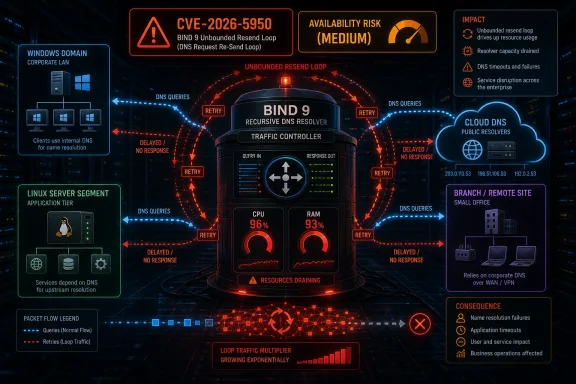
The vulnerability is described as an unbounded resend loop in the resolver state machine during bad-server handling. In plain English, BIND can get stuck retrying in a way that consumes resources rather than cleanly giving up or moving on. An unauthenticated remote attacker can trigger the condition by sending queries that produce the right retry behavior.
That is why the CVSS score lands at 5.3 rather than 9.8. The bug does not leak data, does not allow code execution, and does not let an attacker rewrite DNS answers. It attacks availability, and even there the official impact is “low” in the CVSS vector. But DNS availability is one of those infrastructure dependencies where “low” can feel very high to anyone whose users suddenly cannot resolve the names behind mail, VPN, package mirrors, identity endpoints, or SaaS portals.
The Microsoft wording captures the practical nuance: performance is reduced or resources become intermittently unavailable, but legitimate users are not necessarily locked out in a complete and permanent denial of service. That is a narrow technical statement, not a promise of a pleasant incident. A resolver that works most of the time can still be worse than one that fails decisively, because partial failure produces retries, latency, inconsistent client behavior, and long diagnostic loops.
That is why resolver vulnerabilities have a peculiar shape. They often do not need to compromise the server in the traditional sense. It is enough to make the resolver spend too much time doing legitimate-looking work, or to push it into a pathological retry path that starves other clients.
CVE-2026-5950 fits that pattern. The attacker does not need credentials, local access, or user interaction. The attack vector is the network, and the affected component is designed to receive network queries. The vulnerability is not about a malformed packet instantly crashing
That makes exposure highly dependent on deployment. An open recursive resolver on the public internet is a much more attractive target than a resolver restricted to a corporate LAN. A resolver sitting behind rate limits, access controls, and upstream monitoring has a different risk profile from one serving large anonymous populations. But the presence of “medium” in the advisory should not trick anyone into treating this as a purely theoretical weakness.
In infrastructure, availability bugs are rarely isolated. A resolver under load can cause client retries. Client retries can increase traffic. Monitoring systems can misclassify failures as application outages. Application owners can restart healthy services because every dependency appears to be timing out. The DNS bug may be medium; the operational blast radius can still be very real.
That distinction matters for WindowsForum readers. Many Windows-heavy environments still rely on BIND somewhere: perimeter resolvers, split-horizon DNS, Linux-based network appliances, registrar-side infrastructure, lab networks, cloud images, containers, or MSP-managed services. A Windows domain may be backed by Microsoft DNS internally while still forwarding traffic to BIND resolvers upstream. Conversely, a Linux resolver issue can surface to Windows users as Group Policy delays, failed sign-ins, browser errors, or intermittent application breakage.
The MSRC language also helps frame severity for risk managers. It says the attacker cannot completely deny service to legitimate users and that the impacted resources remain partially available all the time or fully available some of the time. That is a useful boundary against panic, but it should not be read as an argument for postponement.
The more accurate reading is this: CVE-2026-5950 is an availability degradation bug with known fixed releases, no known workaround, and remote unauthenticated exploitability. In enterprise terms, that combination usually means “patch in the next controlled maintenance window,” not “wait until the next quarterly refresh.”
Those ranges tell a story. This is not some ancient unmaintained corner of the DNS world finally being dragged into daylight. The affected builds sit in current, actively used release trains. Shops that have been responsibly applying BIND updates over the last year may still be exposed if they have not yet moved to the new patched releases.
That is one reason DNS patching can be awkward. Many organizations treat resolvers as boring infrastructure, and boring infrastructure often gets updated only when something breaks. DNS also tends to be distributed. A company may have a pair of central resolvers, a few branch-office instances, cloud-forwarding appliances, Kubernetes CoreDNS layers, and third-party-managed recursive services that nobody thinks about until an outage bridge forms.
The first operational task is inventory. Administrators need to know whether they run BIND at all, which versions are deployed, whether those instances perform recursion, and whether they are exposed to untrusted clients. That sounds basic, but DNS inventories are frequently messy because resolvers are often installed as dependencies, inherited through appliances, or maintained by different teams.
The second task is to map trust boundaries. A vulnerable resolver limited to a tightly controlled management network is still worth updating, but it is not the same emergency as an internet-reachable open resolver. A recursive service reachable by guest Wi-Fi, customer networks, student networks, hosting tenants, or partner VPNs deserves faster attention because the attacker population is broader and noisier.
Exposure reduction still matters. Restricting recursion to known clients, blocking open resolver behavior, applying network-level rate controls, and monitoring abnormal query patterns are all sensible defensive moves. But those are compensating controls, not fixes. They reduce who can trigger the bug or how hard they can hit it; they do not repair the resolver state machine.
This is where security teams and infrastructure teams often talk past each other. Security sees a remote unauthenticated vulnerability and asks why the patch is not already deployed. Infrastructure sees “medium,” no public exploit, and a system that has to remain available, then asks why DNS should be disturbed in the middle of a business day. Both instincts are understandable.
The tie-breaker should be reliability. DNS resolvers are usually deployed redundantly, and BIND maintenance releases are a routine part of operating the software. If the environment cannot tolerate rolling resolver updates, that is itself a resilience problem worth fixing. A medium-severity DNS flaw with no workaround is a useful excuse to test whether the resolver tier can actually survive normal maintenance.
Enterprises should stage the patched release, update one resolver at a time, validate recursion, watch latency and failure rates, and then move through the fleet. This is the kind of patch that rewards discipline rather than drama. The worst response is to leave it in a backlog because it is not a critical CVE, then rediscover it weeks later during an unexplained DNS slowdown.
The advisory does not provide exploit instructions, and responsible vendors are careful not to turn a fix notice into a playbook. But patch diffs, release notes, and behavioral testing can narrow the search space. The more widely deployed a vulnerable version is, the more likely someone will experiment.
There is also a difference between targeted exploitation and background internet noise. A vulnerability like this could be useful to someone trying to degrade a specific organization’s resolver infrastructure, but it could also become another tool in the kit for nuisance attacks against exposed DNS services. Medium availability bugs are often attractive because they can be cheap to trigger and difficult to attribute from symptoms alone.
For defenders, the practical question is not “Is there an exploit in the wild today?” It is “Can we tolerate being the last vulnerable resolver in a pool of otherwise patched systems?” Once fixed packages are available, the risk calculus changes. Every day after disclosure gives attackers more time to understand the bug while giving defenders fewer excuses for delay.
That does not mean every BIND instance must be emergency-patched at 2 a.m. It means administrators should avoid the false comfort of silence. No known active exploit is a window of opportunity for orderly maintenance, not a certificate of safety.
For Active Directory environments, internal Microsoft DNS servers often handle zones such as the AD namespace and forward everything else. If those forwarders include vulnerable BIND resolvers, Windows users can experience the impact even though every domain controller is fully patched. The failure will look like intermittent external resolution problems, slow application launches, package download failures, or cloud service connectivity issues.
Hybrid cloud complicates this further. DNS forwarding rules may cross Azure, AWS, on-premises networks, and private endpoints. A vulnerable resolver in one path can produce selective failures that depend on client location, suffix, forwarding rule, or cache state. That kind of topology turns simple version management into detective work.
Administrators should therefore treat CVE-2026-5950 as a DNS architecture review prompt. Identify resolvers, classify them as recursive or authoritative, check BIND versions, and confirm which clients can reach them. The exercise is valuable even if the environment turns out not to be affected, because DNS sprawl is one of the most persistent sources of operational fragility.
The same applies to MSPs and hosting providers. Customers may not know or care what resolver software is behind a managed service, but they will notice intermittent failures. Providers running BIND should be ahead of customer questions with patched infrastructure and clear status messaging.
That is precisely why CVE-2026-5950 deserves attention. DNS is a shared dependency, and shared dependencies create shared confusion during incidents. Application teams blame the network. Network teams blame the resolver. Resolver teams point to upstream behavior. Users report that “the internet is slow,” which is both technically useless and emotionally accurate.
The unbounded-loop detail is also a reminder of how much modern infrastructure depends on state machines behaving under stress. Resolvers do not merely receive a question and return an answer. They track retries, referrals, lame servers, timeouts, transport choices, caching, validation, and failure states. Bugs in that choreography can turn edge cases into resource drains.
The word “unbounded” is doing a lot of work here. Well-designed retry logic must have limits because the network is full of failure. Servers go lame, packets vanish, delegations misbehave, and upstreams time out. A resolver that responds to bad conditions by doing too much work can become an amplifier of failure inside its own process.
That is the deeper lesson for administrators: resilience is not just redundancy. Two vulnerable resolvers behind a load balancer are not a resilient DNS tier if the same query pattern can push both into exhaustion. Real resilience includes patch velocity, observability, traffic controls, and clear ownership.
The less straightforward part is distribution packaging. Many environments do not install BIND directly from ISC tarballs. They consume it through Linux distributions, containers, appliances, or vendor-managed platforms. In those cases, the relevant version string may not map neatly to the upstream release number, and the fix may arrive as a backported patch.
That means administrators should check vendor advisories rather than relying only on
Testing should focus on normal resolver behavior, not just whether the daemon starts. After patching, verify recursion, DNSSEC validation if enabled, forwarding behavior, access-control lists, logging, and performance under ordinary client load. Resolver updates are usually safe, but DNS outages caused by configuration drift are painfully common.
Administrators should also preserve a small amount of before-and-after telemetry. Query volume, response latency, SERVFAIL rates, timeout rates, and CPU usage are all useful signals. If something changes after the update, the team needs evidence quickly. If nothing changes, the same telemetry becomes proof that the maintenance did what it was supposed to do.
There are a few concrete points worth carrying into the next maintenance meeting:
The right response is neither panic nor complacency. Patch the affected BIND resolvers, verify that recursion is not exposed more broadly than intended, and use the incident to tighten DNS inventory before the next advisory arrives. The next DNS flaw may be more severe, or it may simply arrive on a worse day; either way, the organizations that treat this “medium” bug as a rehearsal for disciplined resolver maintenance will be the ones least surprised when DNS once again becomes the center of everything.
 A Medium DNS Bug Can Still Ruin the Day
CVE-2026-5950 lives in the resolver side of BIND 9, not in the authoritative DNS service path that publishes records for a domain. That distinction matters because it tells administrators where to look first: recursive resolvers that answer client questions and chase DNS answers across the internet are the primary concern. Authoritative-only deployments are believed to be unaffected, though ISC has urged operators to understand whether their “authoritative” servers are also making recursive queries in practice.The vulnerability is described as an unbounded resend loop in the resolver state machine during bad-server handling. In plain English, BIND can get stuck retrying in a way that consumes resources rather than cleanly giving up or moving on. An unauthenticated remote attacker can trigger the condition by sending queries that produce the right retry behavior.
That is why the CVSS score lands at 5.3 rather than 9.8. The bug does not leak data, does not allow code execution, and does not let an attacker rewrite DNS answers. It attacks availability, and even there the official impact is “low” in the CVSS vector. But DNS availability is one of those infrastructure dependencies where “low” can feel very high to anyone whose users suddenly cannot resolve the names behind mail, VPN, package mirrors, identity endpoints, or SaaS portals.
The Microsoft wording captures the practical nuance: performance is reduced or resources become intermittently unavailable, but legitimate users are not necessarily locked out in a complete and permanent denial of service. That is a narrow technical statement, not a promise of a pleasant incident. A resolver that works most of the time can still be worse than one that fails decisively, because partial failure produces retries, latency, inconsistent client behavior, and long diagnostic loops.
The Resolver Is the Soft Underbelly of “It’s Always DNS”
DNS resolvers are not glamorous, but they sit on the critical path of nearly every modern workflow. Windows clients discovering domain controllers, administrators pulling updates, Linux hosts resolving repositories, cloud workloads reaching APIs, and browsers opening internal dashboards all begin with name resolution. When that layer gets slow or flaky, symptoms appear everywhere except where the fault actually lives.That is why resolver vulnerabilities have a peculiar shape. They often do not need to compromise the server in the traditional sense. It is enough to make the resolver spend too much time doing legitimate-looking work, or to push it into a pathological retry path that starves other clients.
CVE-2026-5950 fits that pattern. The attacker does not need credentials, local access, or user interaction. The attack vector is the network, and the affected component is designed to receive network queries. The vulnerability is not about a malformed packet instantly crashing
named; it is about inducing the resolver into resource exhaustion through specific conditions in its retry logic.That makes exposure highly dependent on deployment. An open recursive resolver on the public internet is a much more attractive target than a resolver restricted to a corporate LAN. A resolver sitting behind rate limits, access controls, and upstream monitoring has a different risk profile from one serving large anonymous populations. But the presence of “medium” in the advisory should not trick anyone into treating this as a purely theoretical weakness.
In infrastructure, availability bugs are rarely isolated. A resolver under load can cause client retries. Client retries can increase traffic. Monitoring systems can misclassify failures as application outages. Application owners can restart healthy services because every dependency appears to be timing out. The DNS bug may be medium; the operational blast radius can still be very real.
Microsoft’s Role Is a Signal, Not the Center of the Story
Microsoft is not the maintainer of BIND, and CVE-2026-5950 is not a Windows DNS Server vulnerability. The canonical advisory comes from ISC, which maintains BIND and published patched versions for supported branches. Microsoft’s listing is still relevant because MSRC has become a clearinghouse for vulnerability awareness across the software ecosystem that Windows shops actually run.That distinction matters for WindowsForum readers. Many Windows-heavy environments still rely on BIND somewhere: perimeter resolvers, split-horizon DNS, Linux-based network appliances, registrar-side infrastructure, lab networks, cloud images, containers, or MSP-managed services. A Windows domain may be backed by Microsoft DNS internally while still forwarding traffic to BIND resolvers upstream. Conversely, a Linux resolver issue can surface to Windows users as Group Policy delays, failed sign-ins, browser errors, or intermittent application breakage.
The MSRC language also helps frame severity for risk managers. It says the attacker cannot completely deny service to legitimate users and that the impacted resources remain partially available all the time or fully available some of the time. That is a useful boundary against panic, but it should not be read as an argument for postponement.
The more accurate reading is this: CVE-2026-5950 is an availability degradation bug with known fixed releases, no known workaround, and remote unauthenticated exploitability. In enterprise terms, that combination usually means “patch in the next controlled maintenance window,” not “wait until the next quarterly refresh.”
The Affected Version Ranges Are Narrow, but Common Enough to Matter
ISC lists the affected BIND branches as 9.18.36 through 9.18.48, 9.20.8 through 9.20.22, and 9.21.7 through 9.21.21. Supported Preview Edition builds are also affected in the corresponding 9.18 and 9.20 preview ranges. The fixed versions are 9.18.49, 9.20.23, 9.21.22, 9.18.49-S1, and 9.20.23-S1.Those ranges tell a story. This is not some ancient unmaintained corner of the DNS world finally being dragged into daylight. The affected builds sit in current, actively used release trains. Shops that have been responsibly applying BIND updates over the last year may still be exposed if they have not yet moved to the new patched releases.
That is one reason DNS patching can be awkward. Many organizations treat resolvers as boring infrastructure, and boring infrastructure often gets updated only when something breaks. DNS also tends to be distributed. A company may have a pair of central resolvers, a few branch-office instances, cloud-forwarding appliances, Kubernetes CoreDNS layers, and third-party-managed recursive services that nobody thinks about until an outage bridge forms.
The first operational task is inventory. Administrators need to know whether they run BIND at all, which versions are deployed, whether those instances perform recursion, and whether they are exposed to untrusted clients. That sounds basic, but DNS inventories are frequently messy because resolvers are often installed as dependencies, inherited through appliances, or maintained by different teams.
The second task is to map trust boundaries. A vulnerable resolver limited to a tightly controlled management network is still worth updating, but it is not the same emergency as an internet-reachable open resolver. A recursive service reachable by guest Wi-Fi, customer networks, student networks, hosting tenants, or partner VPNs deserves faster attention because the attacker population is broader and noisier.
“No Workaround” Is the Line That Should Focus Patch Plans
ISC says there are no known workarounds for CVE-2026-5950. That is the most important operational sentence in the advisory after the fixed version numbers. If there is no configuration switch that reliably removes the vulnerable behavior, administrators are left with exposure reduction and patching.Exposure reduction still matters. Restricting recursion to known clients, blocking open resolver behavior, applying network-level rate controls, and monitoring abnormal query patterns are all sensible defensive moves. But those are compensating controls, not fixes. They reduce who can trigger the bug or how hard they can hit it; they do not repair the resolver state machine.
This is where security teams and infrastructure teams often talk past each other. Security sees a remote unauthenticated vulnerability and asks why the patch is not already deployed. Infrastructure sees “medium,” no public exploit, and a system that has to remain available, then asks why DNS should be disturbed in the middle of a business day. Both instincts are understandable.
The tie-breaker should be reliability. DNS resolvers are usually deployed redundantly, and BIND maintenance releases are a routine part of operating the software. If the environment cannot tolerate rolling resolver updates, that is itself a resilience problem worth fixing. A medium-severity DNS flaw with no workaround is a useful excuse to test whether the resolver tier can actually survive normal maintenance.
Enterprises should stage the patched release, update one resolver at a time, validate recursion, watch latency and failure rates, and then move through the fleet. This is the kind of patch that rewards discipline rather than drama. The worst response is to leave it in a backlog because it is not a critical CVE, then rediscover it weeks later during an unexplained DNS slowdown.
The Absence of Active Exploitation Is Reassuring, Not Exculpatory
ISC says it is not aware of active exploitation. That is good news, but it is not the same as immunity. DNS availability bugs often become more interesting once advisories teach defenders and attackers what general class of behavior to investigate.The advisory does not provide exploit instructions, and responsible vendors are careful not to turn a fix notice into a playbook. But patch diffs, release notes, and behavioral testing can narrow the search space. The more widely deployed a vulnerable version is, the more likely someone will experiment.
There is also a difference between targeted exploitation and background internet noise. A vulnerability like this could be useful to someone trying to degrade a specific organization’s resolver infrastructure, but it could also become another tool in the kit for nuisance attacks against exposed DNS services. Medium availability bugs are often attractive because they can be cheap to trigger and difficult to attribute from symptoms alone.
For defenders, the practical question is not “Is there an exploit in the wild today?” It is “Can we tolerate being the last vulnerable resolver in a pool of otherwise patched systems?” Once fixed packages are available, the risk calculus changes. Every day after disclosure gives attackers more time to understand the bug while giving defenders fewer excuses for delay.
That does not mean every BIND instance must be emergency-patched at 2 a.m. It means administrators should avoid the false comfort of silence. No known active exploit is a window of opportunity for orderly maintenance, not a certificate of safety.
Windows Shops Should Look Beyond Windows DNS Manager
The most dangerous assumption in a Microsoft-centric environment is that DNS equals the DNS Manager console on a domain controller. In many organizations, that is only part of the picture. Recursive traffic may leave Windows DNS and traverse BIND forwarders, ISP resolvers, cloud-based BIND instances, security appliances, or managed DNS platforms.For Active Directory environments, internal Microsoft DNS servers often handle zones such as the AD namespace and forward everything else. If those forwarders include vulnerable BIND resolvers, Windows users can experience the impact even though every domain controller is fully patched. The failure will look like intermittent external resolution problems, slow application launches, package download failures, or cloud service connectivity issues.
Hybrid cloud complicates this further. DNS forwarding rules may cross Azure, AWS, on-premises networks, and private endpoints. A vulnerable resolver in one path can produce selective failures that depend on client location, suffix, forwarding rule, or cache state. That kind of topology turns simple version management into detective work.
Administrators should therefore treat CVE-2026-5950 as a DNS architecture review prompt. Identify resolvers, classify them as recursive or authoritative, check BIND versions, and confirm which clients can reach them. The exercise is valuable even if the environment turns out not to be affected, because DNS sprawl is one of the most persistent sources of operational fragility.
The same applies to MSPs and hosting providers. Customers may not know or care what resolver software is behind a managed service, but they will notice intermittent failures. Providers running BIND should be ahead of customer questions with patched infrastructure and clear status messaging.
The Real Risk Is the Slow Failure Nobody Owns
Availability vulnerabilities in infrastructure software are often undervalued because they do not produce the clean narrative of data theft or ransomware. There is no stolen database, no web shell, no headline-grabbing privilege escalation. There is just a service that gets slower, less reliable, and harder to trust.That is precisely why CVE-2026-5950 deserves attention. DNS is a shared dependency, and shared dependencies create shared confusion during incidents. Application teams blame the network. Network teams blame the resolver. Resolver teams point to upstream behavior. Users report that “the internet is slow,” which is both technically useless and emotionally accurate.
The unbounded-loop detail is also a reminder of how much modern infrastructure depends on state machines behaving under stress. Resolvers do not merely receive a question and return an answer. They track retries, referrals, lame servers, timeouts, transport choices, caching, validation, and failure states. Bugs in that choreography can turn edge cases into resource drains.
The word “unbounded” is doing a lot of work here. Well-designed retry logic must have limits because the network is full of failure. Servers go lame, packets vanish, delegations misbehave, and upstreams time out. A resolver that responds to bad conditions by doing too much work can become an amplifier of failure inside its own process.
That is the deeper lesson for administrators: resilience is not just redundancy. Two vulnerable resolvers behind a load balancer are not a resilient DNS tier if the same query pattern can push both into exhaustion. Real resilience includes patch velocity, observability, traffic controls, and clear ownership.
The Patch Is Simple; The Inventory May Not Be
For teams already running current ISC packages, the remediation path is straightforward. Move to the patched release closest to the deployed branch: 9.18.49 for the extended support line, 9.20.23 for the stable line, or 9.21.22 for the development branch. Supported Preview Edition users have corresponding S1 builds.The less straightforward part is distribution packaging. Many environments do not install BIND directly from ISC tarballs. They consume it through Linux distributions, containers, appliances, or vendor-managed platforms. In those cases, the relevant version string may not map neatly to the upstream release number, and the fix may arrive as a backported patch.
That means administrators should check vendor advisories rather than relying only on
named -v. A distribution package can carry an older upstream version number with a security fix applied. Conversely, a container image can continue shipping a vulnerable build long after upstream has released a fix. Version management in 2026 is as much about supply chains as it is about packages.Testing should focus on normal resolver behavior, not just whether the daemon starts. After patching, verify recursion, DNSSEC validation if enabled, forwarding behavior, access-control lists, logging, and performance under ordinary client load. Resolver updates are usually safe, but DNS outages caused by configuration drift are painfully common.
Administrators should also preserve a small amount of before-and-after telemetry. Query volume, response latency, SERVFAIL rates, timeout rates, and CPU usage are all useful signals. If something changes after the update, the team needs evidence quickly. If nothing changes, the same telemetry becomes proof that the maintenance did what it was supposed to do.
This Is the Kind of DNS Advisory That Rewards Boring Hygiene
CVE-2026-5950 is not a reason to redesign DNS overnight. It is a reason to reward the teams that already know where their resolvers are, how they are exposed, and how to patch them without causing an outage. The organizations that struggle with this advisory will mostly be the ones that have allowed DNS to become invisible.There are a few concrete points worth carrying into the next maintenance meeting:
- Affected BIND 9 recursive resolver versions include 9.18.36 through 9.18.48, 9.20.8 through 9.20.22, and 9.21.7 through 9.21.21.
- The fixed upstream releases are 9.18.49, 9.20.23, and 9.21.22, with corresponding Supported Preview Edition fixes for eligible ISC customers.
- The vulnerability is remotely reachable and unauthenticated, but its documented impact is availability degradation rather than data theft, code execution, or complete service loss.
- ISC says there are no known workarounds, so access controls and rate limits should be treated as exposure reduction rather than remediation.
- Windows environments should check DNS forwarders, appliances, Linux resolvers, cloud resolver paths, and managed services instead of assuming Microsoft DNS Server is the whole DNS estate.
- The absence of known active exploitation should be used as time for orderly patching, not as a reason to leave recursive resolvers on affected builds.
The right response is neither panic nor complacency. Patch the affected BIND resolvers, verify that recursion is not exposed more broadly than intended, and use the incident to tighten DNS inventory before the next advisory arrives. The next DNS flaw may be more severe, or it may simply arrive on a worse day; either way, the organizations that treat this “medium” bug as a rehearsal for disciplined resolver maintenance will be the ones least surprised when DNS once again becomes the center of everything.
References
- Primary source: MSRC
Published: 2026-05-23T01:01:51-07:00
Security Update Guide - Microsoft Security Response Center
 msrc.microsoft.com
- Related coverage: thehackerwire.com
CVE-2026-5950 - Medium Vulnerability
CVE-2026-5950 is a Medium severity vulnerability (CVSS 5.3). An unbounded resend loop vulnerability exists in the BIND 9 resolver state machine during bad-server handling, enabling a remote unauthenticated...www.thehackerwire.com
- Official source: microsoft.com
MSRC - Microsoft Security Response Center
The Microsoft Security Response Center is part of the defender community and on the front line of security response evolution. For over twenty years, we have been engaged with security researchers working to protect customers and the broader ecosystem.www.microsoft.com
- Related coverage: isc.org
TsuNAME DNS Vulnerability and BIND 9 - ISC
Recently announced TsuNAME vulnerability does not impact BIND 9 Last week researchers announced the TsuNAME vulnerability that impacted several of the largest hosted DNS services on the Internet, including Google’s public DNS and Cisco’s OpenDNS.www.isc.org - Related coverage: radar.offseq.com
CVE-2026-1519: CWE-606 Unchecked Input for Loop Condition in ISC BIND 9 - Live Threat Intelligence - Threat Radar | OffSeq.com
Detailed information about CVE-2026-1519: CWE-606 Unchecked Input for Loop Condition in ISC BIND 9 affecting ISC BIND 9. Get real-time updates, technical detailradar.offseq.com - Related coverage: ftp.iij.ad.jp
