

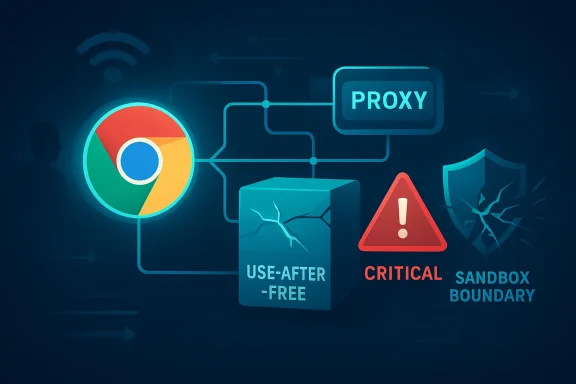
Google has patched CVE-2026-6297, a use-after-free in Proxy that affects Chrome versions before 147.0.7727.101 and carries a Critical Chromium severity rating. The public description says a crafted HTML page could allow an attacker in a privileged network position to potentially achieve a sandbox escape, which makes this far more serious than a routine browser crash. Google’s April 15, 2026 Stable Channel update bundled the fix with 30 other security repairs, and Microsoft is already tracking the issue in its Security Update Guide as a downstream Chromium vulnerability relevant to enterprise patching.
CVE-2026-6297 sits in one of the least glamorous parts of the browser stack, but that is exactly why it matters. Proxy code is often treated as plumbing, yet it can become a powerful pivot point when memory corruption appears in the path between a web page and the browser’s networking behavior. In this case, Google says the flaw is a use-after-free in Proxy, which is a classic memory-safety bug class that frequently turns into reliable exploitation when combined with careful heap grooming and renderer compromise.
The attack framing is especially important. Google’s advisory does not describe a simple drive-by compromise from any random website; instead, it warns that the attacker must already be in a privileged network position and then uses a crafted HTML page to push the browser toward a sandbox escape. That qualifier does not make the issue harmless. It means the vulnerability is most dangerous in environments where traffic can be intercepted, modified, or forced through hostile infrastructure, which is exactly the sort of condition that appears in enterprise Wi-Fi, rogue gateway, captive portal, and targeted adversary scenarios.
The timing also tells an important story. Chrome 147 reached the stable channel on April 7, 2026, and just eight days later Google shipped a follow-up Stable Channel Update for Desktop on April 15 with the CVE-2026-6297 fix included. That is a reminder that modern browser maintenance is no longer a slow quarterly rhythm; it is a continuous response loop where critical memory bugs can surface and be corrected within days of stable-channel rollout.
Microsoft’s involvement matters too. Its Security Update Guide tracks Chromium vulnerabilities even when the initial vendor is Google, because Microsoft Edge inherits much of Chrome’s security posture through the Chromium engine. In practice, that means Chrome patching and Edge patching are now part of the same operational conversation for many Windows administrators, even if the exact release cadence differs.
The advisory attaches a bug bounty reward of $10,000 to the report, and attributes the finding to a researcher named heapracer on March 17, 2026. That is not just a footnote; it suggests the issue was discovered through responsible disclosure rather than public exploitation, which is the best possible case for defenders because it creates a patch window before adversaries can fully weaponize the flaw.
That makes the bug particularly relevant to travelers, remote workers, and organizations that still trust open or lightly controlled network segments. The browser sandbox remains a crucial containment layer, but once an attacker can steer a victim into a vulnerable state and escape the sandbox, the attack path becomes dramatically more serious. It is the difference between “a browser bug” and a full endpoint compromise opportunity.
Browsers are layered systems, and Chrome’s security model depends heavily on compartmentalization. The renderer is supposed to be contained, the browser process is supposed to retain control, and the sandbox is supposed to prevent a content bug from becoming a machine compromise. A Proxy use-after-free is dangerous because it can punch at the boundary between network handling and process isolation, which is exactly where attackers hope to find a leverage point.
Enterprise defenders should read this as a reminder that browsers are not monolithic applications. They are sprawling distributed runtimes with network code, UI code, sandbox code, media stacks, GPU pipelines, and JavaScript engines all interacting under heavy attacker pressure. Each additional subsystem widens the surface where one memory bug can become the stepping stone to a much larger compromise.
That cadence matters because Chrome 147 had only recently arrived on the stable channel. Google’s April 7 stable update introduced Chrome 147 to Windows, Mac, and Linux, and the April 15 follow-up shows how quickly a fresh stable branch can absorb urgent security corrections. For administrators, that means the window between “current” and “vulnerable” can shrink to less than two weeks.
This also reflects a broader truth about modern browser engineering: release channels are now part of the defense model. Stable, early stable, beta, and dev are not just product labels; they are security boundaries that determine how quickly users escape exposure. A fast patch cycle can dramatically reduce risk, but only if users and enterprises actually consume the update.
The Microsoft entry is not the source of the vulnerability, but it is still operationally important. It tells defenders that the issue is part of the shared Chromium security pipeline and should be considered when evaluating browser update completeness, fleet compliance, and exposure windows across mixed Chrome/Edge environments. In other words, the vulnerability is not just a Google problem; it is a Chromium ecosystem problem.
That said, administrators should not assume that Microsoft’s mention of a Chromium CVE means Edge is already fixed at the same moment. The proper response is to verify the installed version, check release notes, and confirm the browser update has actually reached endpoints. Tracking and remediation are not the same thing.
CVE-2026-6297 is especially troubling because the attack precondition is not a local interactive exploit chain. The advisory says the attacker must be in a privileged network position, and that a crafted HTML page can trigger the issue. That combination suggests a sophisticated threat actor could blend traffic control with browser exploitation, which is exactly the kind of multi-stage campaign defenders struggle to detect quickly.
Security teams should also note the human element. Users are often comfortable clicking through pages once they are already authenticated into a network, which can make the network-position requirement feel less important than it is. In reality, that prerequisite is the difference between a random internet nuisance and a targeted intrusion path. That distinction matters.
Google’s April 15 release also included CVE-2026-6296, a Critical heap buffer overflow in ANGLE, which was fixed in the same build family. The proximity of these issues reinforces a familiar pattern in browser hardening: attackers and researchers are still finding highly exploitable memory bugs in complex subsystems that sit close to the hardware and rendering stack.
There is also a strategic implication for competitors. If Chromium continues to absorb this volume of serious security fixes, then browsers built on the same engine inherit both the benefits of Google’s patch work and the burden of quickly integrating it. That is a shared-security model, but it is also a shared-risk model.
This is especially relevant in environments with a large remote workforce. Remote users often rely on networks outside direct corporate control, and browser traffic may traverse environments where interception is easier than administrators realize. In those cases, a Chromium sandbox escape can become a foothold for credential theft, session hijacking, persistence, or lateral movement.
Administrators should remember that browser updates are sometimes slower to finish in managed environments than in consumer setups. Policies, ring-based rollout, and update deferrals can all stretch a fix window beyond what the vendor intended. When the vulnerability is tied to a sandbox escape, that delay is not just operationally inconvenient; it is a measurable exposure period.
The average user does not need to understand heap lifetimes or sandbox internals to reduce risk. They just need to update Chrome promptly and avoid staying on old builds because “nothing seems broken.” The most dangerous browser vulnerabilities are often invisible until they are not, and CVE-2026-6297 fits that pattern exactly.
Consumers should also remember that Chromium-based browsers beyond Chrome can inherit risk, even if the exact patch timing differs. That includes browsers tied to enterprise policies or vendor-managed release trains, where users may not control the update cadence themselves. The safest assumption is simple: if your browser is Chromium-based, check its version now.
It is also worth watching whether Microsoft Edge publishes its own browser update notes that explicitly absorb the same Chromium fix family. That would reinforce the operational reality that browser security is now an ecosystem issue, not a single-vendor issue. For defenders, the safe move is to treat Chromium fixes as shared infrastructure maintenance.
Source: NVD / Chromium Security Update Guide - Microsoft Security Response Center
 Overview
CVE-2026-6297 sits in one of the least glamorous parts of the browser stack, but that is exactly why it matters. Proxy code is often treated as plumbing, yet it can become a powerful pivot point when memory corruption appears in the path between a web page and the browser’s networking behavior. In this case, Google says the flaw is a use-after-free in Proxy, which is a classic memory-safety bug class that frequently turns into reliable exploitation when combined with careful heap grooming and renderer compromise.The attack framing is especially important. Google’s advisory does not describe a simple drive-by compromise from any random website; instead, it warns that the attacker must already be in a privileged network position and then uses a crafted HTML page to push the browser toward a sandbox escape. That qualifier does not make the issue harmless. It means the vulnerability is most dangerous in environments where traffic can be intercepted, modified, or forced through hostile infrastructure, which is exactly the sort of condition that appears in enterprise Wi-Fi, rogue gateway, captive portal, and targeted adversary scenarios.
The timing also tells an important story. Chrome 147 reached the stable channel on April 7, 2026, and just eight days later Google shipped a follow-up Stable Channel Update for Desktop on April 15 with the CVE-2026-6297 fix included. That is a reminder that modern browser maintenance is no longer a slow quarterly rhythm; it is a continuous response loop where critical memory bugs can surface and be corrected within days of stable-channel rollout.
Microsoft’s involvement matters too. Its Security Update Guide tracks Chromium vulnerabilities even when the initial vendor is Google, because Microsoft Edge inherits much of Chrome’s security posture through the Chromium engine. In practice, that means Chrome patching and Edge patching are now part of the same operational conversation for many Windows administrators, even if the exact release cadence differs.
What Google Actually Disclosed
Google’s wording for CVE-2026-6297 is concise but loaded. The company identifies the issue as “Use after free in Proxy” in Google Chrome prior to 147.0.7727.101, and says it could let an attacker in a privileged network position potentially perform a sandbox escape via a crafted HTML page. Google also marked the issue as Critical, which is the strongest signal you get without a confirmed in-the-wild exploit claim.The advisory attaches a bug bounty reward of $10,000 to the report, and attributes the finding to a researcher named heapracer on March 17, 2026. That is not just a footnote; it suggests the issue was discovered through responsible disclosure rather than public exploitation, which is the best possible case for defenders because it creates a patch window before adversaries can fully weaponize the flaw.
Why the “privileged network position” qualifier matters
This phrase should not be glossed over. It implies the attacker has some ability to influence traffic delivery, interception, or routing, rather than merely luring a victim to a page over the public internet. In plain terms, the risk profile shifts toward man-in-the-middle style conditions, hostile local networks, compromised enterprise infrastructure, or targeted access paths where the attacker can manipulate what the browser receives.That makes the bug particularly relevant to travelers, remote workers, and organizations that still trust open or lightly controlled network segments. The browser sandbox remains a crucial containment layer, but once an attacker can steer a victim into a vulnerable state and escape the sandbox, the attack path becomes dramatically more serious. It is the difference between “a browser bug” and a full endpoint compromise opportunity.
- The flaw affects Chrome versions before 147.0.7727.101.
- The issue is a use-after-free in Proxy.
- Google rates it Critical.
- The described attack path requires a privileged network position.
- The exploit scenario involves a crafted HTML page.
- The likely impact is a sandbox escape, not merely a crash.
Why use-after-free bugs remain so dangerous
Use-after-free errors are often dangerous because they arise when software keeps using an object after it has been released from memory. If an attacker can influence timing and memory layout, they may redirect execution, corrupt internal state, or trigger code paths that were never meant to run together. In a browser, where untrusted content is constantly crossing complex object lifetimes, that is exactly the kind of weakness that security teams dread.Where Proxy Fits in Chrome’s Security Model
The Proxy component is not usually the thing casual users think about when they hear “browser security,” but it is part of the machinery that governs how requests are routed. That means a bug here can influence whether traffic is sent directly, proxied, or handled in a way that exposes internal browser assumptions. Once those assumptions break, the code path can become a bridge from a benign page load to memory corruption.Browsers are layered systems, and Chrome’s security model depends heavily on compartmentalization. The renderer is supposed to be contained, the browser process is supposed to retain control, and the sandbox is supposed to prevent a content bug from becoming a machine compromise. A Proxy use-after-free is dangerous because it can punch at the boundary between network handling and process isolation, which is exactly where attackers hope to find a leverage point.
Why this is more than a networking bug
A proxy bug might sound like a configuration issue or a web compatibility problem, but in this case the security impact is what makes it headline-worthy. Google explicitly frames the issue as a route to sandbox escape, which means the real target is not proxy behavior itself but the security boundary that proxy-related logic can help undermine. That is why a flaw in a seemingly narrow subsystem can attract a Critical rating.Enterprise defenders should read this as a reminder that browsers are not monolithic applications. They are sprawling distributed runtimes with network code, UI code, sandbox code, media stacks, GPU pipelines, and JavaScript engines all interacting under heavy attacker pressure. Each additional subsystem widens the surface where one memory bug can become the stepping stone to a much larger compromise.
- Proxy logic can affect how content is fetched and routed.
- The browser’s sandbox boundary is a core security control.
- Memory corruption in routing logic can be a pivot point.
- A network-position condition can make exploitation far more realistic in hostile environments.
Release Timing and Patch Cadence
Google’s stable desktop release on April 15, 2026 updated Chrome to 147.0.7727.101/102 for Windows and Mac and 147.0.7727.101 for Linux. The company said the release includes 31 security fixes, which is a strong reminder that browser updates are increasingly broad security bundles rather than single-purpose patches. CVE-2026-6297 is one line item in that larger hardening wave.That cadence matters because Chrome 147 had only recently arrived on the stable channel. Google’s April 7 stable update introduced Chrome 147 to Windows, Mac, and Linux, and the April 15 follow-up shows how quickly a fresh stable branch can absorb urgent security corrections. For administrators, that means the window between “current” and “vulnerable” can shrink to less than two weeks.
What the speed of this fix says about the threat model
The speed suggests Google considered the issue important enough to move immediately rather than wait for a larger maintenance window. That does not automatically mean exploitation was active in the wild, but it does indicate the bug was serious enough to justify rapid stabilization. In browser security, that usually means “patch now, ask questions later.”This also reflects a broader truth about modern browser engineering: release channels are now part of the defense model. Stable, early stable, beta, and dev are not just product labels; they are security boundaries that determine how quickly users escape exposure. A fast patch cycle can dramatically reduce risk, but only if users and enterprises actually consume the update.
- Chrome Stable 147 first arrived on April 7, 2026.
- The security fix for CVE-2026-6297 landed on April 15, 2026.
- The affected fixed version is 147.0.7727.101.
- Windows and Mac received 147.0.7727.101/102.
- Linux received 147.0.7727.101.
Microsoft’s Tracking and the Edge Angle
Microsoft’s Security Update Guide lists CVE-2026-6297 as a Chromium-origin issue, which is the practical way Microsoft surfaces browser vulnerabilities that also affect Microsoft Edge. That matters because many organizations deploy Edge as their default browser on Windows, and they need a clear way to know when Chromium fixes have been acknowledged and mapped into Microsoft’s patch guidance.The Microsoft entry is not the source of the vulnerability, but it is still operationally important. It tells defenders that the issue is part of the shared Chromium security pipeline and should be considered when evaluating browser update completeness, fleet compliance, and exposure windows across mixed Chrome/Edge environments. In other words, the vulnerability is not just a Google problem; it is a Chromium ecosystem problem.
Why downstream tracking is a big deal
Browser ecosystems increasingly blur vendor boundaries. A bug in Chromium can become a bug in Chrome, Edge, and other Chromium-based products, even if each vendor patches on a slightly different timetable. Microsoft’s tracking helps collapse that confusion into something administrators can act on, especially in environments where Edge and Chrome coexist or where browser choice is managed centrally.That said, administrators should not assume that Microsoft’s mention of a Chromium CVE means Edge is already fixed at the same moment. The proper response is to verify the installed version, check release notes, and confirm the browser update has actually reached endpoints. Tracking and remediation are not the same thing.
- Microsoft tracks Chromium CVEs because Edge shares the engine.
- Enterprise patching often has to coordinate multiple browser channels.
- A Chromium fix does not always mean instant fleet coverage.
- Administrators should validate the actual installed version on endpoints.
Why This Vulnerability Is a Sandbox Escape Story
The most alarming phrase in the advisory is not “use-after-free.” It is sandbox escape. A browser sandbox is designed to keep content bugs inside a restricted execution environment, limiting the blast radius of compromise. When a vulnerability threatens to cross that boundary, the severity rises sharply because the attacker is no longer just breaking the page renderer; they are trying to break out into something with much higher privileges.CVE-2026-6297 is especially troubling because the attack precondition is not a local interactive exploit chain. The advisory says the attacker must be in a privileged network position, and that a crafted HTML page can trigger the issue. That combination suggests a sophisticated threat actor could blend traffic control with browser exploitation, which is exactly the kind of multi-stage campaign defenders struggle to detect quickly.
The practical meaning for endpoint security
For consumer users, the immediate concern is exposure on untrusted networks. For enterprises, the concern is broader: how many users roam through Wi-Fi, VPN split tunnels, captive portals, third-party hotspots, or poorly segmented internal networks where traffic manipulation is possible? In those situations, even a narrow browser flaw can become a fleet-wide risk multiplier.Security teams should also note the human element. Users are often comfortable clicking through pages once they are already authenticated into a network, which can make the network-position requirement feel less important than it is. In reality, that prerequisite is the difference between a random internet nuisance and a targeted intrusion path. That distinction matters.
How It Compares With Other Chrome 147 Fixes
CVE-2026-6297 landed in the same April 15 package as a large group of fixes, including other Critical issues. That context matters because Chrome’s update cadence often reveals patterns: memory-safety bugs in one subsystem often arrive alongside similarly serious flaws in rendering, graphics, and media components. The platform is under constant attack pressure, and the stable branch becomes a consolidation point for many discoveries at once.Google’s April 15 release also included CVE-2026-6296, a Critical heap buffer overflow in ANGLE, which was fixed in the same build family. The proximity of these issues reinforces a familiar pattern in browser hardening: attackers and researchers are still finding highly exploitable memory bugs in complex subsystems that sit close to the hardware and rendering stack.
What the pattern tells us
The pattern is not just that Chrome had multiple bugs, but that the browser remains a large, high-value attack surface where one hardening pass never finishes the job. Every major engine update can expose new assumptions, and every subsystem that handles untrusted input becomes a candidate for a use-after-free, out-of-bounds access, or type confusion. That is why browser security engineering remains a race rather than a destination.There is also a strategic implication for competitors. If Chromium continues to absorb this volume of serious security fixes, then browsers built on the same engine inherit both the benefits of Google’s patch work and the burden of quickly integrating it. That is a shared-security model, but it is also a shared-risk model.
- Chrome 147’s April 15 update included 31 security fixes.
- Another Critical issue in the same release was CVE-2026-6296 in ANGLE.
- The breadth of fixes shows how large the Chromium attack surface remains.
- Downstream browsers inherit both the improvements and the exposure window.
Enterprise Impact: Why Administrators Should Care Immediately
For enterprises, the practical issue is not whether the vulnerability sounds exotic enough for a zero-day blog post. The issue is whether an attacker on a hostile or compromised network can chain this flaw into a reliable escape from the browser sandbox. If the answer is yes, then browser patch compliance becomes a first-order security control, not a nice-to-have maintenance item.This is especially relevant in environments with a large remote workforce. Remote users often rely on networks outside direct corporate control, and browser traffic may traverse environments where interception is easier than administrators realize. In those cases, a Chromium sandbox escape can become a foothold for credential theft, session hijacking, persistence, or lateral movement.
What admins should prioritize
The safest immediate response is to verify that managed Chrome deployments have reached 147.0.7727.101 or later, and to check any Edge channels that depend on Chromium fix propagation. Security teams should also audit endpoints that are likely to roam or connect through untrusted network infrastructure, because those are the devices most likely to be relevant to the attack precondition.Administrators should remember that browser updates are sometimes slower to finish in managed environments than in consumer setups. Policies, ring-based rollout, and update deferrals can all stretch a fix window beyond what the vendor intended. When the vulnerability is tied to a sandbox escape, that delay is not just operationally inconvenient; it is a measurable exposure period.
- Validate Chrome version 147.0.7727.101+ across managed endpoints.
- Confirm browser update rings are not delaying remediation.
- Treat roaming and remote devices as higher exposure assets.
- Review whether Edge has ingested the corresponding Chromium fix.
Consumer Impact: Why Ordinary Users Still Need to Patch
Consumers may look at the “privileged network position” wording and conclude the flaw does not affect them. That would be a mistake. Public Wi-Fi, hotel networks, captive portals, and compromised routers are all plausible real-world places where traffic manipulation becomes possible, and browsers are most vulnerable precisely when users feel safe enough to browse normally.The average user does not need to understand heap lifetimes or sandbox internals to reduce risk. They just need to update Chrome promptly and avoid staying on old builds because “nothing seems broken.” The most dangerous browser vulnerabilities are often invisible until they are not, and CVE-2026-6297 fits that pattern exactly.
The user habit problem
Users tend to postpone browser updates because they fear disruption, tab loss, or a change in workflow. That is understandable, but it is also one of the main reasons browser security bugs remain effective in the wild. A modern browser update is usually the cheapest security upgrade a person can make. This one is no exception.Consumers should also remember that Chromium-based browsers beyond Chrome can inherit risk, even if the exact patch timing differs. That includes browsers tied to enterprise policies or vendor-managed release trains, where users may not control the update cadence themselves. The safest assumption is simple: if your browser is Chromium-based, check its version now.
Strengths and Opportunities
The upside here is that Google moved quickly, disclosed clearly, and shipped a fix in the stable branch before the issue became a broader public crisis. The fact that the bug was rewarded through the regular security bounty program suggests the research pipeline is functioning, not failing. That is good news, even if the underlying vulnerability is serious.- Rapid patch delivery reduced exposure time.
- A clear severity rating helps defenders prioritize.
- The issue was apparently found through responsible disclosure.
- Google tied the fix to a specific minimum safe version.
- Microsoft’s tracking improves cross-platform visibility.
- The disclosure gives security teams a concrete patch target.
- The update strengthens trust in Chromium’s bug bounty ecosystem.
Risks and Concerns
The core concern is that CVE-2026-6297 combines several things defenders dislike: memory corruption, a sandbox escape angle, and a network-position requirement that can be satisfied in realistic hostile environments. That combination suggests the bug may be especially attractive to advanced attackers who can shape traffic or operate near victims. The risk is not theoretical simply because it is conditional.- Privileged network positions are easier to obtain than many users assume.
- Sandbox escapes can turn browser bugs into endpoint compromises.
- Delayed enterprise rollout can leave fleets exposed longer than expected.
- Users on untrusted networks may not realize they are at risk.
- Chromium-based browser ecosystems may patch on different schedules.
- Memory-safety bugs are often highly exploitable once understood.
- The flaw could be combined with other weaknesses in a multi-stage chain.
Looking Ahead
The next thing to watch is how quickly Chrome 147.0.7727.101/102 saturates managed and unmanaged environments. In consumer channels, the rollout should be relatively fast, but enterprise environments will vary based on policy, update rings, and operating conditions. If any sign emerges that exploitation is being observed in the wild, the urgency around this CVE will jump again.It is also worth watching whether Microsoft Edge publishes its own browser update notes that explicitly absorb the same Chromium fix family. That would reinforce the operational reality that browser security is now an ecosystem issue, not a single-vendor issue. For defenders, the safe move is to treat Chromium fixes as shared infrastructure maintenance.
What to monitor next
- Chrome release notes for any follow-up stabilization builds.
- Microsoft Edge update guidance tied to the same Chromium branch.
- Enterprise patch compliance reports for Chrome and Edge.
- Any additional public detail on issue 493628982.
- Reports of unusual browser crashes on untrusted networks.
Source: NVD / Chromium Security Update Guide - Microsoft Security Response Center
