

CVE-2026-63830 is a newly published Linux kernel vulnerability that can let a BPF program obtain writable access to file-backed page-cache data after certain socket-message transformations mishandle internal ownership metadata. For most Windows PCs, this is not a Windows kernel flaw and does not affect Windows applications directly; the immediate Windows-side concern is WSL 2, Linux virtual machines, development appliances, containers running on Linux hosts, and dual-boot systems that use an affected Linux kernel.
The National Vulnerability Database added the record on July 19, 2026, drawing on a kernel.org fix authored by Yiming Qian and reported with Keenan Dong. NVD has not assigned a CVSS score or CWE classification yet, so administrators should resist treating the absence of a severity label as an all-clear. The technical description is unusually clear: this is an integrity failure in a protection boundary intended to stop writable BPF socket contexts from exposing memory that the socket message does not privately own.
The fault sits in
That rule matters when a socket message is backed by something other than private socket memory. The kernel’s own advisory calls out pages brought in through
The vulnerable paths transformed the scatterlist entries—moving, splitting, copying, compacting, or shifting them—without reliably carrying the matching
The kernel patch fixes the bookkeeping rather than attempting to narrow one code path. It keeps
That breadth is important. This is not a classic bounds-check bug where an isolated guard was missing. It is a state-propagation defect: an ownership tag became separated from the object it was supposed to describe.
The published fixed baselines listed by NVD are:
The NVD record also lists the affected source areas:
The precondition is more specialized than “a machine accepts network traffic.” The vulnerable state arises in Linux BPF socket-message handling and requires a later SK_MSG verdict that exposes the affected segment through writable BPF data. Whether an attacker can arrange that depends heavily on the local BPF policy, privileges, loaded programs, socket topology, use of sockmap, kernel configuration, and the application or platform design using the hook.
That does not make the CVE harmless. BPF-based data paths are common enough in advanced networking, observability, service-mesh, proxy, and traffic-control deployments that a flaw crossing from a transformed socket buffer into a file-backed page deserves prompt patching. The risk is highest where a system deliberately combines eBPF socket processing with untrusted or semi-trusted workloads and shared files or data paths.
In short, the security boundary that failed was intended to prevent an eBPF program from treating externally owned memory as its private writable buffer. The patch restores that boundary. The exposure assessment belongs with the Linux platform owner, not merely the team responsible for perimeter networking.
That means a vulnerable WSL 2 kernel could contain this Linux bug even though Windows 10 or Windows 11 itself does not. It also means the appropriate remediation is a WSL/Linux kernel update, not a Windows cumulative update alone.
WSL 1 is materially different. Microsoft’s architecture documentation describes it as a Windows implementation of Linux-compatible interfaces rather than an actual Linux kernel. CVE-2026-63830 concerns Linux kernel
On a Windows endpoint with WSL 2 installed, administrators can begin with:
Microsoft’s WSL documentation says
Do not assume that the distribution’s
The next practical task is identifying systems where SK_MSG BPF is more than theoretical. Look closely at hosts running custom eBPF networking code, socket redirection, transparent proxies, service meshes, experimental TLS offload paths, or platform agents that attach BPF programs to sockets. A generic workstation with no deployed BPF networking policy has a very different exposure profile from a multi-tenant node designed around programmable packet and socket processing.
Administrators should also preserve evidence of the update. Record the package advisory or build identifier that backports the fix, the post-update kernel release, and the reboot or workload restart that put the new kernel into service. A patched package sitting beside an older running kernel is not remediation.
CVE-2026-63830’s immediate lesson is small but sharp: in low-level networking code, metadata is security state. The July 19 CVE publication has put a name on the bug; the operational milestone is making sure every relevant Linux kernel—including the one quietly running beneath WSL 2—is actually carrying the corrected scatterlist ownership handling.
The National Vulnerability Database added the record on July 19, 2026, drawing on a kernel.org fix authored by Yiming Qian and reported with Keenan Dong. NVD has not assigned a CVSS score or CWE classification yet, so administrators should resist treating the absence of a severity label as an all-clear. The technical description is unusually clear: this is an integrity failure in a protection boundary intended to stop writable BPF socket contexts from exposing memory that the socket message does not privately own.
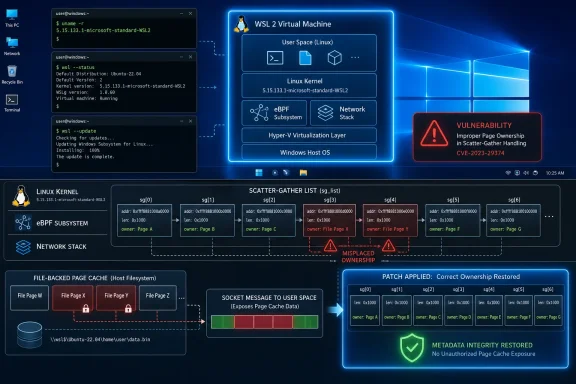 A bitmap lost its place, and page-cache protection went with it
The fault sits in sk_msg, the Linux networking structure used by sockmap and related BPF socket-message processing. An sg.copy bitmap tracks ownership for entries in a scatter-gather list, or scatterlist. When its bit is set, the kernel knows that a segment may reference externally owned memory and must not be exposed as writable through BPF’s ctx->data pointer.That rule matters when a socket message is backed by something other than private socket memory. The kernel’s own advisory calls out pages brought in through
splice(), where data can remain tied to the original file page cache. If BPF is handed a writable pointer to such a page, writes are no longer contained to the expected socket-message buffer; they can alter the underlying cached file data.The vulnerable paths transformed the scatterlist entries—moving, splitting, copying, compacting, or shifting them—without reliably carrying the matching
sg.copy bit along. An externally backed entry could therefore land in a new position with its ownership-protection bit cleared. A later SK_MSG BPF verdict could then receive writable access to that entry.The kernel patch fixes the bookkeeping rather than attempting to narrow one code path. It keeps
sg.copy synchronized whenever sg.data[] entries move, and clears protection state when an entry is replaced by a newly allocated private page or freed. According to the stable-kernel changelog, the work covers BPF pull, push, and pop helpers; sk_msg_shift_left() and sk_msg_shift_right(); sk_msg_xfer(); and tls_split_open_record(), including a partially created final entry during TLS open-record splitting.That breadth is important. This is not a classic bounds-check bug where an isolated guard was missing. It is a state-propagation defect: an ownership tag became separated from the object it was supposed to describe.
The affected code has been present since Linux 4.20
Kernel.org traces the regression to commitd3b18ad31f93, “tls: add bpf support to sk_msg handling.” The NVD affected-product data identifies Linux kernel versions from 4.20 onward as affected until each supported stable branch receives its backport.The published fixed baselines listed by NVD are:
- Linux 6.1.177 and later in the 6.1 stable series.
- Linux 6.6.144 and later in the 6.6 stable series.
- Linux 6.12.95 and later in the 6.12 stable series.
- Linux 6.18.38 and later in the 6.18 stable series.
- Linux 7.1.3 and later in the 7.1 stable series.
The NVD record also lists the affected source areas:
include/linux/skmsg.h, net/core/filter.c, net/core/skmsg.c, and net/tls/tls_sw.c. That combination narrows the practical exposure. Systems without the relevant BPF sockmap/SK_MSG workflows, software TLS handling, or involved message transforms may not exercise the vulnerable sequence. But configuration-based uncertainty is precisely why inventory and patch confirmation are safer than dismissing the issue based on a presumed low likelihood.This is not a remote Windows takeover bug
Nothing in the CVE record establishes a public exploit, a remote unauthenticated attack, privilege escalation to root, or a route from a Linux guest into the Windows host. Administrators should be careful not to infer any of those outcomes from the page-cache write primitive described by the patch.The precondition is more specialized than “a machine accepts network traffic.” The vulnerable state arises in Linux BPF socket-message handling and requires a later SK_MSG verdict that exposes the affected segment through writable BPF data. Whether an attacker can arrange that depends heavily on the local BPF policy, privileges, loaded programs, socket topology, use of sockmap, kernel configuration, and the application or platform design using the hook.
That does not make the CVE harmless. BPF-based data paths are common enough in advanced networking, observability, service-mesh, proxy, and traffic-control deployments that a flaw crossing from a transformed socket buffer into a file-backed page deserves prompt patching. The risk is highest where a system deliberately combines eBPF socket processing with untrusted or semi-trusted workloads and shared files or data paths.
In short, the security boundary that failed was intended to prevent an eBPF program from treating externally owned memory as its private writable buffer. The patch restores that boundary. The exposure assessment belongs with the Linux platform owner, not merely the team responsible for perimeter networking.
WSL 2 needs a kernel check; WSL 1 is a different architecture
For WindowsForum readers, WSL 2 is the most relevant edge case. Microsoft documents that WSL 2 runs an actual Linux kernel inside a lightweight utility VM, while individual distributions operate as containers within that managed environment. Microsoft also maintains the WSL2 Linux kernel source separately from the Windows kernel.That means a vulnerable WSL 2 kernel could contain this Linux bug even though Windows 10 or Windows 11 itself does not. It also means the appropriate remediation is a WSL/Linux kernel update, not a Windows cumulative update alone.
WSL 1 is materially different. Microsoft’s architecture documentation describes it as a Windows implementation of Linux-compatible interfaces rather than an actual Linux kernel. CVE-2026-63830 concerns Linux kernel
sk_msg, BPF, TLS, and scatterlist code, so the specific vulnerable code path does not map to WSL 1.On a Windows endpoint with WSL 2 installed, administrators can begin with:
Code:
wsl --status
wsl --version
wsl --updatewsl --status reports the installed kernel version and that wsl --update updates WSL to the latest available release. After updating, shut down the managed VM with wsl --shutdown, then start the distribution again before validating the running kernel from Linux with uname -r.Do not assume that the distribution’s
apt, dnf, or zypper update alone changes the WSL 2 kernel. In the standard WSL 2 model, Microsoft supplies and updates the shared WSL kernel; the distribution package manager updates userspace packages inside the distribution. Custom WSL kernel configurations are an exception and should be checked against the applied patch, not just the upstream version family.Patch the Linux estate, then verify the unusual cases
Linux administrators should prioritize normal vendor kernel updates, including hosts running Kubernetes nodes, developer workstations, build agents, network appliances, and virtual-machine templates. For systems built from kernel.org stable trees or maintained kernels, move to the relevant fixed release or apply the upstream backport.The next practical task is identifying systems where SK_MSG BPF is more than theoretical. Look closely at hosts running custom eBPF networking code, socket redirection, transparent proxies, service meshes, experimental TLS offload paths, or platform agents that attach BPF programs to sockets. A generic workstation with no deployed BPF networking policy has a very different exposure profile from a multi-tenant node designed around programmable packet and socket processing.
Administrators should also preserve evidence of the update. Record the package advisory or build identifier that backports the fix, the post-update kernel release, and the reboot or workload restart that put the new kernel into service. A patched package sitting beside an older running kernel is not remediation.
CVE-2026-63830’s immediate lesson is small but sharp: in low-level networking code, metadata is security state. The July 19 CVE publication has put a name on the bug; the operational milestone is making sure every relevant Linux kernel—including the one quietly running beneath WSL 2—is actually carrying the corrected scatterlist ownership handling.
References
- Primary source: NVD / Linux Kernel
Published: 2026-07-20T01:05:21-07:00
NVD - CVE-2026-63830
 nvd.nist.gov
- Security advisory: MSRC
Published: 2026-07-20T01:05:21-07:00
Original feed URL
Security Update Guide - Microsoft Security Response Center
 msrc.microsoft.com
