

Linux kernel maintainers have addressed a newly cataloged flaw in AMD’s GPU compute stack, tracked as CVE-2026-63882, that can trigger a NULL-pointer dereference in the
CVE-2026-63882 was published to the CVE and NVD datasets on July 19, 2026, with the record updated on July 20. The issue is described as a resolved Linux kernel vulnerability in the AMD Kernel Fusion Driver, better known as AMDKFD or simply KFD. That driver provides the kernel-side compute interface used by AMD’s ROCm software stack and related GPU-compute workloads.
The vulnerable code resides in
That backport coverage is helpful, but it also means administrators cannot safely assume that an older “long-term support” kernel is protected merely because it belongs to a supported family. The relevant question is the full patch-level version, not whether the system reports Linux 6.1, 6.6, or 6.12.
That distinction is critical because CVE-2026-63882 is not best understood as a flaw in ordinary desktop rendering. It belongs to the more specialized GPU-compute path used by ROCm, HIP applications, high-performance computing software, machine-learning frameworks, and some containerized or virtualized workloads.
For many WindowsForum readers, the closest analogy is the separation between a Windows display driver stack that makes a GPU work for games and desktop applications, and the additional infrastructure required to make that GPU usable for serious compute frameworks. The hardware may be the same, but the workload model and attack surface are not.
The growing use of ROCm in containerized environments broadens the operational significance of KFD. In a typical configuration, a container is granted access to the host’s GPU compute interface through device-node pass-through. The process remains subject to Linux permissions and container isolation boundaries, but the kernel driver is still processing requests originating from workloads that may be less trusted than the host operating system itself.
The exact implementation is intricate, but the bug category is straightforward: the routine relies on a per-process KFD structure that is only available after a prerequisite setup operation has occurred.
A defensive kernel interface should reject an out-of-sequence operation cleanly, normally by returning an error such as
The fix should be viewed as a state-validation correction, not as an expansion of KFD functionality. Applications that follow the documented and expected lifecycle should not need to change their behavior. The primary behavioral difference is that invalid call ordering should now fail safely rather than destabilizing the kernel.
Whether a NULL dereference can be transformed into something more serious depends on technical conditions that are not established by the public CVE entry. Modern kernels generally protect the lowest virtual address pages, and a direct NULL dereference frequently results in a fault rather than controlled execution. Still, the lack of a demonstrated escalation path should not become a rationale for postponing maintenance updates.
The SVM ioctl specifically supports operations for setting and retrieving attributes over virtual-address ranges. Such attributes can influence where memory is preferred, whether it may be prefetched, which devices can access it, and what coherency-related behavior should apply.
A malformed or badly sequenced attribute request is therefore not equivalent to a malformed configuration file. It reaches logic tied to a live process address space and a device driver that coordinates work across CPU memory management and GPU execution.
This ordering requirement may sound obvious to driver developers, but API preconditions have to be enforced in code. Userspace can be buggy, experimental, malicious, compiled against mismatched headers, or attempting to reproduce edge conditions. Kernel APIs must treat all externally supplied requests as untrusted, including requests from applications that otherwise possess permission to access the device.
This is one reason state-machine flaws are common in mature systems software. A driver may correctly handle the normal setup path for years, yet an uncommon sequence involving a newer ioctl, an error path, a process restart, or a compatibility layer exposes an assumption that was never independently checked.
The corrected stable versions identified in the record are:
Administrators should therefore check both the running kernel and their distribution’s security advisory or changelog. A kernel labeled with a vendor suffix may contain the fix even if its visible version is not identical to the upstream release listed above.
That command identifies the kernel currently booted, not merely the newest kernel package installed. On systems where an update has been installed but no reboot has occurred, this distinction matters.
A practical verification sequence is:
The public description also does not state that exploitation has been observed in the wild. It does not identify a proof-of-concept, a remote attack vector, or a demonstrated path from kernel crash to code execution.
However, the line between “local” and “operationally important” is thin on shared systems. A local account on a research server, a job running under a scheduler, a compromised container process granted GPU access, or a hosted development environment can all be meaningful threat scenarios.
The right conclusion is more measured: the bug is a kernel-level reliability and security defect with a plausible local denial-of-service impact, and it should be remediated through normal kernel-update processes.
The relevance for WindowsForum readers comes from the increasingly common hybrid environments in which Windows machines host, manage, or depend on Linux GPU-compute workloads.
A Windows workstation used to administer a Linux ROCm server is not itself vulnerable merely because it connects to that server. But if the Linux host underneath the workload is affected, the organization still faces a continuity and reliability issue.
That makes patch awareness valuable even for administrators whose own workstations run Windows. The user most affected by a KFD outage might be a Windows-based data scientist whose model-training job is running on a Linux cluster several racks away.
Still, Linux gaming and creator systems can include KFD when AMDGPU and compute-oriented packages are present. Enthusiasts who experiment with local AI, Blender-adjacent compute pipelines, development containers, or Linux GPU tooling should apply normal kernel updates rather than assuming the issue is limited to data centers.
The vulnerable route is particularly worth reviewing in environments that expose
This is why containerized GPU workloads deserve special attention. A malformed compute application in one container may not access another tenant’s files directly, yet a kernel driver failure can still disrupt the host’s shared GPU capability.
Schedulers and orchestration platforms should treat GPU-driver patching as part of cluster reliability engineering. Where feasible, drain affected nodes, update their kernels, reboot, run a basic health check, and only then return them to service.
For production services, mitigation should include both patching and resilience testing. It is worth confirming that service supervisors, load balancers, and health checks correctly handle a worker that loses access to its GPU.
Where immediate kernel replacement is not practical, administrators can reduce exposure by limiting access to KFD and avoiding untrusted GPU-compute workloads on affected hosts. That is a compensating control, not a complete remedy.
For container platforms, administrators should avoid indiscriminately passing GPU device nodes into images. A container should receive only the GPU resources it needs, and trusted workload policies should govern who can request them.
The patch will make invalid ordering safer, but it does not make incorrect API usage correct. Applications should still follow the intended lifecycle and handle kernel error returns cleanly.
GPU drivers sit at the intersection of hardware state, virtual memory, process lifecycle, firmware behavior, and asynchronous execution. Tests that focus only on the successful “happy path” are unlikely to cover enough of that terrain.
That complexity is not an argument against patching. It is an argument for treating GPU hosts as first-class infrastructure with maintenance windows, staging environments, rollback plans, and post-update validation.
The fact that normal software generally calls KFD operations in the expected order is helpful, but it is not a security boundary. The kernel must be prepared for calls that arrive out of order.
Administrators should also watch distribution-specific advisories. Upstream fixed version numbers are useful, but deployed systems often run vendor kernels with backported patches. The security notice from the distribution supplying the actual kernel package is the authoritative operational guide for that environment.
As AMD’s Linux compute ecosystem grows, the KFD interface will remain an important target for fuzzing, regression testing, and lifecycle validation. That is not a criticism of the platform; it is the normal consequence of exposing increasingly sophisticated hardware capabilities through a kernel API.
The key lesson is that modern GPUs are no longer peripheral devices in the security sense. They are programmable compute systems connected to privileged kernel code, complex memory-management paths, and production workloads. Fixes such as the one for CVE-2026-63882 may look small at the source-code level, but they help preserve the reliability boundary that increasingly separates a productive GPU platform from a costly service interruption.
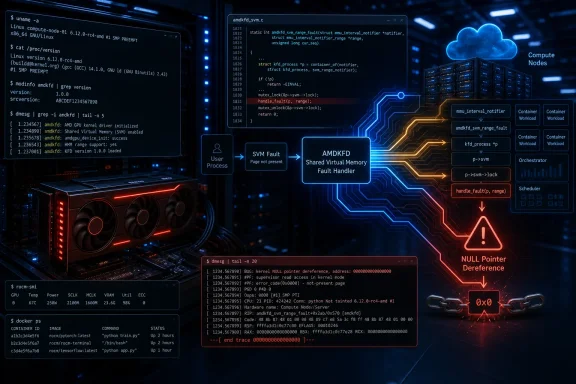
drm/amdkfd driver’s shared virtual memory attribute path. The bug occurs when a userspace process invokes the KFD shared virtual memory ioctl before it has established the process-level GPU virtual-memory state expected by the driver. Put plainly, an application can send a valid-looking request in the wrong order and cause the kernel to follow an uninitialized pointer. The resulting impact is most plausibly a local denial of service, such as a kernel oops, GPU driver reset, or system instability, although the public CVE record currently carries no assigned CVSS score and does not establish privilege escalation or code-execution impact.
 Overview
CVE-2026-63882 was published to the CVE and NVD datasets on July 19, 2026, with the record updated on July 20. The issue is described as a resolved Linux kernel vulnerability in the AMD Kernel Fusion Driver, better known as AMDKFD or simply KFD. That driver provides the kernel-side compute interface used by AMD’s ROCm software stack and related GPU-compute workloads.The vulnerable code resides in
drivers/gpu/drm/amd/amdkfd/kfd_svm.c, specifically within the path that handles shared virtual memory attribute changes. The core condition is unusually clear: process_info may be NULL when an application calls the SVM ioctl without first calling the VM-acquisition ioctl.The affected request sequence
The failing sequence is conceptually simple:- A process opens the KFD compute device.
- It submits an SVM attribute operation.
- It has not first completed the VM-acquisition operation that initializes the expected process state.
- The kernel reaches code that assumes the process state exists and dereferences a NULL pointer.
Why this matters now
The immediate reason to pay attention is that the fix has already been backported into multiple stable kernel lines. The CVE record identifies corrected releases including Linux 6.1.176, 6.6.143, 6.12.93, 6.18.35, and 7.0.12, with the upstream fix included in Linux 7.1 development history.That backport coverage is helpful, but it also means administrators cannot safely assume that an older “long-term support” kernel is protected merely because it belongs to a supported family. The relevant question is the full patch-level version, not whether the system reports Linux 6.1, 6.6, or 6.12.
Background
AMDKFD is part of the Linux graphics and compute subsystem, but it serves a different role from the display-facing portions of the AMDGPU driver. AMDGPU handles broad hardware enablement, graphics functionality, display pipelines, and core device management. KFD adds the machinery needed for heterogeneous compute workloads, allowing applications to submit compute work and manage memory across CPUs and AMD GPUs.That distinction is critical because CVE-2026-63882 is not best understood as a flaw in ordinary desktop rendering. It belongs to the more specialized GPU-compute path used by ROCm, HIP applications, high-performance computing software, machine-learning frameworks, and some containerized or virtualized workloads.
From graphics driver to heterogeneous compute platform
Modern GPU compute platforms need more than a way to launch shader-like programs. They require memory-management policies, queue scheduling, synchronization, virtual addressing, page migration, device affinity, and interaction with the CPU’s process address space. KFD exists to help coordinate these capabilities within Linux.For many WindowsForum readers, the closest analogy is the separation between a Windows display driver stack that makes a GPU work for games and desktop applications, and the additional infrastructure required to make that GPU usable for serious compute frameworks. The hardware may be the same, but the workload model and attack surface are not.
Why ROCm increases the relevance of KFD
ROCm has become AMD’s central software platform for GPU programming on Linux. It provides the runtime, compiler support, libraries, tooling, and framework integration used for workloads ranging from scientific computing to AI inference and training. Its low-level stack necessarily depends on the kernel driver being able to expose compute hardware safely and predictably.The growing use of ROCm in containerized environments broadens the operational significance of KFD. In a typical configuration, a container is granted access to the host’s GPU compute interface through device-node pass-through. The process remains subject to Linux permissions and container isolation boundaries, but the kernel driver is still processing requests originating from workloads that may be less trusted than the host operating system itself.
The Technical Root Cause
The vulnerable routine,svm_range_set_attr, handles an operation intended to alter attributes attached to a range of shared virtual memory. Shared virtual memory, or SVM, is a feature set designed to make CPU and GPU memory interaction more flexible. Rather than treating host memory and GPU memory as wholly separate worlds, the software stack can apply policies governing preferred locations, accessibility, coherence, prefetching, and migration behavior.The exact implementation is intricate, but the bug category is straightforward: the routine relies on a per-process KFD structure that is only available after a prerequisite setup operation has occurred.
A missing state guard
The CVE description states thatprocess_info can be NULL if userspace does not call kfd_ioctl_acquire_vm before calling kfd_ioctl_svm. That means the driver’s SVM path could proceed without confirming that a required process-level virtual-memory relationship had been established.A defensive kernel interface should reject an out-of-sequence operation cleanly, normally by returning an error such as
-EINVAL, -ENODEV, or another appropriate negative error code. Instead, the vulnerable path apparently reached code that expected the missing object to exist.The fix should be viewed as a state-validation correction, not as an expansion of KFD functionality. Applications that follow the documented and expected lifecycle should not need to change their behavior. The primary behavioral difference is that invalid call ordering should now fail safely rather than destabilizing the kernel.
NULL-pointer dereferences are still security-relevant
It is tempting to dismiss a NULL-pointer dereference as “only a crash.” That is too casual, particularly in a kernel driver. A local user who can reliably trigger an oops can potentially interrupt GPU-backed services, terminate workloads, cause a host reboot under strict panic settings, or create a repeated availability problem in a multi-user environment.Whether a NULL dereference can be transformed into something more serious depends on technical conditions that are not established by the public CVE entry. Modern kernels generally protect the lowest virtual address pages, and a direct NULL dereference frequently results in a fault rather than controlled execution. Still, the lack of a demonstrated escalation path should not become a rationale for postponing maintenance updates.
Understanding the KFD SVM Interface
The KFD userspace ABI exposes ioctl operations for GPU compute processes. An ioctl is a kernel-control request delivered through a device file descriptor. These interfaces are common in Linux drivers because they allow userspace to ask the kernel to create queues, allocate or map memory, query device properties, and configure special capabilities.The SVM ioctl specifically supports operations for setting and retrieving attributes over virtual-address ranges. Such attributes can influence where memory is preferred, whether it may be prefetched, which devices can access it, and what coherency-related behavior should apply.
More than a simple memory hint
SVM attributes are not merely application-level suggestions. Depending on the attribute and hardware capabilities, they can affect page migration, page-fault behavior, GPU mappings, performance characteristics, and how memory is treated across devices. That makes reliable validation especially important.A malformed or badly sequenced attribute request is therefore not equivalent to a malformed configuration file. It reaches logic tied to a live process address space and a device driver that coordinates work across CPU memory management and GPU execution.
The required VM acquisition step
TheAMDKFD_IOC_ACQUIRE_VM operation exists to associate the KFD process context with the necessary GPU virtual-memory state. Only after that setup has completed should the process proceed to SVM operations that depend on this state.This ordering requirement may sound obvious to driver developers, but API preconditions have to be enforced in code. Userspace can be buggy, experimental, malicious, compiled against mismatched headers, or attempting to reproduce edge conditions. Kernel APIs must treat all externally supplied requests as untrusted, including requests from applications that otherwise possess permission to access the device.
ABI evolution creates edge cases
KFD’s public interface has grown over time, adding SVM support, CRIU-oriented checkpoint and restore features, debugging functions, memory capabilities, and other compute-related controls. Every additional capability increases the number of possible call sequences and state transitions that must be tested.This is one reason state-machine flaws are common in mature systems software. A driver may correctly handle the normal setup path for years, yet an uncommon sequence involving a newer ioctl, an error path, a process restart, or a compatibility layer exposes an assumption that was never independently checked.
Affected Kernel Versions and Fixed Builds
According to the vulnerability record, the affected code entered the Linux kernel in the 5.14 era. Systems running kernels older than Linux 5.14 are listed as unaffected because the relevant SVM implementation was not present in the same form. Systems using later vulnerable builds require a patch-level check.The corrected stable versions identified in the record are:
- Linux 6.1.176 or later within the 6.1 stable series.
- Linux 6.6.143 or later within the 6.6 stable series.
- Linux 6.12.93 or later within the 6.12 stable series.
- Linux 6.18.35 or later within the 6.18 stable series.
- Linux 7.0.12 or later within the 7.0 stable series.
- Linux 7.1 and later upstream releases include the original fix lineage.
Distribution package versions can obscure the answer
Linux distributions do not always expose vulnerability status through an obvious upstream-style version number. Enterprise distributions frequently backport security patches while preserving a long-running kernel version string. Conversely, a distribution may package a kernel based on an upstream branch that is numerically old but still security-supported.Administrators should therefore check both the running kernel and their distribution’s security advisory or changelog. A kernel labeled with a vendor suffix may contain the fix even if its visible version is not identical to the upstream release listed above.
Checking the running kernel
On most Linux systems, the basic starting point is:uname -rThat command identifies the kernel currently booted, not merely the newest kernel package installed. On systems where an update has been installed but no reboot has occurred, this distinction matters.
A practical verification sequence is:
- Check the currently running kernel with
uname -r. - Compare it with the vendor’s fixed package information.
- Install the distribution’s latest supported kernel update.
- Reboot into the new kernel.
- Run
uname -ragain to verify that the patched build is active.
Exploitability and Severity: What Is Known
The NVD entry currently lists no CVSS 4.0, CVSS 3.x, or CVSS 2.0 score. That absence should be interpreted as an unscored record awaiting enrichment, not as proof that the issue has no security impact. The CVE was only recently published, and severity assessment often trails initial disclosure.The public description also does not state that exploitation has been observed in the wild. It does not identify a proof-of-concept, a remote attack vector, or a demonstrated path from kernel crash to code execution.
Likely access requirements
The apparent attack surface is local: a process must be able to communicate with the KFD interface and issue the relevant ioctl sequence. In many desktop installations, that already limits exposure because KFD is not necessarily enabled, ROCm may not be installed, and ordinary applications may not have access to the compute device.However, the line between “local” and “operationally important” is thin on shared systems. A local account on a research server, a job running under a scheduler, a compromised container process granted GPU access, or a hosted development environment can all be meaningful threat scenarios.
Availability impact is the clearest concern
The most credible near-term consequence is an availability failure. Depending on the exact kernel configuration, graphics stack behavior, and GPU workload state, a triggered NULL dereference could result in:- A kernel warning or oops that leaves the host running but degrades GPU functionality.
- A GPU reset that interrupts active compute jobs.
- A crashed process or failed containerized workload.
- A host reboot if kernel panic policies are configured aggressively.
- A persistent denial-of-service condition if an untrusted process can repeat the trigger.
What should not be assumed
There is currently no basis to characterize CVE-2026-63882 as a confirmed remote-code-execution flaw, a confirmed information-disclosure flaw, or a confirmed privilege-escalation vulnerability. Responsible patching does not require overstating the technical evidence.The right conclusion is more measured: the bug is a kernel-level reliability and security defect with a plausible local denial-of-service impact, and it should be remediated through normal kernel-update processes.
Why Windows Users Should Care
CVE-2026-63882 does not affect the Windows AMD display driver stack directly. The vulnerable component is Linux kernel code, not a Windows kernel-mode display driver, Radeon Software package, or standard DirectX path. A conventional Windows 11 desktop or gaming PC running native Windows software is therefore not in the direct scope of this CVE.The relevance for WindowsForum readers comes from the increasingly common hybrid environments in which Windows machines host, manage, or depend on Linux GPU-compute workloads.
WSL, dual boot, and remote Linux systems
Developers may use Windows as the primary desktop while running Linux through WSL, dual-boot configurations, virtual machines, remote workstations, or dedicated GPU servers. In those arrangements, vulnerability ownership follows the Linux kernel that actually provides the KFD interface.A Windows workstation used to administer a Linux ROCm server is not itself vulnerable merely because it connects to that server. But if the Linux host underneath the workload is affected, the organization still faces a continuity and reliability issue.
GPU compute increasingly crosses operating-system boundaries
AI development and scientific computing are often mixed-platform workflows. Code may be authored in Windows tools, built in Linux containers, and executed on remote AMD accelerator systems. The consumer desktop and the compute host are not the same security boundary, but they are part of the same delivery pipeline.That makes patch awareness valuable even for administrators whose own workstations run Windows. The user most affected by a KFD outage might be a Windows-based data scientist whose model-training job is running on a Linux cluster several racks away.
Consumer systems are usually lower priority
For the average Radeon user who does not run ROCm, HIP, AMD GPU compute containers, or Linux-based accelerator workloads, CVE-2026-63882 is unlikely to warrant emergency action. The affected code path is specialized and requires KFD access.Still, Linux gaming and creator systems can include KFD when AMDGPU and compute-oriented packages are present. Enthusiasts who experiment with local AI, Blender-adjacent compute pipelines, development containers, or Linux GPU tooling should apply normal kernel updates rather than assuming the issue is limited to data centers.
Enterprise and Cloud Impact
Enterprise exposure depends less on the brand of GPU and more on how the GPU is assigned. A server with AMD Instinct accelerators, ROCm installed, and multiple users sharing GPU resources has a materially different risk profile from a workstation where one trusted administrator runs a local compute job.The vulnerable route is particularly worth reviewing in environments that expose
/dev/kfd to containers, job schedulers, CI runners, or research tenants.Containers are not a substitute for driver hardening
Containers package applications, but they share the host kernel. When a container receives direct access to GPU device nodes, its processes can communicate with host kernel drivers. Permission controls, device cgroups, seccomp policies, and runtime configuration all help reduce risk, but they do not turn a kernel driver into a separate virtualized kernel.This is why containerized GPU workloads deserve special attention. A malformed compute application in one container may not access another tenant’s files directly, yet a kernel driver failure can still disrupt the host’s shared GPU capability.
Multi-user research and HPC clusters
Academic, scientific, and engineering clusters often allow many users to submit native binaries or containers. That model makes availability flaws valuable to an attacker even when privilege escalation is not possible. Interrupting a popular accelerator node can consume administrator time, fail jobs, and create costly queue delays.Schedulers and orchestration platforms should treat GPU-driver patching as part of cluster reliability engineering. Where feasible, drain affected nodes, update their kernels, reboot, run a basic health check, and only then return them to service.
AI inference services
Inference infrastructure can be sensitive to short GPU disruptions. Even if an orchestrator restarts failed worker processes, a driver reset can trigger request failures, tail-latency spikes, cache loss, or cascading retries. The risk rises when a node is running large models with expensive initialization steps.For production services, mitigation should include both patching and resilience testing. It is worth confirming that service supervisors, load balancers, and health checks correctly handle a worker that loses access to its GPU.
Mitigation and Operational Guidance
The primary mitigation is to deploy a Linux kernel release that contains the fix. There is no indication that a userspace ROCm update alone can correct the vulnerable kernel logic. Since the bug is in AMDKFD, the running kernel must be patched.Where immediate kernel replacement is not practical, administrators can reduce exposure by limiting access to KFD and avoiding untrusted GPU-compute workloads on affected hosts. That is a compensating control, not a complete remedy.
Priority recommendations
- Patch GPU compute hosts promptly if they run ROCm or provide KFD access to users, containers, or jobs.
- Reboot after the kernel update because installing a package does not replace the kernel already executing in memory.
- Restrict access to GPU device nodes so that only approved workloads and accounts can reach the compute interface.
- Review container device pass-through and avoid granting broad GPU access to arbitrary development containers.
- Monitor kernel logs and GPU health telemetry for oops events, resets, repeated job failures, or abnormal driver recovery activity.
- Plan node draining for shared infrastructure rather than updating live multi-tenant accelerator systems without workload coordination.
Temporary exposure reduction
If a system does not need AMD GPU compute, disabling or not loading the relevant compute components can reduce the reachable attack surface. That decision should be weighed carefully: removing KFD functionality may break ROCm workloads even though graphics and display output continue to function.For container platforms, administrators should avoid indiscriminately passing GPU device nodes into images. A container should receive only the GPU resources it needs, and trusted workload policies should govern who can request them.
Application developers should not rely on accidental behavior
Developers working directly with KFD interfaces should ensure that their code acquires VM state before issuing SVM operations. High-level ROCm and HIP runtimes normally abstract such details, but low-level tooling, test harnesses, fuzzers, custom runtimes, and diagnostic utilities may interact more directly with ioctls.The patch will make invalid ordering safer, but it does not make incorrect API usage correct. Applications should still follow the intended lifecycle and handle kernel error returns cleanly.
Strengths and Opportunities
The handling of CVE-2026-63882 highlights several positive aspects of the Linux kernel security and maintenance model.- The issue has a narrowly identified root cause. The public description points to a specific missing precondition involving
process_infoand VM acquisition, which should make regression analysis more tractable. - The correction has reached multiple stable branches. Backports to several maintained kernel families reduce the chance that users are forced onto a newest-mainline release simply to obtain the fix.
- The remediation appears low risk. A NULL-state validation check is generally less disruptive than a broad architectural change, although every kernel update still requires testing in production environments.
- The disclosure helps operators distinguish compute from graphics exposure. Teams can prioritize systems that actually run KFD-backed workloads rather than treating every AMD graphics installation as equally exposed.
- The case reinforces defensive API design. Kernel developers and runtime authors can use it as a reminder that every ioctl sequence must be validated as though userspace may be buggy or adversarial.
Better test coverage is the long-term win
The deeper opportunity is not merely fixing one dereference. It is improving state-transition tests around KFD operations: invoking calls in the wrong order, repeating them, racing teardown against configuration, handling partial initialization, and exercising incompatible or stale userspace behavior.GPU drivers sit at the intersection of hardware state, virtual memory, process lifecycle, firmware behavior, and asynchronous execution. Tests that focus only on the successful “happy path” are unlikely to cover enough of that terrain.
Risks and Concerns
Several uncertainties remain because the CVE record is newly published and has not yet received a full public severity assessment.- CVSS data is currently unavailable. Organizations must make patching decisions based on technical exposure rather than waiting for a numeric severity score.
- Public exploit evidence has not been established. That reduces urgency for some single-user systems, but it should not be confused with evidence that exploitation is impossible.
- KFD access varies widely by deployment. A laptop with no ROCm stack has a very different exposure profile from a shared AMD accelerator cluster.
- Kernel updates can carry operational risk. GPU compute environments often depend on tightly matched kernel modules, ROCm releases, container images, and orchestration components.
- Availability incidents can be expensive even without data theft. A driver crash on a shared accelerator system can waste compute allocations, fail service-level objectives, and disrupt users beyond the triggering process.
Compatibility remains a practical consideration
AMD’s compute stack includes both kernel-side and userspace components, and organizations commonly standardize on validated combinations. Updating a kernel may require checking out-of-tree AMDGPU packages, secure-boot signing, DKMS rebuilds, custom drivers, and workload certification.That complexity is not an argument against patching. It is an argument for treating GPU hosts as first-class infrastructure with maintenance windows, staging environments, rollback plans, and post-update validation.
Do not mistake stability for immunity
A host that has run the same ROCm workload for months without issue may simply never have encountered the invalid ioctl sequence. Security bugs often remain invisible until a new application version, a malformed request, a test tool, or an attacker explores an untested path.The fact that normal software generally calls KFD operations in the expected order is helpful, but it is not a security boundary. The kernel must be prepared for calls that arrive out of order.
What to Watch Next
The most important near-term development will be the eventual NVD enrichment of CVE-2026-63882. A future CVSS vector may clarify the anticipated privilege requirements, user-interaction assumptions, and availability impact. It may also remain conservative if analysis confirms that the problem is limited to an authenticated local process capable of accessing KFD.Administrators should also watch distribution-specific advisories. Upstream fixed version numbers are useful, but deployed systems often run vendor kernels with backported patches. The security notice from the distribution supplying the actual kernel package is the authoritative operational guide for that environment.
Indicators of a mature response
A well-managed remediation effort should produce evidence that the issue was not merely acknowledged but actually closed:- The affected hosts have been inventoried based on AMD GPU compute use, not just GPU presence.
- Fixed kernel packages have been installed from supported repositories.
- Hosts have rebooted into those fixed kernels.
- ROCm or HIP smoke tests confirm that GPU workloads still operate correctly.
- Logs show no abnormal KFD, AMDGPU, or DRM failures after the update.
- Container and scheduler policies have been reviewed to ensure GPU access is intentionally granted.
Future kernel hardening themes
CVE-2026-63882 will likely be one of many examples that drive more scrutiny toward ioctl state machines. The industry’s rapid expansion of local AI, GPU containers, and heterogeneous computing makes driver reliability a wider security concern than it once was.As AMD’s Linux compute ecosystem grows, the KFD interface will remain an important target for fuzzing, regression testing, and lifecycle validation. That is not a criticism of the platform; it is the normal consequence of exposing increasingly sophisticated hardware capabilities through a kernel API.
Looking Ahead
For most users, this vulnerability is a reminder rather than a crisis: keep Linux kernels current, especially on machines that do real AMD GPU compute work. For organizations operating ROCm servers, shared accelerators, or GPU-enabled containers, it is a practical maintenance item with a clear technical rationale and a straightforward remedy.The key lesson is that modern GPUs are no longer peripheral devices in the security sense. They are programmable compute systems connected to privileged kernel code, complex memory-management paths, and production workloads. Fixes such as the one for CVE-2026-63882 may look small at the source-code level, but they help preserve the reliability boundary that increasingly separates a productive GPU platform from a costly service interruption.
References
- Primary source: NVD / Linux Kernel
Published: 2026-07-21T01:04:12-07:00
NVD - CVE-2026-63882
 nvd.nist.gov
- Security advisory: MSRC
Published: 2026-07-21T01:04:12-07:00
Original feed URL
Security Update Guide - Microsoft Security Response Center
 msrc.microsoft.com
