

CVE-2026-63940 is a newly published Linux kernel vulnerability in KVM’s AMD Secure Encrypted Virtualization handling, and its deceptively small fix carries an outsized operational message for virtualization administrators: a Port I/O request with a length or count of zero must be treated as a no-op before it reaches code that assumes a valid transfer size. The flaw affects the KVM AMD SEV implementation introduced in Linux 5.11, has been assigned a 9.3 Critical CVSS 3.1 score by kernel.org, and is fixed in Linux 6.12.95, 6.18.35, 7.0.12, and 7.1 or later. For ordinary Windows desktop users, this is not a direct Windows vulnerability. For organizations operating Windows workloads on Linux-based KVM hosts—especially confidential VM deployments using AMD SEV, SEV-ES, or SEV-SNP—it is a patching priority that deserves careful, evidence-based triage rather than panic.
The vulnerability is located in
That behavior matters because length-related arithmetic often contains assumptions that are invisible in the happy path. A routine that calculates an ending byte, remaining size, or buffer extent may subtract one from a length. When the supplied length is zero, unsigned arithmetic can convert that expected small value into a very large one. This is the classic length underflow problem: an input that should represent “nothing to process” instead creates an invalid range or corrupts the logic used to validate it.
The published CVE description does not document a public proof of concept, a demonstrated guest-to-host escape, or a complete exploit chain. Administrators should therefore avoid claiming more than the record establishes. But the Linux kernel CNA’s critical rating, the confidentiality, integrity, and availability impacts attributed to the issue, and the location inside a virtualization security boundary mean the prudent course is clear: update affected SEV-capable KVM hosts promptly and verify the running kernel after rebooting.
The important operational takeaway is more limited and more useful: this is a host-kernel vulnerability in a specialized KVM SEV path, not a browser-delivered flaw or a Windows endpoint issue. Exposure depends heavily on whether the host actually runs KVM with AMD SEV support enabled and whether untrusted or less-trusted workloads can exercise the affected paths.
AMD SEV changes the normal trust model of virtualization. In a traditional virtualized deployment, the hypervisor has broad visibility into guest memory and processor state. That is useful for management, debugging, migration, inspection, and performance features, but it also means a compromised or overly privileged host administrator can be a powerful threat to guests.
SEV was designed to reduce that trust. It encrypts guest memory using keys associated with the virtual machine. SEV-ES, or Encrypted State, extends those protections to more CPU register state during transitions. SEV-SNP, or Secure Nested Paging, adds integrity-oriented protections intended to constrain certain classes of malicious hypervisor behavior and support stronger guest attestation.
Port I/O is one of the legacy but still relevant mechanisms used by x86 systems to communicate with hardware and emulated devices. Unlike memory-mapped I/O, Port I/O uses a distinct address space and instructions such as
That makes GHCB and Port I/O handling security-critical plumbing. The guest is less transparent to the host under SEV-ES or SNP, so KVM must carefully validate the structured requests it receives. A malformed request is not necessarily hostile, but it must be treated as untrusted until validated. CVE-2026-63940 is a reminder that confidential computing moves complexity into the validation boundary; it does not remove complexity.
This historical detail matters for long-lived enterprise estates. Many organizations retain custom kernels, vendor kernels, appliance kernels, or long-term-support branches far beyond their original release date. A server may report an old distribution version while carrying a heavily backported kernel, and conversely a seemingly recent distribution package may still contain an affected backport state if its vendor has not released the fix.
Version labels alone are not enough. The decisive question is whether the installed kernel package contains the relevant fix, not whether the operating system’s marketing name sounds recent.
The vulnerable behavior did not explicitly discard such requests before scratch-area setup and related logic. The patch corrects this by making the zero-length condition an explicit early exit.
The result can lead to several dangerous outcomes:
The second approach is stronger here. It reduces the number of code paths that need to reason about zero and isolates the invalid state before resource setup. The patch also enables a warning when KVM attempts to configure a scratch area with a zero length, helping developers discover internal callers that violate the expected contract.
That warning capability may sound mundane, but it is valuable. Kernel hardening is not only about surviving malicious inputs; it is also about making incorrect internal assumptions visible before they become vulnerabilities.
That distinction sharply narrows the affected population. A Linux computer using an Intel processor is not vulnerable through this AMD SEV code path. An AMD machine that never enables KVM or does not use the relevant virtualization features is also materially different from a host actively serving SEV-protected guests.
Port I/O requests are among the operations that can traverse this boundary. A request may involve a simple single I/O operation or a string-style operation representing multiple elements. In either case, a length or count of zero should be harmless—but only if the host kernel recognizes that the request has no work to do.
The vulnerability lies in the gap between “the request contains no data” and “the host code behaves as if it has a valid positive length.” That gap is precisely where arithmetic assumptions become security assumptions.
Any such temporary buffer requires rigorous bounds management. It must be sized correctly, mapped correctly, populated correctly, and released correctly. An empty request does not need a buffer. By refusing to set one up for zero-length operations, the fix makes the scratch-area model simpler and reduces the chance that an invalid calculation affects later handling.
For this reason, the patch lifecycle should include confirmation of the actual running build after maintenance. On most Linux hosts, checking the currently booted kernel version is easy. The difficult work is verifying that the version maps to a vendor build containing the fix and that the host has actually restarted into it.
A standard Windows 10 or Windows 11 desktop, a Windows Server machine running Hyper-V, and a Windows guest VM on VMware or Hyper-V are not directly vulnerable through CVE-2026-63940. The defect is in the Linux kernel’s AMD KVM SEV handling code.
The patch belongs on the Linux host, not inside the Windows guest. Applying Windows Update to a guest VM may still be necessary for other reasons, but it does not correct the KVM host kernel’s zero-length Port I/O handling.
This distinction should shape incident communication. A security team should not issue a blanket instruction for every Windows endpoint to patch because of this CVE. Instead, it should identify teams responsible for Linux hypervisor clusters, confidential-computing platforms, managed KVM services, and appliances that embed Linux underneath a virtualization stack.
Developers may still encounter the issue on a Linux workstation used for local KVM and QEMU testing. If that system hosts SEV-enabled test VMs, it should be patched according to the same principles as a production hypervisor, even if its business impact is lower.
A KVM host carrying only internal, fully trusted VMs in a tightly controlled lab is not equivalent to a multi-tenant platform hosting workloads from separate business units, customers, or automated pipelines. In the latter case, the hypervisor’s ability to robustly validate guest-originated requests is central to the platform’s risk model.
That does not mean every SEV host is immediately compromised. It means the environment has explicitly identified the guest-to-host trust boundary as important enough to invest in hardware-backed memory protection. A critical flaw in the kernel code enforcing part of that boundary should therefore receive a correspondingly high remediation priority.
A disciplined response includes:
That surrounding context matters because it demonstrates that the zero-length Port I/O fix was not discovered in a vacuum. Kernel maintainers were reviewing and correcting multiple edge conditions in the confidential-guest communication path.
The responsible interpretation is that GHCB is complex and security-sensitive. A maintenance release containing this CVE’s correction may also include other reliability and hardening changes. That can increase the practical value of updating beyond the single CVE identifier.
SEV reduces exposure to some threat classes, but its operational interfaces must be carefully implemented. The zero-length case illustrates a broader rule: security-sensitive code should normalize and reject malformed states as close to the trust boundary as possible. The less ambiguous the contract between guest and host, the smaller the opportunity for unexpected arithmetic or state transitions.
If the answer to any of those questions is no, CVE-2026-63940 is an opportunity to correct the process before a more clearly exploitable flaw appears.
The correct inventory unit is the physical or bare-metal hypervisor host and its kernel, not the guest operating system alone.
Administrators should monitor vendor-specific advisories for the Linux distributions and virtualization platforms they operate. The key evidence to collect is the vendor’s statement that a particular kernel package includes the fix, followed by confirmation that the host has booted that package.
Those uncertainties should influence communication, not remediation. It is appropriate to say that the flaw is serious, affects a security-sensitive hypervisor path, and should be patched. It is not appropriate to claim that every AMD Linux machine or every Windows VM is currently exposed to a known guest-to-host takeover.
CVE-2026-63940 is ultimately a lesson in the importance of small checks at major security boundaries. A zero-length request seems trivial, but in kernel virtualization code it can undermine assumptions that govern temporary buffer setup, validation, and guest-host mediation. Linux KVM operators using AMD SEV-family technologies should move to a fixed kernel, reboot into it, and verify the result; Windows administrators should focus on the Linux hosts beneath any KVM-based Windows workloads rather than treating this as a conventional Windows endpoint patch. The most durable response is not simply installing one update, but building the inventory, maintenance discipline, and confidential-computing visibility needed to handle the next hypervisor flaw with the same precision.
 Overview
The vulnerability is located in arch/x86/kvm/svm/sev.c, the Linux kernel source file responsible for substantial portions of KVM’s AMD Secure Encrypted Virtualization support. Its immediate remediation is straightforward: explicitly ignore Port I/O requests whose declared data length is zero, or whose element count is zero, rather than allowing them to travel through code paths that prepare a software scratch area.That behavior matters because length-related arithmetic often contains assumptions that are invisible in the happy path. A routine that calculates an ending byte, remaining size, or buffer extent may subtract one from a length. When the supplied length is zero, unsigned arithmetic can convert that expected small value into a very large one. This is the classic length underflow problem: an input that should represent “nothing to process” instead creates an invalid range or corrupts the logic used to validate it.
The published CVE description does not document a public proof of concept, a demonstrated guest-to-host escape, or a complete exploit chain. Administrators should therefore avoid claiming more than the record establishes. But the Linux kernel CNA’s critical rating, the confidentiality, integrity, and availability impacts attributed to the issue, and the location inside a virtualization security boundary mean the prudent course is clear: update affected SEV-capable KVM hosts promptly and verify the running kernel after rebooting.
The key technical change
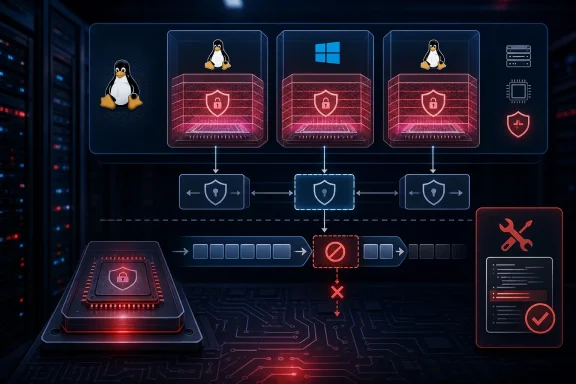
The patch’s conceptual behavior is simple:- KVM receives a Port I/O request originating from the confidential-guest communication path.
- It checks whether the request has a zero byte length or a zero transfer count.
- If the request is empty, KVM ignores it instead of calculating scratch-area requirements.
- Subsequent code can retain stronger assumptions that a processed request has a meaningful size.
- Internal warnings can identify attempts to configure a scratch area with a zero length.
Why the score is attention-grabbing
The CVSS 3.1 vector supplied by kernel.org isAV:L/AC:L/PR:N/UI:N/S:C/C:H/I:H/A:H, yielding a 9.3 Critical score. Its “local” attack vector should not be casually interpreted as “a logged-in Linux user can automatically compromise every host.” In a KVM environment, “local” can involve access to the host, access to a virtual machine, or the ability to invoke a relevant virtualization path, depending on deployment architecture and the eventual exploitation conditions.The important operational takeaway is more limited and more useful: this is a host-kernel vulnerability in a specialized KVM SEV path, not a browser-delivered flaw or a Windows endpoint issue. Exposure depends heavily on whether the host actually runs KVM with AMD SEV support enabled and whether untrusted or less-trusted workloads can exercise the affected paths.
Background
KVM, short for Kernel-based Virtual Machine, has been part of the Linux kernel since 2007 and is one of the foundational technologies behind modern Linux virtualization. It lets the Linux kernel act as a hypervisor, while user-space software such as QEMU, libvirt, OpenStack components, or cloud management platforms provides VM configuration, virtual hardware emulation, and orchestration.AMD SEV changes the normal trust model of virtualization. In a traditional virtualized deployment, the hypervisor has broad visibility into guest memory and processor state. That is useful for management, debugging, migration, inspection, and performance features, but it also means a compromised or overly privileged host administrator can be a powerful threat to guests.
SEV was designed to reduce that trust. It encrypts guest memory using keys associated with the virtual machine. SEV-ES, or Encrypted State, extends those protections to more CPU register state during transitions. SEV-SNP, or Secure Nested Paging, adds integrity-oriented protections intended to constrain certain classes of malicious hypervisor behavior and support stronger guest attestation.
Confidential computing changes the interface, not the need for interfaces
A confidential VM cannot simply hide every interaction from its hypervisor. It still needs to boot, receive interrupts, communicate device activity, handle page-state changes, and carry out certain virtualization operations. AMD’s Guest-Hypervisor Communication Block, usually called GHCB, defines part of that mediated communication for SEV-ES and SEV-SNP scenarios.Port I/O is one of the legacy but still relevant mechanisms used by x86 systems to communicate with hardware and emulated devices. Unlike memory-mapped I/O, Port I/O uses a distinct address space and instructions such as
IN, OUT, INS, and OUTS. Even in highly modern virtual platforms, these operations remain relevant for firmware, boot flows, emulated devices, and compatibility paths.That makes GHCB and Port I/O handling security-critical plumbing. The guest is less transparent to the host under SEV-ES or SNP, so KVM must carefully validate the structured requests it receives. A malformed request is not necessarily hostile, but it must be treated as untrusted until validated. CVE-2026-63940 is a reminder that confidential computing moves complexity into the validation boundary; it does not remove complexity.
The affected history starts with Linux 5.11
The affected code was introduced through work that added initial support for VMGEXIT VM exits in the KVM SVM implementation. The CVE record identifies Linux 5.11 as the first affected release family. Systems running earlier kernels are not affected by this specific issue because they lack the relevant implementation.This historical detail matters for long-lived enterprise estates. Many organizations retain custom kernels, vendor kernels, appliance kernels, or long-term-support branches far beyond their original release date. A server may report an old distribution version while carrying a heavily backported kernel, and conversely a seemingly recent distribution package may still contain an affected backport state if its vendor has not released the fix.
Version labels alone are not enough. The decisive question is whether the installed kernel package contains the relevant fix, not whether the operating system’s marketing name sounds recent.
The Zero-Length Edge Case
At the center of CVE-2026-63940 is an input-validation failure involving a request that describes no data transfer at all. A Port I/O request can express its size through a byte length, a count of elements, or both, depending on the operation and representation. If either meaningful measure is zero, the request should not require a scratch buffer or range computation.The vulnerable behavior did not explicitly discard such requests before scratch-area setup and related logic. The patch corrects this by making the zero-length condition an explicit early exit.
How a tiny value becomes a large problem
Consider a common pattern in systems code: a range begins atstart and extends for len bytes. Code might calculate an inclusive ending index as start + len - 1. This is valid only when len is at least one. At zero, the subtraction occurs first or becomes part of unsigned arithmetic, producing a maximum-sized integer rather than a negative number.The result can lead to several dangerous outcomes:
- A bounds check may validate the wrong address range.
- A buffer-size calculation may appear vastly larger or wrap unexpectedly.
- A copy or mapping routine may make incorrect assumptions about the amount of memory involved.
- A scratch-area allocator may receive invalid sizing parameters.
- Error handling may fail in ways that create secondary bugs or denial-of-service conditions.
Ignoring is safer than repairing downstream
There are two broad ways to handle malformed or empty input. One is to let it continue and make every later function defend itself. The other is to establish a clear contract at the boundary: a zero-length request is semantically empty and is ignored.The second approach is stronger here. It reduces the number of code paths that need to reason about zero and isolates the invalid state before resource setup. The patch also enables a warning when KVM attempts to configure a scratch area with a zero length, helping developers discover internal callers that violate the expected contract.
That warning capability may sound mundane, but it is valuable. Kernel hardening is not only about surviving malicious inputs; it is also about making incorrect internal assumptions visible before they become vulnerabilities.
KVM, SVM, and the SEV Execution Path
Linux KVM has architecture-specific implementations. On AMD systems, the Secure Virtual Machine architecture is commonly abbreviated as SVM. The affected source area sits in KVM’s AMD-specific code, rather than in the generic KVM core or Intel’s virtualization implementation.That distinction sharply narrows the affected population. A Linux computer using an Intel processor is not vulnerable through this AMD SEV code path. An AMD machine that never enables KVM or does not use the relevant virtualization features is also materially different from a host actively serving SEV-protected guests.
VMGEXIT and mediated requests
SEV-ES and SEV-SNP guests may use VMGEXIT to request services from the hypervisor without exposing the full conventional guest CPU state. KVM receives these requests, validates their GHCB representation, and performs or emulates the appropriate action.Port I/O requests are among the operations that can traverse this boundary. A request may involve a simple single I/O operation or a string-style operation representing multiple elements. In either case, a length or count of zero should be harmless—but only if the host kernel recognizes that the request has no work to do.
The vulnerability lies in the gap between “the request contains no data” and “the host code behaves as if it has a valid positive length.” That gap is precisely where arithmetic assumptions become security assumptions.
Why the software scratch area exists
The software scratch area is temporary host-side state used while KVM handles data associated with a guest request. It is not the same thing as ordinary guest RAM, nor does its existence mean guest content is automatically exposed. It is a staging and processing mechanism that helps the kernel safely interpret and act on mediated communications.Any such temporary buffer requires rigorous bounds management. It must be sized correctly, mapped correctly, populated correctly, and released correctly. An empty request does not need a buffer. By refusing to set one up for zero-length operations, the fix makes the scratch-area model simpler and reduces the chance that an invalid calculation affects later handling.
Affected Systems and Fixed Kernels
According to the published CVE record, affected versions begin with Linux 5.11. The record identifies four remediation points across maintained and development lines:- Linux 6.12.95 fixes the issue for the 6.12 stable series.
- Linux 6.18.35 fixes the issue for the 6.18 stable series.
- Linux 7.0.12 fixes the issue for the 7.0 stable series.
- Linux 7.1 includes the original upstream fix.
Determine whether the system is in scope
Administrators should first identify whether an estate actually uses the vulnerable feature combination. The following sequence is more effective than immediately treating every Linux machine as equally exposed:- Identify Linux systems that act as KVM hypervisors, not merely Linux VMs.
- Determine whether the host hardware is AMD-based and supports SEV features.
- Check whether the
kvm_amdmodule is loaded and whether SEV is enabled in the host configuration. - Inventory guests configured for SEV, SEV-ES, or SEV-SNP, including tenant and cloud workloads.
- Compare the installed kernel package against the vendor’s security advisory and fixed build.
- Schedule a reboot or live migration strategy because a new kernel package does not protect the currently running kernel until it is booted.
sev.c implementation.The running kernel is the security boundary
One recurring operational error is to install a patched kernel, see a successful package transaction, and assume the vulnerability is remediated. The host continues running the old kernel until reboot. In virtualized environments, rebooting a host can require evacuation, live migration, maintenance windows, quorum planning, storage coordination, and post-boot health checks.For this reason, the patch lifecycle should include confirmation of the actual running build after maintenance. On most Linux hosts, checking the currently booted kernel version is easy. The difficult work is verifying that the version maps to a vendor build containing the fix and that the host has actually restarted into it.
Windows Users: What This Does and Does Not Affect
WindowsForum readers may encounter CVE-2026-63940 in vulnerability scanners, security feeds, cloud notices, or mixed Windows/Linux infrastructure inventories. It is important to separate direct exposure from indirect exposure.A standard Windows 10 or Windows 11 desktop, a Windows Server machine running Hyper-V, and a Windows guest VM on VMware or Hyper-V are not directly vulnerable through CVE-2026-63940. The defect is in the Linux kernel’s AMD KVM SEV handling code.
Windows guests on Linux KVM hosts
The more relevant scenario is Windows running as a guest operating system on a Linux KVM host. This is common in laboratories, service providers, private clouds, virtual desktop infrastructure, testing farms, and some enterprise workloads. If the Linux host uses AMD SEV-family features and an affected kernel, the host’s vulnerability posture matters to the Windows VM.The patch belongs on the Linux host, not inside the Windows guest. Applying Windows Update to a guest VM may still be necessary for other reasons, but it does not correct the KVM host kernel’s zero-length Port I/O handling.
This distinction should shape incident communication. A security team should not issue a blanket instruction for every Windows endpoint to patch because of this CVE. Instead, it should identify teams responsible for Linux hypervisor clusters, confidential-computing platforms, managed KVM services, and appliances that embed Linux underneath a virtualization stack.
WSL, containers, and developer workstations
Windows Subsystem for Linux does not normally turn a Windows machine into a Linux KVM hypervisor using the affected host-kernel source path. Likewise, running Docker containers on Windows does not automatically create exposure to CVE-2026-63940. The vulnerability requires a much more specific environment involving Linux KVM, AMD’s virtualization extensions, and SEV-related handling.Developers may still encounter the issue on a Linux workstation used for local KVM and QEMU testing. If that system hosts SEV-enabled test VMs, it should be patched according to the same principles as a production hypervisor, even if its business impact is lower.
Enterprise Impact
For enterprises, the key issue is not raw CVSS severity in isolation. It is the intersection of technical exposure, workload trust levels, and the value of the hypervisor boundary.A KVM host carrying only internal, fully trusted VMs in a tightly controlled lab is not equivalent to a multi-tenant platform hosting workloads from separate business units, customers, or automated pipelines. In the latter case, the hypervisor’s ability to robustly validate guest-originated requests is central to the platform’s risk model.
Confidential VMs deserve priority treatment
SEV, SEV-ES, and SEV-SNP are often adopted precisely because a workload has unusually strong confidentiality requirements. These may include regulated applications, sensitive analytics, proprietary model training, cryptographic services, healthcare data processing, or cross-organization cloud deployments.That does not mean every SEV host is immediately compromised. It means the environment has explicitly identified the guest-to-host trust boundary as important enough to invest in hardware-backed memory protection. A critical flaw in the kernel code enforcing part of that boundary should therefore receive a correspondingly high remediation priority.
Patching without breaking availability
Hypervisor patching has costs. Restarting a host can interrupt local storage, reduce cluster capacity, affect software licensing, trigger failover, or expose unrelated configuration drift. Those concerns are real, but they argue for planned maintenance—not indefinite delay.A disciplined response includes:
- Migrating or shutting down guests before host maintenance where supported.
- Verifying backup, replication, and cluster health before beginning.
- Updating firmware and microcode only when separately recommended by the platform vendor; CVE-2026-63940 itself is a kernel software issue.
- Retaining a tested rollback path for the kernel package.
- Validating KVM, network bridges, storage paths, and VM startup behavior after reboot.
- Recording the final booted kernel and the vendor advisory status in the change record.
Why This Is Part of a Larger GHCB Hardening Story
CVE-2026-63940 emerged alongside a broader set of KVM x86 GHCB fixes. The larger maintenance work includes improved validation of MMIO request sizes, stronger handling of scratch-area requirements, page-state-change buffer corrections, and clearer validation and cleanup behavior around VMGEXIT processing.That surrounding context matters because it demonstrates that the zero-length Port I/O fix was not discovered in a vacuum. Kernel maintainers were reviewing and correcting multiple edge conditions in the confidential-guest communication path.
Adjacent fixes are not automatically the same CVE
Administrators should resist two opposite mistakes. The first is assuming that a patch series proves every associated defect is remotely exploitable or already weaponized. The second is assuming that because one patch is small, the broader validation work can be ignored.The responsible interpretation is that GHCB is complex and security-sensitive. A maintenance release containing this CVE’s correction may also include other reliability and hardening changes. That can increase the practical value of updating beyond the single CVE identifier.
Complexity is a security cost
Confidential computing technology combines processor firmware, kernel code, hypervisor behavior, virtual-machine monitors, guest firmware, operating systems, device models, attestation services, and cloud orchestration. Every layer has input formats, state machines, capability negotiation, and failure modes.SEV reduces exposure to some threat classes, but its operational interfaces must be carefully implemented. The zero-length case illustrates a broader rule: security-sensitive code should normalize and reject malformed states as close to the trust boundary as possible. The less ambiguous the contract between guest and host, the smaller the opportunity for unexpected arithmetic or state transitions.
Strengths and Opportunities
CVE-2026-63940 also highlights positive aspects of the Linux kernel security process and of modern confidential-computing operations.- The remediation is narrowly scoped and conceptually easy to validate. Ignoring a zero-length or zero-count I/O request is a clear behavioral rule that reduces ambiguity for later code.
- The fix was backported across multiple stable kernel lines. This improves the odds that organizations can receive protection without abandoning their preferred kernel branch.
- The patch improves diagnostics as well as protection. Allowing warnings for zero-length scratch-area configuration can reveal internal logic errors during testing and regression analysis.
- The CVE record explicitly identifies the affected source area and version boundaries. That gives platform teams concrete information for inventory, package validation, and exception management.
- The issue reinforces the value of feature-aware vulnerability management. Teams can distinguish between every Linux endpoint and the smaller set of AMD KVM hypervisors actively using SEV features.
An opportunity to improve confidential-computing hygiene
Organizations that have deployed SEV can use this event to test whether their controls are mature. Can they identify which clusters support SEV-SNP? Can they distinguish configured capability from active guest use? Can they map a Windows guest to its Linux hypervisor? Can they patch and reboot a host without improvised downtime?If the answer to any of those questions is no, CVE-2026-63940 is an opportunity to correct the process before a more clearly exploitable flaw appears.
Risks and Concerns
The vulnerability’s limited direct scope should not lead to complacency. Several factors can complicate remediation and risk assessment.- The critical CVSS rating may create urgency without supplying a complete exploitation narrative. Security teams should act quickly while avoiding unsupported claims about a proven escape technique or public exploit.
- Distribution backports can obscure fixed status. A package may be protected even if its base kernel version appears old, or vulnerable even if asset data is incomplete. Vendor advisory mapping is essential.
- A kernel update alone is not enough until the host reboots. Running-kernel validation is mandatory, particularly on clustered hypervisors where maintenance may be staggered.
- SEV deployment status can be difficult to inventory. Hardware capability, kernel-module enablement, QEMU configuration, and active confidential guests are different facts that must not be conflated.
- Patch sequencing can be disruptive in capacity-constrained clusters. Organizations should avoid creating a new availability incident by taking down too many hosts simultaneously.
- Adjacent GHCB hardening work suggests deeper complexity. Even after this CVE is addressed, teams should continue routine kernel maintenance rather than treating the single fix as a permanent all-clear.
Do not overgeneralize the Windows connection
A Windows guest on an affected Linux KVM SEV host may be indirectly exposed to host-level risk, but that does not make this a Windows kernel CVE. Conversely, an organization that runs mostly Windows workloads may still have a meaningful exposure if its cloud or private virtualization layer is Linux-based.The correct inventory unit is the physical or bare-metal hypervisor host and its kernel, not the guest operating system alone.
What to Watch Next
The NVD record was published on July 19, 2026 and modified on July 20, 2026. As with many newly published kernel CVEs, the public record may evolve as NVD enrichment, distribution advisories, and downstream package metadata catch up. NVD had not yet supplied its own CVSS assessment at publication time, while the kernel.org CNA score was already present.Administrators should monitor vendor-specific advisories for the Linux distributions and virtualization platforms they operate. The key evidence to collect is the vendor’s statement that a particular kernel package includes the fix, followed by confirmation that the host has booted that package.
Practical next steps for administrators
For teams responsible for KVM infrastructure, the immediate plan should be straightforward:- Locate AMD KVM hypervisors. Prioritize hosts that support or enable SEV, SEV-ES, or SEV-SNP.
- Identify active confidential guests. Treat hosts supporting customer, regulated, or cross-trust-boundary workloads as the highest priority.
- Obtain a fixed vendor kernel. Use the distribution or appliance vendor’s supported update channel rather than applying an isolated source patch unless that is part of an established kernel-management process.
- Perform controlled maintenance. Migrate guests where possible, reboot the host, and validate core virtualization functionality.
- Confirm the running kernel. Do not close the remediation ticket based only on package installation logs.
- Review related updates. Evaluate the broader GHCB/KVM maintenance set and any vendor guidance on SEV operational hardening.
- Document compensating controls where patching is delayed. Restrict access to hypervisor management, limit untrusted guest creation, and reduce exposure while maintenance is scheduled.
Questions that remain open
The public CVE material does not establish every practical precondition for exploitation, whether a malicious guest can reliably reach the vulnerable state in all SEV configurations, or whether specific QEMU and guest-firmware combinations alter reachability. It also does not establish public exploitation in the wild.Those uncertainties should influence communication, not remediation. It is appropriate to say that the flaw is serious, affects a security-sensitive hypervisor path, and should be patched. It is not appropriate to claim that every AMD Linux machine or every Windows VM is currently exposed to a known guest-to-host takeover.
CVE-2026-63940 is ultimately a lesson in the importance of small checks at major security boundaries. A zero-length request seems trivial, but in kernel virtualization code it can undermine assumptions that govern temporary buffer setup, validation, and guest-host mediation. Linux KVM operators using AMD SEV-family technologies should move to a fixed kernel, reboot into it, and verify the result; Windows administrators should focus on the Linux hosts beneath any KVM-based Windows workloads rather than treating this as a conventional Windows endpoint patch. The most durable response is not simply installing one update, but building the inventory, maintenance discipline, and confidential-computing visibility needed to handle the next hypervisor flaw with the same precision.
References
- Primary source: NVD / Linux Kernel
Published: 2026-07-21T01:03:02-07:00
NVD - CVE-2026-63940
 nvd.nist.gov
- Security advisory: MSRC
Published: 2026-07-21T01:03:02-07:00
Original feed URL
Security Update Guide - Microsoft Security Response Center
 msrc.microsoft.com
