

CVE-2026-64076 is a newly published Linux kernel vulnerability in the legacy ebtables control plane, and it is a useful reminder that some of the most consequential kernel security flaws are not dramatic parsing bugs or obvious memory corruptions—they are ordering mistakes. The flaw, rated High by the Linux kernel CNA with a CVSS 3.1 score of 7.8, affects a narrow but important sequence during ebtables module initialization. A race could arise because ebtables exposed its socket-option interface to the rest of the kernel before all supporting state was ready. The upstream fix is compact: register the globally visible socket-option handler last. But the operational implications are broader for Linux servers, network appliances, container hosts, virtualized network stacks, and Windows systems that run Linux workloads through WSL 2 or Docker Desktop.
The vulnerability sits in
CVE-2026-64076 concerns initialization—not the normal packet-processing path. That distinction matters. The problem appears when the relevant kernel functionality is loaded or initialized and another execution context reaches the ebtables socket-option interface before the subsystem has completed registering its per-network-namespace state and its standard target.
The corrected sequence moves the network-namespace setup first, registers the standard target next, and exposes the socket-option interface only after both earlier steps succeed. This follows a well-established kernel initialization rule: the public entry point should be the last thing registered when it depends on preceding setup.
Race conditions are inherently difficult to reproduce because they depend on timing. They often surface only under concurrency, heavy automation, dynamic module activity, container churn, or unusual failure conditions. That makes a narrow ordering correction more significant than its diff size suggests.
Ebtables is specifically associated with Ethernet bridges. A Linux bridge functions much like a software switch, forwarding Ethernet frames among attached interfaces. It is common in virtualization hosts, container networking designs, embedded gateways, home routers, firewall appliances, and systems using virtual Ethernet pairs.
That capability remains useful in specialized environments. A hypervisor host may use bridge rules to control traffic among virtual machines. An appliance may isolate network segments before packets ever reach an IP stack. A container platform can rely on bridges and virtual interfaces as part of its local networking topology.
Still, “legacy” should not be confused with “unused.” Older control planes can persist for years in enterprise images, network appliances, embedded distributions, long-term-support kernels, and automation frameworks that were built around familiar command-line tools. The broad installed base is one reason a race introduced in Linux kernel 5.13 deserves attention even if the vulnerable subsystem is not present on every Linux machine.
The sensitive operation is the registration of ebtables socket options through the Netfilter socket-option mechanism. Once that registration succeeds, the related control operations become globally reachable. That is the publication event.
The ebtables code uses per-network-namespace infrastructure so that each network namespace gets the state it needs. If an interface that accesses ebtables is live before those namespace structures and lifecycle callbacks are registered, callers may encounter state that is absent, incomplete, or not safely governed by the expected initialization and teardown rules.
That is why the patch does not merely add another lock or delay an operation. It changes the initialization order to ensure that the subsystem’s internal foundations exist before the API capable of invoking it is exposed.
The revised ordering also changes cleanup behavior. If registration of the standard target fails, the kernel now unregisters the per-network-namespace subsystem. If socket-option registration fails, it unregisters the standard target and then the namespace subsystem. This reverse-order unwind is important because it avoids leaving a partially initialized component behind.
In other words, the patch closes both sides of the lifecycle problem:
The official fixed versions identified for CVE-2026-64076 are:
The practical question is not merely, “Is the kernel number higher than 6.18.34?” It is:
That does not mean configuration analysis should substitute for patching. A module that is not loaded today can be loaded tomorrow by an administrator, a service, an orchestration process, a package update, or another component with adequate privileges. Configuration can reduce immediate exposure, but it is not the same as remediation.
Those impact dimensions warrant attention, but they should be read with technical discipline. A CVSS score captures a standardized estimate of potential severity; it is not proof that exploitation is trivial in every deployment or that a public exploit exists.
The prudent interpretation is that this is a real kernel synchronization flaw with a high severity assessment, not a confirmed report of widespread exploitation. Security teams should patch based on the affected code path and official severity assessment, while avoiding claims that external attackers can automatically exploit the issue over the network.
For routers, firewalls, Kubernetes nodes, virtual-switch hosts, and edge appliances, an availability failure can have outsized consequences. A single kernel panic on a packet-processing gateway may disrupt connectivity for many users even if the flaw is only triggered locally.
However, WindowsForum readers increasingly run Linux as an integrated workload rather than as a separate physical system. That makes the distinction between host exposure and guest exposure especially important.
The main practical concern is therefore not that ebtables rules on a Windows host are vulnerable. Windows does not use the Linux ebtables subsystem. The concern is whether a user’s WSL 2 Linux kernel is current and whether the workload has meaningful access to the relevant networking and administrative interfaces.
For most typical developer installations, ebtables is unlikely to be the feature users think about first. Yet local Kubernetes environments, custom network namespace experiments, advanced container workflows, and security labs can create conditions that are much closer to a conventional Linux networking host.
A standard unprivileged container does not automatically gain the capabilities needed to administer host networking. But security posture can change sharply when teams use
The right lesson is not “avoid containers.” It is to avoid assuming that the Windows desktop boundary eliminates Linux kernel patch obligations. If a Windows workstation hosts Linux container workloads, it has a Linux kernel maintenance responsibility too.
The guest operating system is the relevant asset. Updating Windows alone will not update a separately managed Linux virtual machine. Conversely, patching a Linux guest addresses the guest kernel issue but does not imply a defect in the Windows host.
A vulnerable ebtables initialization path may be especially relevant where modules are dynamically loaded, hosts are frequently reconfigured, network namespaces are created in bulk, or automation initializes firewall features during node bring-up.
Cluster operators should resist broad assumptions based solely on the word “container.” The important questions are whether the node kernel is vulnerable, whether ebtables bridge support exists, and whether tenants or workloads can gain access to the affected control surface.
For those systems, the patch should be evaluated as part of firmware maintenance rather than as an isolated package update. Administrators should also confirm whether vendor hotfixes require a reboot, whether high-availability peers need staged updating, and whether the appliance preserves custom firewall configuration across firmware changes.
That said, consumer networking increasingly includes more sophisticated equipment: open-source routers, home-lab hypervisors, NAS devices, Pi-based gateways, self-hosted Kubernetes clusters, and small-business firewall appliances. These devices often use Linux bridging extensively.
A complete firmware update is generally safer than cherry-picking a single upstream commit. Kernel changes are tested in stable-release combinations, and appliance vendors commonly package related fixes, configuration migrations, and compatibility updates together.
These are compensating controls, not fixes. They may lower the likelihood that an untrusted workload reaches the control path, but they do not remove the underlying initialization race from an affected kernel.
In concurrent kernel code, initialization is not private simply because it occurs during module load. The moment a handler is registered, initialization becomes part of the system’s externally observable behavior.
The better strategy is to patch first, then plan modernization on a controlled timeline. Security remediation and architecture migration should reinforce each other, but they should not be conflated.
Administrators should watch their vendor advisories for references to CVE-2026-64076 or the ebtables initialization race, especially where kernels are derived from long-term-support branches.
Security teams should therefore treat this CVE as a prompt to keep current with the broader kernel update stream, not as a reason to apply one isolated source patch and defer other network-stack fixes indefinitely.
For managed environments, this may justify adding Linux runtime inventory to endpoint compliance reporting. The result is not only better coverage for CVE-2026-64076, but also a more realistic view of where kernels are actually running across a Windows-centric organization.
The durable lesson is simple: when kernel code publishes a control interface, every dependency behind that interface must already be valid. Linux maintainers corrected that ordering in ebtables, and administrators should now do their part by applying vendor-supported kernel updates, rebooting where necessary, and using the incident to reassess where legacy bridge filtering remains part of their infrastructure.
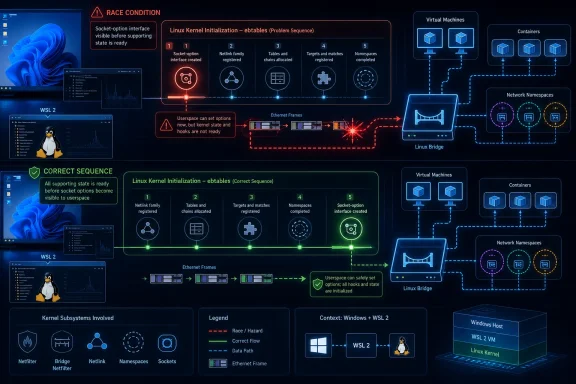 Overview
The vulnerability sits in net/bridge/netfilter/ebtables.c, part of Linux’s bridge-layer packet filtering infrastructure. Ebtables is the older toolset for filtering Ethernet frames, operating at Layer 2 rather than the IP-focused Layer 3 and Layer 4 filtering traditionally associated with iptables.CVE-2026-64076 concerns initialization—not the normal packet-processing path. That distinction matters. The problem appears when the relevant kernel functionality is loaded or initialized and another execution context reaches the ebtables socket-option interface before the subsystem has completed registering its per-network-namespace state and its standard target.
The essential flaw
The vulnerable initialization sequence previously registered several components in this order:- The standard ebtables target was registered.
- The ebtables socket-option handler was registered.
- The per-network-namespace subsystem was registered.
The corrected sequence moves the network-namespace setup first, registers the standard target next, and exposes the socket-option interface only after both earlier steps succeed. This follows a well-established kernel initialization rule: the public entry point should be the last thing registered when it depends on preceding setup.
Why a small patch became a CVE
The upstream change alters only a handful of lines. Yet the patch is security-relevant because lifecycle ordering is a core property of kernel safety. Once an interface is globally reachable, it must behave correctly for all callers—not merely for the initialization thread that created it.Race conditions are inherently difficult to reproduce because they depend on timing. They often surface only under concurrency, heavy automation, dynamic module activity, container churn, or unusual failure conditions. That makes a narrow ordering correction more significant than its diff size suggests.
Background
Linux Netfilter is the framework behind packet filtering, connection tracking, network address translation, packet mangling, and related functions. It is deeply embedded in the Linux networking stack and supports several historical interfaces, including iptables, ip6tables, arptables, ebtables, and the modern nftables framework.Ebtables is specifically associated with Ethernet bridges. A Linux bridge functions much like a software switch, forwarding Ethernet frames among attached interfaces. It is common in virtualization hosts, container networking designs, embedded gateways, home routers, firewall appliances, and systems using virtual Ethernet pairs.
Ebtables and bridge-layer filtering
At a high level, conventional IP firewalling evaluates packets based on IP addresses, ports, protocols, connection states, and similar Layer 3 or Layer 4 properties. Ebtables works closer to the link layer, where decisions can be made based on Ethernet MAC addresses, VLAN tagging, EtherTypes, and bridge-specific forwarding behavior.That capability remains useful in specialized environments. A hypervisor host may use bridge rules to control traffic among virtual machines. An appliance may isolate network segments before packets ever reach an IP stack. A container platform can rely on bridges and virtual interfaces as part of its local networking topology.
Legacy does not mean irrelevant
Ebtables is no longer the preferred direction for new Linux firewall deployments. Nftables provides a more unified rules engine and is generally the modern replacement for multiple older table-based utilities. The Linux bridge documentation explicitly discourages continued reliance on the legacybr_netfilter arrangement when modern nftables-based policy can meet the requirement.Still, “legacy” should not be confused with “unused.” Older control planes can persist for years in enterprise images, network appliances, embedded distributions, long-term-support kernels, and automation frameworks that were built around familiar command-line tools. The broad installed base is one reason a race introduced in Linux kernel 5.13 deserves attention even if the vulnerable subsystem is not present on every Linux machine.
The Technical Root Cause
The core issue is visibility before readiness. The ebtables module initialization function contains several registration steps, each of which makes a different capability available to other portions of the kernel or to user-space callers.The sensitive operation is the registration of ebtables socket options through the Netfilter socket-option mechanism. Once that registration succeeds, the related control operations become globally reachable. That is the publication event.
Publication must come last
A safe module initialization sequence generally follows a dependency-aware pattern:- Allocate or establish internal state.
- Register namespace-scoped state and cleanup handlers.
- Register dependent targets, hooks, or helpers.
- Publish the external interface that can invoke the subsystem.
- On failure, unwind completed work in the reverse order.
Per-network-namespace state is not optional bookkeeping
Linux network namespaces are a foundational isolation mechanism. They allow a single kernel to host separate network stacks, routing tables, interfaces, firewall configurations, and sockets for containers, sandboxes, or virtualized workloads.The ebtables code uses per-network-namespace infrastructure so that each network namespace gets the state it needs. If an interface that accesses ebtables is live before those namespace structures and lifecycle callbacks are registered, callers may encounter state that is absent, incomplete, or not safely governed by the expected initialization and teardown rules.
That is why the patch does not merely add another lock or delay an operation. It changes the initialization order to ensure that the subsystem’s internal foundations exist before the API capable of invoking it is exposed.
A failure path also needs to be correct
Kernel initialization code must handle more than the success case. Every registration point can fail, whether because of resource pressure, conflicting state, unexpected configuration conditions, or another internal error.The revised ordering also changes cleanup behavior. If registration of the standard target fails, the kernel now unregisters the per-network-namespace subsystem. If socket-option registration fails, it unregisters the standard target and then the namespace subsystem. This reverse-order unwind is important because it avoids leaving a partially initialized component behind.
In other words, the patch closes both sides of the lifecycle problem:
- It prevents requests from arriving too early during successful initialization.
- It ensures state is dismantled consistently if initialization fails partway through.
Affected Kernels and Fixed Releases
According to the Linux kernel CVE record, the vulnerability was introduced in Linux kernel version 5.13 by a change that moved ebtables tonet_generic infrastructure. The relevant code remained affected until fixes landed in the supported stable lines.The official fixed versions identified for CVE-2026-64076 are:
- Linux 6.18.34
- Linux 7.0.11
- Linux 7.1 and later
Distribution kernels require separate verification
A system reporting an older-looking kernel version is not automatically unpatched. A distribution may carry the fix in a long-term-support kernel with a vendor-specific release suffix. Conversely, a custom kernel built from an older stable tree can remain vulnerable even if the operating system release itself appears current.The practical question is not merely, “Is the kernel number higher than 6.18.34?” It is:
For vendor-supported systems, the correct answer should come from the distribution’s security advisory, package changelog, errata portal, or support documentation. For appliance firmware, administrators may need confirmation from the vendor because the kernel is often integrated into a broader firmware image rather than independently updated.Has the kernel package installed on this machine incorporated the upstream initialization-order fix for ebtables?
Configuration still matters
The vulnerable code is specific to bridge Netfilter ebtables support. Exposure depends on whether the feature is built into the kernel or available as a module, whether it is present in the deployed kernel configuration, and whether the module can be loaded or is already loaded.That does not mean configuration analysis should substitute for patching. A module that is not loaded today can be loaded tomorrow by an administrator, a service, an orchestration process, a package update, or another component with adequate privileges. Configuration can reduce immediate exposure, but it is not the same as remediation.
Exploitability and Security Impact
The CVSS vector assigned by the Linux kernel CNA is AV:L/AC:L/PR:L/UI:N/S:U/C:H/I:H/A:H. In plain English, that assessment treats the issue as locally reachable, low in attack complexity, requiring low privileges, requiring no user interaction, and potentially capable of affecting confidentiality, integrity, and availability.Those impact dimensions warrant attention, but they should be read with technical discipline. A CVSS score captures a standardized estimate of potential severity; it is not proof that exploitation is trivial in every deployment or that a public exploit exists.
What “local” means in a modern environment
Local kernel vulnerabilities have become more operationally important as systems consolidate workloads. “Local” can mean a logged-in user on a conventional server, but it can also mean:- A process inside a container with a risky privilege configuration.
- A workload with permissions to manipulate network namespaces.
- A user in a shared development environment.
- A tenant with access to network-administration capabilities.
- A service account on a network appliance.
- A local process in a WSL 2 Linux instance.
Do not overstate the public evidence
The published CVE description and upstream patch explain the race and the required initialization ordering, but they do not provide a proof-of-concept exploit or a detailed exploitation chain. There is no need to invent one.The prudent interpretation is that this is a real kernel synchronization flaw with a high severity assessment, not a confirmed report of widespread exploitation. Security teams should patch based on the affected code path and official severity assessment, while avoiding claims that external attackers can automatically exploit the issue over the network.
Why availability deserves special consideration
Race conditions frequently produce instability before they produce a reliable privilege-escalation primitive. Depending on the exact timing and the surrounding code paths, unexpected calls into partially initialized state can lead to crashes, warnings, malformed state transitions, or other reliability failures.For routers, firewalls, Kubernetes nodes, virtual-switch hosts, and edge appliances, an availability failure can have outsized consequences. A single kernel panic on a packet-processing gateway may disrupt connectivity for many users even if the flaw is only triggered locally.
Why This Matters to Windows Users
CVE-2026-64076 is a Linux kernel vulnerability. It does not affect the Windows kernel, Windows Defender Firewall, the Windows Filtering Platform, or native Windows bridging code directly.However, WindowsForum readers increasingly run Linux as an integrated workload rather than as a separate physical system. That makes the distinction between host exposure and guest exposure especially important.
WSL 2 is the clearest Windows-adjacent case
Windows Subsystem for Linux version 2 runs a real Linux kernel inside a lightweight virtual machine. If a WSL 2 distribution uses a vulnerable Linux kernel configuration with the affected ebtables functionality available, the Linux environment—not Windows itself—could be within scope.The main practical concern is therefore not that ebtables rules on a Windows host are vulnerable. Windows does not use the Linux ebtables subsystem. The concern is whether a user’s WSL 2 Linux kernel is current and whether the workload has meaningful access to the relevant networking and administrative interfaces.
For most typical developer installations, ebtables is unlikely to be the feature users think about first. Yet local Kubernetes environments, custom network namespace experiments, advanced container workflows, and security labs can create conditions that are much closer to a conventional Linux networking host.
Docker Desktop and Linux containers
Docker Desktop commonly uses a Linux-based backend on Windows, often integrated with WSL 2. Linux containers therefore run against a Linux kernel boundary even when the workstation itself is a Windows PC.A standard unprivileged container does not automatically gain the capabilities needed to administer host networking. But security posture can change sharply when teams use
--privileged, grant CAP_NET_ADMIN, mount sensitive host resources, enable host networking equivalents, or allow containers to create and manipulate network namespaces.The right lesson is not “avoid containers.” It is to avoid assuming that the Windows desktop boundary eliminates Linux kernel patch obligations. If a Windows workstation hosts Linux container workloads, it has a Linux kernel maintenance responsibility too.
Hyper-V, virtual appliances, and lab environments
The same applies to Linux guests running under Hyper-V, VMware Workstation, VirtualBox, or other hypervisors. A Linux firewall virtual machine, router image, Kubernetes node, testing appliance, or bridge-heavy lab guest must be patched as a Linux system.The guest operating system is the relevant asset. Updating Windows alone will not update a separately managed Linux virtual machine. Conversely, patching a Linux guest addresses the guest kernel issue but does not imply a defect in the Windows host.
Enterprise Impact
Organizations operating Linux at scale should view CVE-2026-64076 through the lens of network-role concentration. The flaw is specialized, but the environments most likely to use bridge-level filtering can also be the environments where one instability event affects many workloads.Virtualization and private cloud platforms
Linux bridges remain common in virtual-machine networking. They may sit beneath virtual switches, attach virtual NICs, enforce segmentation, connect overlay endpoints, or support specialized traffic paths. Even where Open vSwitch, eBPF, or hardware offload is used, Linux bridge functionality may remain present in host configurations or appliance images.A vulnerable ebtables initialization path may be especially relevant where modules are dynamically loaded, hosts are frequently reconfigured, network namespaces are created in bulk, or automation initializes firewall features during node bring-up.
Kubernetes and container orchestration
Modern Kubernetes networking often uses nftables, iptables compatibility layers, eBPF, CNI-managed virtual Ethernet interfaces, and network namespaces. Not every cluster will rely on ebtables, and many will never expose the affected path. But node images can contain legacy components, compatibility packages, or CNI integrations that make bridge filtering relevant.Cluster operators should resist broad assumptions based solely on the word “container.” The important questions are whether the node kernel is vulnerable, whether ebtables bridge support exists, and whether tenants or workloads can gain access to the affected control surface.
Network appliances and edge systems
The most direct operational exposure may be in appliance-style deployments: routers, UTM devices, firewall distributions, VPN gateways, industrial gateways, and embedded Linux systems. These products frequently rely on Linux bridges, VLANs, virtual interfaces, and rules engines, while their update cadence can be slower than mainstream server distributions.For those systems, the patch should be evaluated as part of firmware maintenance rather than as an isolated package update. Administrators should also confirm whether vendor hotfixes require a reboot, whether high-availability peers need staged updating, and whether the appliance preserves custom firewall configuration across firmware changes.
A practical enterprise response sequence
A disciplined response can follow this order:- Identify Linux kernel assets that use bridging, container networking, virtual switching, or network appliances.
- Determine kernel provenance by separating vendor-supported packages from custom, appliance, and self-built kernels.
- Check whether the vendor has backported the fix, rather than relying only on upstream version numbers.
- Prioritize systems with local multi-user access or delegated network administration because the CVSS vector assumes local access with low privileges.
- Schedule kernel updates and reboots through normal change-control processes.
- Validate post-update kernel versions and workload networking before closing the remediation ticket.
- Review privileged container and namespace policies to reduce exposure to future kernel networking flaws.
Consumer and Small-Business Impact
For a typical desktop Linux user or Windows user with a basic WSL development environment, CVE-2026-64076 is unlikely to be an immediate crisis. The affected component is not the everyday browsing, office, or gaming path, and the vulnerability is not described as remotely reachable.That said, consumer networking increasingly includes more sophisticated equipment: open-source routers, home-lab hypervisors, NAS devices, Pi-based gateways, self-hosted Kubernetes clusters, and small-business firewall appliances. These devices often use Linux bridging extensively.
Home routers and firewall distributions
Users running custom router firmware or a dedicated firewall distribution should check for vendor updates rather than manually patching kernel files. Such systems are often purpose-built around bridge interfaces, VLANs, and firewall rules, so a bridge Netfilter issue is more relevant there than on an ordinary desktop.A complete firmware update is generally safer than cherry-picking a single upstream commit. Kernel changes are tested in stable-release combinations, and appliance vendors commonly package related fixes, configuration migrations, and compatibility updates together.
Development systems
Developers running WSL 2, Docker Desktop, Minikube, Kind, local Kubernetes distributions, or virtual Linux labs should keep the underlying Linux components updated. The key point is that update responsibility can be split across several layers:- Windows Update may update Windows itself.
- A WSL update may refresh the WSL-managed kernel or platform components.
- A Linux distribution update refreshes packages inside the distribution.
- Docker Desktop updates its own backend and supporting components.
- A manually managed virtual machine requires its own guest kernel update.
Remediation Guidance
The Linux kernel CVE team recommends updating to a current stable kernel rather than individually cherry-picking the repair. That recommendation is especially sound for a concurrency fix because a patch can rely on behavior and surrounding corrections in the stable series into which it was accepted.Patch the kernel, not just the user-space tools
Updatingebtables, iptables, nftables, or a firewall management frontend alone does not correct this vulnerability. The affected file is part of the Linux kernel. The remediation must therefore arrive through a kernel update, a vendor kernel package, or an appliance firmware release containing the corrected kernel code.Verification checklist
After maintenance, administrators should verify the following:- The running kernel, not merely the installed package list, includes the vendor’s fix.
- A reboot occurred when the updated kernel requires it.
- Bridge-dependent workloads still function, including virtual machines, containers, VLANs, VPNs, and firewall policies.
- High-availability pairs remain compatible if firewall or gateway nodes were updated in stages.
- Custom kernel modules still load correctly after the kernel upgrade.
- Monitoring baselines are restored, particularly on hosts where networking modules are loaded dynamically.
Temporary risk reduction
If immediate patching is impossible, teams can reduce risk by minimizing unnecessary ebtables use, preventing untrusted local users from obtaining network-administration privileges, and avoiding privileged container configurations unless they are operationally required.These are compensating controls, not fixes. They may lower the likelihood that an untrusted workload reaches the control path, but they do not remove the underlying initialization race from an affected kernel.
Strengths and Opportunities
The handling of CVE-2026-64076 contains several positive signals for Linux infrastructure operators.- The vulnerability has a narrowly defined upstream fix. The root cause is clear: an external interface was registered before its dependencies were ready.
- The correction aligns with existing kernel design patterns. The ebtables code now follows the same principle already applied in related iptables, IPv6 tables, and ARP tables code.
- The issue was caught through code review and pattern analysis. A report related to another patch prompted maintainers to examine comparable initialization paths, demonstrating the value of reviewing entire bug classes rather than only isolated symptoms.
- Stable fixes are identified across multiple kernel release lines. This gives vendors a clear upstream basis for backporting and validation.
- The CVE description explicitly favors whole-kernel updates. That guidance discourages risky ad hoc patching in production environments.
A broader engineering lesson
The larger opportunity is to treat public-interface registration as a security boundary. This principle applies beyond ebtables: device nodes, netlink handlers, sysfs attributes, socket options, debug interfaces, BPF hooks, and driver callbacks should become reachable only after every required backing structure is ready.In concurrent kernel code, initialization is not private simply because it occurs during module load. The moment a handler is registered, initialization becomes part of the system’s externally observable behavior.
Risks and Concerns
The immediate technical fix is straightforward, but several operational risks remain.- Legacy components can be difficult to inventory. Organizations may not know where ebtables is enabled, loaded, or indirectly used by appliance software.
- Upstream and vendor version numbers can be misleading. A lower visible version can contain a backported fix, while a custom build can remain vulnerable despite an otherwise current operating system.
- A “local” rating can hide multi-tenant relevance. Containers, shared hosts, build systems, and delegated network administration can make local kernel bugs material to broader environments.
- Privileged container practices amplify exposure. Granting network-administration capabilities or using privileged containers can erode isolation and increase access to sensitive kernel networking controls.
- Firmware update delays are common. Network appliances and embedded systems may remain on old kernels long after mainstream server distributions have shipped fixes.
- Migration from ebtables can introduce outages. Moving directly to nftables without rule translation, testing, and rollback planning can break segmentation or forwarding behavior.
The migration caveat
Nftables is generally the strategic direction for Linux packet filtering, but “replace ebtables immediately” is not a universal incident-response action. Existing rulesets may encode device-specific assumptions, Layer 2 matching behavior, bridge topology, and vendor integrations that need careful validation.The better strategy is to patch first, then plan modernization on a controlled timeline. Security remediation and architecture migration should reinforce each other, but they should not be conflated.
What to Watch Next
The most important short-term development is vendor backporting. The upstream CVE record names fixed versions in the current stable lines, but enterprise distributions, cloud images, appliance makers, and WSL-adjacent platforms will publish fixes according to their own maintenance models.Administrators should watch their vendor advisories for references to CVE-2026-64076 or the ebtables initialization race, especially where kernels are derived from long-term-support branches.
Adjacent Netfilter lifecycle fixes
This issue appeared as part of broader Netfilter maintenance work involving initialization, teardown, table registration, and module lifecycle behavior. That context matters because code-review findings about one ordering flaw can reveal similar patterns elsewhere.Security teams should therefore treat this CVE as a prompt to keep current with the broader kernel update stream, not as a reason to apply one isolated source patch and defer other network-stack fixes indefinitely.
WSL and managed desktop maintenance
Windows administrators supporting developer workstations should confirm that their endpoint patching processes cover Linux runtimes in addition to Windows itself. A clean Windows update report does not necessarily prove that WSL distributions, Docker Desktop backends, local virtual appliances, or Linux test VMs are current.For managed environments, this may justify adding Linux runtime inventory to endpoint compliance reporting. The result is not only better coverage for CVE-2026-64076, but also a more realistic view of where kernels are actually running across a Windows-centric organization.
Looking Ahead
CVE-2026-64076 is not a reason for alarmism, but it is a reason for precision. The vulnerability is limited to a specific Linux bridge Netfilter ebtables initialization path, is locally reachable rather than remotely exposed by default, and has a clear upstream remediation. At the same time, the affected code sits in a privileged kernel subsystem that can be relevant to virtual switches, containers, firewall appliances, and Windows-hosted Linux workloads.The durable lesson is simple: when kernel code publishes a control interface, every dependency behind that interface must already be valid. Linux maintainers corrected that ordering in ebtables, and administrators should now do their part by applying vendor-supported kernel updates, rebooting where necessary, and using the incident to reassess where legacy bridge filtering remains part of their infrastructure.
References
- Primary source: NVD / Linux Kernel
Published: 2026-07-21T01:04:27-07:00
NVD - CVE-2026-64076
 nvd.nist.gov
- Security advisory: MSRC
Published: 2026-07-21T01:04:27-07:00
Original feed URL
Security Update Guide - Microsoft Security Response Center
 msrc.microsoft.com
