

CVE-2026-64077 is a newly published Linux kernel vulnerability in the legacy ebtables portion of Netfilter, and it matters to Windows users chiefly through the Linux systems that now sit beside, beneath, and sometimes inside Windows: WSL 2 distributions, container hosts, developer workstations, Hyper-V guests, edge appliances, and mixed Windows/Linux enterprise estates. The issue was assigned a CVSS 3.1 score of 7.8 (High) by the Linux kernel CNA, reflecting a locally accessible flaw with low attack complexity and potentially severe effects on confidentiality, integrity, and availability. The practical message is straightforward: organizations should identify Linux kernels from the affected range, prioritize vendor-supported kernel updates, and avoid treating the presence of a Windows host as protection for an unpatched Linux guest or container node.
CVE-2026-64077 addresses a lifecycle and synchronization problem in the Linux kernel’s ebtables implementation. Ebtables is a packet-filtering framework for Ethernet bridge traffic, operating at Layer 2 rather than the Layer 3 IP focus commonly associated with iptables or the modern nftables framework.
The flaw is not a conventional remotely reachable network-service bug. Instead, it concerns how ebtables tables and their packet-processing hooks are registered, detached, and ultimately cleaned up. That makes the vulnerability especially relevant where a local actor can administer network namespaces, manipulate bridge filtering configuration, load or unload related modules, or otherwise exercise privileged networking workflows.
That separation is important. In concurrent kernel code, “no longer active” is not identical to “safe to destroy.” Packet-processing paths, per-network-namespace teardown, module exit operations, and control-plane updates can overlap in ways that make a one-step unregister-and-free sequence unsafe.
It does mean defenders should avoid dismissing the issue simply because the vulnerable subsystem is old or specialized. Kernel flaws involving object lifetime, teardown ordering, and concurrent access often produce outcomes that are harder to characterize from the patch description alone, especially while downstream vendors are still assessing reachability and configuration-specific impact.
Unlike a typical host firewall rule set that evaluates IP addresses and TCP or UDP ports, ebtables works with Ethernet-level properties such as MAC addresses, VLAN-related bridge traffic, and frame-level decisions. Linux hosts that act as bridges can use it to filter traffic between virtual machines, containers, physical interfaces, wireless segments, or other attached network endpoints.
A modern enterprise may therefore contain ebtables even when its administrators primarily manage nftables, firewalld, Kubernetes network policy tooling, or vendor-specific network orchestration. The relevant question is not whether a team intentionally writes ebtables rules today; it is whether the kernel includes and exposes the affected code and whether installed software can cause those paths to be exercised.
The affected period therefore spans far more than short-lived development kernels. Systems built around older long-term-support images, custom appliance kernels, or slow-moving product releases merit careful inventory work, particularly if their vendor backports security fixes without changing the visible upstream-style version string.
The central change is the addition of a second per-network-namespace list: one list retains active ebtables tables, while the other retains tables that have been taken out of service but have not completed their final cleanup.
An active table is discoverable and can be used by the relevant filtering path. A dead table has been removed from active use, but remains tracked until the cleanup stage can dispose of it safely. This is a familiar pattern in systems programming: retire an object first, then reclaim it only after the surrounding concurrency rules guarantee it is no longer needed.
This ordered split is more than housekeeping. It makes it possible to remove the table from the visible active configuration while retaining a controlled reference to it for the phase that follows hook removal. The result is a clearer ownership model and a narrower opportunity for stale or partially torn-down state to be reached.
That closes a complementary initialization-side race. The aim is to ensure that other code cannot discover a table structure before the structure’s essential hook-operation state has been fully established. In kernel concurrency work, protecting both entry and exit paths is critical; fixing destruction without examining publication can leave a different timing window intact.
In this case, the pattern aligns ebtables with earlier Netfilter work in the related x_tables area. The upstream commit message explicitly notes that the same helper routines cannot simply be reused because the
The repair recognizes that distinction. The first phase stops normal use by moving the table out of the active collection and unregistering hooks. The second phase handles the resource cleanup after the component’s lifecycle has reached the appropriate point.
Read-Copy-Update, commonly abbreviated as RCU, is widely used in the Linux kernel to allow high-performance reads while updates occur. Its performance benefits are substantial, especially in networking paths, but it requires exact discipline: writers must ensure that an object is not reclaimed until preexisting readers can no longer be using it.
Module unloading and network namespace teardown are areas where ordering matters enormously. A resource may appear independent until an exit path runs under load, during a shutdown, or while another subsystem is still unwinding its own registrations. Adjusting teardown order is therefore part of making the new two-stage model coherent rather than an incidental cleanup.
A personal Linux workstation with no bridge interfaces and no ebtables modules in use is not operationally equivalent to a container host that dynamically constructs bridges and namespaces for workloads. Neither is automatically safe or automatically exploitable, but their attack surface differs substantially.
However, “low privileges” in Linux environments can encompass a wide range of realities: a local account on a shared development host, a compromised service account, a user inside a development VM, a containerized workload granted excessive capabilities, or a tenant with access to namespace-related functionality. Weak local isolation can turn a supposedly limited issue into a more consequential escalation path.
For systems that consolidate many workloads, credentials, development secrets, or build pipelines, that second stage can be highly valuable. The security decision should therefore weigh business role and tenancy, not merely the “AV:L” label.
For WindowsForum readers, the important nuance is that Windows increasingly acts as a host and management plane for Linux workloads. That architecture divides responsibility: Windows security controls remain essential, while the Linux guest kernel has its own independent patch level and attack surface.
Whether a particular WSL 2 environment can reach the affected ebtables code depends on the kernel build, enabled configuration, loaded modules, and the capabilities available within the distribution. Users should not assume that a fully patched Windows installation automatically means every WSL 2 Linux kernel and distribution package is current.
The key administrative question is simple: where does the Linux kernel actually run? If container workloads execute in a local or remote Linux VM, the kernel update responsibility belongs to that Linux environment. Updating a container image alone cannot patch the host kernel that provides namespaces, bridges, and Netfilter.
Enterprises should treat Linux guests as first-class managed assets. That means kernel patch baselines, restart planning, inventory coverage, endpoint detection where appropriate, and the same vulnerability-management discipline applied to Windows Server or Windows client systems.
The broad affected range beginning at Linux 5.15 increases the importance of asset inventory. Long-lived distributions frequently retain kernel version branding while selectively incorporating hundreds of backported fixes, so simplistic version comparisons can generate both false positives and false negatives.
A useful response sequence is:
For fleets with high availability requirements, rolling node replacement is usually safer than attempting broad in-place maintenance. Drain workloads, update one node or a small canary pool, validate networking behavior, then progress through the remainder of the fleet.
This is especially important in environments that have accumulated legacy ebtables rules over time. A patch that corrects teardown behavior should not ordinarily alter intended policy semantics, but upgrade testing should still verify the paths that matter to production traffic.
Still, the growing popularity of WSL 2, home labs, NAS devices, Docker-based services, and small office network appliances makes the issue relevant beyond traditional server rooms. A home server that hosts containers, a router appliance based on Linux, or a Windows PC used for local Kubernetes development can all involve the underlying technology.
For most users, the correct solution is the vendor’s supported kernel update. Custom builds are appropriate only for organizations with the engineering capacity to own testing, rollback, security tracking, and future maintenance.
Removing unused components is not a replacement for patching. It can, however, reduce future exposure and simplify incident response. A smaller, better-understood networking stack is easier to update, monitor, and validate.
The Windows relevance comes from Linux integration. WSL 2, local container tooling, Hyper-V guests, and remote Linux infrastructure managed from Windows all mean that a Windows-centric organization can still own affected Linux kernels. Good security reporting should preserve that distinction.
That narrower scope may reduce exposure for many installations. It should also encourage precise assessment rather than blanket assumptions that either all Linux systems are critically exposed or that no modern environment could possibly use the legacy subsystem.
Administrators should monitor their Linux distribution, cloud platform, appliance, and container-platform advisories for explicit references to CVE-2026-64077. The kernel project’s stated fixed versions are the upstream baseline, but vendors ultimately determine the supported package and restart procedure for each deployment.
Security teams should therefore record both the running kernel release and the installed package build, then match those values to vendor statements. “We are on 5.15” is not sufficient evidence either of vulnerability or remediation.
That does not justify alarmist claims. It does justify a prompt, measured response: patch high-value and multi-tenant systems first, restrict unnecessary privilege paths, and verify that the running—not merely installed—kernel contains the corrected code.
Organizations that rely heavily on Linux networking should view this as a reason to keep kernel cadence healthy, minimize deprecated compatibility layers, and test security updates as a routine operational capability rather than an emergency-only exercise.
CVE-2026-64077 is a reminder that the modern Windows ecosystem is no longer neatly separated from Linux kernel security. The vulnerability is squarely in Linux ebtables, not Windows itself, but Windows users and administrators increasingly depend on Linux through WSL 2, containers, virtual machines, and network appliances. The right response is neither panic nor neglect: identify affected kernels introduced from Linux 5.15 onward, use supported vendor updates that include the upstream fixes in Linux 6.18.34, 7.0.11, or 7.1 and later equivalents, reboot or rotate systems into the patched kernel, and use the update cycle to reduce unnecessary bridge-filtering and container privileges.
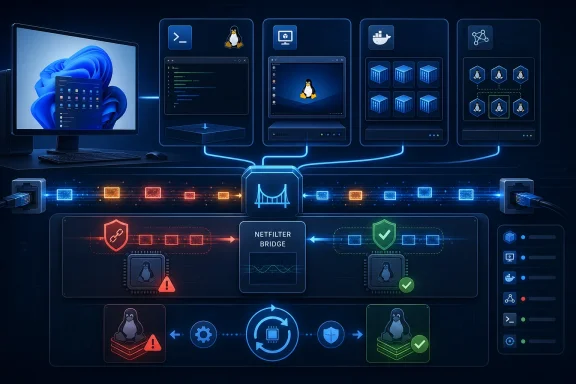 Overview
CVE-2026-64077 addresses a lifecycle and synchronization problem in the Linux kernel’s ebtables implementation. Ebtables is a packet-filtering framework for Ethernet bridge traffic, operating at Layer 2 rather than the Layer 3 IP focus commonly associated with iptables or the modern nftables framework.The flaw is not a conventional remotely reachable network-service bug. Instead, it concerns how ebtables tables and their packet-processing hooks are registered, detached, and ultimately cleaned up. That makes the vulnerability especially relevant where a local actor can administer network namespaces, manipulate bridge filtering configuration, load or unload related modules, or otherwise exercise privileged networking workflows.
The key technical finding
The upstream repair moves ebtables to a two-stage removal scheme. A table is first removed from the active list and has its network hooks unregistered; it is then retained in a separate “dead tables” list until the later cleanup phase can safely free its associated resources.That separation is important. In concurrent kernel code, “no longer active” is not identical to “safe to destroy.” Packet-processing paths, per-network-namespace teardown, module exit operations, and control-plane updates can overlap in ways that make a one-step unregister-and-free sequence unsafe.
Why the CVSS rating deserves attention
The kernel CNA’s 7.8 score corresponds to a local attack vector with low complexity, low privileges required, no user interaction, unchanged scope, and high potential impact across confidentiality, integrity, and availability. This does not mean every Linux machine is equally exposed, nor does it prove that a reliable public exploit exists.It does mean defenders should avoid dismissing the issue simply because the vulnerable subsystem is old or specialized. Kernel flaws involving object lifetime, teardown ordering, and concurrent access often produce outcomes that are harder to characterize from the patch description alone, especially while downstream vendors are still assessing reachability and configuration-specific impact.
Background
Ebtables predates the broad migration toward nftables and remains part of the Linux networking stack for bridge-level filtering and translation. It can inspect and influence Ethernet frames traversing Linux bridges, making it relevant to virtualization, network appliances, container networking, segmentation policies, and specialized routing or switching configurations.Unlike a typical host firewall rule set that evaluates IP addresses and TCP or UDP ports, ebtables works with Ethernet-level properties such as MAC addresses, VLAN-related bridge traffic, and frame-level decisions. Linux hosts that act as bridges can use it to filter traffic between virtual machines, containers, physical interfaces, wireless segments, or other attached network endpoints.
A legacy subsystem with modern deployment relevance
The word legacy can create a false sense of safety. Ebtables may not be the preferred interface for greenfield deployments, but older tooling, compatibility layers, embedded distributions, virtualization stacks, and appliance software can keep it in active use for years.A modern enterprise may therefore contain ebtables even when its administrators primarily manage nftables, firewalld, Kubernetes network policy tooling, or vendor-specific network orchestration. The relevant question is not whether a team intentionally writes ebtables rules today; it is whether the kernel includes and exposes the affected code and whether installed software can cause those paths to be exercised.
The origin point: Linux kernel 5.15
According to the Linux kernel CVE record, the issue was introduced in Linux kernel version 5.15 by a change described as preventing ebtables tables from being hooked by default. That is a significant detail because Linux 5.15 became a long-lived kernel line in many distributions, appliances, cloud images, and enterprise environments.The affected period therefore spans far more than short-lived development kernels. Systems built around older long-term-support images, custom appliance kernels, or slow-moving product releases merit careful inventory work, particularly if their vendor backports security fixes without changing the visible upstream-style version string.
The upstream fixed versions
As of July 21, 2026, the Linux kernel CVE record identifies these upstream fixes:- Linux 6.18.34 includes a stable-tree fix.
- Linux 7.0.11 includes a stable-tree fix.
- Linux 7.1 includes the original upstream fix.
What the Patch Changes
The fix is modest in line count but substantial in design intent. It modifies the ebtables registration and removal process across the core implementation and the bridge filtering, bridge NAT, and broute table components.The central change is the addition of a second per-network-namespace list: one list retains active ebtables tables, while the other retains tables that have been taken out of service but have not completed their final cleanup.
Active tables versus dead tables
Before the fix, the cleanup logic could remove a table from the active list and proceed toward teardown in a way that did not adequately distinguish between visibility to new users and safety for ongoing kernel activity. The revised model treats these as separate states.An active table is discoverable and can be used by the relevant filtering path. A dead table has been removed from active use, but remains tracked until the cleanup stage can dispose of it safely. This is a familiar pattern in systems programming: retire an object first, then reclaim it only after the surrounding concurrency rules guarantee it is no longer needed.
Hook unregistering becomes an explicit first stage
The patched code changes the pre-exit unregister function so that it locates the table on the active list, moves it to the dead-table list, releases the ebtables mutex, and unregisters the Netfilter hooks. The later unregister function searches the dead-table list, logs the removal, and performs the remaining cleanup.This ordered split is more than housekeeping. It makes it possible to remove the table from the visible active configuration while retaining a controlled reference to it for the phase that follows hook removal. The result is a clearer ownership model and a narrower opportunity for stale or partially torn-down state to be reached.
Registration receives the same scrutiny
The patch also changes table registration. The table’s hook-operation pointer is assigned while the ebtables mutex is still held, and the table is added to the active list only after hook registration succeeds.That closes a complementary initialization-side race. The aim is to ensure that other code cannot discover a table structure before the structure’s essential hook-operation state has been fully established. In kernel concurrency work, protecting both entry and exit paths is critical; fixing destruction without examining publication can leave a different timing window intact.
Why Two-Stage Removal Matters
Two-stage removal is a standard defensive pattern for kernel and systems code that manages objects observed by multiple execution contexts. An object can be logically removed from service before it is physically destroyed, with the gap allowing in-flight users and deferred callbacks to drain safely.In this case, the pattern aligns ebtables with earlier Netfilter work in the related x_tables area. The upstream commit message explicitly notes that the same helper routines cannot simply be reused because the
ebt_table structure’s layout differs from the x_tables equivalent.Logical deletion is not memory reclamation
A table disappearing from a list only answers one question: can new list walkers find it? It does not, by itself, establish that no CPU still holds a reference, no hook callback can reach its state, and no teardown sequence remains dependent on the object.The repair recognizes that distinction. The first phase stops normal use by moving the table out of the active collection and unregistering hooks. The second phase handles the resource cleanup after the component’s lifecycle has reached the appropriate point.
RCU and synchronization are part of the story
The registration error path in the patch now includes an explicit synchronization step before cleanup when Netfilter hook registration fails. This is consistent with the core problem being one of safe handoff between concurrent readers and object teardown.Read-Copy-Update, commonly abbreviated as RCU, is widely used in the Linux kernel to allow high-performance reads while updates occur. Its performance benefits are substantial, especially in networking paths, but it requires exact discipline: writers must ensure that an object is not reclaimed until preexisting readers can no longer be using it.
Ordering changes in module exit paths
The patch also changes the order in which the broute, filter, and NAT ebtables modules unregister their templates and per-network-namespace subsystems. This is an often-overlooked clue about the defect class.Module unloading and network namespace teardown are areas where ordering matters enormously. A resource may appear independent until an exit path runs under load, during a shutdown, or while another subsystem is still unwinding its own registrations. Adjusting teardown order is therefore part of making the new two-stage model coherent rather than an incidental cleanup.
Scope and Exposure
The vulnerable code resides in Linux bridge Netfilter ebtables components. Its relevance depends on more than a kernel version: configuration, installed modules, local privilege boundaries, use of Linux bridges, network namespaces, and the operational role of the system all affect real-world exposure.A personal Linux workstation with no bridge interfaces and no ebtables modules in use is not operationally equivalent to a container host that dynamically constructs bridges and namespaces for workloads. Neither is automatically safe or automatically exploitable, but their attack surface differs substantially.
Systems most likely to deserve priority review
The following environments should generally move to the front of a remediation queue:- Container hosts and Kubernetes worker nodes may create bridges, virtual Ethernet pairs, and network namespaces at high frequency.
- Virtualization hosts may use Linux bridges to connect guests, tenant networks, or virtual switches.
- Network appliances and edge systems often retain ebtables compatibility for frame filtering and bridge policy enforcement.
- Multi-tenant development servers may grant users access to containers, namespaces, or network-administration capabilities.
- Custom embedded Linux products may run long-lived kernels where upstream version tracking is incomplete or vendor patch cadence is slow.
Privilege requirements should be interpreted carefully
The published vector lists Privileges Required: Low, not None. That distinction matters. A remote unauthenticated internet attacker is not the threat model described by the CVSS vector.However, “low privileges” in Linux environments can encompass a wide range of realities: a local account on a shared development host, a compromised service account, a user inside a development VM, a containerized workload granted excessive capabilities, or a tenant with access to namespace-related functionality. Weak local isolation can turn a supposedly limited issue into a more consequential escalation path.
The absence of a remote vector is not a reason to defer indefinitely
Organizations commonly prioritize remote code execution ahead of local privilege escalation, and that is reasonable. But a local kernel vulnerability may become the second stage in a broader intrusion chain: an attacker first compromises a lower-privileged application account, then exploits the kernel to obtain stronger host-level control.For systems that consolidate many workloads, credentials, development secrets, or build pipelines, that second stage can be highly valuable. The security decision should therefore weigh business role and tenancy, not merely the “AV:L” label.
Windows, WSL 2, and Hyper-V Implications
CVE-2026-64077 is a Linux kernel issue, not a flaw in the Windows kernel or in Windows Defender Firewall. A standard Windows desktop that does not run Linux virtual machines, WSL 2, Docker-style Linux containers, or third-party Linux virtualization is not directly affected by this specific vulnerability.For WindowsForum readers, the important nuance is that Windows increasingly acts as a host and management plane for Linux workloads. That architecture divides responsibility: Windows security controls remain essential, while the Linux guest kernel has its own independent patch level and attack surface.
WSL 2 is a real Linux kernel environment
WSL 2 runs Linux distributions in a lightweight virtual machine using a real Linux kernel. Linux user-space software, kernel modules, namespaces, and networking behavior inside that environment are therefore distinct from Windows-native processes.Whether a particular WSL 2 environment can reach the affected ebtables code depends on the kernel build, enabled configuration, loaded modules, and the capabilities available within the distribution. Users should not assume that a fully patched Windows installation automatically means every WSL 2 Linux kernel and distribution package is current.
Docker Desktop and development tooling
Windows development machines frequently run Linux containers through Docker Desktop, Podman-related workflows, local Kubernetes distributions, CI agents, or virtual machines. The operational impact depends on architecture: some tools use a managed Linux VM, some use WSL 2 integration, and others connect to a remote Linux engine.The key administrative question is simple: where does the Linux kernel actually run? If container workloads execute in a local or remote Linux VM, the kernel update responsibility belongs to that Linux environment. Updating a container image alone cannot patch the host kernel that provides namespaces, bridges, and Netfilter.
Hyper-V isolation remains valuable, but it is not patching
Hyper-V and virtualization boundaries can reduce the blast radius of a compromised Linux guest. They do not eliminate the need to update that guest’s kernel, especially if it hosts sensitive workloads, developer credentials, shared mounts, internal source code, or network access.Enterprises should treat Linux guests as first-class managed assets. That means kernel patch baselines, restart planning, inventory coverage, endpoint detection where appropriate, and the same vulnerability-management discipline applied to Windows Server or Windows client systems.
Enterprise Impact and Operational Priorities
For enterprise defenders, CVE-2026-64077 is primarily a patch-management and exposure-analysis problem. The patch itself is upstream and available in identified kernel lines, but the operational challenge is determining which vendor kernels incorporate it and which systems enable the relevant bridge Netfilter pathways.The broad affected range beginning at Linux 5.15 increases the importance of asset inventory. Long-lived distributions frequently retain kernel version branding while selectively incorporating hundreds of backported fixes, so simplistic version comparisons can generate both false positives and false negatives.
Start with ownership, not just scanning
A vulnerability scanner may flag a version range, but a durable response needs clear service ownership. Platform teams typically own base images and worker nodes; endpoint teams may own developer WSL setups; networking teams may own bridge appliances; and product groups may own embedded Linux images.A useful response sequence is:
- Identify Linux systems using kernels derived from 5.15 or later that have not been confirmed as patched.
- Classify systems by bridge, container, virtualization, and multi-tenant networking use.
- Obtain vendor-specific confirmation that the CVE fix is included in the deployed kernel package.
- Apply the vendor-supported kernel update and schedule a reboot or controlled host rotation.
- Validate workload networking, bridge policy, and container connectivity after deployment.
- Document exceptions with compensating controls and an expiration date.
Reboot planning is not optional
A kernel package update on disk does not normally replace the kernel currently executing. The vulnerable kernel remains active until the machine is rebooted into the updated kernel, or until an approved live-patching mechanism has explicitly applied the relevant change.For fleets with high availability requirements, rolling node replacement is usually safer than attempting broad in-place maintenance. Drain workloads, update one node or a small canary pool, validate networking behavior, then progress through the remainder of the fleet.
Test the networking behavior that actually matters
Because this is a Netfilter and bridge-lifecycle fix, post-update checks should include more than “the server came back online.” Validate container-to-container communication, north-south ingress, service discovery, VLAN or bridge policy behavior, NAT where applicable, and any appliance-specific forwarding rules.This is especially important in environments that have accumulated legacy ebtables rules over time. A patch that corrects teardown behavior should not ordinarily alter intended policy semantics, but upgrade testing should still verify the paths that matter to production traffic.
Consumer and Small-Business Impact
For consumers, the immediate risk is typically lower than for shared Linux infrastructure. Most Windows users do not manage ebtables directly, and many home Linux installations do not use bridge filtering at all.Still, the growing popularity of WSL 2, home labs, NAS devices, Docker-based services, and small office network appliances makes the issue relevant beyond traditional server rooms. A home server that hosts containers, a router appliance based on Linux, or a Windows PC used for local Kubernetes development can all involve the underlying technology.
Sensible actions for enthusiasts
Windows enthusiasts and small administrators should focus on practical hygiene rather than panic:- Update the Linux kernel through the supported distribution, appliance, or platform channel.
- Update WSL and installed distributions rather than assuming Windows Update covers every Linux component.
- Restart the relevant Linux VM, WSL environment, appliance, or host after applying kernel updates.
- Avoid granting containers unnecessary network-administration capabilities.
- Remove obsolete bridge-filtering rules and modules if they are no longer needed.
Avoid unsupported patching shortcuts
The Linux kernel CVE announcement explicitly advises against cherry-picking the individual commit as a standalone fix. That recommendation is sound. Kernel changes are tested as part of larger stable releases, and manually applying a security patch to a vendor kernel can create support, compatibility, and regression problems.For most users, the correct solution is the vendor’s supported kernel update. Custom builds are appropriate only for organizations with the engineering capacity to own testing, rollback, security tracking, and future maintenance.
Strengths and Opportunities
CVE-2026-64077 also illustrates several positive aspects of the current Linux security and maintenance process.- The flaw has a concrete upstream fix across current stable kernel lines. Administrators are not left waiting for a theoretical mitigation or an uncommitted design proposal.
- The repair improves lifecycle clarity rather than only masking one symptom. Separating active and dead tables creates a more understandable ownership model for future maintenance.
- The patch addresses both publication and teardown concerns. Keeping the hook-operation assignment protected by the mutex reduces the chance of exposing partially initialized state.
- The change follows a pattern already used in related Netfilter code. Consistency across x_tables and ebtables can make correctness reviews and future hardening easier.
- The public record identifies the introduction point and affected source files. That detail helps distributors, appliance vendors, and internal kernel teams audit backports accurately.
A useful prompt for reducing legacy attack surface
The vulnerability is also an opportunity to review whether ebtables is still needed at all. Many deployments have moved policy administration toward nftables or higher-level networking stacks, yet retain older modules and rules because nobody has revisited them.Removing unused components is not a replacement for patching. It can, however, reduce future exposure and simplify incident response. A smaller, better-understood networking stack is easier to update, monitor, and validate.
Risks and Concerns
The technical fix is clear, but several operational and security uncertainties remain significant.- Exploitability is configuration-dependent. The CVSS rating is a useful severity indicator, but it does not prove that every affected kernel configuration is practically exploitable.
- The NVD had not yet provided its own CVSS assessment as of July 21, 2026. The currently visible 7.8 High score originates with kernel.org’s CNA analysis.
- Distribution backports complicate version-based decisions. An older displayed kernel version may be patched, while a superficially newer custom kernel may not include the needed change.
- Container environments can blur privilege boundaries. Excessive capabilities, privileged containers, host networking, and namespace access can make a local flaw more relevant than administrators expect.
- Kernel updates carry availability and regression risk. Network-heavy deployments should use staged rollout and rollback planning rather than treating the update as a routine user-space package refresh.
Do not overstate the Windows angle
It would be inaccurate to frame CVE-2026-64077 as a Windows vulnerability. It is not. There is no indication that ordinary Windows networking, Windows Firewall, or the Windows kernel is directly affected.The Windows relevance comes from Linux integration. WSL 2, local container tooling, Hyper-V guests, and remote Linux infrastructure managed from Windows all mean that a Windows-centric organization can still own affected Linux kernels. Good security reporting should preserve that distinction.
Do not confuse ebtables with all firewalling
Not every system using Netfilter, iptables compatibility commands, nftables, or a Linux firewall is necessarily using the affected ebtables table lifecycle. The vulnerable area is specifically in bridge Netfilter ebtables handling.That narrower scope may reduce exposure for many installations. It should also encourage precise assessment rather than blanket assumptions that either all Linux systems are critically exposed or that no modern environment could possibly use the legacy subsystem.
What to Watch Next
The first days after a CVE publication are often incomplete. Advisories evolve as distribution maintainers evaluate backports, vendors publish package updates, researchers assess exploitability, and asset-management platforms add detection logic.Administrators should monitor their Linux distribution, cloud platform, appliance, and container-platform advisories for explicit references to CVE-2026-64077. The kernel project’s stated fixed versions are the upstream baseline, but vendors ultimately determine the supported package and restart procedure for each deployment.
Watch for downstream advisories and backports
Major distributions may ship the patch under package revisions that do not map neatly to upstream numbers. Enterprise Linux platforms, for example, commonly retain an older base version while backporting security changes. Appliance vendors may package custom kernels on their own schedules.Security teams should therefore record both the running kernel release and the installed package build, then match those values to vendor statements. “We are on 5.15” is not sufficient evidence either of vulnerability or remediation.
Watch for exploitation evidence, but patch first
There was no need to wait for public exploit reporting before acting on a High-rated kernel CVE. Exploit development can follow patch analysis, and kernel fixes frequently reveal enough detail for researchers to focus their testing.That does not justify alarmist claims. It does justify a prompt, measured response: patch high-value and multi-tenant systems first, restrict unnecessary privilege paths, and verify that the running—not merely installed—kernel contains the corrected code.
Watch the broader Netfilter hardening trend
The ebtables fix is part of a wider lesson about synchronization in networking subsystems. Fast-path packet handling, namespace management, module lifetime, and dynamic rule updates place heavy demands on locking and memory-reclamation discipline.Organizations that rely heavily on Linux networking should view this as a reason to keep kernel cadence healthy, minimize deprecated compatibility layers, and test security updates as a routine operational capability rather than an emergency-only exercise.
CVE-2026-64077 is a reminder that the modern Windows ecosystem is no longer neatly separated from Linux kernel security. The vulnerability is squarely in Linux ebtables, not Windows itself, but Windows users and administrators increasingly depend on Linux through WSL 2, containers, virtual machines, and network appliances. The right response is neither panic nor neglect: identify affected kernels introduced from Linux 5.15 onward, use supported vendor updates that include the upstream fixes in Linux 6.18.34, 7.0.11, or 7.1 and later equivalents, reboot or rotate systems into the patched kernel, and use the update cycle to reduce unnecessary bridge-filtering and container privileges.
References
- Primary source: NVD / Linux Kernel
Published: 2026-07-21T01:03:09-07:00
NVD - CVE-2026-64077
 nvd.nist.gov
- Security advisory: MSRC
Published: 2026-07-21T01:03:09-07:00
Original feed URL
Security Update Guide - Microsoft Security Response Center
 msrc.microsoft.com