

CVE-2026-64079 is a newly published Linux kernel flaw in the Netfilter x_tables subsystem that can turn an unlucky race between firewall-table registration and network-namespace teardown into a kernel NULL-pointer dereference. The issue is not presented as a remote code-execution bug, and no severity score has yet been assigned by NVD, but it matters because the affected machinery sits beneath classic
Linux Netfilter is the kernel framework responsible for inspecting, accepting, rejecting, translating, marking, and otherwise processing network traffic. It is the foundation beneath several familiar administration tools, including
That long tail is significant. A vulnerability in a mature compatibility subsystem can affect systems that are otherwise modern, because organizations rarely replace all firewall automation at once. It is common to find a contemporary Linux distribution with an nftables-capable kernel while applications and deployment scripts still invoke
In plain language, the kernel could briefly publish an object that looked ready to other parts of the networking subsystem even though one of its critical internal pointers was still
Whether a particular environment has a realistic exploitation path depends on configuration, privileges, namespace use, firewall-management behavior, kernel build options, and the distribution’s backport status. Administrators should therefore avoid overstating the issue as universally remotely exploitable. The confirmed problem is a kernel crash condition arising from unsafe concurrent lifecycle handling.
That ordering created this temporary state:
The result is a general-protection fault, which is a class of fatal kernel exception on common architectures. Depending on kernel configuration and platform policy, that may generate an oops, kill a task, leave a subsystem unstable, or escalate to a full panic and reboot. In production, a kernel oops is never something to casually dismiss: even if the system remains running, the integrity and availability implications demand investigation.
The CVE therefore is not about a conventional firewall rule that matches the wrong packet. It is about the lifecycle of firewall infrastructure inside a network namespace. The relevant race becomes plausible where namespaces are frequently created, configured, torn down, or reconfigured alongside firewall-table activity.
This is an example of a broader concurrency principle: locks are not merely about preventing two threads from modifying the same list at the same instant. They also define the point at which partial initialization becomes fully visible to other code. Moving allocation inside the protected region ensures observers cannot discover a half-built table.
Why a
A superficial mitigation might have been to add a conditional check in the cleanup callback: if the operations pointer is
If registration had partially succeeded, hooks might already have been published to the packet-processing path. Simply skipping cleanup because an internal pointer is missing could leave hooks installed, leak state, create use-after-free conditions later, or produce a firewall configuration that no longer matches the kernel’s bookkeeping.
The upstream approach is stronger because it fixes the lifecycle invariant rather than merely masking one symptom. A table is not listed as registered until it has the resources necessary to be safely unregistered.
That does not make concurrency bugs disappear, but it narrows the number of places where developers must preserve subtle ordering requirements. In security-sensitive kernel networking code, centralized ownership rules are often safer than parallel implementations that drift over time.
The important detail in this CVE is that hook registration may have published at least one hook before returning an error. That means the system cannot safely assume “failure equals no observable effect.”
Why
The patch calls for an RCU synchronization step if hook registration fails after partial publication. Read-Copy-Update, or RCU, is a Linux synchronization mechanism optimized for read-mostly paths. Network packet processing is a classic case: the kernel wants packets to traverse rule hooks efficiently without taking heavyweight locks for every packet.
When a hook might already be reachable by readers, removing it from a list is not necessarily enough. CPUs may still hold references acquired before the removal. An RCU grace period ensures that pre-existing readers have completed before the kernel frees or invalidates the associated state.
This is why the patch’s error path matters as much as the initial mutex change. It handles two distinct risks:
Without the RCU wait, an error unwind might remove bookkeeping while a packet path still uses it. That class of bug can be more severe than a deterministic NULL dereference because it may produce timing-dependent memory corruption, intermittent crashes, or state corruption that is difficult to reproduce.
Deferring the message until registration passes its failure points preserves a more trustworthy audit trail. It also avoids the need for a compensating unregister message solely because registration had to be unwound.
The change highlights a useful engineering lesson: transactional behavior includes observability. A system is not fully correct if its internal data structures are rolled back but its logs suggest success.
For example, an enterprise distribution may advertise a kernel based on an earlier long-term branch while carrying hundreds or thousands of later corrections. Conversely, a self-built kernel, an appliance image, or a custom cloud image may use a newer nominal version without a particular stable fix.
The right question is not simply “Is this kernel newer than 5.13?” It is: Does the vendor’s kernel package include the CVE-2026-64079 fix or an equivalent backport?
Administrators should inventory actual firewall tooling rather than relying on a distribution’s default recommendation. Compatibility layers are often where older kernel paths remain active long after a migration appears complete.
The most important distinction is that WSL 1 and WSL 2 are architecturally different. WSL 1 translates Linux system calls and does not run the same full Linux kernel architecture as WSL 2. This CVE concerns Linux kernel Netfilter code, making WSL 2 the relevant environment.
Container users should remember that patch responsibility is divided. Updating a Linux distribution inside WSL may update that distribution’s userspace packages, while the WSL kernel itself may be updated through Windows or WSL servicing. Docker Desktop may also package, manage, or depend on its own Linux VM components. The correct remediation path depends on the precise architecture.
The Windows host remains important for business continuity, but patching Windows alone will not repair the vulnerable kernel inside a Linux guest. A guest crash can still interrupt developer workflows, CI jobs, local clusters, lab networks, or services exposed from the VM.
A cluster node can be especially exposed if it combines rapid pod turnover, network-policy enforcement, iptables-compatible rule programming, and high traffic volume. None of these factors alone establishes exploitability, but together they make prompt maintenance prudent.
Because CI systems are designed to execute code from many branches, repositories, or contributors, they deserve special attention. An availability issue that can be triggered by a sufficiently capable workload may become a practical service-disruption vector even if it does not offer data theft or privilege escalation.
The CVE does not establish that an unprivileged remote tenant can trigger the race on every deployment. However, it reinforces a familiar truth: when tenant-controlled workloads interact with kernel namespace and packet-filtering infrastructure, availability bugs can become multi-tenant risks.
Organizations should be wary of disabling firewall controls, broadening privileges, or dismantling container isolation as a workaround. Those actions can introduce more direct security problems than the bug they aim to avoid. The safest interim measure is operational containment: reduce exposure where feasible, monitor aggressively, and schedule kernel maintenance quickly.
For Windows users running WSL 2, it is equally important to distinguish the Linux distribution userspace from the kernel supplied to the WSL environment. Updating Ubuntu packages inside WSL does not automatically establish that the host-managed WSL kernel includes the repaired Netfilter code.
That discipline applies far beyond firewall hooks. Device registration, filesystem mounts, service discovery, driver initialization, connection tracking, and container runtime state all face similar hazards when partial construction becomes visible too early.
At the same time, administrators should not downplay a kernel crash because it is “only” a denial of service. Availability is a core security property, especially for routers, gateways, CI infrastructure, shared compute nodes, and systems that host business-critical workloads.
Administrators should track the vendor that actually supplies their running kernel. For an Ubuntu VM, that may be Canonical; for an enterprise server, a commercial distribution vendor; for a cloud appliance, the appliance maker; and for WSL 2, the servicing path responsible for the WSL kernel.
Until then, prudent language is warranted. The correct operational posture is to patch based on the confirmed kernel defect, not to wait for sensationalized exploit claims or assume that a missing public exploit means no action is needed.
Migration must be planned carefully. Firewall behavior, container networking, tooling compatibility, orchestration integrations, and operational expertise all matter. Replacing one subsystem without validating policy equivalence can create security gaps of its own.
CVE-2026-64079 is a concise example of how a seemingly small initialization-order mistake can become a meaningful kernel stability problem when it crosses namespace teardown, packet-filter hooks, error recovery, and concurrent execution. The fix is technically sound because it restores a crucial guarantee: once a firewall table is visible, its hook state must already be valid, and any partially published packet path must be fully quiesced before teardown. Windows users operating Linux through WSL 2, Docker Desktop, virtual machines, or developer clusters should treat the affected Linux kernel as a distinct patching responsibility, while enterprise teams should prioritize the container-heavy systems where network namespaces and firewall state are constantly in motion.
iptables, ip6tables, and arptables firewall handling. For Windows users, the practical exposure is concentrated in Linux environments running alongside Windows—especially WSL 2 distributions, Docker Desktop’s Linux backend, Kubernetes nodes, virtual machines, CI runners, and network appliances—not in the Windows networking stack itself.
 Background
Linux Netfilter is the kernel framework responsible for inspecting, accepting, rejecting, translating, marking, and otherwise processing network traffic. It is the foundation beneath several familiar administration tools, including iptables, ip6tables, arptables, ebtables, and newer nftables deployments that may retain compatibility with older rule-management interfaces.Why x_tables Still Matters
The x_tables component is a shared kernel framework used by the traditional table-based packet-filtering interfaces. Althoughnftables has been the strategic successor to legacy iptables tooling for years, x_tables remains important because legacy command-line utilities, compatibility layers, appliance software, scripts, container hosts, and enterprise policies continue to rely on it.That long tail is significant. A vulnerability in a mature compatibility subsystem can affect systems that are otherwise modern, because organizations rarely replace all firewall automation at once. It is common to find a contemporary Linux distribution with an nftables-capable kernel while applications and deployment scripts still invoke
iptables semantics.The CVE’s Core Finding
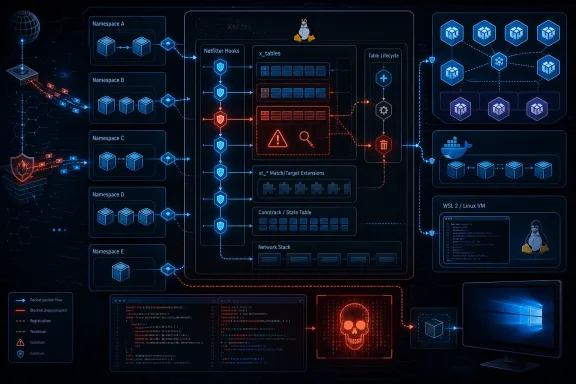
CVE-2026-64079 addresses a race condition in the registration of x_tables firewall tables. Before the fix, a table could become visible in a per-network-namespace list before the corresponding per-namespace Netfilter hook-operation data had been fully allocated.In plain language, the kernel could briefly publish an object that looked ready to other parts of the networking subsystem even though one of its critical internal pointers was still
NULL. If namespace cleanup began during that window, the cleanup path could attempt to unregister packet hooks through that invalid pointer and crash the kernel.A Reliability Bug With Security Relevance
The upstream description frames the bug as a resolved kernel vulnerability and includes a reported general-protection fault in the hook-unregistration path. That makes the immediate concern availability: a local or container-adjacent workload that can repeatedly exercise the timing window may be able to cause a denial of service by provoking a host or guest crash.Whether a particular environment has a realistic exploitation path depends on configuration, privileges, namespace use, firewall-management behavior, kernel build options, and the distribution’s backport status. Administrators should therefore avoid overstating the issue as universally remotely exploitable. The confirmed problem is a kernel crash condition arising from unsafe concurrent lifecycle handling.
The Technical Anatomy of the Race
The vulnerable path involves registration routines for ARP, IPv4, and IPv6 firewall tables. These routines eventually rely on common x_tables code to register a table for a particular network namespace and connect it to Netfilter hook operations.A Table Became Visible Too Soon
The ordering flaw was straightforward in concept but dangerous in a concurrent kernel. The registration flow added a firewall table to a per-network-namespace list before allocating a copied array of hook-operation structures.That ordering created this temporary state:
- The table was already discoverable through the namespace’s table list.
- The associated hook-operation pointer had not yet been populated.
- A concurrent teardown operation could find the table.
- The teardown path could pass the
NULLhook-operation pointer into the hook-unregistration function.
Why the Crash Happens
The reported fault occurs in the function responsible for unregistering Netfilter hooks. The cleanup callback locates the table and attempts to remove its hooks as part of namespace shutdown. If the table’s operation array is missing, the unregister routine receives an invalid pointer and can dereference it.The result is a general-protection fault, which is a class of fatal kernel exception on common architectures. Depending on kernel configuration and platform policy, that may generate an oops, kill a task, leave a subsystem unstable, or escalate to a full panic and reboot. In production, a kernel oops is never something to casually dismiss: even if the system remains running, the integrity and availability implications demand investigation.
The Importance of Per-Namespace State
Linux network namespaces are isolated instances of networking state. They are fundamental to containers, sandboxes, network emulation, VPN isolation, and multi-tenant application designs. Each namespace can maintain separate interfaces, routes, firewall configuration, sockets, and related data.The CVE therefore is not about a conventional firewall rule that matches the wrong packet. It is about the lifecycle of firewall infrastructure inside a network namespace. The relevant race becomes plausible where namespaces are frequently created, configured, torn down, or reconfigured alongside firewall-table activity.
Why the Mutex Boundary Is the Real Fix
The upstream repair moves hook-operation allocation into the x_tables core and performs it while the relevant mutex protects the registration process. That is more than a minor code shuffle: it restores a critical object-publication rule.Construct Before Publish
The safest lifecycle pattern for shared kernel objects is simple:- Allocate all required resources.
- Initialize the object completely.
- Validate any operations that may fail.
- Publish the object only when it is ready for concurrent users.
- Tear it down in the reverse order.
This is an example of a broader concurrency principle: locks are not merely about preventing two threads from modifying the same list at the same instant. They also define the point at which partial initialization becomes fully visible to other code. Moving allocation inside the protected region ensures observers cannot discover a half-built table.
Why a NULL Check Would Be Inferior
A superficial mitigation might have been to add a conditional check in the cleanup callback: if the operations pointer is NULL, skip unregistration. That would prevent one crash path but could create a different correctness problem.If registration had partially succeeded, hooks might already have been published to the packet-processing path. Simply skipping cleanup because an internal pointer is missing could leave hooks installed, leak state, create use-after-free conditions later, or produce a firewall configuration that no longer matches the kernel’s bookkeeping.
The upstream approach is stronger because it fixes the lifecycle invariant rather than merely masking one symptom. A table is not listed as registered until it has the resources necessary to be safely unregistered.
Centralizing the Logic
Moving allocation into the shared x_tables core also reduces duplication across ARP, IPv4, and IPv6 table registration paths. When common state handling lives in one layer, maintainers have a better chance of applying the same lifetime guarantees consistently across related subsystems.That does not make concurrency bugs disappear, but it narrows the number of places where developers must preserve subtle ordering requirements. In security-sensitive kernel networking code, centralized ownership rules are often safer than parallel implementations that drift over time.
Error Unwinding and the RCU Dimension
The CVE fix does more than relocate memory allocation. It also strengthens error handling for a partial registration failure, especially after Netfilter hooks may have become visible to packet processing.Registration Can Fail After Publication
Kernel registration functions often perform multiple operations, any of which can fail. A routine may allocate memory, prepare structures, register hooks, create associated state, update bookkeeping, and emit audit records. If an error occurs halfway through, the code must reverse completed actions without exposing dangling state.The important detail in this CVE is that hook registration may have published at least one hook before returning an error. That means the system cannot safely assume “failure equals no observable effect.”
Why synchronize_rcu() Is Needed
The patch calls for an RCU synchronization step if hook registration fails after partial publication. Read-Copy-Update, or RCU, is a Linux synchronization mechanism optimized for read-mostly paths. Network packet processing is a classic case: the kernel wants packets to traverse rule hooks efficiently without taking heavyweight locks for every packet.When a hook might already be reachable by readers, removing it from a list is not necessarily enough. CPUs may still hold references acquired before the removal. An RCU grace period ensures that pre-existing readers have completed before the kernel frees or invalidates the associated state.
This is why the patch’s error path matters as much as the initial mutex change. It handles two distinct risks:
- The mutex prevents a half-initialized table from becoming discoverable during registration.
- RCU synchronization ensures that partially published hooks are no longer executing before cleanup proceeds.
Packet Processing Must Stop First
The practical safety rule is: do not tear down hook state until packet-processing paths can no longer execute it. In a heavily loaded host, that distinction is not academic. Network traffic may be arriving on several CPUs, and hook traversal may overlap with an administrative operation that changes firewall configuration or destroys a namespace.Without the RCU wait, an error unwind might remove bookkeeping while a packet path still uses it. That class of bug can be more severe than a deterministic NULL dereference because it may produce timing-dependent memory corruption, intermittent crashes, or state corruption that is difficult to reproduce.
Audit Logging Is Part of Correct Failure Handling
One of the less obvious changes described in the CVE concerns audit logging. The registration audit message is delayed until all relevant operations have succeeded.Avoiding Misleading Success Records
Security and operational logging should reflect committed actions, not work that might complete. If the kernel emits a firewall-registration audit event before all setup steps succeed, a subsequent rollback can leave audit logs claiming a configuration change that never became durable.Deferring the message until registration passes its failure points preserves a more trustworthy audit trail. It also avoids the need for a compensating unregister message solely because registration had to be unwound.
Why This Matters to Enterprises
For regulated organizations, firewall changes can be tied to change-management records, SIEM correlation, incident response timelines, and compliance evidence. An inaccurate audit event is not as dramatic as a kernel crash, but it can cause real operational confusion during an outage or security investigation.The change highlights a useful engineering lesson: transactional behavior includes observability. A system is not fully correct if its internal data structures are rolled back but its logs suggest success.
A Better Transactional Model
The repaired flow behaves more like a transaction:- Prepare internal resources.
- Register packet-processing hooks.
- Confirm that all required steps completed.
- Publish the final registration state.
- Emit the audit record.
- On failure, remove any partial publication and wait for active readers where necessary.
Scope: Which Linux Systems Should Care?
The CVE record identifies Linux kernel source files associated with x_tables and the IPv4, IPv6, and ARP table implementations. The affected upstream lineage begins with Linux kernel 5.13 according to the supplied version information, while the relevant stable fixes are associated with two upstream stable commits.Kernel Version Alone Is Not Enough
Administrators should not decide exposure solely by comparing a running kernel’s visible version number to an upstream advisory. Linux vendors routinely backport targeted security and stability fixes into kernels that retain an older-looking base version.For example, an enterprise distribution may advertise a kernel based on an earlier long-term branch while carrying hundreds or thousands of later corrections. Conversely, a self-built kernel, an appliance image, or a custom cloud image may use a newer nominal version without a particular stable fix.
The right question is not simply “Is this kernel newer than 5.13?” It is: Does the vendor’s kernel package include the CVE-2026-64079 fix or an equivalent backport?
Systems Most Likely to Exercise the Path
The affected code is most relevant where all of the following overlap:- Legacy x_tables interfaces are compiled and in use.
- Firewall tables are registered or manipulated.
- Network namespaces are created or destroyed.
- The environment allows concurrent lifecycle activity.
- The kernel lacks the relevant fix.
The nftables Caveat
Systems using nftables are not automatically outside the scope of concern. The vulnerability is specific to the x_tables family, but nftables-era distributions often retain iptables compatibility components. An application, container image, orchestration plugin, or administration script can invoke legacy interfaces even when the host’s preferred firewall framework is nftables.Administrators should inventory actual firewall tooling rather than relying on a distribution’s default recommendation. Compatibility layers are often where older kernel paths remain active long after a migration appears complete.
Impact on Windows Users and Windows-Centered Environments
CVE-2026-64079 does not describe a vulnerability in the native Windows kernel, Windows Defender Firewall, Windows Filtering Platform, or Hyper-V’s Windows host networking stack. Its relevance to the Windows ecosystem comes through Linux workloads hosted, managed, or accessed from Windows.WSL 2 Environments
WSL 2 runs a real Linux kernel in a lightweight virtualized environment. A user who runs containers, Kubernetes tooling, development servers, firewall experiments, network emulation, or privileged Linux utilities inside WSL 2 may therefore operate an affected Linux kernel if the installed WSL kernel has not received the fix.The most important distinction is that WSL 1 and WSL 2 are architecturally different. WSL 1 translates Linux system calls and does not run the same full Linux kernel architecture as WSL 2. This CVE concerns Linux kernel Netfilter code, making WSL 2 the relevant environment.
Docker Desktop and Container Toolchains
Docker Desktop on Windows commonly uses a Linux VM or WSL 2 backend. Containers depend heavily on network namespaces, virtual interfaces, NAT rules, and packet filtering. The mere presence of containers does not prove an exploitable condition, but it makes the affected subsystem more relevant than it would be on a conventional single-namespace desktop workload.Container users should remember that patch responsibility is divided. Updating a Linux distribution inside WSL may update that distribution’s userspace packages, while the WSL kernel itself may be updated through Windows or WSL servicing. Docker Desktop may also package, manage, or depend on its own Linux VM components. The correct remediation path depends on the precise architecture.
Virtual Machines and Developer Labs
Windows developers commonly run Ubuntu, Fedora, Debian, Kali, router images, security appliances, and custom kernels through Hyper-V, VMware Workstation, VirtualBox, or cloud-connected development environments. In these cases, the guest Linux kernel is the primary patch target.The Windows host remains important for business continuity, but patching Windows alone will not repair the vulnerable kernel inside a Linux guest. A guest crash can still interrupt developer workflows, CI jobs, local clusters, lab networks, or services exposed from the VM.
Enterprise Exposure: Containers, CI, and Multi-Tenant Infrastructure
For enterprises, the operational risk is less about an individual administrator typing one firewall command and more about systems that churn network namespaces at scale.Container Hosts Create the Right Conditions
Container runtimes and orchestration systems create and remove isolated networking environments routinely. Each workload may receive a separate network namespace, virtual Ethernet pair, routing configuration, and firewall or NAT treatment. That constant lifecycle activity is exactly the kind of concurrency pressure that can reveal race conditions.A cluster node can be especially exposed if it combines rapid pod turnover, network-policy enforcement, iptables-compatible rule programming, and high traffic volume. None of these factors alone establishes exploitability, but together they make prompt maintenance prudent.
CI/CD Systems Are Easy to Overlook
Continuous integration runners often create ephemeral containers or virtual environments for every job. They may build networking-heavy projects, invoke privileged test suites, run container-in-container workflows, or load firewall rules as part of integration testing.Because CI systems are designed to execute code from many branches, repositories, or contributors, they deserve special attention. An availability issue that can be triggered by a sufficiently capable workload may become a practical service-disruption vector even if it does not offer data theft or privilege escalation.
Hosting and Managed Platforms
Shared hosting, Platform-as-a-Service environments, and managed Kubernetes deployments must evaluate tenant boundaries carefully. A kernel panic or host-level instability event can affect more than the workload that triggered it.The CVE does not establish that an unprivileged remote tenant can trigger the race on every deployment. However, it reinforces a familiar truth: when tenant-controlled workloads interact with kernel namespace and packet-filtering infrastructure, availability bugs can become multi-tenant risks.
Practical Mitigation and Verification
The first mitigation is to install the Linux kernel update supplied by the relevant distribution, platform provider, appliance vendor, cloud image maintainer, or Windows subsystem provider. Since the CVE was published on July 19, 2026 and remains newly enriched, organizations should expect advisory coverage and package availability to develop unevenly across vendors.A Sensible Response Sequence
Administrators should approach the issue as a kernel lifecycle bug requiring disciplined patch management:- Identify every Linux kernel that matters. Include physical servers, virtual machines, cloud instances, WSL 2 environments, Docker Desktop backends, appliance images, build runners, and Kubernetes worker nodes.
- Check vendor advisories and package changelogs. Look specifically for CVE-2026-64079 or the equivalent Netfilter x_tables registration fix.
- Prioritize high-churn namespace environments. Container hosts, CI runners, Kubernetes nodes, and multi-tenant systems should move ahead of static systems in the patch queue.
- Install the updated kernel through the supported channel. Avoid manually applying an upstream patch to a vendor kernel unless that is already part of the organization’s engineering process.
- Reboot or otherwise transition into the patched kernel. Installing a package does not secure a machine that continues running the old kernel.
- Validate the active kernel after maintenance. Confirm that the running kernel, not just the installed package list, matches the patched build.
- Monitor for related symptoms. Review kernel logs for general-protection faults, Netfilter unregister crashes, unexpected node reboots, and unusual container-network teardown failures.
Temporary Risk Reduction
Where immediate patching is impossible, reducing namespace churn and limiting unnecessary firewall-table manipulation may reduce the chance of encountering the race. This is not a substitute for installing the fix.Organizations should be wary of disabling firewall controls, broadening privileges, or dismantling container isolation as a workaround. Those actions can introduce more direct security problems than the bug they aim to avoid. The safest interim measure is operational containment: reduce exposure where feasible, monitor aggressively, and schedule kernel maintenance quickly.
Avoid Version-String False Confidence
A system can report a kernel release number that looks old yet include the correction through a backport. It can also report a newer-looking custom kernel missing a stable patch. Package release notes, distribution security trackers, and vendor statements are the authoritative indicators.For Windows users running WSL 2, it is equally important to distinguish the Linux distribution userspace from the kernel supplied to the WSL environment. Updating Ubuntu packages inside WSL does not automatically establish that the host-managed WSL kernel includes the repaired Netfilter code.
Strengths and Opportunities
The response to CVE-2026-64079 demonstrates several positive aspects of kernel security maintenance.- The patch fixes the lifecycle invariant rather than hiding the crash. Allocating hook operations before a table becomes visible prevents the invalid state from existing.
- The error path receives first-class treatment. Adding RCU synchronization acknowledges that rollback is unsafe if packet-processing readers may still observe partially published hooks.
- Audit records become more accurate. Deferring the registration event until successful completion improves the reliability of security telemetry.
- The shared x_tables core gains clearer ownership. Centralizing allocation logic reduces duplicated lifecycle handling across ARP, IPv4, and IPv6 table code.
- The CVE publication gives administrators a concrete tracking handle. Teams can now connect upstream engineering work to inventories, patch tickets, exception processes, and post-maintenance verification.
A Useful Lesson for Systems Developers
The deeper opportunity is methodological. The bug illustrates why concurrent code should define an explicit “publication point” for each object. Before that point, the object is private and may be incomplete. After that point, every field required by any observer must be valid, and the teardown path must account for every reader model.That discipline applies far beyond firewall hooks. Device registration, filesystem mounts, service discovery, driver initialization, connection tracking, and container runtime state all face similar hazards when partial construction becomes visible too early.
Risks and Concerns
Despite the targeted nature of the repair, several concerns deserve continuing attention.- NVD had not assigned CVSS scoring at publication time. The absence of a score should not be interpreted as evidence of low risk or lack of urgency.
- Affected version data requires vendor interpretation. Stable backports and custom kernels mean upstream version ranges cannot replace product-specific verification.
- Legacy compatibility use may be hidden. Organizations that believe they have migrated fully to nftables may still invoke x_tables through scripts, images, plugins, or compatibility tooling.
- Namespace-intensive infrastructure can magnify availability impact. A kernel fault on a shared worker node can disrupt many workloads at once.
- Temporary mitigations are incomplete. Reducing namespace activity does not eliminate the underlying race and may be impractical for container platforms.
- Crash-only symptoms can be difficult to diagnose. If an intermittent panic is attributed only to generic networking stress, teams may miss the connection to registration and teardown concurrency.
Do Not Overstate the Threat Model
It is important to preserve technical accuracy. The published description documents a NULL-pointer dereference during a specific concurrent sequence; it does not, by itself, prove a universal remote takeover path, a data-disclosure flaw, or a privilege escalation on every Linux installation.At the same time, administrators should not downplay a kernel crash because it is “only” a denial of service. Availability is a core security property, especially for routers, gateways, CI infrastructure, shared compute nodes, and systems that host business-critical workloads.
What to Watch Next
The next development to monitor is vendor remediation coverage. Upstream fixes are essential, but the operational question for most organizations is when their distribution, cloud image, WSL servicing channel, appliance firmware, or managed-platform kernel incorporates the correction.Distribution Advisories and Backports
Major Linux vendors will likely describe their own affected package builds and remediation status as they evaluate the issue. Their advisories may classify the practical severity differently depending on kernel configuration, namespace support, shipped firewall tooling, and supported product versions.Administrators should track the vendor that actually supplies their running kernel. For an Ubuntu VM, that may be Canonical; for an enterprise server, a commercial distribution vendor; for a cloud appliance, the appliance maker; and for WSL 2, the servicing path responsible for the WSL kernel.
Reproduction and Exploitability Research
Researchers may eventually publish proof-of-concept reliability tests, reproducer scripts, or further analysis of privilege requirements. Such work can clarify whether the race is mainly a rare accidental crash under load or a condition that a local attacker can reliably drive.Until then, prudent language is warranted. The correct operational posture is to patch based on the confirmed kernel defect, not to wait for sensationalized exploit claims or assume that a missing public exploit means no action is needed.
A Shift Away From Legacy Interfaces
Longer term, this CVE may also prompt renewed attention to firewall modernization. Moving to nftables where practical can simplify policy management and reduce dependence on older compatibility paths, though it is not a retroactive remedy for systems that still use x_tables today.Migration must be planned carefully. Firewall behavior, container networking, tooling compatibility, orchestration integrations, and operational expertise all matter. Replacing one subsystem without validating policy equivalence can create security gaps of its own.
CVE-2026-64079 is a concise example of how a seemingly small initialization-order mistake can become a meaningful kernel stability problem when it crosses namespace teardown, packet-filter hooks, error recovery, and concurrent execution. The fix is technically sound because it restores a crucial guarantee: once a firewall table is visible, its hook state must already be valid, and any partially published packet path must be fully quiesced before teardown. Windows users operating Linux through WSL 2, Docker Desktop, virtual machines, or developer clusters should treat the affected Linux kernel as a distinct patching responsibility, while enterprise teams should prioritize the container-heavy systems where network namespaces and firewall state are constantly in motion.
References
- Primary source: NVD / Linux Kernel
Published: 2026-07-21T01:01:35-07:00
NVD - CVE-2026-64079
 nvd.nist.gov
- Security advisory: MSRC
Published: 2026-07-21T01:01:35-07:00
Original feed URL
Security Update Guide - Microsoft Security Response Center
 msrc.microsoft.com
