

Microsoft’s Security Update Guide now tracks CVE-2026-8368, a credential-disclosure flaw in Perl’s LWP::UserAgent before version 6.83, where Authorization and Proxy-Authorization headers can be forwarded to a different origin during HTTP redirects, exposing secrets to any attacker-controlled redirect destination. It is not a Windows kernel bug, not an Active Directory flaw, and not the kind of vulnerability that will light up endpoint dashboards with a dramatic exploit chain. That is precisely why it deserves attention.
The uncomfortable lesson of CVE-2026-8368 is that modern infrastructure still depends on small, old, trusted client libraries whose behavior becomes security policy by accident. Perl may no longer be fashionable in new greenfield architecture decks, but LWP::UserAgent sits inside scripts, monitoring tools, migration jobs, internal portals, backup glue, package workflows, and administrative automation that often outlives the teams that wrote it. A redirect that silently carries credentials across an origin boundary is not a cinematic breach; it is the sort of quiet footgun that leaks a bearer token into a log file and waits for someone else to notice.
Microsoft listing CVE-2026-8368 is a reminder that the Security Update Guide is no longer just a map of Windows patches. It has become part of the enterprise vulnerability weather system: a place where defenders check not only for Microsoft-owned code, but also for components that intersect with Microsoft platforms, cloud workloads, developer stacks, and administrator habits. A Perl library bug can matter to Windows shops because Windows shops are full of Perl, even when nobody wants to admit it.
That does not mean Microsoft is shipping vulnerable Perl code in every Windows installation. The practical question is narrower and more important: do your systems, build agents, admin scripts, third-party tools, or packaged applications use libwww-perl and LWP::UserAgent versions earlier than 6.83? If the answer is yes, the affected behavior can appear anywhere those scripts make authenticated HTTP requests and automatically follow redirects.
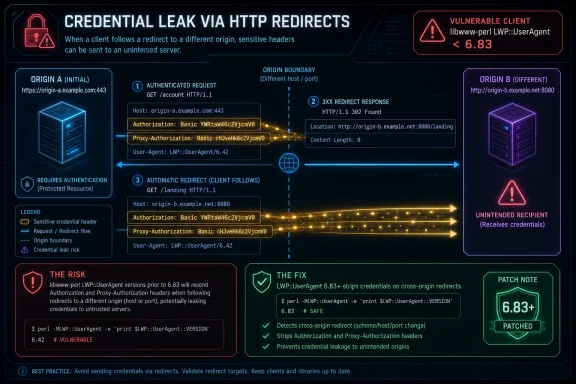
The flaw is simple enough to explain without flattening the risk. Before version 6.83, LWP::UserAgent could preserve caller-supplied Authorization and Proxy-Authorization headers when following a 3xx redirect to a different scheme, host, or port. In security terms, that means a header intended for one origin could be sent to another origin.
That violates the expectation most administrators have absorbed from browsers and modern HTTP clients: credentials scoped to one place should not casually travel to another. It also violates the mental model many developers carry when they write a short script, set an Authorization header, and assume the library will handle redirect hygiene safely. CVE-2026-8368 exists in the gap between those assumptions.
But redirects are also a trust transition. A request begins with one destination and may end at another. If a client treats that journey as a mere transport detail, rather than a change in security context, secrets can cross a boundary they were never meant to cross.
That is what makes this bug more than an implementation nit. Authorization headers are not decoration. They can contain bearer tokens, Basic authentication material, API keys wrapped in custom schemes, proxy credentials, or other values that function as keys to protected services.
In a vulnerable flow, an attacker does not necessarily need to compromise the original service. They need to influence a redirect in a path used by an authenticated client. That influence might come from a malicious endpoint, a compromised intermediate service, an open redirect, a poisoned configuration value, or a test environment that was never supposed to become production plumbing.
The risk is especially sharp in automation because scripts often run with service credentials broader than any individual user would receive. A developer testing an API may use a narrow token; a nightly sync job may use a credential that can read entire repositories, copy artifacts, or update deployment metadata. When automation leaks, it often leaks sideways into systems with surprising reach.
That distinction matters. A blanket removal of credentials on every redirect would break legitimate applications that redirect from one path to another within the same service. A permissive model, however, leaks secrets when a request crosses to a different origin. The patch chooses the security boundary that web developers and browser security models have made familiar for years.
There is also an opt-out for applications that truly need the old behavior. That is sensible engineering, but it should be treated as a compatibility escape hatch rather than a recommended configuration. If an application deliberately forwards credentials across origins, it should be able to explain why, document which origins are trusted, and survive an audit of that decision.
The release also tightens another redirect edge: refusing HTTPS-to-HTTP redirects by default. That is part of the same philosophy. Redirects are not just routing hints; they can downgrade confidentiality, expand trust, and move data into places where it can be observed.
For administrators, the lesson is straightforward. Updating to libwww-perl 6.83 or later is the clean fix, but the broader remediation is to review which automation follows redirects while holding secrets. Patch the library, then look for places where the application design assumed the network would always be honest.
Windows environments are particularly good at preserving this kind of code. A script written to bridge a ticketing system and an inventory database in 2014 may still run from Task Scheduler. A monitoring plugin downloaded years ago may still query an internal endpoint. A vendor appliance may still bundle a Perl runtime because it was stable, portable, and good enough.
That is how vulnerabilities in mature libraries become enterprise problems. They do not need to dominate new application development. They need only to sit in the execution path of tools that handle credentials. LWP::UserAgent has long been a standard answer to “make an HTTP request from Perl,” and that makes its redirect semantics security-relevant.
This is also why software bills of materials remain harder in practice than they sound in procurement meetings. The vulnerable component may not be a line item in a purchasing system. It may be nested in a vendor package, frozen in a container image, bundled with a monitoring integration, or installed on a forgotten jump box by a previous administrator.
The “where is Perl installed?” question is useful but insufficient. The sharper question is “where is LWP::UserAgent making authenticated outbound requests?” That is the path from inventory to risk.
The damage often emerges later. A token appears in an access log. A proxy captures a header. A malicious endpoint receives credentials and reuses them against the real service. A debugging transcript gets uploaded to a ticket. A short-lived secret turns out to be long-lived enough.
That delayed visibility makes CVE-2026-8368 operationally different from a remote code execution bug. The immediate fix is a version upgrade, but incident response may require asking whether credentials were already exposed. If a vulnerable script has contacted untrusted or semi-trusted endpoints, token rotation may be the safer assumption.
The difficulty is proving a negative. Many environments do not retain enough outbound HTTP detail to reconstruct redirect chains after the fact. Even when proxy logs exist, they may not capture headers, and in many cases they should not. The very logging that would prove exposure can itself become a sensitive-data hazard.
So the right response is risk-based rather than theatrical. Identify high-value automation first: scripts that access source repositories, artifact stores, cloud APIs, password vaults, internal admin panels, or deployment systems. If those scripts used affected LWP::UserAgent versions and followed redirects across origins, rotate the associated credentials and patch the runtime.
On a developer workstation, that may mean CPAN, Strawberry Perl, ActivePerl-era installations, MSYS2, Cygwin, Git-adjacent tooling, or application-specific bundles. On a server, it may mean vendor software, monitoring agents, old automation frameworks, or locally maintained scripts. In containers, it may mean a base image that quietly pulled in a distribution package months ago.
The Windows admin’s instinct to check installed programs will catch only part of this. Perl modules can live in multiple library paths, and packaged applications may carry private copies. A host can have more than one Perl runtime, each with its own module tree and its own version of libwww-perl.
That fragmentation is annoying, but it is also normal. The modern Windows estate is not just Windows components; it is Windows plus runtimes, package managers, agents, developer ecosystems, and cloud tooling. Treating those layers as “not our patching problem” is how small library flaws become durable exposure.
The best discovery approach is boring and effective. Search managed hosts and build images for libwww-perl versions. Query Perl module versions where Perl is present. Ask vendors whether their products bundle affected LWP::UserAgent releases. Review scripts that set Authorization or Proxy-Authorization headers explicitly.
Security-conscious developers know this problem from server-side request forgery defenses, OAuth redirect URI validation, and open redirect bugs. The same principle applies here in miniature. A Location header is data from another system. If that data causes credentials to move, it deserves scrutiny.
The vulnerable behavior becomes especially concerning when combined with services that accept user-controlled URLs. Suppose an internal tool fetches a URL supplied by a partner system while attaching an internal bearer token. Suppose the first endpoint redirects to an attacker-controlled host. If the client carries the token along, the attacker has turned ordinary HTTP behavior into credential exfiltration.
Even without a malicious partner, configuration drift can produce similar outcomes. A service endpoint changes ownership. A staging hostname expires. A redirect points to a temporary domain. A proxy rewrites traffic in a way nobody documented. The vulnerability rewards every loose edge in the system.
That is why the patch’s origin-aware stripping is the right default. It does not assume redirects are evil. It assumes origins matter. In 2026, that should be the minimum standard for any HTTP client carrying credentials.
The first prioritization filter is whether LWP::UserAgent is present at all. The second is whether it is older than 6.83. The third, and most important, is whether it is used for credentialed HTTP requests with automatic redirects enabled. A vulnerable library sitting unused on a lab machine is not the same as a vulnerable library powering a deployment bot with production credentials.
Developers should examine code paths that manually set Authorization headers. They should also look for proxy authentication, because Proxy-Authorization can be just as sensitive in environments where outbound access is mediated through authenticated proxies. In some networks, proxy credentials are the keys to broad egress capability.
Administrators should not forget build systems. CI/CD runners are credential magnets, and many contain older scripting runtimes for compatibility with legacy jobs. If a build job pulls dependencies, calls internal APIs, or uploads artifacts using Perl scripts, it belongs in the review set.
For vendors, the responsibility is equally plain. If a product bundles libwww-perl, the customer should not have to reverse-engineer the module tree to learn whether it is affected. Publish the bundled version, ship an update, and explain whether any product feature makes authenticated requests that follow redirects.
Microsoft can list, describe, and track the vulnerability. CPAN maintainers can patch the library. NVD can catalog the record. Linux distributions and package ecosystems can ship updates. But none of that guarantees your particular Perl script, vendor bundle, or frozen server image has changed.
That is the uncomfortable bargain of modern software maintenance. We consume shared components because they save time and reduce custom code. In exchange, we inherit their security properties and must keep track of them after the original deployment moment has faded.
This vulnerability also shows why “just patch” is both correct and incomplete. Upgrading libwww-perl to 6.83 or later closes the unsafe default. But if credentials may already have crossed an origin boundary, patching does not pull them back. Tokens, passwords, and proxy secrets need their own lifecycle.
The right operational stance is calm urgency. CVE-2026-8368 is not a reason to panic-rebuild every Windows server. It is a reason to find credentialed Perl HTTP clients, update them, and treat unexpected redirect destinations as potential exposure points.
Admin scripts now hold cloud tokens, service principals, API keys, repository credentials, and proxy secrets. They trigger deployments, create users, move data, and synchronize systems across trust boundaries. A small HTTP client behavior inside that automation can be just as consequential as a misconfigured firewall rule.
CVE-2026-8368 is a clean example because the bug is easy to understand. The client followed a redirect and brought credentials along when it should not have. There is no need for speculative memory corruption or exotic exploitation. The failure is mundane, and that is what makes it relevant.
Security programs often struggle with mundane failures because they do not fit neatly into executive dashboards. “Patch Perl HTTP library to stop credential forwarding on cross-origin redirects” is not as dramatic as “critical remote code execution.” But attackers do not grade vulnerabilities on narrative appeal. They grade them on access.
The organizations that handle this well will be the ones that already know where their automation lives. The organizations that struggle will be the ones that discover, during remediation, that nobody owns the script that owns the credential that owns the deployment path.
That workaround should be temporary. Manual redirect handling is easy to get wrong, and every local exception becomes another piece of security logic that future maintainers must understand. The patched library default is the better long-term answer.
After patching, test behavior. A simple internal redirect test can confirm that Authorization headers are retained for same-origin redirects and removed when the redirect crosses scheme, host, or port. This is especially useful for teams worried that the upgrade could break legacy workflows that depended on forwarding credentials.
If something breaks because it required credentials to follow a cross-origin redirect, treat that breakage as a design review, not merely a regression. There may be a legitimate architecture behind it, but it should be explicit. Cross-origin credential forwarding should not be an accidental dependency.
CVE-2026-8368 will not be remembered as the biggest vulnerability of 2026, and that is fine; most real enterprise risk is not cinematic. Its significance is more durable: it shows how much trust we place in the default behavior of old, useful libraries, and how easily that trust can outlive the assumptions that made it safe. The next round of hardening will not only be about patching operating systems faster, but about treating every credentialed client—no matter how small, scripted, or unfashionable—as part of the security perimeter.
The uncomfortable lesson of CVE-2026-8368 is that modern infrastructure still depends on small, old, trusted client libraries whose behavior becomes security policy by accident. Perl may no longer be fashionable in new greenfield architecture decks, but LWP::UserAgent sits inside scripts, monitoring tools, migration jobs, internal portals, backup glue, package workflows, and administrative automation that often outlives the teams that wrote it. A redirect that silently carries credentials across an origin boundary is not a cinematic breach; it is the sort of quiet footgun that leaks a bearer token into a log file and waits for someone else to notice.
 A Small Perl Bug Lands in Microsoft’s Enterprise Weather System
Microsoft listing CVE-2026-8368 is a reminder that the Security Update Guide is no longer just a map of Windows patches. It has become part of the enterprise vulnerability weather system: a place where defenders check not only for Microsoft-owned code, but also for components that intersect with Microsoft platforms, cloud workloads, developer stacks, and administrator habits. A Perl library bug can matter to Windows shops because Windows shops are full of Perl, even when nobody wants to admit it.That does not mean Microsoft is shipping vulnerable Perl code in every Windows installation. The practical question is narrower and more important: do your systems, build agents, admin scripts, third-party tools, or packaged applications use libwww-perl and LWP::UserAgent versions earlier than 6.83? If the answer is yes, the affected behavior can appear anywhere those scripts make authenticated HTTP requests and automatically follow redirects.
The flaw is simple enough to explain without flattening the risk. Before version 6.83, LWP::UserAgent could preserve caller-supplied Authorization and Proxy-Authorization headers when following a 3xx redirect to a different scheme, host, or port. In security terms, that means a header intended for one origin could be sent to another origin.
That violates the expectation most administrators have absorbed from browsers and modern HTTP clients: credentials scoped to one place should not casually travel to another. It also violates the mental model many developers carry when they write a short script, set an Authorization header, and assume the library will handle redirect hygiene safely. CVE-2026-8368 exists in the gap between those assumptions.
Redirects Are Where Convenience Becomes Attack Surface
HTTP redirects are one of the web’s great conveniences. They let services move users from old URLs to new ones, shift traffic to regional endpoints, enforce HTTPS, hand off downloads, and manage authentication flows. Developers rely on client libraries to follow them automatically because handling every 301, 302, 303, 307, and 308 manually is tedious and error-prone.But redirects are also a trust transition. A request begins with one destination and may end at another. If a client treats that journey as a mere transport detail, rather than a change in security context, secrets can cross a boundary they were never meant to cross.
That is what makes this bug more than an implementation nit. Authorization headers are not decoration. They can contain bearer tokens, Basic authentication material, API keys wrapped in custom schemes, proxy credentials, or other values that function as keys to protected services.
In a vulnerable flow, an attacker does not necessarily need to compromise the original service. They need to influence a redirect in a path used by an authenticated client. That influence might come from a malicious endpoint, a compromised intermediate service, an open redirect, a poisoned configuration value, or a test environment that was never supposed to become production plumbing.
The risk is especially sharp in automation because scripts often run with service credentials broader than any individual user would receive. A developer testing an API may use a narrow token; a nightly sync job may use a credential that can read entire repositories, copy artifacts, or update deployment metadata. When automation leaks, it often leaks sideways into systems with surprising reach.
The Patch Draws the Boundary Developers Assumed Was Already There
The libwww-perl 6.83 fix changes the redirect behavior in the way many users probably thought it already worked. LWP::UserAgent now strips Authorization and Proxy-Authorization headers on cross-origin redirects, where cross-origin means a change in scheme, host, or port. Same-origin redirects can retain credentials, preserving normal behavior for services that redirect within their own boundary.That distinction matters. A blanket removal of credentials on every redirect would break legitimate applications that redirect from one path to another within the same service. A permissive model, however, leaks secrets when a request crosses to a different origin. The patch chooses the security boundary that web developers and browser security models have made familiar for years.
There is also an opt-out for applications that truly need the old behavior. That is sensible engineering, but it should be treated as a compatibility escape hatch rather than a recommended configuration. If an application deliberately forwards credentials across origins, it should be able to explain why, document which origins are trusted, and survive an audit of that decision.
The release also tightens another redirect edge: refusing HTTPS-to-HTTP redirects by default. That is part of the same philosophy. Redirects are not just routing hints; they can downgrade confidentiality, expand trust, and move data into places where it can be observed.
For administrators, the lesson is straightforward. Updating to libwww-perl 6.83 or later is the clean fix, but the broader remediation is to review which automation follows redirects while holding secrets. Patch the library, then look for places where the application design assumed the network would always be honest.
Perl’s Decline in Fashion Has Not Reduced Its Operational Blast Radius
It is tempting to file this one under “legacy Perl problem” and move on. That would be a mistake. Perl’s cultural moment may have passed, but its operational footprint remains deep in the same way that PowerShell, Bash, VBScript, Python, and batch files remain deep: because glue code accumulates where business processes meet real systems.Windows environments are particularly good at preserving this kind of code. A script written to bridge a ticketing system and an inventory database in 2014 may still run from Task Scheduler. A monitoring plugin downloaded years ago may still query an internal endpoint. A vendor appliance may still bundle a Perl runtime because it was stable, portable, and good enough.
That is how vulnerabilities in mature libraries become enterprise problems. They do not need to dominate new application development. They need only to sit in the execution path of tools that handle credentials. LWP::UserAgent has long been a standard answer to “make an HTTP request from Perl,” and that makes its redirect semantics security-relevant.
This is also why software bills of materials remain harder in practice than they sound in procurement meetings. The vulnerable component may not be a line item in a purchasing system. It may be nested in a vendor package, frozen in a container image, bundled with a monitoring integration, or installed on a forgotten jump box by a previous administrator.
The “where is Perl installed?” question is useful but insufficient. The sharper question is “where is LWP::UserAgent making authenticated outbound requests?” That is the path from inventory to risk.
Credential Leaks Rarely Look Like Exploits at First
Credential disclosure vulnerabilities are awkward for defenders because the first observable event may look normal. A script makes an HTTP request. A server returns a redirect. The client follows it. Another server receives a header. Nothing crashes, no shell spawns, and no antivirus alert appears.The damage often emerges later. A token appears in an access log. A proxy captures a header. A malicious endpoint receives credentials and reuses them against the real service. A debugging transcript gets uploaded to a ticket. A short-lived secret turns out to be long-lived enough.
That delayed visibility makes CVE-2026-8368 operationally different from a remote code execution bug. The immediate fix is a version upgrade, but incident response may require asking whether credentials were already exposed. If a vulnerable script has contacted untrusted or semi-trusted endpoints, token rotation may be the safer assumption.
The difficulty is proving a negative. Many environments do not retain enough outbound HTTP detail to reconstruct redirect chains after the fact. Even when proxy logs exist, they may not capture headers, and in many cases they should not. The very logging that would prove exposure can itself become a sensitive-data hazard.
So the right response is risk-based rather than theatrical. Identify high-value automation first: scripts that access source repositories, artifact stores, cloud APIs, password vaults, internal admin panels, or deployment systems. If those scripts used affected LWP::UserAgent versions and followed redirects across origins, rotate the associated credentials and patch the runtime.
Windows Shops Should Look Beyond Windows Update
For WindowsForum readers, the practical trap is assuming that anything in Microsoft’s vulnerability universe is handled by Windows Update, Microsoft Update, or the monthly cumulative patch. CVE-2026-8368 is not that kind of item. It lives in the dependency layer, which means remediation depends on how Perl and libwww-perl arrived in the environment.On a developer workstation, that may mean CPAN, Strawberry Perl, ActivePerl-era installations, MSYS2, Cygwin, Git-adjacent tooling, or application-specific bundles. On a server, it may mean vendor software, monitoring agents, old automation frameworks, or locally maintained scripts. In containers, it may mean a base image that quietly pulled in a distribution package months ago.
The Windows admin’s instinct to check installed programs will catch only part of this. Perl modules can live in multiple library paths, and packaged applications may carry private copies. A host can have more than one Perl runtime, each with its own module tree and its own version of libwww-perl.
That fragmentation is annoying, but it is also normal. The modern Windows estate is not just Windows components; it is Windows plus runtimes, package managers, agents, developer ecosystems, and cloud tooling. Treating those layers as “not our patching problem” is how small library flaws become durable exposure.
The best discovery approach is boring and effective. Search managed hosts and build images for libwww-perl versions. Query Perl module versions where Perl is present. Ask vendors whether their products bundle affected LWP::UserAgent releases. Review scripts that set Authorization or Proxy-Authorization headers explicitly.
The Real Exploit Primitive Is Trusting the Next Location Header
The most dangerous part of this vulnerability is not that redirects exist. It is that redirects are often treated as instructions rather than proposals. When a server says “go over there,” a client library may obey before the application has had a chance to ask whether “there” is still inside the trust boundary.Security-conscious developers know this problem from server-side request forgery defenses, OAuth redirect URI validation, and open redirect bugs. The same principle applies here in miniature. A Location header is data from another system. If that data causes credentials to move, it deserves scrutiny.
The vulnerable behavior becomes especially concerning when combined with services that accept user-controlled URLs. Suppose an internal tool fetches a URL supplied by a partner system while attaching an internal bearer token. Suppose the first endpoint redirects to an attacker-controlled host. If the client carries the token along, the attacker has turned ordinary HTTP behavior into credential exfiltration.
Even without a malicious partner, configuration drift can produce similar outcomes. A service endpoint changes ownership. A staging hostname expires. A redirect points to a temporary domain. A proxy rewrites traffic in a way nobody documented. The vulnerability rewards every loose edge in the system.
That is why the patch’s origin-aware stripping is the right default. It does not assume redirects are evil. It assumes origins matter. In 2026, that should be the minimum standard for any HTTP client carrying credentials.
Security Teams Need to Translate This From CVE to Workflow
The CVE description is technically clear, but it does not automatically tell an organization what to do Monday morning. Security teams need to translate it into workflow: inventory, prioritize, patch, rotate where needed, and prevent recurrence. That translation is where many dependency vulnerabilities either get fixed quickly or disappear into a backlog labeled “medium, third-party.”The first prioritization filter is whether LWP::UserAgent is present at all. The second is whether it is older than 6.83. The third, and most important, is whether it is used for credentialed HTTP requests with automatic redirects enabled. A vulnerable library sitting unused on a lab machine is not the same as a vulnerable library powering a deployment bot with production credentials.
Developers should examine code paths that manually set Authorization headers. They should also look for proxy authentication, because Proxy-Authorization can be just as sensitive in environments where outbound access is mediated through authenticated proxies. In some networks, proxy credentials are the keys to broad egress capability.
Administrators should not forget build systems. CI/CD runners are credential magnets, and many contain older scripting runtimes for compatibility with legacy jobs. If a build job pulls dependencies, calls internal APIs, or uploads artifacts using Perl scripts, it belongs in the review set.
For vendors, the responsibility is equally plain. If a product bundles libwww-perl, the customer should not have to reverse-engineer the module tree to learn whether it is affected. Publish the bundled version, ship an update, and explain whether any product feature makes authenticated requests that follow redirects.
Microsoft’s Disclaimer Is Boilerplate, but the Risk Is Not
The Microsoft Knowledge Base disclaimer attached to this kind of entry is legal boilerplate: information provided as-is, no warranties, no liability for damages. It is easy to skip because every administrator has seen some version of it a thousand times. Yet it usefully underscores the division of responsibility in dependency security.Microsoft can list, describe, and track the vulnerability. CPAN maintainers can patch the library. NVD can catalog the record. Linux distributions and package ecosystems can ship updates. But none of that guarantees your particular Perl script, vendor bundle, or frozen server image has changed.
That is the uncomfortable bargain of modern software maintenance. We consume shared components because they save time and reduce custom code. In exchange, we inherit their security properties and must keep track of them after the original deployment moment has faded.
This vulnerability also shows why “just patch” is both correct and incomplete. Upgrading libwww-perl to 6.83 or later closes the unsafe default. But if credentials may already have crossed an origin boundary, patching does not pull them back. Tokens, passwords, and proxy secrets need their own lifecycle.
The right operational stance is calm urgency. CVE-2026-8368 is not a reason to panic-rebuild every Windows server. It is a reason to find credentialed Perl HTTP clients, update them, and treat unexpected redirect destinations as potential exposure points.
The Admin Script Is Part of the Security Boundary Now
There was a time when internal scripts were treated as harmless plumbing. They lived on file shares, ran from scheduled tasks, and were understood by one person who had not worked at the company since Windows Server 2012 R2 was young. That era is over, whether organizations have admitted it or not.Admin scripts now hold cloud tokens, service principals, API keys, repository credentials, and proxy secrets. They trigger deployments, create users, move data, and synchronize systems across trust boundaries. A small HTTP client behavior inside that automation can be just as consequential as a misconfigured firewall rule.
CVE-2026-8368 is a clean example because the bug is easy to understand. The client followed a redirect and brought credentials along when it should not have. There is no need for speculative memory corruption or exotic exploitation. The failure is mundane, and that is what makes it relevant.
Security programs often struggle with mundane failures because they do not fit neatly into executive dashboards. “Patch Perl HTTP library to stop credential forwarding on cross-origin redirects” is not as dramatic as “critical remote code execution.” But attackers do not grade vulnerabilities on narrative appeal. They grade them on access.
The organizations that handle this well will be the ones that already know where their automation lives. The organizations that struggle will be the ones that discover, during remediation, that nobody owns the script that owns the credential that owns the deployment path.
The Fix Is Simple; Proving Coverage Is the Work
The practical response to CVE-2026-8368 is refreshingly concrete, even if the discovery work is not. Upgrade libwww-perl to version 6.83 or later wherever affected versions are installed. For applications that cannot be upgraded immediately, disable automatic redirects on credentialed requests or strip sensitive headers before following redirects across origins.That workaround should be temporary. Manual redirect handling is easy to get wrong, and every local exception becomes another piece of security logic that future maintainers must understand. The patched library default is the better long-term answer.
After patching, test behavior. A simple internal redirect test can confirm that Authorization headers are retained for same-origin redirects and removed when the redirect crosses scheme, host, or port. This is especially useful for teams worried that the upgrade could break legacy workflows that depended on forwarding credentials.
If something breaks because it required credentials to follow a cross-origin redirect, treat that breakage as a design review, not merely a regression. There may be a legitimate architecture behind it, but it should be explicit. Cross-origin credential forwarding should not be an accidental dependency.
The Practical Shape of a Sane Response
The remediation plan does not need drama, but it does need ownership. CVE-2026-8368 sits at the intersection of vulnerability management, scripting hygiene, vendor management, and secrets rotation. That means it will fall through cracks unless somebody turns it into specific tasks.- Inventory systems, containers, build agents, and vendor packages for libwww-perl and confirm whether LWP::UserAgent is older than version 6.83.
- Prioritize any affected code that sends Authorization or Proxy-Authorization headers while allowing automatic HTTP redirects.
- Upgrade to libwww-perl 6.83 or later, and avoid opting back into credentialed cross-origin redirects unless there is a documented and reviewed reason.
- Rotate credentials for high-value automation if affected clients may have followed redirects to untrusted, user-controlled, expired, or poorly governed destinations.
- Add redirect-origin tests to critical automation so future library or configuration changes do not silently reintroduce credential forwarding.
CVE-2026-8368 will not be remembered as the biggest vulnerability of 2026, and that is fine; most real enterprise risk is not cinematic. Its significance is more durable: it shows how much trust we place in the default behavior of old, useful libraries, and how easily that trust can outlive the assumptions that made it safe. The next round of hardening will not only be about patching operating systems faster, but about treating every credentialed client—no matter how small, scripted, or unfashionable—as part of the security perimeter.
References
- Primary source: MSRC
Published: 2026-06-03T01:41:56-07:00
Security Update Guide - Microsoft Security Response Center
 msrc.microsoft.com
- Related coverage: sentinelone.com
CVE-2026-8368: Perl LWP::UserAgent Header Leak Vulnerability
CVE-2026-8368 is an information disclosure vulnerability in Perl LWP::UserAgent. Learn about its impact, affected versions, and mitigation methods.www.sentinelone.com
- Related coverage: metacpan.org
- Official source: microsoft.com
MSRC - Microsoft Security Response Center
The Microsoft Security Response Center is part of the defender community and on the front line of security response evolution. For over twenty years, we have been engaged with security researchers working to protect customers and the broader ecosystem.www.microsoft.com
- Related coverage: cert.gov.vu
Advisory 117 CVE 2026 20805 Microsoft Windows Information Disclosure Vulnerability
PDF documentcert.gov.vu
