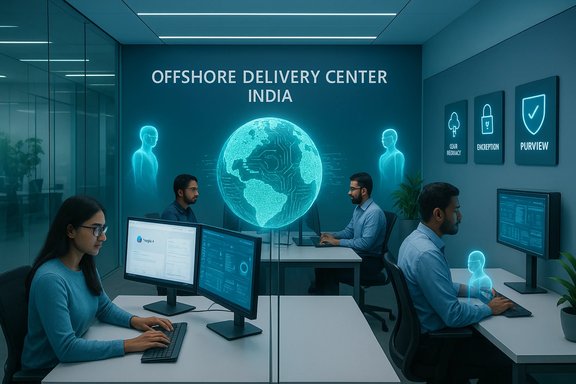
Cyclotron’s announcement that it is expanding offshore hiring in India and launching a dedicated AI Workforce marks a clear acceleration in the company’s strategy to meet surging client demand across AI, Azure, Security, and M&A integration services. The company is positioning a new India hub as a technical and operational engine that promises faster project turnarounds through alternating time zones and a 24-hour delivery model, while reinforcing its product and Microsoft partnership credentials. This expansion builds on Cyclotron’s recent Microsoft recognitions and product investments, but the move also raises practical questions about operational risk, data governance, and long-term talent strategy that enterprise buyers should weigh carefully.
Cyclotron is a San Francisco–based professional services and software company that focuses on Microsoft-centric solutions spanning Azure, Microsoft 365, security and compliance, and AI-enabled automation. Founded in 2014, Cyclotron has in recent years emphasized AI-first service offerings and proprietary products—most notably an agentsecurity offering branded Cyclotron Pulse—while deepening its Microsoft partnership footprint. The firm publicly highlights multiple Microsoft awards and a Solutions Partner designation for Security, citing Purview and Microsoft 365 governance engagements as core strengths. The company’s recent public statements and press outreach position the India hiring expansion as the first phase of creating a dedicated AI Workforce: a distributed engineering and operations center focused on accelerating AI project delivery, Copilot implementations, security automation, and M&A systems integration. Cyclotron also emphasizes an Employee First posture—flexible work-from-home, competitive perks, and global career paths—to attract and retain talent in competitive Indian markets.
Source: HRTech Series Cyclotron Expands Offshore Hiring to Accelerate Client Success in AI, Azure, Security, and M&A Services
 Background / Overview
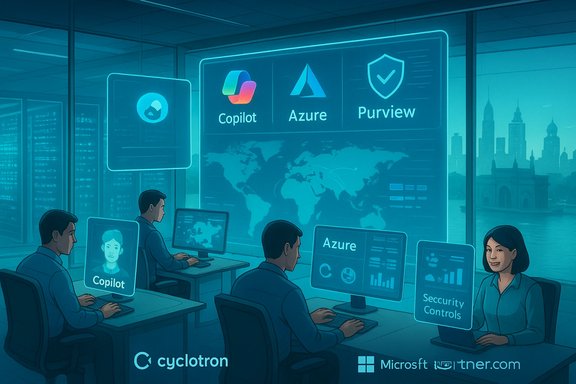
Cyclotron is a San Francisco–based professional services and software company that focuses on Microsoft-centric solutions spanning Azure, Microsoft 365, security and compliance, and AI-enabled automation. Founded in 2014, Cyclotron has in recent years emphasized AI-first service offerings and proprietary products—most notably an agentsecurity offering branded Cyclotron Pulse—while deepening its Microsoft partnership footprint. The firm publicly highlights multiple Microsoft awards and a Solutions Partner designation for Security, citing Purview and Microsoft 365 governance engagements as core strengths. The company’s recent public statements and press outreach position the India hiring expansion as the first phase of creating a dedicated AI Workforce: a distributed engineering and operations center focused on accelerating AI project delivery, Copilot implementations, security automation, and M&A systems integration. Cyclotron also emphasizes an Employee First posture—flexible work-from-home, competitive perks, and global career paths—to attract and retain talent in competitive Indian markets. What Cyclotron announced — the essentials
- Cyclotron is expanding offshore hiring in India to scale delivery capacity across AI, Azure, Security, and M&A services.
- The expansion is framed as the launch of a dedicated AI Workforce—a hub intended to provide engineering, analytics, automation, and managed services to clients globally.
- By leveraging alternating time zones, Cyclotron aims to operate on an extended cycle (effectively 24/7), enabling faster-turnaround projects and reduced downtime for customers.
- The move is positioned as complementary to Cyclotron’s existing product ecosystem (including Cyclotron Pulse) and recent Microsoft recognitions, such as the 2024 Compliance Partner of the Year and selection to Microsoft’s 2025–2026 Inner Circle for AI Business Solutions.
Why this matters now: market context
The enterprise AI and Copilot wave
Large enterprises and system integrators are racing to embed Microsoft Copilot, agentic AI, and Azure-based models across workflows. Major announcements—both from Microsoft and large partners—have signaled a shift from pilots to broad deployments, and many customers now prioritize partners who can deliver secure, governed, and scalable Copilot and agentic AI solutions. In that environment, service firms that combine Microsoft expertise with productized governance and security tooling are more attractive to enterprise buyers.Why India and the offshore model
India remains a primary talent pool for enterprise software engineering, cloud operations, and AI delivery. A distributed delivery model that uses India as a hub typically provides:- Access to deep engineering talent at scale and competitive labor costs.
- The ability to staff large, cross-functional teams for integration-intensive work (Azure migrations, Copilot enablement, M&A consolidation).
- A time-zone advantage enabling near-continuous progress on time-sensitive projects.
Cyclotron’s Microsoft relationship and product stack — the evidence
Cyclotron’s public materials underline a close Microsoft partnership and an emphasis on security and compliance. Notable points that the company has highlighted include:- Winning the 2024 Microsoft Compliance Partner of the Year (Global)—a sign of demonstrated capability with Microsoft Purview and compliance tooling. Cyclotron has also published case materials describing Purview deployments and client outcomes.
- Selection to Microsoft’s 2025–2026 Inner Circle for AI Business Solutions, an invitation-only program for top partners based on sales and performance metrics within Microsoft’s AI ecosystem. Cyclotron frames this as evidence of its leadership in enterprise AI and Copilot-led engagements.
- Productized IP such as Cyclotron Pulse, framed as an agent lifecycle visibility and security product intended to govern, detect, and secure AI agent activity. The company positions this product as complementary to Microsoft’s Copilot and Azure AI capabilities.
Strengths: why this expansion could work for clients
1. Faster execution through an extended delivery cycle
Cyclotron’s model of leveraging “alternating time zones” is well-worn in the services industry: staff in India pick up work from U.S. or European teams at the end of their business day and continue development, testing, or incident response. That can materially shorten delivery timelines for complex projects like Copilot rollouts, Azure migrations, and M&A system integrations. Cyclotron’s expansion explicitly targets this advantage.2. Product + services differentiation
A key strength is the combination of productized tooling (for agent security, compliance, and governance) with hands-on consulting and IT delivery capabilities. For customers worried about the operational risks of Copilot or agentic AI, that mix—if executed properly—reduces the time to production and increases confidence in ongoing governance. Cyclotron’s public materials emphasize both aspects.3. Microsoft channel benefits
Being recognized by Microsoft—through Partner of the Year awards and an Inner Circle invitation—can mean improved go-to-market alignment, earlier product roadmap visibility, and streamlined escalation paths when customers need Microsoft product support. Cyclotron’s recent recognitions enhance its credibility in the Microsoft ecosystem.4. Talent and cost efficiency
By expanding in India, Cyclotron gains access to a large base of engineers, cloud specialists, and data scientists, which can reduce per-project costs and increase bench depth for rapid engagements. Their stated Employee First approach could help recruiting and retention if accompanied by local competitiveness in pay, training, and career development.Risks and caveats — what enterprise buyers should consider
Data residency, sovereignty, and compliance risk
Shifting execution offshore does not absolve clients of data-residency and regulatory obligations. Organizations operating under GDPR, sectoral privacy rules, or strict cross-border data transfer requirements must ensure contractually and technically that any offshore engineering work complies with applicable laws. Cyclotron’s compliance credentials and Purview expertise are relevant here, but buyers should insist on concrete contractual commitments, auditable controls, and clear data-flow diagrams before proceeding.IP, model access, and intellectual property ownership
AI projects often involve building custom prompts, pipelines, and model configurations that embed proprietary business logic. Offshore execution increases the surface area for potential IP leakage unless robust protections are in place—employee NDAs, secure code repos, role-based access, and privileged access management. Cyclotron’s security specializations are relevant, but technical controls must be validated during procurement and onboarding.Quality control and knowledge transfer
Offshore teams can deliver speed, but maintaining architectural integrity, code quality, and operational standards requires disciplined QA, shared engineering best practices, and a robust knowledge-transfer plan. Rapid scaling without investment in onboarding, peer reviews, and senior architecture oversight risks producing brittle systems that fail to scale or secure AI agents in production. Cyclotron will need to demonstrate maturity in global delivery processes to mitigate this.Vendor claims that require scrutiny
Cyclotron’s public messaging includes strong claims—such as being the “#1 Worldwide Microsoft Copilot partner” and references to large Copilot license deployments. These assertions come from company and PR channels; independent verification of partner rankings and licensing counts is not always publicly available. Buyers should treat such statements as vendor-supplied and request transparent proof (customer references, Microsoft co-sell or procurement confirmations, licensing contracts) to validate scale and experience claims.Geopolitical and supply-chain considerations
Vendor strategies that depend on large offshore delivery centers can be affected by international relations, visa regimes, local policy changes, or provider-specific limitations. Enterprises with critical national-security or defense contracts should conduct a heightened supply‑chain risk analysis and include exit/continuity clauses in contracts.How to evaluate Cyclotron’s offering — a buyer checklist
- Request documented examples of prior Copilot and agentic AI deployments, including:
- Customer outcomes (time-to-value, usage metrics), anonymized where necessary.
- Architecture diagrams showing data flows, model hosting, and governance integration.
- Ask for proof of Microsoft partnership status and award details:
- Copies of partner designation certificates or Microsoft co-sell references.
- Specifics on Inner Circle participation—what benefits were conferred and how they tangibly help customers.
- Require a binding data-handling and security addendum that covers:
- Data residency, encryption at rest and in transit, logging and monitoring, and third‑party audits (SOC 2, ISO 27001).
- Validate IP and code ownership terms:
- Clear contractual clauses on deliverables, source code escrow, and reuse of proprietary modules.
- Pilot before scale:
- Start with a bounded pilot to validate Cyclotron’s 24/7 delivery model, quality controls, and cross‑team collaboration.
- Check references:
- Speak directly to at least two customers who have completed similar projects and probe for delivery cadence, security posture, and post‑go‑live support quality.
Implications for specific client profiles
Large enterprises seeking Copilot at scale
For enterprises looking to roll out Microsoft 365 Copilot and integrate agentic workflows, a partner that couples Copilot enablement with compliance tooling is attractive. Cyclotron’s Purview expertise and Microsoft recognitions are relevant, but scale claims should be corroborated with customer case studies and Microsoft co‑sell evidence.Mid-market companies undergoing M&A
M&A integrations are integration-heavy and time-sensitive: consolidating identity, data, and collaboration platforms across acquired entities can be accelerated by a partner with repeatable frameworks. Cyclotron’s message emphasizes M&A integration expertise; prospective clients should validate framework maturity and past M&A outcomes during procurement.Security- and compliance‑sensitive customers
Customers operating in regulated industries will value Cyclotron’s Compliance Partner recognition, but should still insist on third-party audits, contractually enforced controls, and clear incident-response procedures. The presence of a security-focused product like Cyclotron Pulse is promising; ask for technical detail and architecture review before engagement.Strategic analysis: business logic and long-term outlook
Cyclotron’s expansion reflects a broader industry dynamic: partners that can combine Microsoft AI tooling, security expertise, and scalable delivery are highly valued. The firm’s strategy—to productize governance/security around agentic AI, secure Microsoft channel credentials, and increase offshore engineering capacity—aligns with market demand for fast, secure, and cheap (relatively) AI-enabled outcomes. If Cyclotron can maintain quality, attract senior talent in India, and keep a tight compliance posture, the company stands to convert demand into durable revenue growth. However, long-term success depends on execution risk: large offshore operations require strong middle management, mature delivery processes, and cultural integration between geographically dispersed teams. The competitive landscape is also intense—global consultancies and large Indian IT services firms are investing heavily in Copilot and Azure expertise. Cyclotron must therefore demonstrate differentiators beyond cost and speed—namely product depth, security rigor, and measurable customer outcomes.Practical recommendations for procurement teams
- Insist on a staged engagement model: pilot → iterate → scale. Use the pilot to validate both technical outcomes and governance controls.
- Set measurable SLAs for security, delivery cadence, and response times that reflect a 24/7 delivery model. Include penalties and remediation steps.
- Audit the vendor’s security stack: require access to penetration-test results, SOC 2 or equivalent reports, and a walkthrough of Cyclotron Pulse’s architecture if that product will be part of the engagement.
- Build a shadow‑ops capability internally: even with offshore delivery, retain a small in-house team that understands the architecture and can validate deliverables independently.
- Negotiate knowledge-transfer and source-code escrow terms to protect IP and ensure continuity if vendor relationships change.
What Cyclotron needs to demonstrate next
To convert its hiring expansion into sustained market advantage, Cyclotron should prioritize:- Transparent evidentiary material: release detailed, anonymized customer outcomes and architecture blueprints that show how Copilot, Purview, and Cyclotron Pulse integrate in production.
- Third‑party validation: publish independent audit results, SOC statements, or credible third-party assessments of Cyclotron Pulse and service delivery maturity.
- Local leadership and training: demonstrate investment in India-based leadership, structured career ladders, and ongoing upskilling programs to reduce attrition and raise delivery quality.
Conclusion
Cyclotron’s offshore expansion in India and the creation of a dedicated AI Workforce is a logical strategic move that responds to urgent market demand for rapid, governed Copilot and Azure-based solutions. The company’s Microsoft recognitions and productized security offerings strengthen its buyer proposition and could enable faster project delivery and improved governance—provided claims are validated and project execution remains disciplined. For enterprise buyers, Cyclotron’s offering is promising but not risk-free: careful procurement practices, contractual rigor, and staged pilots are essential to convert the vendor’s speed advantage into durable, secure outcomes. Cyclotron’s next critical tasks are to back public claims with transparent evidence, demonstrate operational maturity in its offshore delivery model, and ensure that security and IP protections scale with rapid growth.Source: HRTech Series Cyclotron Expands Offshore Hiring to Accelerate Client Success in AI, Azure, Security, and M&A Services