

Storage and data protection vendors spent the final days of March and the opening hours of April making a familiar but increasingly urgent argument: resilience now means much more than backup alone. The week’s biggest announcements spanned cloud storage benchmarking, privacy operations, identity recovery, AI-driven insider risk, cryptographic validation, and private cloud modernization. Taken together, the news shows a market that is moving away from single-purpose tools and toward platforms that can prove control, recovery, and governance under audit, under attack, and under AI pressure.
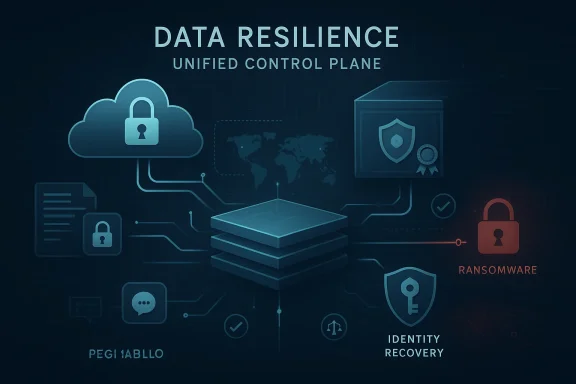
The through line in this week’s storage and data protection news is simple: data resilience is being redefined. Backup vendors are talking about immutability and recovery, storage vendors are emphasizing performance variability and multi-cloud design, and security vendors are now reaching into AI assistants, identity systems, and privacy workflows. The old boundaries between storage, security, and governance are collapsing, and buyers are being asked to think in systems rather than silos.
That shift is visible in the breadth of the announcements covered by Solutions Review for the week of April 3, 2026. The roundup includes Backblaze’s regional cloud-storage performance data, BigID’s unified privacy management platform, Cohesity’s identity resilience guidance for Microsoft Entra ID, Exabeam’s expansion of behavioral analytics into ChatGPT and Copilot, Hammerspace’s FIPS 140-3 validation efforts, and ValorC3’s managed private cloud push. Solutions Review’s editors framed these updates as part of a wider stream of product news, M&A, VC activity, hiring, and market commentary that now defines the storage and protection landscape. (solutionsreview.com)
Just as important is what the roundup implies about buyer behavior. Enterprises are no longer selecting storage on raw capacity alone; they are weighing recovery speed, immutability, jurisdictional compliance, identity recovery, and AI data governance. In other words, storage is increasingly becoming the control plane for operational trust. That is a major change for the market, and it helps explain why so many vendors are now attaching security and compliance claims to what used to be straightforward infrastructure announcements.
The news also reflects a broader competitive reality: every vendor wants to be the answer to resilience, but no one vendor can convincingly cover every layer. Backblaze is making the case for benchmark transparency and multi-cloud flexibility. BigID is pitching unification of privacy and AI governance. Cohesity is extending the backup conversation into identity recovery. Exabeam is warning that AI assistants can become insider-risk channels. Hammerspace is chasing regulated AI data estates, and ValorC3 is selling an alternative to hyperscaler unpredictability. The market is fragmenting on features while consolidating around outcomes.
This also speaks to a deeper market tension. Cloud storage is often marketed as standardized, but actual performance is shaped by distance, peering, platform architecture, and workload type. When independent benchmarks reveal that different providers win different categories, buyers get a stronger reason to architect for portability. That is especially true for media workflows, backup targets, AI training pipelines, and disaster recovery replicas, where latency-sensitive transfers can quickly become business-critical.
This is where AI changes the equation. AI systems can ingest copies of data into training sets, embeddings, vector stores, and prompt logs, which makes classic governance tools feel too static. A privacy stack that can discover data, apply rights requests, and manage consent in the same workflow has an obvious appeal to regulated enterprises. It also suggests that privacy vendors now have to think like data operations vendors, because the data lifecycle no longer stops at the database.
The historical significance is that data protection vendors used to focus on restoring files, VMs, or databases. Now they are being pulled into the restoration of trust itself. That is a much harder problem. Recovering identity means restoring policies, permissions, group memberships, and change histories in the right order, while ensuring the compromised state is not brought back with the good state. It is a clean recovery problem, not just a backup problem.
The deeper point is that AI assistants can amplify both productivity and risk. A user can paste confidential code, customer records, or internal strategy into a chatbot faster than a policy team can react. If the assistant is available across browsers, desktops, and mobile clients, the visibility problem becomes worse. Behavioral analytics may not solve the whole problem, but it can at least provide detection where simple application allowlists cannot.
This is especially relevant as more AI workloads cross between cloud, on-premises, and sovereign environments. A global data platform is only useful in regulated contexts if it can preserve control over keys, encryption, and policy enforcement while still delivering performance. Hammerspace’s broader strategy has been to keep architecture standards-based and non-proprietary, which should help it in enterprise and public-sector deals where lock-in is a concern. (hammerspace.com)
The integration of Veeam is also telling. Backup and recovery are no longer add-ons in private cloud designs; they are central to the value proposition. Buyers want the ability to recover quickly, preserve sovereignty, and avoid vendor-induced operational surprises. If a private cloud platform can bundle those outcomes with managed operations, it becomes a serious alternative rather than a compromise.
That last point is worth underlining. Many backup failures are not caused by a lack of technology but by the complexity of deploying and operating it correctly. Object First is betting that “simple immutability” is more scalable than policy-heavy designs that assume perfectly trained operators. In the SMB and distributed-enterprise segments, that is a persuasive argument.
That means the most interesting vendor developments in the coming weeks may not be the biggest product launches, but the ones that reveal how these categories are being combined. Will storage vendors deepen their security integrations? Will privacy platforms prove AI governance in production? Will backup vendors continue moving into identity recovery? Those questions will shape how the market evolves through the second quarter.
In the end, the week of April 3, 2026, is less about one breakout product than about a collective reset in how the industry talks about storage and protection. The best vendors are no longer promising to store data safely in the abstract; they are promising to preserve trust, recover identity, enforce privacy, and withstand attack when the data platform itself becomes part of the threat surface.
Source: Solutions Review Storage and Data Protection News for the Week of April 3; Updates from Exabeam, Hammerspace, Object First & More
 Overview
The through line in this week’s storage and data protection news is simple: data resilience is being redefined. Backup vendors are talking about immutability and recovery, storage vendors are emphasizing performance variability and multi-cloud design, and security vendors are now reaching into AI assistants, identity systems, and privacy workflows. The old boundaries between storage, security, and governance are collapsing, and buyers are being asked to think in systems rather than silos.That shift is visible in the breadth of the announcements covered by Solutions Review for the week of April 3, 2026. The roundup includes Backblaze’s regional cloud-storage performance data, BigID’s unified privacy management platform, Cohesity’s identity resilience guidance for Microsoft Entra ID, Exabeam’s expansion of behavioral analytics into ChatGPT and Copilot, Hammerspace’s FIPS 140-3 validation efforts, and ValorC3’s managed private cloud push. Solutions Review’s editors framed these updates as part of a wider stream of product news, M&A, VC activity, hiring, and market commentary that now defines the storage and protection landscape. (solutionsreview.com)
Just as important is what the roundup implies about buyer behavior. Enterprises are no longer selecting storage on raw capacity alone; they are weighing recovery speed, immutability, jurisdictional compliance, identity recovery, and AI data governance. In other words, storage is increasingly becoming the control plane for operational trust. That is a major change for the market, and it helps explain why so many vendors are now attaching security and compliance claims to what used to be straightforward infrastructure announcements.
The news also reflects a broader competitive reality: every vendor wants to be the answer to resilience, but no one vendor can convincingly cover every layer. Backblaze is making the case for benchmark transparency and multi-cloud flexibility. BigID is pitching unification of privacy and AI governance. Cohesity is extending the backup conversation into identity recovery. Exabeam is warning that AI assistants can become insider-risk channels. Hammerspace is chasing regulated AI data estates, and ValorC3 is selling an alternative to hyperscaler unpredictability. The market is fragmenting on features while consolidating around outcomes.
Cloud Storage Performance Is Becoming a Geography Problem
Backblaze’s Q1 2026 performance stats may be the most useful reminder in the roundup that cloud storage still behaves like infrastructure, not magic. The company’s benchmarking showed that performance varies significantly by region and workload, with no single provider winning everywhere. In US-East, upload and download times improved quarter over quarter, while in EU-Central the results shifted again, with Cloudflare R2 and Wasabi standing out in several categories and AWS not leading consistently. (solutionsreview.com)Why the Benchmarking Matters
The practical significance is that cloud storage decisions should be workload-aware and region-aware, not brand-led. Too many procurement conversations still begin with broad assumptions about “the best” provider, when the real answer is usually “the best provider for this region, this object size, this transfer pattern, and this SLA.” Backblaze is using the report to reinforce a multi-cloud argument, and that message lands because the data show a real spread in outcomes. (solutionsreview.com)This also speaks to a deeper market tension. Cloud storage is often marketed as standardized, but actual performance is shaped by distance, peering, platform architecture, and workload type. When independent benchmarks reveal that different providers win different categories, buyers get a stronger reason to architect for portability. That is especially true for media workflows, backup targets, AI training pipelines, and disaster recovery replicas, where latency-sensitive transfers can quickly become business-critical.
The Strategic Implication
The strategic implication is that multi-cloud is no longer just a resilience slogan. It is becoming a technical hedge against regional inconsistency and a commercial hedge against vendor lock-in. If one provider leads for 256KiB files while another wins 2MiB transfers and a third performs best in another geography, then enterprise architects need policies and tooling that can route around variance instead of pretending it does not exist.- Benchmark transparency is becoming a buying criterion.
- Regional diversity matters as much as vendor reputation.
- Workload-specific tuning beats one-size-fits-all architectures.
- Performance claims should be tested under real transfer patterns.
- Multi-cloud planning is increasingly a practical necessity, not a luxury.
Privacy and AI Governance Are Converging
BigID’s announcement of Unified Privacy Management for People Data and AI pushes privacy software into a more ambitious role. The platform combines personal-data discovery, data rights automation, consent enforcement, and AI privacy governance into a single system designed to work across the enterprise data landscape. The company’s pitch is that privacy programs have looked operational on paper for years, while remaining hard to prove under audit in practice. (prnewswire.com)From Compliance Workflows to Control Systems
That framing is important because privacy has shifted from a policy issue to a systems issue. Enterprises are no longer just trying to maintain notices and approval records; they are trying to trace how personal data moves through structured systems, unstructured repositories, and AI training pipelines. BigID’s emphasis on correlating data back to individuals, and on validating and logging every action, reflects the new reality that privacy teams must produce evidence, not just intent. (prnewswire.com)This is where AI changes the equation. AI systems can ingest copies of data into training sets, embeddings, vector stores, and prompt logs, which makes classic governance tools feel too static. A privacy stack that can discover data, apply rights requests, and manage consent in the same workflow has an obvious appeal to regulated enterprises. It also suggests that privacy vendors now have to think like data operations vendors, because the data lifecycle no longer stops at the database.
Why the Market Is Moving
The market is moving this direction because fragmented privacy tools create gaps that are impossible to defend when regulators, customers, or internal auditors ask hard questions. The announcement is a response to that pressure, but it is also a competitive signal: privacy vendors that cannot address AI data use will look incomplete very quickly. BigID’s message is that unified governance is not a convenience feature; it is the only way to keep privacy programs believable. (prnewswire.com)- Personal-data discovery must extend into AI systems.
- Consent enforcement is becoming an operational control.
- Data rights requests need evidence trails.
- AI privacy governance is now part of core compliance.
- Audit readiness is a product requirement, not a policy document.
Enterprise Impact Versus Consumer Impact
For enterprises, this is about scale, traceability, and legal defensibility. For consumers, the practical effect is less visible but still meaningful: better handling of deletion requests, access rights, and consent choices can translate into fewer failures and slower leakage of rights into AI systems. The consumer-facing promise is better stewardship; the enterprise-facing promise is audit-proof control. Both matter, but the enterprise use case will drive buying decisions first.Identity Resilience Is Now a Backup Problem
Cohesity’s REDLab advisory on Microsoft Entra ID is a strong sign that identity systems have fully entered the data-protection conversation. The company defines identity resilience as the ability to secure, recover, and investigate identity systems so organizations can return to service quickly after an attack. That matters because identity outages are no longer just authentication issues; they are business outages. (solutionsreview.com)Why Identity Has Become a Recovery Target
Modern ransomware and intrusion campaigns often target the control plane first. If attackers compromise Active Directory or Entra ID, they can use privileges to widen access, disable defenses, or block recovery. Cohesity’s guidance emphasizes reducing excessive privileges, configuring controls correctly, and automating recovery workflows with immutable backups if compromise occurs. The company’s January 2026 expansion of its Identity Resilience portfolio, including ITDR capabilities, shows that it is treating identity as a recoverable asset rather than a fixed assumption. (cohesity.com)The historical significance is that data protection vendors used to focus on restoring files, VMs, or databases. Now they are being pulled into the restoration of trust itself. That is a much harder problem. Recovering identity means restoring policies, permissions, group memberships, and change histories in the right order, while ensuring the compromised state is not brought back with the good state. It is a clean recovery problem, not just a backup problem.
Why the Messaging Is Resonating
Cohesity is clearly betting that identity recovery will become a mainstream board-level concern. The logic is sound: if an attacker can make the identity layer untrustworthy, then every downstream security control starts to fail. Backup and recovery vendors are therefore being asked to protect not only data, but also the mechanisms used to authenticate and authorize access to data. That widens the scope of resilience in a way many legacy teams are still catching up to. (cohesity.com)- Identity compromise can halt operations as effectively as data loss.
- Recovery must be automated to avoid reintroducing compromise.
- Immutable backups matter for identity systems too.
- Testing recovery paths is now a security requirement.
- Privilege reduction is part of resilience, not just hardening.
AI Assistants Are Creating New Insider Threat Telemetry
Exabeam’s expansion of Agent Behavior Analytics into OpenAI ChatGPT and Microsoft Copilot is one of the week’s clearest signs that enterprise security vendors are now treating AI assistants as part of the insider-threat surface. Exabeam says it can monitor queries, shared data, frequency, and location to baseline normal use and detect misuse or exfiltration through AI assistants. The telemetry then feeds into existing TDIR workflows so suspicious activity can be investigated like any other behavior anomaly. (exabeam.com)Why This Is a Meaningful Shift
This matters because AI tools are no longer passive productivity layers. They are increasingly acting on behalf of employees, touching sensitive data, and interacting with cloud services that security teams may not fully understand. Exabeam’s approach is to treat those interactions as behavior signals rather than as isolated application events. That is a clever move, because it allows the company to extend a familiar security model into a new class of tools. (exabeam.com)The deeper point is that AI assistants can amplify both productivity and risk. A user can paste confidential code, customer records, or internal strategy into a chatbot faster than a policy team can react. If the assistant is available across browsers, desktops, and mobile clients, the visibility problem becomes worse. Behavioral analytics may not solve the whole problem, but it can at least provide detection where simple application allowlists cannot.
Competitive Implications
Exabeam’s move also shows how cybersecurity vendors are competing to define the guardrails around AI adoption. If one company can detect suspicious prompt behavior, data sharing patterns, or unusual assistant use, it can position itself as the control point for the AI workforce. That creates pressure on SIEM, UEBA, and insider-risk rivals to answer the same question: can you see what employees and agents are doing inside AI tools, or are you blind until exfiltration already happened? (exabeam.com)- AI assistants are now part of the insider-risk conversation.
- Prompt and sharing telemetry can reveal misuse patterns.
- Behavioral baselines are more useful than static rules here.
- TDIR workflows need to absorb AI-related events.
- Visibility is becoming a differentiator in AI security.
FIPS Validation Is Becoming a Market Signal
Hammerspace’s FIPS 140-3 validation push is about more than a certification badge. For governments, defense contractors, and regulated enterprises, validated cryptography remains a gatekeeper for procurement and deployment. The NIST CMVP listing shows a Hammerspace cryptographic module entry with a FIPS 140-3 initial validation dated March 13, 2026, which aligns with the vendor’s messaging about integrating certified encryption into its AI data platform.Why Compliance Still Moves Deals
Security certification matters because it shortens the trust conversation. A platform that can point to validated cryptography has a stronger position in environments where regulators, auditors, and procurement teams expect standardized assurance. Hammerspace is trying to make the case that regulated AI workflows need both high-performance data orchestration and certifiable protection.This is especially relevant as more AI workloads cross between cloud, on-premises, and sovereign environments. A global data platform is only useful in regulated contexts if it can preserve control over keys, encryption, and policy enforcement while still delivering performance. Hammerspace’s broader strategy has been to keep architecture standards-based and non-proprietary, which should help it in enterprise and public-sector deals where lock-in is a concern. (hammerspace.com)
What It Means for AI Data Estates
The key market question is whether cryptographic validation will become a baseline expectation for AI infrastructure. If AI systems are going to process sensitive records, research data, or controlled workloads, then encryption can no longer be an afterthought. Vendors that can tie performance claims to validated security are likely to look more credible than those that treat compliance as a separate checkbox.- FIPS validation strengthens trust in regulated environments.
- Certified crypto can reduce procurement friction.
- AI data platforms need policy and performance together.
- Standards-based architectures remain a competitive advantage.
- Sovereign and public-sector use cases depend on assurance.
Private Cloud Is Returning as an Enterprise Escape Hatch
ValorC3’s managed private cloud launch, built on Platform9 Managed OpenStack and Veeam-powered protection, is another sign that some enterprises are reconsidering their dependence on public-cloud elasticity. The company is pitching cloud-like agility with more control over performance, sovereignty, and recovery than hyperscaler-first designs typically allow. That message speaks directly to organizations frustrated by VMware uncertainty, cloud cost volatility, or data residency requirements. (valorc3.com)Why Private Cloud Is Back in the Conversation
Private cloud never really disappeared, but it lost some mindshare during the hyperscaler boom. Now it is reemerging in a more pragmatic form: not as a nostalgia play, but as a control platform for workloads that are too expensive, too regulated, or too latency-sensitive to leave entirely in public cloud. ValorC3 is explicitly positioning its platform around VMware exit and public-cloud repatriation, which puts it in the middle of a major enterprise planning trend. (valorc3.com)The integration of Veeam is also telling. Backup and recovery are no longer add-ons in private cloud designs; they are central to the value proposition. Buyers want the ability to recover quickly, preserve sovereignty, and avoid vendor-induced operational surprises. If a private cloud platform can bundle those outcomes with managed operations, it becomes a serious alternative rather than a compromise.
The Competitive Pressure
This move increases pressure on both hyperscalers and traditional infrastructure vendors. Hyperscalers have scale, but they do not always have the best answer for every cost, compliance, or sovereignty issue. Traditional infrastructure vendors have depth, but they may not provide the simplicity enterprises now expect. Managed private cloud sits in the middle and tries to solve for both control and convenience. (valorc3.com)- Sovereignty is driving renewed interest in private cloud.
- Recovery capabilities are central to platform selection.
- VMware disruption is pushing evaluation cycles.
- Managed operations reduce the burden of private-cloud ownership.
- Hybrid architectures remain the dominant practical model.
Object First and the Immovable Backup Layer
Object First’s RSAC presence reinforces a message that has become central to the post-ransomware era: backup storage must be designed to resist tampering, not merely to store data. The company is leaning hard into the idea of absolute immutability, with on-premises backup storage purpose-built for Veeam and aimed at SMB, ROBO, and distributed enterprises. The timing is deliberate, arriving as ransomware actors continue to target backup infrastructure itself. (objectfirst.com)Why Immutability Still Sells
Immutability remains one of the strongest recovery assurances in the market because it narrows the attacker’s options. If the backup target cannot be altered, encrypted, or deleted by administrators or attackers, recovery becomes far more dependable. Object First’s pitch is that simplicity matters just as much as technical hardness: secure, deployable, and low-friction storage is more likely to be adopted than an elegant system that requires deep security expertise. (objectfirst.com)That last point is worth underlining. Many backup failures are not caused by a lack of technology but by the complexity of deploying and operating it correctly. Object First is betting that “simple immutability” is more scalable than policy-heavy designs that assume perfectly trained operators. In the SMB and distributed-enterprise segments, that is a persuasive argument.
The Broader Backup Market
The market implication is that backup vendors must now prove not just recoverability, but recoverability under attack. That pushes them toward hardware-anchored immutability, zero-trust design, and tighter integration with recovery workflows. Object First has been building that narrative for several product cycles, and its RSAC messaging suggests it expects ransomware-proof backup to remain a top buying concern through 2026. (objectfirst.com)- Immutable storage reduces the blast radius of ransomware.
- Simplicity can be a security advantage.
- Veeam-centric ecosystems remain commercially powerful.
- SMB and distributed enterprises need practical recovery tools.
- Backup is now a frontline security control.
Strengths and Opportunities
The week’s announcements reveal a market with real momentum, but also with unusually clear paths for differentiation. Vendors that can connect data protection to governance, compliance, and identity resilience will have a better story than those still selling isolated features. The opportunity is not just to sell more software; it is to become the platform that enterprises trust when things go wrong.- Benchmark-driven selection is giving buyers better ways to compare cloud storage providers.
- Unified privacy platforms can replace fragmented toolchains and reduce audit pain.
- Identity resilience opens a larger market for backup vendors beyond file and VM recovery.
- AI assistant monitoring gives security vendors a new control surface.
- FIPS validation strengthens credibility in public-sector and regulated deals.
- Private cloud modernization gives enterprises a practical exit from cloud cost and control issues.
- Immutable backup design remains a strong answer to ransomware-driven risk.
Risks and Concerns
The same trends that create opportunity also create friction. More visibility can mean more monitoring, more compliance can mean more process overhead, and more integration can mean more complexity. The danger for buyers is that resilience becomes a bigger architecture problem than the organizations are prepared to own.- Tool sprawl may worsen if vendors unify features without true integration.
- AI monitoring could trigger privacy and labor-relations concerns if deployed aggressively.
- Identity recovery remains operationally difficult and easy to test poorly.
- Cloud benchmarking can be misleading if buyers overgeneralize from one region or workload.
- Compliance certifications do not eliminate implementation risk.
- Private cloud can reintroduce management burden if “managed” services are underspecified.
- Immutability claims still need verification under realistic attack scenarios.
Looking Ahead
The next phase of the storage and data protection market will likely be defined by convergence. Storage performance, privacy governance, identity protection, and AI telemetry are no longer separate buying categories in practice. They are parts of the same resilience conversation, especially for enterprises that operate under regulatory pressure or face elevated ransomware risk.That means the most interesting vendor developments in the coming weeks may not be the biggest product launches, but the ones that reveal how these categories are being combined. Will storage vendors deepen their security integrations? Will privacy platforms prove AI governance in production? Will backup vendors continue moving into identity recovery? Those questions will shape how the market evolves through the second quarter.
- Watch for more identity-centric recovery announcements.
- Expect more AI governance features in privacy and security platforms.
- Look for additional regional benchmark data from cloud storage vendors.
- Track whether FIPS and other certifications become more prominent in AI infrastructure.
- Pay attention to private cloud repatriation as cost pressure continues.
- Monitor whether immutable backup claims are matched by simpler deployment.
In the end, the week of April 3, 2026, is less about one breakout product than about a collective reset in how the industry talks about storage and protection. The best vendors are no longer promising to store data safely in the abstract; they are promising to preserve trust, recover identity, enforce privacy, and withstand attack when the data platform itself becomes part of the threat surface.
Source: Solutions Review Storage and Data Protection News for the Week of April 3; Updates from Exabeam, Hammerspace, Object First & More
