

Digital Brands Group’s recent string of technology announcements — from an exploratory program on Microsoft Azure Quantum to a commercial deployment of AI-driven brand-protection tools with SECUR3D and a partnership to onboard Herschel Supply Co. — signals a clear pivot in strategy: the company is positioning itself as a technology-forward e‑commerce operator that treats advanced computing, data security, and IP protection as core competitive levers. The disclosures combine short‑term commercial moves (AI-based brand protection and marketplace monitoring) with longer‑horizon R&D (quantum and post‑quantum cryptography readiness), and they merit close scrutiny because the mix of marketing language, genuine technical substance, and investor signaling can easily be conflated.
Source: The Manila Times Digital Brands Group Explores Quantum Computing Initiatives Using Microsoft Azure Quantum
 Background
What the company announced — a concise summary
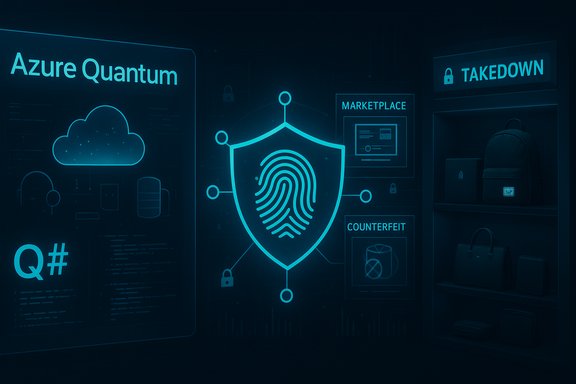
Digital Brands Group (NASDAQ: DBGI) has published several technology‑focused releases in 2025 that together define a two‑track technology agenda. First, the company announced it is exploring quantum computing initiatives using Microsoft Azure Quantum to evaluate quantum‑machine‑learning and quantum‑inspired optimization approaches for personalization and customer segmentation, and to study quantum‑resilient data protection strategies. The company framed this work as exploratory research rather than an operational migration. Second, DBG expanded its AI‑enabled eCommerce toolset by partnering with SECUR3D to deploy the AssetSafe™ platform for proactive IP and brand protection. As part of that program, Herschel Supply Co. — a design‑led accessories brand founded in Vancouver in 2009 — is a named customer deploying AssetSafe to detect counterfeits and unauthorized listings across marketplaces and social platforms. The AssetSafe product is described as an AI‑driven platform for detection, monitoring, and automated enforcement.Why this matters now
Three forces make these announcements noteworthy for e‑commerce operators and enterprise IT professionals:- Quantum trajectory: Hyperscalers and quantum vendors increasingly package research sandboxes for enterprise experimentation. Azure Quantum offers multi‑vendor access and developer tooling that reduce friction for pilots. That makes exploratory programs both inexpensive and visible.
- IP risk at scale: Marketplaces and UGC channels continue to expose brands to counterfeit and trademark misuse; automated detection and takedown tooling is becoming a practical and sometimes necessary part of digital brand defense. AssetSafe is presented as one of those pragmatic tools.
- Crypto and data protection horizons: Enterprises holding long‑lived customer records must plan for post‑quantum cryptography (PQC) migration even while pursuing quantum research; the disclosures tie a defensive PQC posture to exploratory quantum work, a pattern increasingly recommended by security practitioners.
Overview: the announcements in more detail
Azure Quantum exploration — what DBG actually said
DBG’s statement made three concrete, bounded claims about areas under investigation:- Hyper‑personalized recommendations using quantum or quantum‑inspired models to enhance product discovery.
- Advanced clustering and segmentation to refine lifetime‑value models and target offers.
- Quantum‑resilient data protection to safeguard consumer and transaction information against future quantum threats.
SECUR3D and Herschel: near‑term commercial activity
Separately, DBG announced partnerships to operationalize AI‑driven brand protection. SECUR3D’s AssetSafe™ platform is described as providing:- Proactive detection and digital fingerprints of brand assets,
- Ongoing monitoring across marketplaces and social channels, and
- Automated enforcement workflows to reduce counterfeit exposure.
Technical context: what Azure Quantum offers and what "exploration" realistically entails
What Azure Quantum is today
Azure Quantum is a hybrid cloud service that aggregates access to multiple quantum hardware providers (IonQ, Quantinuum, Rigetti, PASQAL, and more), offers developer tooling (Q#, QDK, and QIR), and includes simulators and quantum‑inspired optimization tools. It is explicitly positioned as an enterprise sandbox for algorithm prototyping and optimization pilots rather than a guarantee of immediate quantum advantage for ML workloads. Microsoft’s documentation stresses hybrid development, simulator‑first experiments, and resource estimation tools for planning.Practical, near‑term experiments a retailer can run on Azure Quantum
A careful enterprise pilot typically follows a safe, simulator‑first playbook:- Use quantum‑inspired optimizers or annealing‑style solvers for combinatorial problems (inventory, pricing buckets, ranking subproblems).
- Prototype localized subroutines (for example, a sampling stage or a ranking‑scoring hybrid) on simulators and compare rigorously with classical baselines.
- Reserve hardware runs for reproducibility checks once simulator results justify the cost and experimental value.
- Parallelize a PQC readiness program: inventory cryptographic assets, trial NIST‑approved PQC algorithms in test environments, and plan crypto‑agility for production.
Where quantum advantage is most plausible (and where it is not)
- Plausible: Combinatorial optimization subproblems; targeted sampling methods where speedups can be measured against classical heuristics; and cryptographic planning (PQC readiness).
- Unlikely in the near term: large, general‑purpose recommender systems that rely on deep neural networks trained on massive datasets. Quantum ML for broad‑scale recommender replacements is still research‑level work and has not demonstrated a clear production advantage beyond highly specific subproblems.
Risk, reward, and credibility — critical analysis
Strategic strengths of DBG’s approach
- Balanced posture (research + defense): Pairing exploratory quantum pilots with PQC readiness is tactically sound. It shows awareness that quantum poses both opportunity and long‑term risk to cryptography.
- Low‑friction platform choice: Azure Quantum reduces upfront capital expenditure and provides a multi‑vendor experimental surface that is appropriate for R&D teams. Using an established cloud provider accelerates iteration cycles.
- Near‑term revenue and brand protection focus: The SECUR3D AssetSafe deployment with Herschel is a credible commercial move: IP protection tools address immediate operational pain points for consumer brands and can deliver measurable returns via reduced counterfeit exposure and greater marketplace integrity.
Key risks and possible overreach
- Marketing vs. engineering reality: Public announcements often use aspirational language. Phrases like “exploring advanced quantum initiatives” can attract investor enthusiasm but risk creating unrealistic expectations if pilots don’t produce quick, measurable outcomes. DBG’s own forward‑looking disclaimers underscore this.
- Timeline and resource mismatch: Quantum research requires time, domain expertise (quantum algorithms, error mitigation, QC‑classical hybridization), and disciplined measurement. Small organizations can under‑estimate the cost and engineering effort to turn pilot results into production gains.
- Data governance and compliance exposures: Any pilot involving customer data — even in sandboxes — must maintain strict anonymization, PCI/PII compliance, and vendor data‑handling agreements. Mistakes here can create legal and reputational risk. A robust human‑in‑the‑loop governance model is essential.
- PQC migration complexity: Moving to post‑quantum algorithms is not zero cost. Some PQC primitives increase key sizes or change performance profiles; interoperability and legacy systems present nontrivial migration challenges. These are solvable but require planned engineering cycles.
SECUR3D and AssetSafe: real‑world applicability and caveats
What AssetSafe claims to offer
AssetSafe is marketed as an AI‑driven IP protection suite that creates unique digital fingerprints of assets (including 3D models and imagery), monitors marketplaces and social platforms for infringement, and automates enforcement and takedowns. For brands like Herschel this promises faster detection of counterfeit listings and reduced manual moderation costs.Where vendors like SECUR3D add value — and where buyers should push for proof
- Value:
- Automation of detection and initial triage to reduce time‑to‑takedown.
- Scale: marketplaces generate millions of listings; automation is necessary to cover that surface.
- For brands with complex IP (designs, 3D assets), geometry and texture analysis can detect lifted or slightly altered copies.
- Due diligence buyers should demand:
- False positive/negative rates on live marketplace data and representative classes of infringement.
- Transparency on datasets and model training (to avoid privacy or IP leakage).
- SLAs and enforcement efficacy metrics (how often detections result in actual removal).
- Data handling and legal posture for takedown requests in diverse jurisdictions.
Practical checklist and recommended roadmap for DBG and similar retailers
Immediate (0–6 months)
- Scope narrow, measurable pilots — pick bounded recommendation subproblems or optimization routines, define business KPIs (CTR lift, LTV delta, cost per acquisition change).
- Run simulator baselines on Azure Quantum and compare against best classical methods before any paid hardware runs.
- Kick off PQC inventory: list cryptographic assets, categorize by lifetime and sensitivity, and prioritize migration candidates (key management, long‑term archives).
- Operationalize AssetSafe with clear performance measurement: detection accuracy, time to enforcement, and a playbook for disputed removals.
Medium (6–18 months)
- Publish internal reproducible benchmarks for pilot experiments to discipline claims and enable auditability.
- Invest in hybrid talent (quantum algorithm engineers, ML ops, cryptographers) or retain expert partners for technical depth.
- Stage PQC transitions into noncritical TLS and archived data flows first, then expand as interoperability tests pass.
Long (18+ months)
- Reassess areas of quantum advantage with updated vendor capabilities and peer benchmarks. Only scale when reproducible advantage over classical baselines exists.
- Integrate successful quantum subroutines into hybrid pipelines where they demonstrably improve business metrics.
Investor and customer lens: what to watch next
- For investors: Treat the quantum exploration as R&D and not a revenue driver unless DBG publishes reproducible metrics showing production‑grade improvements. Short‑term commercial value will more likely come from brand protection and marketplace integrity work.
- For customers and partners: Demand clarity on privacy, data handling, and enforcement results for any marketplace‑monitoring product. For loyalty and personalization pilots, ensure classical fallbacks and clear consent practices for PII usage.
- For technical readers: Watch for published benchmarks, open methodology, and third‑party audits. The first production‑grade signal that matters will be reproducible, peer‑verifiable improvements over classical baselines or demonstrable, low‑risk PQC migration steps.
Wider industry signals and context
- Microsoft’s public progress on quantum research — including hardware advances and a growing Azure Quantum ecosystem — has increased enterprise curiosity and lowered the marginal cost of experimentation, but it has not eliminated the core engineering challenges of error correction and algorithmic maturity. The industry’s messaging is therefore a mix of credible engineering progress and calibrated caution.
- At the same time, NIST’s PQC standardization and cloud vendors’ PQC tooling make cryptographic preparedness a near‑term operational task, not a philosophical concern. That pragmatic angle is one of the most immediate benefits enterprises gain by pairing exploratory quantum work with concrete PQC migration plans.
Conclusion
Digital Brands Group’s twin announcements — exploring Azure Quantum for long‑horizon research while deploying AI‑powered brand protection with SECUR3D and bringing Herschel on board — are a textbook example of a small public company balancing aspirational technology signaling with immediate commercial operations. The Azure Quantum initiative is strategically sensible as a controlled R&D program tightly coupled to a parallel PQC readiness track; it should be read as experimentation rather than an imminent overhaul of recommender systems. The SECUR3D/Herschel work is the operational linchpin that can deliver short‑term, measurable value in brand integrity and marketplace trust. Success for DBG will depend on disciplined experimentation, hard KPIs, transparent benchmarks, and cautious investor communications that separate long‑horizon research from near‑term commercial progress. Companies contemplating similar moves should treat quantum pilots as learning investments, prioritize PQC migration for long‑lived secrets, and demand demonstrable accuracy and legal readiness from IP‑protection vendors. If DBG follows the pragmatic, evidence‑driven roadmap its announcements imply, the combined strategy could strengthen both its short‑term commerce operations and long‑term technical resilience.Source: The Manila Times Digital Brands Group Explores Quantum Computing Initiatives Using Microsoft Azure Quantum
