

dBpoweramp’s latest Reference build tightens the screws on audio quality and high‑volume workflows: a new ARDFTSRC resampler, refreshed CD Ripper scanning, large‑library performance improvements, and a formal end to 32‑bit builds position the R2025.11.12 update as both a fidelity‑focused release and a pragmatic cleanup that forces users to plan upgrades and test migrations carefully.
dBpoweramp has long been a staple utility for Windows users who demand accurate ripping, reliable batch conversion and robust metadata handling. The product bundles a CD Ripper, Music Converter, Batch Converter, ID Tag Editor and Explorer shell integrations into a single suite, and ships with many common codecs out of the box while allowing extensions via Codec Central. The suite offers a 21‑day trial of the Reference edition before reverting to the Free edition, and remains widely used by enthusiasts and professional archivists. The R2025.11.12 release is explicitly billed as a quality and workflow update: the headline is the new ARDFTSRC resampler (presented as an alternative to the respected SSRC), alongside a number of reliability and performance improvements, updated encoder builds, and a move to 64‑bit–only distribution. These changes reflect two converging priorities: advancing audio fidelity for conversion and DSP operations, and simplifying maintenance by dropping legacy platform support.
Conclusion: dBpoweramp R2025.11.12 refines the converter for listeners and archivists who demand both quality and scale, but the changes also raise practical migration and verification tasks — most notably the end of 32‑bit support and the inclusion of patched encoder builds. Adopt the update with a short pilot, preserve your legacy installers until migration is complete, and use the new resampler options deliberately: they’re powerful tools that deserve verification, not blind default switches.
Source: Neowin dBpoweramp Music Converter 2025.11.12
 Background
dBpoweramp has long been a staple utility for Windows users who demand accurate ripping, reliable batch conversion and robust metadata handling. The product bundles a CD Ripper, Music Converter, Batch Converter, ID Tag Editor and Explorer shell integrations into a single suite, and ships with many common codecs out of the box while allowing extensions via Codec Central. The suite offers a 21‑day trial of the Reference edition before reverting to the Free edition, and remains widely used by enthusiasts and professional archivists. The R2025.11.12 release is explicitly billed as a quality and workflow update: the headline is the new ARDFTSRC resampler (presented as an alternative to the respected SSRC), alongside a number of reliability and performance improvements, updated encoder builds, and a move to 64‑bit–only distribution. These changes reflect two converging priorities: advancing audio fidelity for conversion and DSP operations, and simplifying maintenance by dropping legacy platform support. What’s new in R2025.11.12
ARDFTSRC: a new resampler option
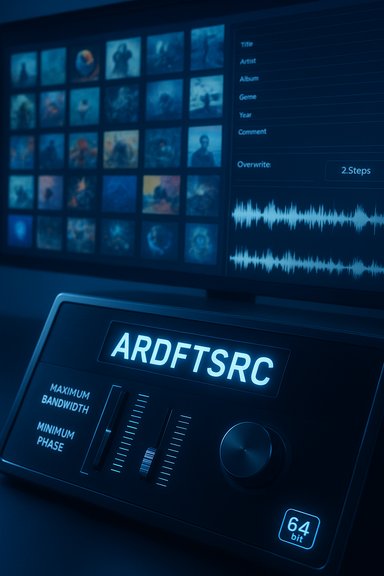
- A brand‑new resampling method, ARDFTSRC, has been added after months of development with the goal of offering a higher‑quality Sample Rate Conversion (SRC) option than SSRC.
- ARDFTSRC is reported to support conversion to arbitrary sample rates (for example, non-standard rates such as 123456 Hz), expanding flexibility for unusual conversion targets and research workflows.
- Global resampler controls have been exposed in the Control Center → Advanced area, with parameters such as Maximum Bandwidth and Minimum Phase (the latter intended to reduce pre‑ringing artifacts).
- The existing Resample DSP effect can now override the global resampler configuration on a per‑job basis, giving users both default quality controls and specific overrides when needed.
CD Ripper and scanning changes
- The CD Ripper and ID Tag tools now use Windows Image Acquisition (WIA) for scanning discs, which means the system scanning dialog is shown consistently and the previous “scan settings” menu option has been removed to streamline the UI.
- Improvements to track offset handling were made: if a disc has no metadata and a manual track offset is applied, track titles and the displayed Title field will behave more predictably (e.g., Title shown as “Track X” when no metadata exists).
- Several bug fixes were applied to ripping edge cases, including pre‑emphasis handling and saved manual track offsets in dB Cache (the app’s internal metadata cache).
Large‑library and batch conversion improvements
- New file‑selection code and a reworked overwrite check mean the Converter can now handle hundreds of thousands of tracks more efficiently, with a two‑stage overwrite check that avoids UI freezes during long scans. The developers say converting 250k files now takes minutes to check instead of hours.
- The overwrite dialog had UX refinements (the Unique button functions better) and the overall flow for very large jobs was engineered to remain responsive.
- A range of parsing and tag‑writer optimizations were added for MP4/M4A handling and picture data sanity checks, improving behavior with very large files and embedded artwork.
Encoder and codec updates
- The included LAME build was updated to 3.101.b3 with a q4 patch and optional AVX‑512 optimizations on Windows, and equivalent updates for macOS were noted; these patched builds are commonly used to address encoder regressions and performance. Community binary repositories and forums document the availability and performance characteristics of these patched LAME builds.
- WavPack received labeling updates for encoding modes (“high” and “extra high”), and additional codec and parser efficiencies were implemented for large MP4/M4A files.
Platform and packaging changes
- dBpoweramp has officially ended 32‑bit support: future installers and updates will be 64‑bit only. The project frames this as a pragmatic decision, noting that 64‑bit CPUs have been standard for many years and the market for 32‑bit Windows is effectively nonexistent.
- The Spoon blog and change logs on the dBpoweramp site reflect this direction and guide users toward 64‑bit installations.
Technical validation and cross‑checks
The most load‑bearing technical claims in the release notes were cross‑checked against dBpoweramp’s official site and active community resources:- The ARDFTSRC resampler and the addition of global resampler options are documented on the official site’s change log and discussed on the dBpoweramp forum where the developer posted implementation notes and a beta download. This confirms both the feature and that it was pursued through internal testing channels.
- The LAME update to 3.101.b3 with q4 patches and an AVX‑512‑optimized binary is corroborated by third‑party binary indexes and community threads (rarewares/hydrogenaudio), which host and benchmark patched LAME builds widely used by Windows audio tools when official upstream binaries lag. That contextual evidence indicates the LAME binary included is a community‑verified patched build rather than necessarily an immediately upstream official LAME release. Users should treat patched third‑party binaries accordingly and verify provenance if they run in sensitive environments.
- The trial model (21 days for Reference before falling back to Free) and the standard codec list (mp3, FLAC, ALAC, m4a, WAV, AIFF, etc. are reflected on the dBpoweramp product pages and help indexes.
Strengths: what this release does well
- Audio fidelity and control. Introducing an additional high‑quality resampler with tunable bandwidth and phase options is a clear boon for audiophiles and archivists who want precise control over resample artifacts and frequency response. The ability to pick minimum‑phase filters reduces pre‑ringing at the cost of phase linearity — a pragmatic trade for many listening contexts.
- Large‑library usability. Rewriting file selection and making overwrite checks a two‑stage, non‑blocking process is a concrete improvement for anyone who runs large batch jobs. Faster scanning and a responsive UI during large conversions lowers the operational cost of mass migration or format normalization projects.
- Cleaner maintenance surface. Dropping 32‑bit builds simplifies testing, packaging and security patching for the dBpoweramp team. Given the small and shrinking population of 32‑bit Windows users, this reduces complexity for the developer and shortens the path to modern optimizations (AVX, AVX2, AVX‑512 instruction sets when available).
- Practical ripping fixes. Using Windows Image Acquisition for scanning and smoothing track offset behavior addresses several long‑standing pain points for users who batch‑rip discs with partial or missing metadata. The CD Ripper’s deeper handling of edge cases improves reliability for archival work.
- Updated encoders with performance focus. Bundling a patched LAME that benefits from compiler and SIMD optimizations gives faster encoding on modern CPUs — an obvious win when converting large libraries, though it comes with provenance caveats (see below).
Risks, caveats and user action items
1) Dropping 32‑bit support — migration required
- Impact: Anyone still running 32‑bit Windows or using the 32‑bit edition of dBpoweramp will not receive future updates and will be offered archived installers only.
- Action: Inventory your machines and ensure critical ripping/conversion systems are migrated to 64‑bit Windows. For locked‑down embedded devices relying on 32‑bit builds, plan a transition period and retain archived installers and licenses off‑network if necessary. dBpoweramp’s blog acknowledges the decision and the archival approach.
2) New resampler — test before adopting as default
- Risk: Resampler choices are a quality trade; minimum‑phase filters reduce pre‑ringing but alter phase relationships and may change the perceived timbre of material, especially in complex mixes or phase‑sensitive workflows.
- Action: Run A/B tests on representative material (classical, electronic, heavily transient content). Compare ARDFTSRC to SSRC and SoX/LibSoXR options where possible, listening for pre‑ring, post‑ring and tonality differences at typical resample targets (44.1→48k, 96k→44.1k, and non‑standard rates). Keep a fallback profile that uses SSRC until you’re satisfied.
3) Patched encoder binaries and provenance
- Risk: The LAME build in the changelog references patched 3.101.b3 builds with AVX‑512. Many patched binaries are prepared by community builders (john33, others) and distributed through trusted community mirrors. Those builds may not be the official upstream LAME project artifacts.
- Action: If you require only officially sanctioned binaries, validate whether dBpoweramp’s included LAME comes from official sources or is a community‑patched binary. For high‑security environments, consider compiling LAME from source or using officially released upstream artifacts and point dBpoweramp to that encoder instead of the bundled binary. Cross‑check binary checksums and review community discussion threads for any regressions or compatibility caveats.
4) Large‑scale operations still need staging
- Risk: Even with performance improvements, converting hundreds of thousands of tracks is an operation with risk (metadata collisions, artwork size issues, storage bottlenecks).
- Action: Implement a staged pipeline:
- Test conversions on a 1–2% representative sample of your library.
- Verify metadata fidelity and embedded artwork behavior.
- Run a full metadata backup and catalog export (M3U/CSV) before the first mass conversion.
- Use non‑destructive output folders and only switch to in‑place overwrite after verifying a full batch.
5) UI and integration regressions remain possible
- Risk: Any major change to file selection, overwrite checks and shell integration can produce regressions in Explorer context menus or in third‑party automation scripts.
- Action: After updating, spot‑check Explorer context menu entries (Convert To / Quick Convert), validate any automation that invokes dBpoweramp from the command line, and ensure scheduled batch jobs behave identically. Keep the prior installer available for quick rollback if needed.
Practical testing checklist for power users and IT pros
- Back up dBpoweramp settings and the PerfectMeta/dB Cache directory before the update.
- On a test machine, install R2025.11.12 and run conversions on:
- A live album with gapless transitions.
- A heavily processed modern pop/master.
- High‑resolution files (96k/192k) to sample ARDFTSRC behavior.
- Validate the CD Ripper flow:
- Insert multiple discs with missing metadata and confirm WIA scanning behavior.
- Test manual track offset application and saving to dB Cache.
- Run a 1,000‑file batch conversion using your usual preset and observe:
- Overwrite dialog behavior.
- CPU and memory characteristics.
- Time to finish file selection and conversion start.
- If you use external LAME binaries, point dBpoweramp to your preferred compiled encoder and compare results vs bundled binary. Validate checksums and test a small encode set for reliability.
How this release fits the wider ecosystem
dBpoweramp’s focus on resampling, DSP effect overrides and high‑volume conversion performance mirrors broader trends in audio tooling: developers are spending engineering effort on quality of transcode (not just format coverage) and on workflows that scale to large personal and institutional libraries. At the same time, many audio tools have adopted community‑patched encoder builds for practical reasons (performance, regression fixes) — an approach that raises valid questions about binary provenance and long‑term maintainability. The move to 64‑bit builds follows industry practice and makes future SIMD and compiler optimizations easier to deliver.Final assessment — who should upgrade, and when
- Upgrade promptly if:
- You maintain large libraries and need faster, non‑blocking file checks.
- You care about resample quality and want to experiment with ARDFTSRC.
- You rely on updated MP4/M4A parsing and tag writing for very large or artwork‑heavy files.
- Delay or stage the upgrade if:
- You still run 32‑bit systems or rely on legacy installs that cannot be moved to 64‑bit.
- Your workflows require strictly upstream‑validated encoder binaries and you want to control the LAME build provenance.
- You depend on scripted or automated interactions with dBpoweramp’s shell integration and cannot tolerate any temporary regressions during the migration window.
Conclusion: dBpoweramp R2025.11.12 refines the converter for listeners and archivists who demand both quality and scale, but the changes also raise practical migration and verification tasks — most notably the end of 32‑bit support and the inclusion of patched encoder builds. Adopt the update with a short pilot, preserve your legacy installers until migration is complete, and use the new resampler options deliberately: they’re powerful tools that deserve verification, not blind default switches.
Source: Neowin dBpoweramp Music Converter 2025.11.12
