

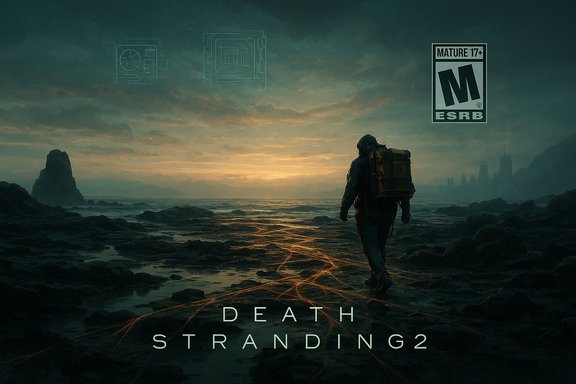
The ESRB has quietly listed a Windows PC entry for Death Stranding 2: On the Beach, a move that strongly suggests a PC port is in the works even though neither Kojima Productions nor Sony Interactive Entertainment has formally announced a release date or storefront plans. The rating entry identifies Sony as the publisher and carries the same "Mature (17+)" descriptor and content flags that accompanied the PS5 release, providing the first hard signal that the sequel will likely follow the original Death Stranding’s pattern of a delayed—but inevitable—PC arrival.
Death Stranding 2: On the Beach launched as a PlayStation 5 exclusive earlier in the year and has generated strong critical attention and awards-season nominations. Historically, the original Death Stranding debuted on PlayStation before a PC version arrived several months later; that precedent is why an ESRB listing for PC is widely read as a reliable early indicator of a planned PC release rather than an out‑of‑left‑field rumor. The ESRB listing mirrors those patterns: it names Windows PC as a platform and keeps the same Mature rating and content descriptors seen on console entries. This article dissects the ESRB listing, explains what can — and cannot — be inferred from it, and evaluates the technical and commercial implications for Windows gamers. It cross-checks multiple industry outlets and certification records to verify the core claims and flags where details remain unverified or speculative.
Practical takeaway: view the ESRB listing as confirmation that a PC version exists, but wait for an official announcement to plan upgrades, preorders, or streaming schedules. In the meantime, ensure your PC is ready with storage headroom, updated drivers, and a willingness to wait for first‑wave community reports if you want the smoothest launch-day experience.
Death Stranding 2’s ESRB listing is the clearest public sign yet that Kojima’s latest will cross to Windows — the most consequential remaining question is WHEN. Pending an official reveal from Kojima Productions or Sony Interactive Entertainment, the prudent approach is to treat this rating as solid evidence that a PC port is forthcoming while keeping expectations calibrated: port confirmed, timetable and distribution details still pending.
Source: TechPowerUp ESRB Tips Death Stranding 2 PC Launch | TechPowerUp}
 Background / Overview
Death Stranding 2: On the Beach launched as a PlayStation 5 exclusive earlier in the year and has generated strong critical attention and awards-season nominations. Historically, the original Death Stranding debuted on PlayStation before a PC version arrived several months later; that precedent is why an ESRB listing for PC is widely read as a reliable early indicator of a planned PC release rather than an out‑of‑left‑field rumor. The ESRB listing mirrors those patterns: it names Windows PC as a platform and keeps the same Mature rating and content descriptors seen on console entries. This article dissects the ESRB listing, explains what can — and cannot — be inferred from it, and evaluates the technical and commercial implications for Windows gamers. It cross-checks multiple industry outlets and certification records to verify the core claims and flags where details remain unverified or speculative.What the ESRB listing actually shows
The headline facts
- The ESRB database lists Death Stranding 2: On the Beach with a Windows PC platform entry and assigns the game an M (Mature 17+) rating.
- The rating entry identifies Sony Interactive Entertainment as the publisher for the PC version, rather than the third‑party arrangement used for the first game’s PC launch.
- Content descriptors in the listing match the PS5 release: Blood and Gore, Partial Nudity, Strong Language, and Violence (the wording varies slightly across outlets but the descriptors are consistent).
What the ESRB entry does not tell us
- The ESRB entry does not provide a release date, platform store (Steam, Epic Games Store, Microsoft Store), system requirements, or regional launch windows. Those details are typically provided by publishers at announcement time, not in rating metadata.
- A certification entry confirms a submission for classification; it does not guarantee a near‑term launch. Historically some ESRB listings appear months before a public release or even months before a formal announcement. The appearance of a rating should be read as a sign of intent, not a timetable.
Cross‑checking the record: independent confirmation and nuance
Multiple reputable outlets quickly mirrored the ESRB listing, providing independent confirmation and useful context.- Gematsu’s coverage reproduces the ESRB entry and highlights that Sony is listed as the publisher for the PC entry, a departure from the first game’s PC publisher arrangement.
- Windows Central confirms the rating and places it in historical perspective: ports of Sony exclusives often follow months after console launch, and an ESRB entry typically precedes public announcements by several weeks or months.
- Regional and language outlets (Gamespark, Tweakers, Vandal and others) echo the core facts and call out that the PC listing uses the same content descriptors as the PS5 release; they also note that ESRB entries have previously previewed ports well before public disclosure.
Why an ESRB entry is a reliable indicator — and why it can still mislead
Why it matters
The ESRB only classifies software that is submitted to it, and submissions for console ports and PC ports are routine steps publishers take before launch. For major releases, the classification process is one of the final pre‑release checks and often occurs shortly before regional storefront metadata is published. That makes an ESRB entry a credible leak when it appears ahead of an official announcement.Why it isn’t definitive
- ESRB listings can precede announcements by anywhere from days to many months. Past examples include listings that were accurate indicators of upcoming ports but appeared long before the publisher chose to publicize release windows. Tweakers and other outlets have pointed out cases (e.g., Black Myth: Wukong) where ESRB records preceded a release by many months. That history cautions against using a rating as proof of an imminent launch.
- The ESRB metadata will show the submitted publisher(s) and platforms, but it does not indicate whether the entry is a placeholder, a regional or test submission, or a final marketing SKU. All are possible.
What PC players should expect (realistically)
Likely commercial and distribution characteristics
- Publisher: The ESRB listing names Sony Interactive Entertainment as the publisher for the PC listing. If Sony self‑publishes on PC it simplifies distribution decisions (stores, PC‑specific marketing, and potential PlayStation/PC parity). Historically, Sony has published many of its first‑party titles on PC under its own label or in partnership; the shift away from third‑party publishers for PC ports is notable and may affect post‑launch support.
- Timing: Expect a staggered window. The original Death Stranding released on PlayStation first, and the PC build followed roughly eight months later. If DS2 follows a similar pattern the earliest reasonable estimate is months after the PS5 launch; many outlets suggest an early‑to‑mid 2026 window is plausible if the ESRB filing signals a near‑term port. However, this is speculative — publishers occasionally accelerate or delay ports for technical or strategic reasons.
- Where: No storefront is listed in the ESRB entry. Major options are Steam, Epic Games Store, and potentially the Microsoft Store or a Sony‑run launcher; expect an official announcement to clarify this.
Technical and feature expectations (educated, cautious guesses)
While no official PC system requirements have been published yet, several realistic expectations follow from modern porting practice and the precedent set by the first game:- A PC port will likely include graphics and performance options not present in the PS5 baseline: framerate uncapping, resolution scaling, ultrawide support, and possibly vendor‑specific upscalers (DLSS/XeSS/FSR) depending on engine support and developer choices.
- Expect support for keyboard + mouse and configurable controller mappings (including DualSense features if Sony chooses to surface them on PC).
- PC releases of first‑party Sony games in recent years sometimes add or refine quality‑of‑life features (photo modes, adjustable HUD, mod‑friendliness to varying degrees), though the degree of modder access depends on the publisher’s policy.
- System requirements will likely follow modern AAA norms: SSD recommended, mid‑to‑high‑range GPU for higher fidelity modes, and increased VRAM for higher texture pools. Exact numbers must wait for official specs.
Commercial and strategic implications
Sony’s publisher listing matters
If Sony is listed as the PC publisher — rather than a partner like 505 Games that handled the first game’s PC port — that indicates tighter first‑party control over distribution and updates. That could lead to faster patching cycles and closer alignment between PlayStation and PC versions, but it could also affect pricing models and timed promotions. Industry outlets flagged this distinction as one of the story’s more consequential details.Timing and marketing windows
With large showcase events coming up (PC Gaming Show, The Game Awards and other year‑end showcases), industry observers have speculated that Sony or Kojima Productions might use one of these platforms to formally announce the PC launch and to show PC‑specific features. Several outlets mention those events as likely announcement venues, but that remains conjecture until a publisher confirms.Risks, unknowns and what to watch for
- Announcement vs. availability: An ESRB listing is not a launch announcement. Count on several possible timelines: immediate announcement + short delay, announcement timed to a big show, or an extended delay while the port is completed. Don’t base pre‑purchase decisions on a rating alone.
- Publisher strategy: If Sony really self‑publishes the PC release, expect tighter control over pricing and packaging. That may be positive for long‑term support but could mean less third‑party involvement for bundled or localized editions.
- Feature parity and performance: PC ports often receive further graphical polish but may also ship with platform‑specific bugs at launch. Expect early driver updates and possible day‑one patches; this pattern repeated during the original Death Stranding’s PC debut. Plan to wait for community feedback if you need a rock‑solid launch experience.
- False positives: ESRB entries have historically flagged ports months before release; some projects change schedule. Use the ESRB signal as credible but not decisive evidence of timing.
How to prepare your Windows PC (practical checklist)
- Reserve storage headroom: modern AAA ports often require significant SSD space; ensure you have an NVMe/SATA SSD with ample free space and a plan to expand if needed.
- Keep Windows and GPU drivers current: update to the latest stable Microsoft cumulative updates and vendor WHQL drivers before installation to reduce day‑one compatibility issues.
- Back up game saves (if you play on multiple platforms) and check cross‑save policies once the PC release is announced.
- Test controller and peripheral setups in advance; some PC releases add DualSense support and extra configuration panels.
- Wait for official system requirements to plan upgrades — announcements typically publish a Minimum/Recommended/Ultra tier that helps make targeted decisions.
What to watch next (timeline & signals)
- Official publisher announcement (Kojima Productions / Sony): the single most important signal that will confirm platform details, release date, and storefront.
- Storefront metadata (Steam/Epic/Microsoft): once a product page appears, you’ll see system requirements, preload windows, and pricing.
- ESRB follow‑ups in other regions (PEGI, USK): cross‑regional ratings often follow and can corroborate details like release windows and publisher entries.
- Developer statements about PC features: these will confirm or deny expectations such as upscaling, unlocked framerates, and DualSense feature parity.
Final analysis — what this means for Windows gamers
The ESRB listing for Death Stranding 2: On the Beach is a high‑quality signal that a PC edition exists and that Sony is positioning itself as the publisher for that release. For Windows players, that increases the likelihood of a well‑supported, first‑party PC launch with potential parity in content and timely post‑launch patches. The fastest realistic timeline is consistent with the precedent set by the original Death Stranding — several months after the PS5 release — which places a likely PC arrival window in the months following the ESRB rating, but publishers can and do vary timing for strategic or technical reasons. Strengths of this development include broader accessibility for PC players, improved multiplayer/community reach, and the possibility that Sony’s direct publishing will deliver a robust PC experience. The chief risk is timing ambiguity: an ESRB classification is not an announcement, and it may precede either a near‑term launch or a slow, methodical rollout.Practical takeaway: view the ESRB listing as confirmation that a PC version exists, but wait for an official announcement to plan upgrades, preorders, or streaming schedules. In the meantime, ensure your PC is ready with storage headroom, updated drivers, and a willingness to wait for first‑wave community reports if you want the smoothest launch-day experience.
Death Stranding 2’s ESRB listing is the clearest public sign yet that Kojima’s latest will cross to Windows — the most consequential remaining question is WHEN. Pending an official reveal from Kojima Productions or Sony Interactive Entertainment, the prudent approach is to treat this rating as solid evidence that a PC port is forthcoming while keeping expectations calibrated: port confirmed, timetable and distribution details still pending.
Source: TechPowerUp ESRB Tips Death Stranding 2 PC Launch | TechPowerUp}


