Debenhams PayPal Pilot: Agentic Commerce Redefines In App Shopping

  • Thread Author
Debenhams’ move to let customers discover, receive personalised recommendations and complete purchases entirely inside the PayPal app marks a clear inflection point: a major UK retail group has co‑developed an agentic shopping experience with a payments platform that now wants to be a shopping surface as well as a wallet. ([newsroom.paypal-cooom.paypal-corp.com/2025-10-28-PayPal-Launches-Agentic-Commerce-Services-to-Power-AI-Driven-Shopping)

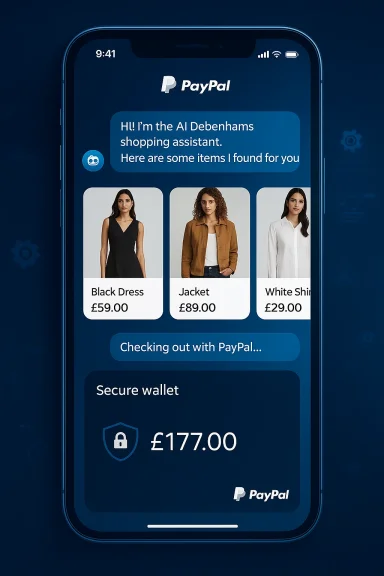
PayPal AI shopping assistant screen showing three clothing items and a £177 secure wallet balance.Background​

Debenhams Group — the digital retail operator behind the Debenhams name and a portfolio that includes Karen Millen, boohoo, and other high‑volume fashion labels — has announced a partnership with PayPal to embed an AI shopping assistant inside the PayPal mobile app. Shoppers will be able to ask for product suggestions, browse curated selections from Debenhams brands, and checkout without leaving the chat experience. The pilot is currlected US customers, with a wider US and UK roll‑out planned later in the year.
This is being billed as a UK first for a retailer to offer a full discovery‑to‑checkout journey inside the PayPal app, and the work has been co‑developed by Debenhams Group and PayPal as part of broader AI investments at Debenhams, which include multi‑cloud and generative AI initiatives. PayPal describes the capability using the term agentic commerce — an experience where the AI agent acts on the user’s behalf, asking follow‑ups and completing actions rather than returning static search links.

What exactly has been built​

The consumer flow — conversation, not search​

At a consumer level the experience compresses the traditional shopping funnel into a conversational loop:
  • Open PayPal app → start a conversation with the AI assistant.
  • Assistant asks clarifying questions, reads contextual profile signals and recommends items from the Debenhams catalogue.
  • When ready, the shopper confirms and PayPal completes payment and delivery using stored credentials and tokenised checkout within the chat UI.
This replaces separate discovery, product pages and a redirect to checkout with a single, conversational transaction. PayPal and Debenhams emphasise that the merchant remains the merchant of record while PayPal provides the wallet, tokenised checkout and buyer‑protection primitives.

Integrations and third‑party tooling​

The pilot links PayPal’s agentic layer to third‑party AI tools such as Perplexity and Microsoft Copilot for expanded discovery, reasoning and catalog enrichment capabilities. PayPal has also publicly launched a suite of agentic commerce services — including store sync to make merchant catalogs discoverable across AI surfaces and an “agent‑ready” payments pattern that supports delegated, tokenised settlement. Those capabilities are explicitly designed to let a single integration make a merchant visible across multiple AI shopping channels.

Commercial scale and rationale​

Debenhams told reporting outlets that approximately 16% of the group’s sales are already processed through PayPal — a figure the company uses to explain why embedding discovery inside the PayPal app is commercially logical: capture intent where those customers already prefer to pay and reduce friction between inspiration and purchase. The partnership is positioned as a way to expand reach without large incremental marketing spend.

Why this matters: strategic implications for retailers and platforms​

For Debenhams: distribution, conversion and a technology playbook​

Embedding the shopping experience into PayPal gives Debenhams:
  • Immediate distribution into a large, active wallet user base.
  • A faster path to purchase by pre‑filling payment and delivery information.
  • A new discovery surface where brand exposure can be syndication‑led rather than search‑oriented.
Those benefits map to Debenhams’ broader strategy of repositioning as a technology‑first marketplace — it has already invested in AWS for generative AI content and catalogue processing, and in pricing/merchandising systems to make supply and price signals responsive. Combining catalogue enrichment, dynamic pricing and in‑chat checkout can, in theory, deliver a closed loop: discovery, conversion, fulfilment and analytics feeding back into merchandising decisions.

For PayPal: from rails to surface​

For PayPal this is part of a deliberate repositioning: move from being a payment rail to becoming a shopping surface and an orchestrator for agentic commerce. PayPal’s agentic commerce services (store sync, agent ready) are explicitly designed to make merchant product data discoverable in AI platforms such as Perplexity and Copilot, allowing PayPal to capture more of the shopping moment and to keep buyer protections and fraud controls tightly coupled to the transaction. That shift increases PayPal’s strategic exposure to conversion metrics and merchant economics.

The technology stack: primitives that matter​

Several technical building blocks underpin agentic commerce and are central to the Debenhams–PayPal integration:
  • Catalog sync / store feeds — canonical, machine‑readable product files and enriched attributes so agents can recommend accurate SKUs.
  • Delegated, tokenised payments — short‑lived tokens and delegated auth that let the assistant initiate checkout without exposing raw card details.
  • Order orchestration & fulfilment hooks — an API layer so that agent‑initiated orders can be routed to merchant systems, preserving merchant‑of‑record responsibilities.
  • Third‑party reasoning engines — integrations to tools like Perplexity or Copilot for verification, multi‑step reasoning and richer conversational responses.
These primitives are what PayPal offers in its agentic commerce suite and what Microsoft and other platform partners are standardising for in‑chat purchases. That commonality is why merchants can be enabled across multiple AI shopping surfaces via one integration rather than bespoke connectors for each new assistant.

Strengths — what this launches right​

  • Massive friction reduction. The fewer context switches a shopper experiences between desire and payment, the higher the potential conversion. Conversational checkout directly targets the classic drop‑off between browse and payment.
  • Familiar payments experience. Using PayPal’s wallet and buyer protections can reassure customers who would otherwise hesitate to enter payment details in third‑party surfaces.
  • Speed of merchant enablement. PayPal’s store sync and agentic services promise faster onboarding of merchant catalogues acrols, lowering engineering cost for merchants.
  • Coherent tech stack for Debenhams. When catalogue enrichment (AWS/Bedrock), pricing engines and in‑app discovery are combined, merchants can make agentic demand more predictable and actionable. (press.aboutamazon.com)

Risks and unknowns — the other side of the ledger​

This is an attractive commercial proposition, but it comes with real, practical risks. Below are the most pressing issues retailers, platforms and consumers will need to confront.

1) Data flows and privacy: whose signals are used, and how?​

Agentic assistants rely on profile signals, past purchase history and contextual preferences to personalise recommendations. That raise:
  • What data is shared between PayPal and Debenhams for recommendation purposes?
  • Has the customer given explicit consent to use purchase history from other merchants or wallets?
  • How are profiles minimised, segmented or deleted on demand?
Regulators in the UK and EU are already focused on AI transparency and data minimisation; embedding personalisation into a payments app increases the likelihood of regulatory scrutimand contractual clarity about data scopes, retention, and the right to audit.

2) Who really owns the customer relationship?​

Even if merchant of record,” discovery inside PayPal risks shifting habitual browsing away from brand storefronts. Over time this can erode direct customer relationships, first‑party data and CRM channels — a strategic vulnerability for brand owners who rely on owned audiences for repeat purchases and higher lifetime value. Merchants must negotiate continuing access to post‑purchase contact information, receipts, and loyalty integration.

3) Returns, disputes and fulfilment friction​

Agent‑initiated purchases that hide the full checkout experience can complicate post‑purchase flows. If confirmation emails, tracking links or return portals are inconsistent or host‑channel dependent, customer friction and dispute volumes may rise — and with them, chargebacks and reputational damage. Merchant and platform SLAs for fulfilment, returns and dispute resolution must be explicit and testable.

4) Catalog fidelity and oversells​

If price or inventory feeds are stale, agents can recommend items that are out of stock or incorrectly priced. That results in disappointed customers and operational cost. Real‑time inventory sync and event‑driven reconciliation tooling are essential. In practice, this means merchants must invest in robust API reliability and reconciliation monitoring before scaling agentic channels.

5) Concentration risk and commercial economics​

Routinising discovery inside a few dominant agentic surfaces creates concentration risk: intermediaries that control attention can unilaterally change economics or visibility rules. Merchants should insist on transparent enrollment practices, clear fee structures and exit strategies if an assistant’s terms become commercially unfavourable.

The competitive landscape — not the only game in town​

Agentic commerce is accelerating across multiple major players:
  • Microsoft’s Copilot Checkout introduced in‑chat purchasing and lists PayPal, Stripe and Shopify among partners enabling in‑chat settlement and inventory surfacing. That product illustrates a parallel path where merchants are discoverable and purchasable inside Copilot conversations.
  • PayPal’s own agentic commerce services (store sync, agent ready) position it to enable merchant discoverability across platforms like Perplexity and Copilot without multiple bespoke integrations.
  • Platform and payment providers — Wix, BigCommerce partners and others — are rapidly integrating with PayPal’s agentic tooling to make merchant feeds AI discoverable, increasing the number of surfaces available to brands.
For merchants this means a multi‑front world: competing agentic surfaces could each become important distribution channels, and merchant strategy should be to participate widely while preserving critical first‑party touchpoints.

Practical checklist: how retailers should pilot agentic channels today​

For IT leads, product owners and integration teams, the sensible route is deliberate, measured pilots. Here’s a compact, practical playbook:
  • Prioritise catalog fidelity. Ensure event‑driven inventory APIs, accurate pricing and SKU canonicalisation.
  • Instrument everything. Track where traffic originates, conversion by surface, returns and disputes separately for agentic channels.
  • Contractual protections. Require explicit terms for data sharing, enrollment, fees and dispute handling in any platform agreement.
  • Preserve CRM access. Negotiate guaranteed post‑purchase contact details and rights to remarket to customers who purchased via the assistant.
  • Mock and test dispute flows. Simulate returns and chargebacks originating from agentic purchases to validate operational readiness.
  • Keep direct channels healthy. Continue investing in owned search, email and app experiences — these are insurance against intermediary dependency.

Consumer perspective — convenience, but know the tradeoffs​

From a shopper standpoint the value is obvious: faster discovery, personalised recommendations and checkout without the friction of form‑filling and redirects. For customers who already trust PayPal, the convenience of using stored credentials and buyer protection is attractive.
Buyers should, however, be mindful of a few points:
  • Confirm which payment method and delivery address will be used before finalising purchases.
  • Keep order confirmations and receipts; agentic checkout flows might surface different email footers or return instructions.
  • Understand dispute and returns policies — being inside a third‑party app should not reduce your rights, but practical handling may differ.

Regulatory and ethical considerations​

Agentic commerce intersects with consumer protection, data privacy and emerging AI accountability regimes. Regulators are already concentrating on:
  • Transparency — customers should know when they are interacting with an agent and what data is being used to inform recommendations.
  • Explainability and audit trails — personalisation and price‑targeting must be auditable so that consumers and regulators can understand why a particular product or price was shown.
  • Portability and consent — consumers should be able to withdraw consent and demand portability of profile signals used for personalisation.
Merchants and platforms that bake these safeguards into contracts and engineering will be better placed to scale without regulatory friction.

Verdict: an incremental revolution that requires hard engineering and governance​

Debenhams’ deal with PayPal is not a marketing stunt; it is a concrete example of agentic commerce moving from preview to pilot. The combination of PayPal’s payment and buyer‑protection primitives with Debenhams’ catalogue and brand portfolio creates a plausible path to improved conversion and a better shopping UX for certain customers.
But convenience alone is not enough to win long term. The model’s success will hinge on disciplined engineering (real‑time catalog sync, robust fulfilment orchestration), contractual clarity (data sharing, fees, dispute handling) and governance that preserves consumer rights and merchant control. Without those, agentic commerce risks shifting value to intermediaries and creating operational headaches for merchants — from refunds to reputational risk.
If PayPal, Debenhams and other participants get the balance right, agentic commerce could deliver the most significant change in online retail since mobile shopping moved the web into pockets. If they don’t, the next chapter may be fought in chargebacks, regulator enquiries and merchant complaints rather than in higher conversion metrics. The prudent course for retailers is clear: pilot with instrumentation, lock down governance, and preserve first‑party channels while exploring the upside of agentic distribution.

Conclusion
The Debenhams–PayPal integration is an early, credible example of agentic commerce — a shopping future where discovery, conversation and payment collapse into a single, AI‑driven interaction. It demonstrates the potential commercial upside of reducing friction and harnessing large wallet audiences, while also highlighting the very real engineering, governance and regulatory work required to make these experiences reliable, fair and scalable. For merchants, the message is pragmatic: experiment quickly, instrument comprehensively, and demand contractual and technical guarantees that preserve brand control and customer protections before you lean in.

Source: Prolific North Debenhams partners with PayPal for UK-first in “AI-powered shopping” - Prolific North
 

Debenhams Group’s decision to embed a full shopping experience inside the PayPal app marks a defining moment in how British high-street brands will meet customers online: shoppers can now discover items, receive personalised recommendations, and complete payment without ever leaving PayPal’s conversational interface.

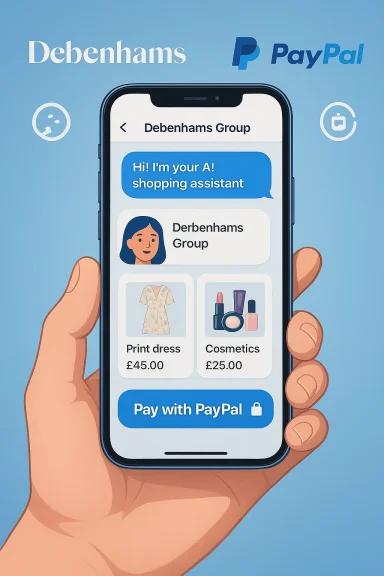
Phone screen shows Debenhams Group shopping assistant with dress and cosmetics tiles and PayPal checkout.Background​

Debenhams Group — the parent company of PrettyLittleThing, boohoo, boohooMAN, Karen Millen and Debenhams — has struck a commercial and technical partnership with PayPal to deliver an AI-driven, in‑app shopping assistant that combines discovery, recommendation and checkout in a single chat experience. The group describes the tie-up as the first UK retail deployment that enables customers to complete the entire purchase journey inside the PayPal app. The programme is currently in limited trials in the United States with a broader US and UK roll‑out scheduled later in the year.
For context, this move is part of a wider industry shift commonly described as agentic commerce — where conversational AI agents not only help users find products but also act on their behalf to place orders, handle payments and orchestrate fulfilment. PayPal itself has been positioning “agentic commerce” as a core strategy and rolling out developer and merchant tools to enable catalog sync, tokenised payments and agent-ready integrations.

What has been built — a practical overview​

The consumer journey, reimagined​

  • Open the PayPal app and start a conversation with an AI assistant.
  • Provide a prompt or answer follow-up questions that the assistant asks to refine style, budget and size.
  • Receive a curated set of product suggestions surfaced from Debenhams Group brands.
  • Select an item and complete the purchase inside the chat flow using stored PayPal credentials; payment and delivery are initiated without a redirect to a merchant website.
This is not a simple chatbot that returns links; it is designed to handle chained reasoning, profile-aware recommendations and tokenised payments — the technical building blocks that underpin agentic commerce: catalog feed synchronization, order orchestration and delegated (token-based) payment. PayPal’s public materials and partner announcements show the same primitives being delivered to merchants via features often described as store sync and agent-ready toolsets.

How Debenhams Group is participating​

Debenhams Group supplies product catalogues from multiple brands and makes curated SKU selections discoverable to PayPal’s agent layer. The group emphasises the customer‑facing benefits — discovery, inspiration and speed — while PayPal supplies the conversational surface, wallet credentials, fraud and identity protections that enable in‑chat checkout. Debenhams’ CEO has framed the partnership as a major step toward making shopping “faster and more intuitive” for customers.

Why this matters: strategic rationale for both parties​

For Debenhams Group: reach, conversion, and marketplace momentum​

Debenhams Group has been rebuilding as a technology-first retail platform following its relaunch and strategic repositioning. Embedding into PayPal is a way to:
  • Capture shoppers at the moment of intent inside a widely used payments app.
  • Reduce purchase friction — eliminating redirects and redundant form‑filling on mobile.
  • Extend reach to PayPal’s 400M+ account base and its agentic commerce distribution channels.
The group reported that roughly 16% of its sales already route through PayPal, which helps explain why a deeper integration was commercially attractive. For a marketplace-style operator with multiple brands, the hypothesis is simple: lowered friction plus personalised discovery increases conversion and average order value.

For PayPal: evolution from payments to platform​

This partnership furthers PayPal’s stated ambition to move from a pure payment processor to a commerce platform where the payment layer becomes the front door to retail discovery. PayPal’s agentic commerce strategy bundles identity, fraud protection, tokenised credentials and buyer-seller protections — precisely the services an AI agent needs to securely initiate purchases on behalf of users. Embedding discovery into PayPal’s app increases the time users spend in the company’s ecosystem and creates new GMV (gross merchandise value) capture opportunities.

Validation: what we can verify and what remains provisional​

  • The partnership and product description are publicly reported in multiple trade outlets and fintech publications; PayPal’s agentic commerce messaging is consistent with the technical capabilities described. The claim that Debenhams Group is the first UK retailer to support a full in‑app PayPal purchase flow is corroborated in multiple industry reports, though the industry is evolving fast and similar pilots exist elsewhere in other forms. The available evidence supports the “first” claim in the specific context of a Debenhams‑PayPal full checkout inside the PayPal app in the UK.
  • PayPal’s trial activity in the United States and integrations with third‑party reasoning engines such as Perplexity and Microsoft Copilot are documented in partner announcements and product updates; these integrations form part of PayPal’s wider agentic commerce playbook. The Debenhams deployment is described as being co‑developed with PayPal and leveraging these agentic building blocks.
  • Direct quotes attributed to Debenhams’ CEO Dan Finley and to Mike Edmonds, PayPal’s VP of Agentic Commerce, appear in multiple reports and are consistent across those accounts. Those quotes have been included in public coverage summarising the partnership.
Caveat: some operational figures and commercial terms (merchant fees, revenue‑share models, data‑sharing agreements and detailed catalogue feed SLAs) are not publicly disclosed in press coverage and therefore remain unverified. Those contractual mechanics will determine how value and risk are split between PayPal and its merchant partners. Any firm conclusions about margin impacts or long-term economics should therefore be treated as provisional until commercial terms are disclosed.

The technical anatomy: how agentic commerce is constructed​

Core primitives​

  • Catalog sync: merchant product feeds are synchronised into the agent layer so the AI can return live SKUs and prices.
  • Identity and tokenised payments: PayPal supplies tokenised wallet credentials and stored addresses so agents can complete checkout without re‑prompting the user.
  • Order orchestration and fulfilment triggers: once payment is authorised, PayPal triggers the merchant’s order management and fulfilment flows while preserving merchant‑of‑record responsibilities.
These primitives are the same building blocks PayPal detailed in its “Instant Buy” and agentic commerce materials: the company emphasises secure identity, buyer protections and fraud detection as differentiators for enabling AI to transact on behalf of users.

How external reasoning engines are used​

In trials, PayPal has integrated third‑party reasoning or search agents such as Perplexity and Microsoft Copilot to expand discovery and verification capabilities. Those services help the assistant evaluate product suitability, consolidate reviews and provide contextual reasoning beyond a single retailer’s inventory. Integrations of this kind let the assistant act less like a store directory and more like a personal shopper that must recall preferences, compare options and reason through tradeoffs for the user.

The customer experience: benefits and limitations​

Immediate benefits for shoppers​

  • Reduced friction: completing the entire purchase in a single app dramatically shortens the path from inspiration to checkout.
  • Personalisation at scale: a contextual assistant that remembers preferences can surface more relevant items and speed decision-making.
  • Convenience on mobile: the experience is optimised for small screens where form‑filling and redirects cause drop‑off.
  • Consolidated protection: PayPal’s buyer protection and risk systems are active during the in‑app checkout.

Shortcomings and user pain points to watch​

  • Loss of browsing autonomy: some shoppers prefer to compare official merchant pages, reviews and independent delivery/returns policies rather than accept agent-synthesised summaries.
  • Control over data and preferences: shoppers may unintentionally reveal profile signals and preferences that could be used for targeting across different brands and services.
  • Edge case handling: returns, refunds, partial shipments, and complex customisations still require robust handoffs to merchant systems; there is risk of a poor experience if orchestration is incomplete.

Commercial implications for brands and marketplaces​

Upside for merchants​

  • Higher conversion: by capturing intent inside the payments app, merchants can reduce abandoned carts and friction.
  • Access to incremental demand: being discoverable via PayPal’s assistant exposes merchants to shoppers who might never reach their own storefronts.
  • Simplified checkout onboarding: PayPal’s store sync and agent‑ready tools reduce engineering lift for merchants wanting to participate in agentic channels.

Downside risks and strategic tradeoffs​

  • Dependence on distribution: merchants risk becoming discoverable property inside a third‑party app rather than building direct customer relationships. Over time, platform control of the conversational surface could erode direct brand engagement.
  • Economic leakage: undisclosed commissions or referral fees can make the economics unattractive for certain product categories, particularly low‑margin fashion and home goods.
  • Channel conflict: if PayPal surfaces curated SKUs from the same merchant at different price points or promotional mixes, it may undercut the merchant’s own pricing strategy.
  • Data sharing and ownership: merchants must understand what data PayPal stores and how it is shared back for CRM, retargeting and customer lifetime value calculations.
These tradeoffs need to be reflected in commercial agreements and performance forecasting; the operational complexity is non‑trivial even for retailers with mature omnichannel stacks.

Regulatory, privacy and fraud considerations​

Privacy and consent​

An AI that models and remembers preferences crosses several privacy boundaries. Firms must ensure:
  • Clear consent mechanisms for profile‑driven recommendations.
  • Transparent user controls to review, correct and delete preference data.
  • Explicit disclosures if third‑party reasoning engines or external data sources are used to enhance recommendations.
UK and EU privacy regimes require careful data mapping and lawful bases for processing. Merchants and PayPal will need robust privacy notices and opt‑out flows that are accessible inside the chat experience.

Fraud, identity and dispute resolution​

PayPal’s value proposition rests on identity verification and fraud mitigation — but agentic checkout changes the fraud surface. Tokenised payments reduce credential theft, but fake or coerced conversations pose new fraud risks. There will need to be:
  • Strong device and session authentication.
  • Behavioural analysis to detect automated or abusive agent interactions.
  • Clear buyer protection policies adapted for agent‑driven purchases.
PayPal’s public materials highlight these protections as differentiators, but regulators and consumer groups will watch how well protections hold up as transactions move into AI agents’ remit.

Competitive landscape and market timing​

PayPal is not the only player racing toward in‑app, conversational commerce. Over the past year, other AI‑first platforms and search agents — Perplexity, OpenAI’s shopping features, Microsoft Copilot and Google’s shopping initiatives — have been building similar discovery and checkout integrations. Some of these players already experiment with integrated checkout flows and merchant partnerships. The Debenhams–PayPal news is therefore less about technical novelty and more about PayPal leveraging its payments moat to own the conversational surface for transacting.
Timing matters. Mobile remains the dominant commerce surface for fashion and beauty purchases, and shoppers exhibit low tolerance for friction. Agentic commerce promises speed and convenience, but consumer trust and perceived control will determine how rapidly adoption scales. Reports from other pilots indicate strong initial engagement, but long‑term adoption will depend on consistent user experience across returns, refunds and shipping — areas where history shows friction can rapidly erode goodwill.

Operational checklist for merchants considering agentic channels​

If you’re a retailer or brand that wants to participate in PayPal‑style agentic channels, here’s a pragmatic sequence to prepare:
  • Inventory readiness: ensure your product catalogue is clean, SKU‑level availability is accurate, and marketplace rules for returns and taxes are applied.
  • Integration plan: implement store sync / feed formats required by the agentic partner and validate latency SLAs for price and stock updates.
  • Fulfilment readiness: verify that your OMS (order management system) and logistics partners can accept agent‑triggered orders and support partial shipments.
  • Customer policies: standardise returns, refunds and communications to ensure the agent can surface clear policy information during the chat.
  • Data governance: map what data the agent will receive and ensure contractual clarity on ownership, retention and downstream use.
  • Economics and reporting: model potential fees, attribution rules and conversion uplifts to assess profitability.

Risks that could stall the agentic commerce rollout​

  • Fragmented standards: without industry norms for catalog feeds, reputation signals and dispute resolution, every merchant-partner integration becomes bespoke and expensive.
  • Consumer trust erosion: early missteps with fulfilment or returns in agentic flows could rapidly lower consumer adoption and invite regulatory scrutiny.
  • Platform power consolidation: if PayPal captures a large share of discovery and checkout, smaller merchants may face higher costs or limited access, accelerating consolidation.
  • Economic misalignment: if the incremental conversion from agentic channels does not justify fees and fulfilment complexity, merchants may withdraw or demand better economics.
Any of these factors could temper the early enthusiasm around agentic commerce and will require careful playbooks from merchants and platform providers.

What this means for shoppers, brands and the wider retail industry​

For shoppers, the promise is simple: faster discovery and fewer clicks. For brands, the moment is existential — the conversational surface is a new battleground for brand attention. Retailers that embrace agentic channels with robust operational systems stand to win improved conversion and reach. Those that ignore the shift risk ceding control of customer relationships and data to platforms that own the payment and conversational layer.
From an industry perspective, the Debenhams–PayPal partnership is an important early indicator that mainstream retail is moving past experimental pilots and into practical merchant integrations. The approach aligns with recent moves across the payments and AI ecosystems, where identity, tokenised credentials and fraud detection are central to enabling AI agents to transact safely.

Recommendations for retailers and platform builders​

  • Treat agentic commerce as a channel, not a replacement. Maintain direct customer acquisition and CRM investments even as you test agentic distribution.
  • Insist on transparent commercial terms, attribution models and data returns in partner contracts.
  • Build resilient fulfilment and returns operations before scaling agentic channels; customer support load after a bot-driven sale can be disproportionately high if logistics fail.
  • Invest in privacy and consent UX: shoppers must be able to see, control and delete preference data used by agents.
  • Run closed pilots that measure not just conversion but post‑purchase metrics (returns, disputes, NPS) to understand true ROI.
These are practical steps that separate bounded experiments from scalable, profitable adoption.

Conclusion​

The Debenhams Group and PayPal initiative is a pragmatic, high-profile example of agentic commerce moving from concept to commerce. It pushes a powerful idea: the payments layer can host discovery, recommendations and checkout in a single conversational surface. For merchants, the upside is clear — lower friction, new distribution and potential revenue gains. For PayPal, the move accelerates a strategic shift from payment processor to commerce platform.
But the wider success of agentic commerce will hinge on operational discipline, transparent economics, and trust: fast checkout is only valuable when orders arrive as promised and buyers retain control over their data. Debenhams Group’s early adoption will be a useful case study for the industry — illustrating both the potential of in‑app AI shopping and the hard, often unglamorous work required to scale it responsibly.

Source: Retail Technology Innovation Hub First for Debenhams Group as it teams with PayPal on AI driven shopping experience in UK — Retail Technology Innovation Hub
 

Back
Top