Paul Thurrott’s short chapter on “De‑Enshittify an Existing Install of Windows 11” is a focused, practical walkthrough that hands users a low‑risk, high‑reward pathway for reclaiming control of an existing Windows 11 installation without wiping the machine. The chapter centers on one tool—Win11Debloat, a community‑maintained PowerShell utility with a GUI front end—which Thurrott demonstrates as a flexible, reversible way to remove unwanted apps, disable telemetry, and neutralize Microsoft’s aggressive service integrations like Copilot, Bing search, and forced update behaviors. His approach is conservative where it needs to be (don’t remove the Microsoft Store), pragmatic where it helps (create a restore point, update in‑box apps first), and repeatable for long‑term maintenance. / Overview
Windows 11 has evolved into a modern operating system that, by design, favors integrated services, online account flows, and a steady stream of in‑box apps and telemetry. For many users, that means a tradeoff: convenience and features versus bloat, tracking, and unexpected UI/behavior changes. The community response has been steady for years—tools, scripts, and custom ISOs that restore privacy and performance have matured into a pragmatic ecosystem of options. Thurrott frames this chapter as the post‑install option: if you don’t want to rebuild a Windows image from scratch (Tiny11, modified ISOs, or Rufus bypasses), you can still achieve most benefits by cleaning an existing install with a reputable debloat script.
Why this matters noividuals prefer an iterative, reversible approach that preserves apps, drivers, licenses, and custom data while removing the parts of Windows that are objectively harmful or unnecessary for their workflows. Win11Debloat aims to be that tool: transparent, scriptable, and auditable. The project is actively maintained and its README, wiki, and distribution pages describe both default safe behaviors and advanced options for more aggressive cleanup.
Thurrott’s recommended uninstall candidates are the obvious “enshittified” offenders: Microsoft Edge (if you don’t want it), OneDrive (if you dislike forced cloud sync), Office Hub/Copilot prompts, Widgets Experience, Bing search/News integrations, and vendor junk like trial AVs or OEM AI assistants. He highled apps are harmless, but they clutter the Start menu and deliver low value to many users.
Two practical notes Thurrott adds:
If you follow a conservative process—backups, update Store apps first, test in Lite mode, and avoid removing the Microsoft Store—you can achieve the majority of the benefits Thurrott promises: a quieter, faster, less tracking‑heavy Windows 11 that behaves the way you want. For administrators, Win11Debloat’s parameterized modes (Sysprep, per‑user, defaults) make it suitable for imaging and deployment automation; for home users, the GUI and undo guidance remove much of the fear of irreversible change.
Source: Thurrott.com De-Enshittify an Existing Install of Windows 11
Windows 11 has evolved into a modern operating system that, by design, favors integrated services, online account flows, and a steady stream of in‑box apps and telemetry. For many users, that means a tradeoff: convenience and features versus bloat, tracking, and unexpected UI/behavior changes. The community response has been steady for years—tools, scripts, and custom ISOs that restore privacy and performance have matured into a pragmatic ecosystem of options. Thurrott frames this chapter as the post‑install option: if you don’t want to rebuild a Windows image from scratch (Tiny11, modified ISOs, or Rufus bypasses), you can still achieve most benefits by cleaning an existing install with a reputable debloat script.
Why this matters noividuals prefer an iterative, reversible approach that preserves apps, drivers, licenses, and custom data while removing the parts of Windows that are objectively harmful or unnecessary for their workflows. Win11Debloat aims to be that tool: transparent, scriptable, and auditable. The project is actively maintained and its README, wiki, and distribution pages describe both default safe behaviors and advanced options for more aggressive cleanup.
 Win11Debloat: What it is and how it works
The architecture and design philosophy
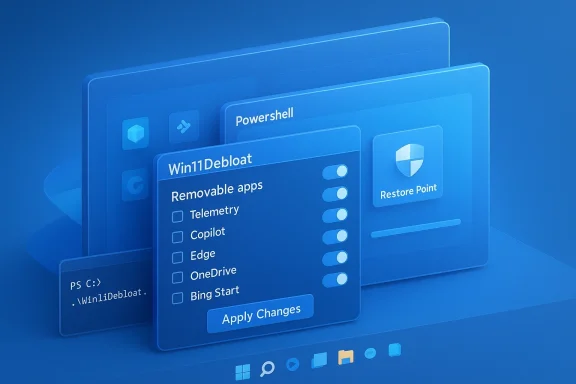
Win11Debloat is a PowerShell script that exposes a menu GUI by default and offers command‑line parameters for automation. It performs two kinds of operations:- App removal — uninstall built‑in and vendor apps (with special handling for OneDrive and Microsoft Edge).
- System tweaks — change privacy-related registry values, disable telemetry pipelines, strip Copilot and Bing integrations, and apply UI tweaks (Explorer, Start menu, taskbar).
Quick usage summary (as Thurrott documents)
Thurrott’s walkthrough follows the script’s default “quick method”: invoke the download-and-run PowerShell one‑liner from an elevated Terminal, allow the GUI to open, and step through three main screens:- Start — begin the process and choose to continue.
- App Removal — switch the view to “Only show installed apps” and choose what to remove.
- System Tweaks — granular toggles for telemetry, ads, Copilot, Edge suggestions, Bing search in Start, updates behavior, and more.
- Overview — confirm whether to apply tweaks to the current user or all users, whether to remove apps for all users, rre point, and optionally restart Explorer immediately. Then click “Apply Changes.”
Deep dive: app removal, Edge, and OneDrive
App removal behavior and safe defaults
Win11Debloat offers a curated list of packages it can remove. The list intentionally excludes a few items that are either hard to replace or essential for certain scenarios—most notably, the Microsoft Store. The script and its documentation repeatedly warn: do not remove Store unless you understand the recovery steps, because reinstalling the Store can be non‑trivial and is sometimes prone to edge cases. The author’s wiki notes that nearly all removed apps are reinstallable from the Store or via winget, but the Microsoft Store itself and a couple of specialized overlays are exceptions.Thurrott’s recommended uninstall candidates are the obvious “enshittified” offenders: Microsoft Edge (if you don’t want it), OneDrive (if you dislike forced cloud sync), Office Hub/Copilot prompts, Widgets Experience, Bing search/News integrations, and vendor junk like trial AVs or OEM AI assistants. He highled apps are harmless, but they clutter the Start menu and deliver low value to many users.
Microsoft Edge: why it’s special, and how Win11Debloat handles it
Microsoft Edge is treated specially in the script for two reasons:- Edge has deep runtime integrations in Windows (protocol handlers, WebView2, and provisioning).
- Microsoft has deliberately made Edge stubborn to remove to protect service integration and updates.
Two practical notes Thurrott adds:
- If you remove Edge, you must install another browser and set it as default. Windows may still try to route some links or web fragments via Edge or the Edge runtime unless you also address protocol associations and WebView2 behavior.
- Some apps depend on the Edge WebView2 runtime; removing Edge itself does not necessarily remove WebView2, but some modern Store or web‑based apps may cause Edge to be reinstalled unless you install WebView2 runtime separately and then rerun the script. Microsoft’s documentation clarifies that WebView2 is a separate runtime that does not automatically change the default browser.
OneDrive removal
OneDrive is simpler but still handled specially: the script uses winget when available to uninstall OneDrive cleanly. Thurrott points out that many users prefer local file management and that OneDrive’s default behavior (controlled sync, background uploads, and enforced account nudges) is a frequent complaint. Because OneDrive is less entangled than Edge, it’s generally safe to remove—just ensure you’ve synced or backed up any files you need first.System tweaks: the privacy and behavior toggles you should care about
Thurrott isolates a focused subset of system tweaks that he considers the core “de‑enshittify” moves. Theseoptions you should strongly consider toggling off:- Privacy & Suggested Content
- Disable telemetry,ed ads.
- Disable tips, tricks, and suggested content across Windows.
- Disable lock screen tips and suggested content.
- Hide Microsoft 365 ads iAI / Copilot
- Disable Microsoft Copilot (if present).
- Disable AI featu.
- Windows Update
- Prevent automatic restarts while signed in.
- Disable delivery optimization that shares downloaded updates with other PCs.
- Start Menu
- Disable Bing web search and Copilot integration in Start.
Safety, reversibility, and maintenance
Restore points, undo files, and reinstallation paths
Win11Debloat makes a point of creating an optional system restore point before applying sweeping changes. In addition, the project documents revert steps—registry undo files, guidance for reinstalling apps via Microsoft Store or winget, and special notes for components that are tricky to recover (Store itself, some Xbox overlays). Thurrott reiterates this advice: create a restore point and/or image backup, test a small batch of changes, and verify system behavior before performing broad removals.Why you may need to reapply debloat after updates
A persistent reality: Windows feature updates and monthly servicing sometimes reprovision built‑in apps, restore default settings, or change registry policies. Several community threads and the project documentation caution that debloating is not a once‑and‑forever job—after major updates you may need to reapply selected tweaks. Thurrott acknowledges this and recommends treating Win11Debloat as a repeatable maintenance step in your post‑update checklist.Microsoft Store behavior: why update apps first
Thurrott’s counterintuitive but sensible tip: update all in‑box Microsoft Store apps before running Win11Debloat. The rationale is that the Store will silently update apps in the background; if you remove an app before it has been updated, the Store can later reinstall or reprovision it when it next runs automatic updates. The wider platform context supports this caution: Microsoft has tightened how Store updates are applied (users now have limited long‑term ability to fully disable automatic Store updates), so synchronizing updates before removal reduces the risk of a reinstallation loop.Practical checklist: how to run Win11Debloat safely
- Back up your data and create a disk image or VM snapshot if possible.
- Ensure you have an alternative browser downloaded and an installer handy if you plan to remove Edge.
- Open Microsoft Store and update all built‑in apps. Wait until Store shows no pending updates.
- Run Win11Debloat from an elevated Terminal and step through the GUI:
- Toggle “Only show installed apps” during the App Removal screen.
- Uncheck the Microsoft Store—do not remove it.
- Select OneDrive, Edge (if you know what you’re doing), and vendor crapware.
- Apply the privacy/system tweaks you want (telemetry off, Copilot off, disable Bing in Start, disallow delivery optimization).
- Create a restore point (Win11Debloat can do this) and choose whether changes apply to the current user or all users.
- Click “Apply Changes” and watch the output. Reboot if prompted.
- Verify essential functionality (printing, VPN, games, Office, enterprise apps) for 48–72 hours. If something breaks, consult the project’s Reverting Changes wiki.
Strengths: why Win11Debloat is a strong choice today
- Transparency and auditability. Everything Win11Debloat does is in plain PowerShell; you can read it, modify it, or run only the portions you trust. That level of visibility is rare among end‑user debloaters.
- Granular controls. You can apply privacy tweaks without deleting apps, or vice versa, and choose per‑user vs. system‑wide effects. This is ideal for shared machines and imaging scenarios.
- Active maintenance and community. The project is actively maintained, has extensive documentation, and offers restore guidance—important for tools that touch many OS subsystems.
Risks and caveats you must acknowledge
- Reprovisioning after major updates. Windows feature updates can undo some changes and reprovision apps. Be prepared to reapply your preferred configuration after major patches.
- Edge and runtime entanglement. Forcefully uninstalling Edge is supported but risky. Some apps depend on Edge runtime behavior; removing Edge can lead to unexpected reinstallation or functional loss for apps that use WebView2. Microsoft documents that WebView2 is a separate runtime and should be used instead of removing runtime components casually, so take the extra step of installing or managing WebView2 if needed.
- Microsoft Store is fragile to remove. Removing the Store can be hard to reverse and may leave the system unable to reinstall many in‑box apps automatically; the official guidance and community experience both warn against uninstalling the Store unless you have a robust recovery plan.
- AV and enterprise policies. Aggressive system changes can trip endpoint protections or conflict with enterprise management policies. Validate on one machine before mass deployment.
How this fits with other de‑enshittify apprTiny11 Builder (rebuild approach):** Build a custom ISO that omits bloat from first boot. This is more thorough but more invasive and less easy to update. Use Tiny11 Builder when you want a fresh, minimal image for multiple machines.
- Rufus / installer tweaks: Create installation media that bypasses certain OOBE or hardware checks. Useful when installing from scratch on legacy hardware. Less relevant for post‑install cleanup.
- O&O ShutUp10++ and privacy GUIs: Less invathat avoids app removal. Good for users who want to reduce telemetry without tampering with apps. Win11Debloat is broader in scope (apps + privacy).
Final assessment and recommendation
Win11Debloat is a mature, well‑documented, and pragmatic tool for de‑enshittifying an existing Windows 11 installation. It’s the right balance for users who want a low‑friction, reversible way to reclaim privacy and remove bloat without rebuilding images or managing custom ISOs. Paul Thurrott’s chapter provides a calm, ush that respects safety (restore points, update first, don’t delete the Store) while explaining advanced options for power users.If you follow a conservative process—backups, update Store apps first, test in Lite mode, and avoid removing the Microsoft Store—you can achieve the majority of the benefits Thurrott promises: a quieter, faster, less tracking‑heavy Windows 11 that behaves the way you want. For administrators, Win11Debloat’s parameterized modes (Sysprep, per‑user, defaults) make it suitable for imaging and deployment automation; for home users, the GUI and undo guidance remove much of the fear of irreversible change.
Actionable summary (short)
- Back up the device and update Microsoft Store apps first.
- Run Win11Debloat from an elevated Terminal; use Lite mode first if unsure.
- Avoid uninstalling the Microsoft Store. Create a restore point before any mass removals.
- If you uninstall Edge, install an alternative browser, consider installing the WebView2 runtime, and expect to reapply settings after major updates.
Source: Thurrott.com De-Enshittify an Existing Install of Windows 11