

Microsoft’s latest viral scare — a translated headline proclaiming a “Horror: A New Windows 12 with Ubiquitous Paid Subscriptions is Coming” — did exactly what sensational tech copy does best: it compounded real trends (AI-first features, subscription monetization, device certification programs) into a single, terrifying narrative that a full-numbered Windows 12 will ship in 2026, refuse to run on older machines, and lock advanced functionality behind recurring fees. That story circulated widely and was republished and discussed across forums in the last week, but a careful reading of the evidence shows the dramatic combo of a mandatory 40 TOPS NPU requirement and a subscription‑only OS is, at best, an unverified synthesis of engineering breadcrumbs and commercial speculation. rview
The short version: Microsoft is publicly pushing AI deeper into Windows, and hardware vendors are shipping processors and SoCs with neural accelerators (NPUs). Microsoft has run branding and certification programs that promote devices with higher local AI capability (for example, Copilot+ device classes), and the company already sells subscription services such as Microsoft 365 and Windows 365 that make the “subscription Windows” narrative superficially plausible. But there is no authoritative public announcement from Microsoft that confirms a consumer retail product named “Windows 12” with a universal, hard 40 TOPS NPU requirement or a plan to convert the base OS into a subscription product this year.
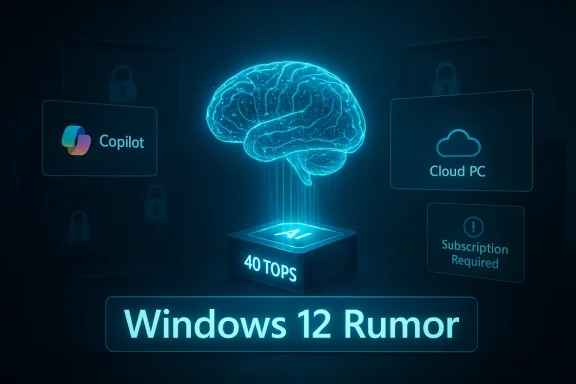
The viral piece stitches together several real, separate facts:
The most widely repeated assertions were:
The critical distinction is whether Copilot will be:
Independent reporting and expert commentary indicate Microsoft may experiment with premium OS‑adjacent features behind subscriptions — for example, enhanced Copilot capabilities, cloud‑assisted recall and multimodal generation, or advanced security services tied to identity and tenant control — while continuing to offer a base OS in familiar licensing forms. Several outlets that investigated the rumor concluded that a subscription‑only Windows consumer OS lacks credible confirmation and would be strategically and legally risky.
For readers: prepare prudently, validate claims against primary sources, and avoid reactionary hardware purchases driven by aggregator headlines. If you manage an IT estate, start compatibility inventories now and pilot cloud mediations where necessary — but do not treat the viral headline as a roadmap.
Microsoft’s AI push is real; the doomsday package of “Windows 12 bricking your PC unless you subscribe and buy a 40 TOPS NPU” is not. The responsible approach — for users, IT teams, and journalists — is to separate plausible engineering direction from unverified product claims, demand authoritativeness from vendors, and insist on transparent migration paths before declaring technical obsolescence a fait accompli. The next 12–18 months will reveal whether Microsoft’s experiments become new standard behavior or a set of optional premium experiences layered on top of a largely familiar Windows experience. Until Microsoft publishes clear, primary evidence to the contrary, treat the apocalyptic headlines as an alarm bell, not a fait accompli.
Source: Inbox.lv Horror: A New Windows 12 with Ubiquitous Paid Subscriptions is Coming
The short version: Microsoft is publicly pushing AI deeper into Windows, and hardware vendors are shipping processors and SoCs with neural accelerators (NPUs). Microsoft has run branding and certification programs that promote devices with higher local AI capability (for example, Copilot+ device classes), and the company already sells subscription services such as Microsoft 365 and Windows 365 that make the “subscription Windows” narrative superficially plausible. But there is no authoritative public announcement from Microsoft that confirms a consumer retail product named “Windows 12” with a universal, hard 40 TOPS NPU requirement or a plan to convert the base OS into a subscription product this year.
The viral piece stitches together several real, separate facts:
- Microsoft is integrating Copilot across Windows and experimenting with deeper system‑level agent behaviors.
- OEMs and silicon vendors are marketing devices with dedicated NPUs and promoting local inference performance in TOPS as a headline spec.
- Microsoft already runs subscription products (Microsoft 365, Windows 365) and bundles premium features behind paid tiers in other product families.
 What the viral claims actually said
The most widely repeated assertions were:- A consumer OS called Windows 12 (sometimes referenced with internal codenames like Hudson Valley Next) will ship to consumers in 2026.
- The OS will be built on a modular “CorePC” architecture and will elevate Copilot from an optional assistant to a pervasive, always‑on system agent.
- Full on‑device AI functionality will require a dedicated NPU capable of roughly 40 TOPS, and machines that lack such an NPU will either lose functionality or be outright unsupported.
- Advanced AI features — and potentially core parts of the user experience — will be gated behind recurring subscriptions, ending the one‑time license era for consumer Windows.
Fact‑check: hardware, NPUs and the “40 TOPS” number
What is TOPS and why it appears in headlines
TOPS (Trillions Of Operations Per Second) is a vendor metric for neural accelerator throughput. It’s a high‑level throughput number that silicon vendors use to compare accelerators’ raw compute capability for matrix and tensor operations. TOPS is useful for quick marketing comparisons but it is not a single predictor of real model performance — memory subsystem, runtime optimizations, model quantization, on‑chip ML stacks, and OS integration matter just as much. Operating systems have historically specified capability classes or feature flags rather than hard numeric gates; demanding “40 TOPS to boot” would be unprecedented and operationally brittle.What Microsoft and partners have actually said
Microsoft’s public Copilot+ and AI‑PC messaging does call out device classes where local inference is prioritized, and marketing materials have referenced NPUs at “40+ TOPS” as a premium threshold for Copilot+ experiences. Microsoft’s partner and product collateral emphasize that certain advanced, local AI features work best on devices with robust acceleration, and OEMs have marketed chips (Qualcomm, Intel, AMD) with claimed TOPS figures to hit those programs. However, these materials discuss device tiers and enhanced experiences — not an absolute minimum required to run the OS itself.Practical feasibility and timeline
A literal, universal 40 TOPS requirement imposed at OS install time would immediately disqualify a huge portion of the installed base and even many recent mainstream notebooks. That raises obvious political, economic and legal questions (regulatory scrutiny, consumer backlash, and massive e‑waste pressure). Industry reporting has thus treated the 40 TOPS figure as either a certification target for premium devices or a misunderstanding of internal engineering benchmarks — not a published minimum required for running the OS at all.Copilot at the center: system agent or optional feature?
Microsoft has steadily converted Copilot from a sidebar assistant into a platform capability that can surface context, act on behalf of users, and be integrated across apps. That direction explains why some sources portray Copilot as central to future Windows builds. But system‑level integration does not necessarily equal forced use or paid gating. Microsoft’s internal engineering experiments and partner programs often get translated into consumer narratives that overstate immediacy and scope. The evidence to date shows incremental Copilot integration inside Windows 11 and OEM device programs, not a wholesale rebrand that transforms Copilot into a pay‑only system service overnight.The critical distinction is whether Copilot will be:
- a suite of opt‑in capabilities that ship in Windows (free or premium tiers), or
- a mandatory system agent that cannot be disabled and is tied to subscription access.
The subscription question: will Windows become recurring‑bill only?
There is an important nuance the viral narrative glosses over: Microsoft already runs several subscription services tied to Windows experiences — notably Windows 365 (Cloud PC) for streamed, managed desktops and Microsoft 365 for productivity and Copilot tiers. Those products demonstrate Microsoft’s commercial appetite for subscriptions, but they are targeted offerings with explicit cloud economics and enterprise billing models. Conflating those with the retail Windows license model is incorrect.Independent reporting and expert commentary indicate Microsoft may experiment with premium OS‑adjacent features behind subscriptions — for example, enhanced Copilot capabilities, cloud‑assisted recall and multimodal generation, or advanced security services tied to identity and tenant control — while continuing to offer a base OS in familiar licensing forms. Several outlets that investigated the rumor concluded that a subscription‑only Windows consumer OS lacks credible confirmation and would be strategically and legally risky.
Why the panic spread so fast: the mechanics of modern rumor
The rumor cycle that produced the viral Inbox.lv headline followed a predictable pattern:- Internal code names, engineering experiments and OEM certification criteria leak or get briefly discussed in partner docs.
- Translators, aggregation sites, or AI summarizers recast those fragments as a single, imminent product plan.
- Social platforms compress nuance into outrage headlines that trigger wide sharing.
- Copycats and low‑quality publishers republish the sensational framing, creating an illusion of corroboration.
Practical impacts and scenarios: what could happen, and what’s unlikely
Realistic, near‑term scenarios (plausible)
- Microsoft continues to evolve Windows 11 with deeper Copilot integration and ships targeted features in Windows Insider and staged releases.
- OEMs and silicon vendors push “AI PC” certification tiers (Copilot+, premium devices) that advertise NPUs and local inference performance metrics; buyers are nudged toward those devices for low‑latency experiences.
- Premium Copilot features (advanced generation, long‑term memory, enterprise agent management) are offered as part of paid Microsoft 365 or specialized bundles, not as a replacement for the base OS license.
- For users who prioritize local inference and offline agent features, device upgrade cycles accelerate for high‑end workstations and ultrabooks supporting dedicated NPUs.
Implausible or high‑risk claims (unlikely without major signals)
- A mandatory, hard‑stop 40 TOPS requirement that prevents Windows from booting on older hardware. This would be disruptive and legally fraught and is not supported by primary Microsoft documentation.
- Aard change that removes one‑time OEM retail licensing in favor of a universal subscription for consumer Windows in 2026. No credible roadmap or public filing signals that level of immediate change.
Risks, trade‑offs and what Microsoft must manage
If Microsoft moves toward an AI‑driven platform with premium tiers, three categories of risk are front and center:- Trust and user choice. Forcing or deeply burying opt‑outs for Copilot‑style features will erode user trust and drive consumers toward alternatives or into blocking changes that hurt Microsoft’s reputation.
- Platform fragmentation and e‑waste. Imposing new hardware gates without clear, long‑term compatibility plans creates e‑waste and harms users who can’t upgrade — plus it risks regulatory scrutiny.
- Regulatory and antitrust exposure. Using OS control to favor Microsoft cloud services or to tie core productivity features to subscriptions could attract competition authorities and consumer protection actions in multiple jurisdictions.
What users and IT teams should do now
Short checklist for sensible, non‑panic preparation:- Inventory your estate. Identify machines by CPU family and whether they include an NPU or dedicated accelerator; log RAM and storage metrics as well.
- Prioritize critical systems. If Copilot/AI features are business‑critical, plan phased upgrades for a subset of machines rather than a blanket rip‑and‑replace.
- Monitor Microsoft channels. Rely on Microsoft’s official blog posts, Windows Insider releases and OEM compatibility lists — not aggregator headlines — before making procurement decisions.
- Pilot cloud fallbacks. Evaluate Windows 365 Cloud PC as a bridge for older endpoints or mixed hardware estates where local inference is not feasible.
- Tighten governance. For enterprises, expand DLP, consent controls and telemetry review before enabling agentic Copilot features broadly.
Strengths of Microsoft’s AI direction — and why the debate matters
There are legitimate, potentially large benefits to bringing robust on‑device AI to everyday PCs:- Lower latency and better privacy for local inference tasks when models run on device instead of in the cloud.
- Offline capabilities for edge scenarios where connectivity is poor or regulated.
- New workflows that blend system‑level context with agentic assistants to automate repetitive tasks across apps.
What to watch next (concrete signals that would change the assessment)
Watch for these primary, verifiable signals:- Official Microsoft announcements or blog posts that explicitly name a consumer product as Windows 12 and list published system requirements. That would move the conversation from rumor into fact.
- Windows Insider builds or developer previews that pivot baseline functionality into Copilot agents that cannot be disabled. That would be a strong signal of systemic change.
- OEM certification lists that specify hard NPU numeric thresholds as required for basic OS compatibility rather than optional premium features.
- Microsoft licensing or SKU documentation that modifies OEM retail licensing terms into mandatory suer retail copies of Windows.
Final analysis: how much to worry — and why the hype is useful
The viral “Windows 12 subscription horror” narrative did an important public service even as it exaggerated facts: it forced immediate scrutiny of Microsoft’s AI roadmap, licensing trends and OEM device programs. Those are worthy topics. The panic around a 2026 “Windows 12” release, however, outstrips the evideajectory: Microsoft will continue to weave AI into Windows and will push device classes that highlight local acceleration. That is confirmed by partner materials and Copilot+ messaging.- Doubt the timeline and the absolute hardware gating: there is no credible, primary evidence that Microsoft will ship a subscription‑only Windows 12 with a hard 40 TOPS NPU install gate in 2026. Several outlets that investigated the rumors reached the same conclusion.
For readers: prepare prudently, validate claims against primary sources, and avoid reactionary hardware purchases driven by aggregator headlines. If you manage an IT estate, start compatibility inventories now and pilot cloud mediations where necessary — but do not treat the viral headline as a roadmap.
Microsoft’s AI push is real; the doomsday package of “Windows 12 bricking your PC unless you subscribe and buy a 40 TOPS NPU” is not. The responsible approach — for users, IT teams, and journalists — is to separate plausible engineering direction from unverified product claims, demand authoritativeness from vendors, and insist on transparent migration paths before declaring technical obsolescence a fait accompli. The next 12–18 months will reveal whether Microsoft’s experiments become new standard behavior or a set of optional premium experiences layered on top of a largely familiar Windows experience. Until Microsoft publishes clear, primary evidence to the contrary, treat the apocalyptic headlines as an alarm bell, not a fait accompli.
Source: Inbox.lv Horror: A New Windows 12 with Ubiquitous Paid Subscriptions is Coming
