

A week of breathless headlines claiming Microsoft was preparing an AI‑first, subscription‑gated “Windows 12” — and even specifying mandatory neural‑processor performance thresholds — left users outraged, vendors scrambling, and headlines corrected in rapid succession. The panic was avoidable: the most explosive claims were not grounded in a single, verifiable Microsoft announcement but in a stitched‑together stack of codenames, engineering notes, and recycled reporting that amplified into apparent consensus.
The rumor cycle fed on three adjacent realities: Microsoft’s clear pivot to AI features within Windows 11, OEMs’ increasing use of neural accelerators in PC platforms, and a broader industry move toward subscriptions for services. Those elements — Copilot integration, on‑device inference hardware, and recurring revenue models — are factual and observable. When assembled without contextd a single scary picture: a new numbered Windows that would force consumers to pay monthly and to toss otherwise‑functional PCs.
That synthesis was what made the story believable. But plausibility is not proof. The original claims combined internal project names (variants of “Hudson Valley,” “CorePC”), discussion of modular platform experiments, and marketing language around “Copilot+” devices into an apparent product announcement that never existed. Multiple beat reporters and fact‑checking outlets quickly pushed back; independent follow‑ups traced the chain to a handful of thinly sourced items that were republished and translated into dozens of derivative posts.
But the evidence for a coordinated product-level shift was missing. Microsoft had not published a formal announcement naming a consumer product “Windows 12,” nor released a public roadmap promising a 2026 retail launch for a numbered successor to Windows 11. Independent reporting and Microsoft’s own public channels instead pointed to continued evolution within Windows 11 — including targeted platform updates and Copilot enhancements — rather than an immediate, mandatory conversion of the retail OS to subscription billing.
Independent technology coverage affirms the existence of the Copilot+ program and its 40+ TOPS guidance while adding essential nuance: TOPS is a crude, hardware‑marketing shorthand that does not translate directly to user experience for every model or workload. Software efficiency, model size, quantization, runtime support, and thermal/power constraints matter far more than a single TOPS number alone. Reviewers and analysts have repeatedly warned that the advertised TOPS figure can be useful for OEM differentiation but is not a universal performance guarantee.
Practical takeaway: Copilot+ hardware targets represent where Microsoft and its OEM partners want to standardize premium local AI, but those targets are certification thresholds — not mandatory gates to run Windows as a consumer OS.
Reporting across reputable outlets supports this reading: the 26H1 channel is being previewed in Insider builds for specific silicon, while the mainstream servicing lane remains Windows 11 with scheduled feature updates. Observers caution that Microsoft’s branching and platform work create a more fragmented update story in 2026, but they do not constitute the kind of single, company‑wide announcement that would justify calling the moment “Windows 12” with an enforced subscription model.
That distinction mattered: legitimate product teases about a futuonal attention and, in places, lent an air of credibility to the simultaneous but unrelated Windows rumor. Readers conflated the two narratives; publishers sometimes bundled them together. The result was a messy information diet in which speculative and confirmed items sat side by side, increasing the chance of misinterpretation. ([windowscentral.com](Xbox just dropped the Project Helix codename and confirmed new hardware of translation, amplification, and automated syndication in rumor propagation
This episode is a textbook case of modern rumor economics. A speculative piece — whether an informal translation of partner materials or a small number of leaked engineering notes — is picked up by low‑barrier syndication networks, rewritten by automated summarizers, and republished with attention‑grabbing headlines. Social platforms then compress nuance into outrage‑friendly blurbs. The perceived volume of coverage (dozens of pages repeating the same claim) creates the illusion of independent corroboration.
Generative models and SEO farms accelerate this feedback loop. Machine translations drop editorial filters; content mills reframe dated internal engineering breadcrumbs as “breaking” news; and aggregators recycle the result. The net effect is a wildfire of misinformation seeded by plausibility and fanned by scale. Journalists and editors must apply extra scrutiny to translation‑based scoops and one‑source technical claims, and readers should demand primary documentation for consequential product changes.
This episode is also a lesson in responsible reporting and consumption: plausible technical detail can masquerade as inevitability when aggregated at scale. Demand primary sources, insist on context for technical metrics like TOPS, and treat device certification language as what it is — an OEM and marketing signal, not an instant policy change. If you manage devices, test in pilot rings and ask vendors for written compatibility windows; if you simply use a PC, breathe — Windows 11 continues to receive updates, and premium on‑device AI is an option, not an immediate mandate.
Source: Neowin Microsoft Weekly: fake Windows 12 reports, furious users, and new Xbox
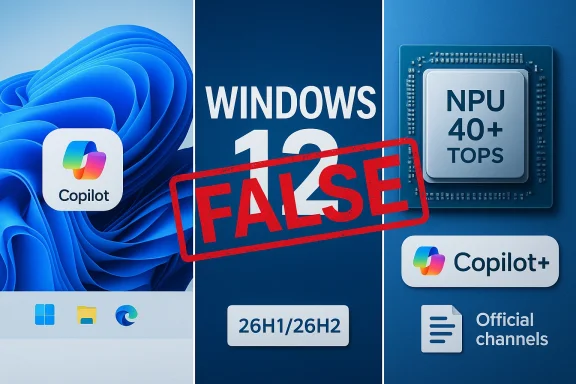 Background: how a plausible tech narrative became a panic
The rumor cycle fed on three adjacent realities: Microsoft’s clear pivot to AI features within Windows 11, OEMs’ increasing use of neural accelerators in PC platforms, and a broader industry move toward subscriptions for services. Those elements — Copilot integration, on‑device inference hardware, and recurring revenue models — are factual and observable. When assembled without contextd a single scary picture: a new numbered Windows that would force consumers to pay monthly and to toss otherwise‑functional PCs.That synthesis was what made the story believable. But plausibility is not proof. The original claims combined internal project names (variants of “Hudson Valley,” “CorePC”), discussion of modular platform experiments, and marketing language around “Copilot+” devices into an apparent product announcement that never existed. Multiple beat reporters and fact‑checking outlets quickly pushed back; independent follow‑ups traced the chain to a handful of thinly sourced items that were republished and translated into dozens of derivative posts.
What the viral reports actually claimed — and why those claims mattered
The distilled viral narrative contained three headline assertions:- A retail product called Windows 12 would ship imminently as a ground‑up, AI‑first OS replacing or superseding Windows 11.
- Full functionality would be gated behind dedicated on‑device Neural Processing Units (NPUs), typically reported as needing ~40 TOPS (trillions of operations per second).
- Many advanced AI features would only be available via subscription, effectively turning core OS capabilities into recurring revenue.
But the evidence for a coordinated product-level shift was missing. Microsoft had not published a formal announcement naming a consumer product “Windows 12,” nor released a public roadmap promising a 2026 retail launch for a numbered successor to Windows 11. Independent reporting and Microsoft’s own public channels instead pointed to continued evolution within Windows 11 — including targeted platform updates and Copilot enhancements — rather than an immediate, mandatory conversion of the retail OS to subscription billing.
Verifying the technical claims: Copilot+, NPUs and the 40 TOPS figure
One of the most recurring technical specifics in the rumors was the “40 TOPS” threshold. That figure is not an invention: it is part of Microsoft’s marketing and certification language around Copilot+ PCs. Microsoft defines Copilot+ devices as PCs equipped with an advanced NPU capable of performing more than 40 TOPS, positioning that hardware as the baseline for a premium, local‑inference experience that runs certain Copilot features on‑device. This is a device qualification, not a declaration that Windows will refuse to boot on lesser hardware.Independent technology coverage affirms the existence of the Copilot+ program and its 40+ TOPS guidance while adding essential nuance: TOPS is a crude, hardware‑marketing shorthand that does not translate directly to user experience for every model or workload. Software efficiency, model size, quantization, runtime support, and thermal/power constraints matter far more than a single TOPS number alone. Reviewers and analysts have repeatedly warned that the advertised TOPS figure can be useful for OEM differentiation but is not a universal performance guarantee.
Practical takeaway: Copilot+ hardware targets represent where Microsoft and its OEM partners want to standardize premium local AI, but those targets are certification thresholds — not mandatory gates to run Windows as a consumer OS.
Where Microsoft actually stands: Windows 11 evolution, 26H1/26H2 cadence, and platform work
Contrary to the “Windows 12 is imminent” framing, Microsoft’s recent public posture emphasizes incremental Windows 11 evolution and platform work targeted at new silicon families. The company published preview builds and documentation for a pair of 2026 updates — Windows 11 version 26H1 (a hardware‑targeted release intended for select ARM/specialized silicon) and a broader 26H2 update expected later in the year — rather than signaling an immediate, retail‑branded successor. Microsoft has explicitly positioned 26H1 as a selective enablement for next‑generation ARM hardware, not as an across‑the‑board replacement for existing Windows 11 installations.Reporting across reputable outlets supports this reading: the 26H1 channel is being previewed in Insider builds for specific silicon, while the mainstream servicing lane remains Windows 11 with scheduled feature updates. Observers caution that Microsoft’s branching and platform work create a more fragmented update story in 2026, but they do not constitute the kind of single, company‑wide announcement that would justify calling the moment “Windows 12” with an enforced subscription model.
Xbox: Project Helix and the separate conversation that rode the wave
The same news cycle that churned Windows 12 chatter also included a separate, verifiable piece of product news from Microsoft’s gaming arm: Microsoft’s confirmation of development on the next Xbox iteration — referred to in recent coverage as Project Helix — which the company described as a next‑generation console designed to play both Xbox and PC games. Unlike the Windows rumor, the Xbox story comes from Microsoft and was widely reported by major outlets; it is a distinct announcement that helped the week feel loaded with concrete product news even as the Windows story remained speculative.That distinction mattered: legitimate product teases about a futuonal attention and, in places, lent an air of credibility to the simultaneous but unrelated Windows rumor. Readers conflated the two narratives; publishers sometimes bundled them together. The result was a messy information diet in which speculative and confirmed items sat side by side, increasing the chance of misinterpretation. ([windowscentral.com](Xbox just dropped the Project Helix codename and confirmed new hardware of translation, amplification, and automated syndication in rumor propagation
This episode is a textbook case of modern rumor economics. A speculative piece — whether an informal translation of partner materials or a small number of leaked engineering notes — is picked up by low‑barrier syndication networks, rewritten by automated summarizers, and republished with attention‑grabbing headlines. Social platforms then compress nuance into outrage‑friendly blurbs. The perceived volume of coverage (dozens of pages repeating the same claim) creates the illusion of independent corroboration.
Generative models and SEO farms accelerate this feedback loop. Machine translations drop editorial filters; content mills reframe dated internal engineering breadcrumbs as “breaking” news; and aggregators recycle the result. The net effect is a wildfire of misinformation seeded by plausibility and fanned by scale. Journalists and editors must apply extra scrutiny to translation‑based scoops and one‑source technical claims, and readers should demand primary documentation for consequential product changes.
Wh— and which fears are justified
The emotional intensity of the reaction came from a few hard truths:- Software subscriptions have become the dominant commercial model for cloud and productivity tools, and many users are legitimately worried about recurring costs replacing one‑time ownership.
- Historically, Microsoft has occasionally introduced hardware fences that left older devices without flagship features (for example, some security, UX or virtualization capabilities), creating a real precedent for gating.
- The addition of always‑on AI agents and deeper integration of cloud services raises privacy, telemetry, and control questions for consumers and enterprises alike.
Practical guidance for users, IT managers, and buyers
- Anchor decisions to primary sources. Always consult Microsoft’s official docs, the Windows Insider feed, and OEM certification pages before reworking procurement or upgrade schedules. If a claim lacks a Microsoft blog post, an official product page, or independent confirmation from established beat reporters, treat it as speculative.
- Distinguish device certification from OS licensing:
- Copilot+ is a device tier with a 40+ TOPS NPU target for enhanced local AI.
- Windows 365 and Microsoft 365 are subscription services aimed at cloud desktops and productivity, resot the same as converting the base retail Windows license into a recurring charge. Confirm these differences with vendor documentation before reacting.
- If you manage a fleet:
- Test AI features in a pilot ring.
- Request written compatibility and support windows from OEM partners before committing to mass upgrades.
- Watch the servicing lanes for 26H1 and 26H2; do not assume branch parity until Microsoft publishes upgrade guidance.
- For consumers considering new hardware:
- Evaluate whether on‑device inference matters for your workflows. For many users, cloud-accelerated AI or lightweight local models will be sufficient for years.
- If you want the smoothest local AI experience, a Copilot+ device (40+ TOPS NPU) is where manufacturers are focusing premium features — but it’s a convenience and performance choice, not a legal gating on Windows.
- For journalists and editors:
- Label machine translations clearly.
- Verify that any claim about a product launch or licensing change maps back to a primary Microsoft artifact or corroborated OEM documents.
- When reporting technical thresholds like TOPS, include contextual explanations of what the metric does — and does not — mean for end users.
Critical analysis: strengths, risks, and what to watch next
Strengths- Microsoft’s clear investment in making AI an integral part of the Windows experience has genuine upside: improved productivity, better accessibility tooling, and new local‑privacy options when models can run on a device rather than in the cloud. The Copilot+ program signals intent to standardize hardware capabilitue local experiences.
- Strategic device tiering (e.g., Copilot+) can accelerate software innovation by ensuring a minimum hardware baseline for advanced features, avoiding the “lowest‑common‑denominator” boxing that can slow platform progress.
- Communications and framing are a liability. Microsoft’s branching strategy with 26H1/26H2 is technically defensible but creates upgrade confusion in the market; without clear, prominently published guidance, OEMs, enterprises, and consumers will fill the vacuum with speculation.
- The 40 TOPS talking point, while real, is easily misread as a hard gate. That marketing shorthand obscures the messy reality of model size, software stacks, thermal and battery constraif inference strategies that vendors will adopt.
- Subscription creep remains a legitimate concern. Microsoft already monetizes cloud desktops (Windows 365) and productivity (Microsoft 365), and the plausibility that some advanced AI experiences could be paywalled is high. The policy, trust, and antitrust consequences of hardwiring core features behind paywalls would be substantial; any such move would require explicit Microsoft communication and probably prolonged industry debate.
- Official Microsoft channels (Windows blogs, Windows Insider, licensing pages) for any product naming or licensing changes. Absent a Microsoft announcement, treat strong versions of the Windows 12 story as unverified.
- OEM certification pages and Copilot+ device lists for real‑world examples of the 40+ TOPS guidance and what features those devices actually enable.
- Regulatory scrutiny and enterprise procurement guidance. If Microsoft considered converting any core OS functionality into a subscription, expect immediate attention from enterprise customers and regulators; there would be policy, contract, and communications implications to resolve.
Final verdict: separate signals from noise
The “Windows 12” flap was less an announcement and more a stress test of the modern information ecosystem. Microsoft’s strategic trajectory — deeper AI integration, targeted hardware tiers, and subscription services for certain cloud experiences — is real. But the leap from those signals to a single, mandated, subscription‑locked consumer OS arriving in 2026 is unsupported by primary evidence. Readers and IT decision‑makers should anchor plans to Microsoft’s official documentation and to veteran reporting, not to velocity or volume of syndication.This episode is also a lesson in responsible reporting and consumption: plausible technical detail can masquerade as inevitability when aggregated at scale. Demand primary sources, insist on context for technical metrics like TOPS, and treat device certification language as what it is — an OEM and marketing signal, not an instant policy change. If you manage devices, test in pilot rings and ask vendors for written compatibility windows; if you simply use a PC, breathe — Windows 11 continues to receive updates, and premium on‑device AI is an option, not an immediate mandate.
Source: Neowin Microsoft Weekly: fake Windows 12 reports, furious users, and new Xbox
