

TipRanks’ weekend note highlighting “notable open interest changes” for February 4th landed as a compact market flag — but the movement beneath the headline shows a mix of institutional structuring, hedging, and directional positioning that deserves closer scrutiny before anyone treats the alerts as trade instructions.
Open interest (OI) and changes in OI are central to options-market signaling: they record how many contracts remain open and, when combined with volume, help tell whether large trades are new positions or simply rolls and closes. TipRanks’ roundup on February 4th highlighted several chains where OI moved meaningfully — and where tape-watchers and flow aggregators flagged unusual activity. Those flags should be treated as starting points for chain-level research, not as trade calls.
Two related themes recur across the data and independent flow vendors:
As always, use the alert as a lead, perform the chain-level verification steps (V/OI, matched fills, IV term-structure), cross-check any headline dollar figures with primary flow tables, and favor defined-risk replications if you choose to act. TipRanks gave us a useful semaphore on February 4th — interpreting the light correctly requires the hard work of chain-level forensics and discipline.
Source: TipRanks Notable open interest changes for February 4th - TipRanks.com
 Background / Overview
Open interest (OI) and changes in OI are central to options-market signaling: they record how many contracts remain open and, when combined with volume, help tell whether large trades are new positions or simply rolls and closes. TipRanks’ roundup on February 4th highlighted several chains where OI moved meaningfully — and where tape-watchers and flow aggregators flagged unusual activity. Those flags should be treated as starting points for chain-level research, not as trade calls.Two related themes recur across the data and independent flow vendors:
- Large blocks and sweep patterns often appear in mega-cap stocks, particularly names tied to the AI/cloud narrative; and
- ETF-level flows (notably SPY) can amplify or mask equity-level options activity because underlying liquidity and index mechanics interact with desk hedging and authorized-participant actions.
What TipRanks flagged on February 4th — the headlines and the reality
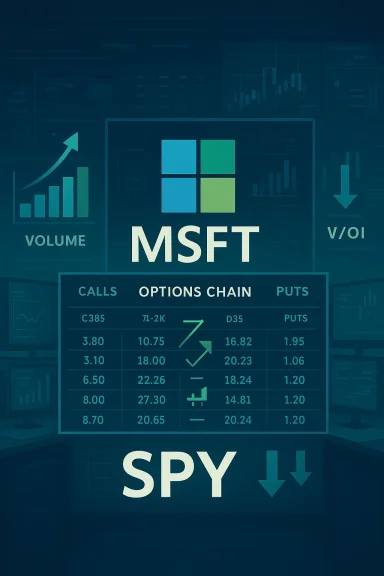
TipRanks’ “Notable open interest changes” package for February 4th aggregates chain-level shifts and puts them in market context. The takeaway headlines were:- Concentrated activity in large-cap tech option chains, with Microsoft among the names receiving the most attention; and
- ETF flow dynamics — notably SPY — that create a backdrop where index-level redemptions or creations can change pressure on large constituents.
Deep dive: Microsoft (MSFT) — the largest and most illustrative case
The raw footprint TipRanks and several flow desks highlighted
Among the names called out repeatedly in the aggregated alerts, Microsoft (MSFT) stands out. Flow scans in the days running up to and including February 4th registered:- A cluster of large call trades concentrated in January–February expiries and into longer-dated tenors;
- A set of sizable put trades, sometimes at strikes close to the prevailing stock price; and
- Sweeps and block executions that appeared on time-and-sales as aggressive buy-to-open prints.
What the numbers tell us — V/OI, OI spikes and interpretation
Two metrics are indispensable when decoding OI changes:- Volume-to-Open-Interest ratio (V/OI) — a spike here suggests new positions are being opened; and
- Absolute OI change — used together with strike clustering to show where the market is building persistent exposure.
Why the tape likely means hedged bullishness (not pure speculation)
The pattern of:- Longer-dated call purchases combined with shorter-dated call sales (diagonals),
- Parallel protective put buys, and
- Call spreads and calendar spreads
Market context that explains the trades
MSFT’s narrative — heavy AI/cloud capex, evolving margins, and earnings calendars — creates a very natural environment for:- Long-term convexity plays (long-dated calls) and
- Short-term protection (puts) around earnings or macro windows.
SPY and ETF-level mechanics — why index flows matter for open interest
TipRanks’ weekend wrap also emphasized ETF flow mechanics — and the SPY five-day net outflow figure sparked particular attention. The key points to understand:- ETF creations and redemptions are executed by authorized participants (APs); large net redemptions in a compressed window can force APs and market-makers to rebalance the underlying basket, which can transiently increase selling pressure on the largest index constituents.
- In a market where the index is increasingly driven by a handful of mega-caps, large SPY flows can have outsized second-order effects on those names’ liquidity and derivatives hedging flows.
How to read open interest changes correctly — a practical primer
If TipRanks or any alert flags a strike with big OI movement, use this checklist to decode the signal. These are distilled from the verification and cross-vendor comparisons in the aggregated material.- Check V/OI for the strike across multiple sessions — sustained V/OI >> 1 suggests new positions were opened.
- Confirm whether the print was a sweep (executed across venues at the aggressive side) or a block (single-fill). Sweeps often indicate urgency but can be a single leg of a multi-leg execution.
- Look for matched fills at other strikes/expiries in the minutes following the print — matched opposite fills almost always indicate multi-leg structures.
- Cross-check implied-volatility (IV) term structure — a front-end IV spike vs longer-dated IV shows event-driven pricing for nearby expiries.
- Verify corporate calendar events (earnings, analyst day, major announcements) — some heavy flow simply hedges a known upcoming event.
Cross-checks, verification, and the limits of tape interpretation
One of the responsibilities when reporting market alerts is to cross-verify claims; that’s particularly true with open interest and flow alerts because:- Data feeds differ — some vendors label the same execution differently (sweep vs block), and raw premium totals vary with which legs are visible in a single feed.
- Counterparty attribution is opaque — public options prints do not identify the buyer or seller’s institutional identity; calling large prints “whales” or “insider moves” is probabilistic, not definitive.
- Leg-based structures can mask directional exposure — diagonals, calendars, and condors create appearance-of-direction in single-leg feeds while producing a more nuanced economic exposure.
- Multiple flow vendors (CheddarFlow, MarketChameleon style summaries reported in the files),
- Exchange time-and-sales where possible, and
- Public corporate calendars and analyst notes.
Tactical takeaways for traders and risk managers
For readers who want practical, non-prescriptive steps after seeing a TipRanks open-interest alert:- Do this first:
- Use the checklist from the “How to read” section and confirm V/OI, IV term structure, and matched fills before sizing any position.
- Consider defined-risk constructions:
- Debit verticals, diagonals, and collars are preferred ways to emulate institutional exposure with capped downside rather than attempting to replicate naked option sweeps. Several vendors in the aggregated files recommend multi-leg replication for retail-sized accounts.
- Watch market microstructure and dealer flow:
- Large dealer inventory swings from market-makers can cause delta flow in the underlying; monitor short-term order-flow and spreads if you’re trading around flagged strikes.
- Manage position sizing and execution risk:
- Institutional desks use algorithmic execution and can access block liquidity; retail traders copying prints often experience larger slippage and worse fills. Scale in and prefer liquid strikes with robust OI.
- Use a multi-session confirmation rule:
- If open interest growth persists for 2–3 sessions and V/OI remains elevated, it’s likelier that the positions are persistent rather than transient.
Risks, misreads, and when alerts mislead
TipRanks-style alerts are extremely useful for surface visibility — but they are especially prone to misinterpretation in a few scenarios:- Interpreting hedging as directional conviction. Protective puts bought by long-holders will appear as bearish premium but are, economically, insurance. Treat such prints as hedges until chain-level structure proves otherwise.
- Relying on single-vendor totals for dollar-value claims. Different vendors have different windows and calculation methods; the SPY five-day net outflow headline is illustrative: plausible, contextually meaningful, but not a single-source truth until verified.
- Failing to account for dealer and AP mechanics. Index ETF rebalancing, AP creation/redemption flows, and dealer hedging can generate transient pressure in both options and the underlying — these are often mechanical and not always predictive of durable directional moves.
- Attempting to replicate institutional fills without institutional execution. Execution and slippage materially change performance; many retail replications of large prints underperform the original institutional idea for reasons of liquidity and execution.
Strengths and limitations of the TipRanks report — a balanced assessment
Strengths- Signal discovery: TipRanks’ roundup functions well as a lead generator — it surfaces strikes and chains that merit chain-level investigation.
- Market-context framing: The piece properly ties options flow to broader ETF and macro narratives (SPY flows, mega-cap concentration), which helps readers place discrete chain alerts inside a larger story.
- Numerical precision caveats: As noted, some headline numbers (e.g., a five-day net outflow figure for SPY) require corroboration from primary fund-flow tables before being treated as fact.
- Omitted chain-level detail: Alerts by nature compress multi-leg activity into single-line summaries; that simplification can lead to misinterpretation if not followed by chain examination.
- Attribution opacity: The feed cannot identify counterparties; calling prints “smart money” is probabilistic and must be hedged with caution.
Quick-reference checklist for WindowsForum readers who saw the Feb 4 alert
- If you saw a TipRanks open-interest alert:
- Pull the chain and check V/OI and OI change across 3 sessions.
- Look for matched fills indicating multi-leg trades (diagonals/calendars).
- Verify whether protective puts exist near the money — these often reveal hedging.
- Confirm any index/ETF flows cited with a second provider before assuming macro-driven pressure (SPY example).
- If you consider trading, prioritize defined-risk structures and scale sizing relative to your execution capability.
Conclusion
TipRanks’ “Notable open interest changes for February 4th” serves exactly the role it should: a concise market flag that directs experienced traders and risk managers to pockets of activity. The more detailed material available from independent flow-trackers and exchange-level observation paints a consistent picture for the flagged instances — especially in MSFT — of institutional players assembling structured bullish exposure with layered protection rather than simple naked directional bets. That distinction matters: it changes how a rational participant hedges, sizes, and executes.As always, use the alert as a lead, perform the chain-level verification steps (V/OI, matched fills, IV term-structure), cross-check any headline dollar figures with primary flow tables, and favor defined-risk replications if you choose to act. TipRanks gave us a useful semaphore on February 4th — interpreting the light correctly requires the hard work of chain-level forensics and discipline.
Source: TipRanks Notable open interest changes for February 4th - TipRanks.com
