

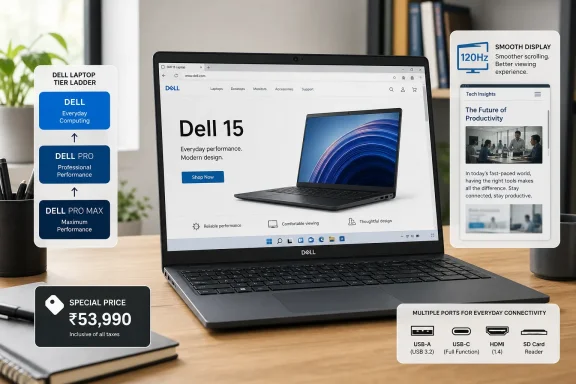
Dell’s everyday 15-inch consumer laptop line has moved from the familiar Inspiron badge to plainer names such as Dell 15, with Indian retail listings around ₹53,990 showing the same Windows 11, Intel Core, 15.6-inch full-HD formula that defined its predecessor. The name has changed faster than the product category underneath it. As TechnoSports noted in its buyer-focused write-up, the new badge is less a reinvention than a simplification of a long-running Dell mainstream laptop recipe. That is precisely why the rebrand matters: not because Dell 15 is suddenly exotic, but because PC makers are trying to make ordinary laptops feel easier to buy at the exact moment the market is becoming harder to understand.
Inspiron was never the glamour label in Dell’s house. It was the practical one: the laptop you bought for school, home office work, browser tabs, streaming, spreadsheets, and the occasional family photo edit. For many buyers, especially in price-sensitive markets, “Inspiron 15” meant “safe enough” in a way few model numbers ever could.
Dell’s broader naming shift, announced around CES 2025 and widely covered by outlets including Ars Technica, PCWorld, TechRadar, and Windows Central, swept away decades of familiar branding across XPS, Inspiron, Latitude, and Precision. In their place came a cleaner grid: Dell, Dell Pro, and Dell Pro Max, with tiers such as Plus and Premium used to signal price and capability.
On paper, this is rational. PC brands have accumulated years of suffixes, sub-brands, screen-size numbers, CPU-generation hints, and retailer-specific configurations. The average buyer walking into a store or scrolling through Amazon India does not want to decode whether “Inspiron 15 3520,” “Inspiron 15 3530,” and “Dell 15 DC15250” are meaningfully different machines or merely branches of the same family tree.
But rational does not always mean reassuring. Inspiron had earned recognition precisely because it survived the churn. Dell’s bet is that a simpler name can replace that accumulated trust without making buyers feel as if the product itself has become less knowable.
That specification tells you exactly where the laptop lives. It is for users who spend more time in Chrome, Edge, Office, WhatsApp Web, Teams, Zoom, YouTube, Netflix, Google Docs, and light creative apps than in Blender, DaVinci Resolve, or modern AAA games. It is a machine built around adequacy, and adequacy remains underrated in consumer technology.
Dell’s official product material for the Dell 15 DC15250 line also points to a familiar 15.6-inch full-HD, 120Hz, anti-glare IPS display option, which lines up with the sort of panels that have become common in late-era Inspiron 15 machines. Amazon India listings for similar Inspiron 3530 and Dell 15 configurations show the same broad pattern: 13th- or 14th-generation Intel chips, 8GB or 16GB of memory, 512GB SSDs, Windows 11, and bundled Microsoft Office options in some SKUs.
The continuity is the point. A buyer who liked the Inspiron proposition is not being asked to accept a radical new design philosophy. They are being asked to accept that the old name has been folded into a tidier shelf label.
The caveat is brightness and color. Many Dell 15 and Inspiron-class panels in this segment are 250-nit, 45 percent NTSC displays, which means they are perfectly serviceable indoors but not designed for serious color work or bright outdoor use. That distinction matters more than the marketing phrase “FHD 120Hz,” because a fast panel is not automatically a premium panel.
Still, compared with the dull 60Hz screens that haunted affordable 15-inch laptops for years, this is a meaningful quality-of-life improvement. It does not turn a ₹53,990 notebook into a creator workstation, but it does make the everyday Windows experience feel smoother. For the buyer Dell is targeting, that may be more valuable than a marginal CPU bump.
This is where the rebrand risks obscuring the useful facts. “Dell 15” tells you screen size. It does not tell you whether you are getting the better display, enough memory, or the Office bundle you expected. The name is simpler, but the buying decision still lives in the configuration table.
That is not a flaw if expectations are sane. Integrated graphics are fine for streaming video, browser acceleration, Office workloads, casual games, older titles, and light image editing. They are not a substitute for a discrete GPU when the workload shifts to heavy video exports, 3D rendering, local AI experimentation, or modern gaming at high settings.
The Windows laptop market is currently full of AI PC messaging, NPU claims, and Copilot+ branding, but the mainstream Dell 15 buyer should remain grounded in old-fashioned questions. How much RAM does this configuration include? Is the SSD large enough? Is the display the 120Hz IPS option or a lesser panel? Does the keyboard include backlighting? What is the actual processor model, not just the words “Intel Core”?
This is where Dell’s simplification helps only halfway. The family name may be easier, but the spec sheet still decides the machine. A Dell 15 with 8GB of RAM and an entry Intel Core chip is a different experience from a Dell 15 with 16GB and a stronger Core i5-class processor, even if both sit under the same friendly label.
That is why Dell’s warranty and support story still matters. TechnoSports points to a one-year onsite hardware service as part of the appeal, and Dell has long leaned on serviceability and support infrastructure as a reason to choose its mainstream machines over less familiar alternatives. In this segment, the laptop is often a household device, a student device, or a small-business workhorse. Downtime is not theoretical.
The competitive set is unforgiving. HP, Lenovo, Asus, Acer, and several online-first brands often offer louder specs at similar prices. Some will provide OLED screens, more RAM, or newer processor labels in flash sales. Dell’s counterargument has traditionally been consistency: not always the highest spec-per-rupee, but a lower-risk purchase from a brand buyers recognize.
Dropping Inspiron makes that argument harder in the short term. Dell now has to teach buyers that “Dell 15” is not generic filler. It is the new name for the same lane Inspiron occupied.
The new structure is also suspiciously phone-like. As several outlets observed when Dell announced the change, the shift toward plain Dell, Dell Pro, and Dell Pro Max echoes the kind of product ladder Apple helped normalize. The idea is obvious: base for normal people, Pro for work, Pro Max for maximum capability.
But laptops are not phones. A 15-inch Dell laptop can be a low-end home machine, a decent student laptop, or a surprisingly capable office device depending on configuration. The same outer name can hide major differences in processor generation, RAM, display panel, battery, ports, weight, and software bundle.
This is the new problem Dell inherits. Inspiron may have been old-fashioned, but it carried years of buyer shorthand. Dell 15 is cleaner, yet more anonymous. It reduces clutter at the brand level while pushing more responsibility onto retailers, spec tables, and reviewers.
XPS had a more passionate following than Inspiron, so the emotional stakes were different. Enthusiasts cared about XPS because it represented Dell’s premium Windows laptop identity. Inspiron mattered in a quieter way: it was the name many ordinary buyers trusted precisely because they did not want to become laptop enthusiasts.
That difference may be why Inspiron can disappear with less noise. Nobody forms a Reddit identity around owning a sensible 15-inch home laptop. But mass-market trust is still trust, and Dell should not assume silence equals indifference.
For Windows users, the lesson is not to mourn the badge too dramatically. It is to recognize that PC makers are increasingly treating brand architecture as software: something to be refactored, renamed, and pushed across the portfolio. The hardware, meanwhile, often evolves more slowly than the labels suggest.
That makes 16GB of RAM the safer choice for most buyers, even in a mainstream Dell 15. An 8GB model may still be acceptable for light use, but it leaves less room for the way real people actually use laptops: many tabs open, documents half-finished, media playing in the background, and updates arriving at inconvenient times. SSD storage is now table stakes, but memory remains the spec too many buyers underweight.
Processor branding also deserves skepticism. “Latest-gen Intel Core processor options,” as retail copy often says, is not a complete performance claim. The exact chip matters, as does the power profile Dell configures, the cooling system, and whether the laptop throttles under sustained work.
This is not a criticism unique to Dell. It is the reality of Windows laptop shopping in 2026. A clean name reduces anxiety only if the configuration is honest enough to match the buyer’s life.
HDMI matters when you need to connect to a classroom projector, office monitor, or television without hunting for an adapter. USB-A still matters because printers, mice, flash drives, and older peripherals have not vanished. An SD card slot remains useful for cameras, documents, and quick file transfers in households and small businesses.
This is another place where Dell’s everyday laptop philosophy survives the branding change. Inspiron machines were rarely exciting, but they were often sensible. If Dell 15 keeps that sensibility, the rebrand becomes less consequential.
The danger is that “simplification” eventually becomes cost-cutting in disguise. Buyers should watch future Dell 15 revisions carefully. A cleaner name is fine; fewer useful ports, soldered memory limits, worse panels, or weaker service terms would be a different story.
The same laptop family can appear under multiple listings with slightly different processors, RAM amounts, Office versions, antivirus bundles, keyboard options, colors, weights, and warranty descriptions. One listing may say Dell 15, another may still say Inspiron 3530, and a third may combine old and new language such as “Dell 15 previously Inspiron.” That is not a great consumer experience, even if the underlying machine is perfectly fine.
This is where Dell’s transition period becomes visible. Rebrands do not happen all at once in retail channels. Old stock, refreshed stock, regional naming, marketplace SEO, and seller copy all overlap, creating a strange moment where the old name is gone in strategy but still alive in search results.
For buyers, the safest approach is boring but effective: match the exact processor, RAM, SSD, display, warranty, and software bundle before comparing prices. Do not assume two Dell 15 listings are identical. Do not assume an Inspiron-labelled listing is obsolete. And do not pay extra merely because one page has cleaner branding.
But simplification becomes useful only when it preserves meaningful distinctions. If “Dell” covers too wide a range of consumer machines, buyers may still need reviewer guides and retailer filters to understand what they are seeing. If “Plus” and “Premium” do too much work, the old confusion simply returns under new labels.
The Dell 15 case shows both sides of the strategy. The name is easy to parse: Dell laptop, 15-inch screen. That is good. But the old Inspiron name carried a promise about class and purpose that “Dell 15” has to rebuild from scratch.
This is branding as interface design. The best interface hides complexity without hiding truth. The worst merely hides complexity until the buyer has already clicked “buy.”
The everyday 15-inch Windows laptop remains one of the most important devices in the market. It is large enough to work on comfortably, cheap enough to sell in volume, flexible enough for families, and familiar enough for institutions. It does not need to be exciting to be consequential.
Inspiron lasted because Dell understood that category. The best versions were not perfect, but they hit the expected notes: acceptable build, enough performance, recognizable service, normal ports, and prices that moved during sales. Dell 15 inherits that job.
The open question is whether Dell can maintain that discipline while chasing the AI PC cycle and cleaner global branding. If mainstream buyers start seeing worse value under simpler names, the rebrand will look cynical. If the machines remain dependable and easier to compare, Dell will have done something useful.
 Dell Retires a Name Buyers Actually Understood
Inspiron was never the glamour label in Dell’s house. It was the practical one: the laptop you bought for school, home office work, browser tabs, streaming, spreadsheets, and the occasional family photo edit. For many buyers, especially in price-sensitive markets, “Inspiron 15” meant “safe enough” in a way few model numbers ever could.Dell’s broader naming shift, announced around CES 2025 and widely covered by outlets including Ars Technica, PCWorld, TechRadar, and Windows Central, swept away decades of familiar branding across XPS, Inspiron, Latitude, and Precision. In their place came a cleaner grid: Dell, Dell Pro, and Dell Pro Max, with tiers such as Plus and Premium used to signal price and capability.
On paper, this is rational. PC brands have accumulated years of suffixes, sub-brands, screen-size numbers, CPU-generation hints, and retailer-specific configurations. The average buyer walking into a store or scrolling through Amazon India does not want to decode whether “Inspiron 15 3520,” “Inspiron 15 3530,” and “Dell 15 DC15250” are meaningfully different machines or merely branches of the same family tree.
But rational does not always mean reassuring. Inspiron had earned recognition precisely because it survived the churn. Dell’s bet is that a simpler name can replace that accumulated trust without making buyers feel as if the product itself has become less knowable.
The Dell 15 Is Still an Inspiron in Spirit
The Dell 15 described by TechnoSports is not trying to become an XPS-class halo machine or a workstation. Its appeal is deliberately modest. The typical configuration centers on Intel Core processor options, integrated Intel graphics, a 15.6-inch full-HD anti-glare display with refresh rates up to 120Hz, Windows 11, a slim-enough chassis, and mainstream connectivity including USB-A, USB-C, HDMI, an SD card slot, and Wi-Fi.That specification tells you exactly where the laptop lives. It is for users who spend more time in Chrome, Edge, Office, WhatsApp Web, Teams, Zoom, YouTube, Netflix, Google Docs, and light creative apps than in Blender, DaVinci Resolve, or modern AAA games. It is a machine built around adequacy, and adequacy remains underrated in consumer technology.
Dell’s official product material for the Dell 15 DC15250 line also points to a familiar 15.6-inch full-HD, 120Hz, anti-glare IPS display option, which lines up with the sort of panels that have become common in late-era Inspiron 15 machines. Amazon India listings for similar Inspiron 3530 and Dell 15 configurations show the same broad pattern: 13th- or 14th-generation Intel chips, 8GB or 16GB of memory, 512GB SSDs, Windows 11, and bundled Microsoft Office options in some SKUs.
The continuity is the point. A buyer who liked the Inspiron proposition is not being asked to accept a radical new design philosophy. They are being asked to accept that the old name has been folded into a tidier shelf label.
The Screen Upgrade Is More Useful Than the Badge
Among the more practical details in this class of Dell 15 machines is the 120Hz full-HD display. In gaming laptops, 120Hz is old news. In budget and mid-range productivity laptops, it still makes the whole system feel less stale, especially when scrolling documents, switching windows, or navigating long webpages.The caveat is brightness and color. Many Dell 15 and Inspiron-class panels in this segment are 250-nit, 45 percent NTSC displays, which means they are perfectly serviceable indoors but not designed for serious color work or bright outdoor use. That distinction matters more than the marketing phrase “FHD 120Hz,” because a fast panel is not automatically a premium panel.
Still, compared with the dull 60Hz screens that haunted affordable 15-inch laptops for years, this is a meaningful quality-of-life improvement. It does not turn a ₹53,990 notebook into a creator workstation, but it does make the everyday Windows experience feel smoother. For the buyer Dell is targeting, that may be more valuable than a marginal CPU bump.
This is where the rebrand risks obscuring the useful facts. “Dell 15” tells you screen size. It does not tell you whether you are getting the better display, enough memory, or the Office bundle you expected. The name is simpler, but the buying decision still lives in the configuration table.
Intel Integrated Graphics Still Define the Boundary
The Dell 15 formula also keeps one of Inspiron’s most important limits: integrated graphics. Depending on the exact processor and configuration, buyers may see Intel UHD Graphics or Iris Xe-class branding. Either way, this is not a machine sold on GPU muscle.That is not a flaw if expectations are sane. Integrated graphics are fine for streaming video, browser acceleration, Office workloads, casual games, older titles, and light image editing. They are not a substitute for a discrete GPU when the workload shifts to heavy video exports, 3D rendering, local AI experimentation, or modern gaming at high settings.
The Windows laptop market is currently full of AI PC messaging, NPU claims, and Copilot+ branding, but the mainstream Dell 15 buyer should remain grounded in old-fashioned questions. How much RAM does this configuration include? Is the SSD large enough? Is the display the 120Hz IPS option or a lesser panel? Does the keyboard include backlighting? What is the actual processor model, not just the words “Intel Core”?
This is where Dell’s simplification helps only halfway. The family name may be easier, but the spec sheet still decides the machine. A Dell 15 with 8GB of RAM and an entry Intel Core chip is a different experience from a Dell 15 with 16GB and a stronger Core i5-class processor, even if both sit under the same friendly label.
The Price Is the Product
At around ₹53,990, the Dell 15 sits in the brutal middle of the Indian Windows laptop market. This is a band where buyers expect reliability, a recognizable brand, onsite service, Windows 11, SSD storage, a decent display, and enough performance to last several years. They are not shopping for luxury; they are shopping against regret.That is why Dell’s warranty and support story still matters. TechnoSports points to a one-year onsite hardware service as part of the appeal, and Dell has long leaned on serviceability and support infrastructure as a reason to choose its mainstream machines over less familiar alternatives. In this segment, the laptop is often a household device, a student device, or a small-business workhorse. Downtime is not theoretical.
The competitive set is unforgiving. HP, Lenovo, Asus, Acer, and several online-first brands often offer louder specs at similar prices. Some will provide OLED screens, more RAM, or newer processor labels in flash sales. Dell’s counterargument has traditionally been consistency: not always the highest spec-per-rupee, but a lower-risk purchase from a brand buyers recognize.
Dropping Inspiron makes that argument harder in the short term. Dell now has to teach buyers that “Dell 15” is not generic filler. It is the new name for the same lane Inspiron occupied.
Dell’s Rebrand Solves a Real Problem and Creates a New One
The old Dell naming structure was messy because the PC business is messy. Inspiron, XPS, Latitude, Precision, Vostro, OptiPlex, Alienware, screen sizes, numeric generations, and retailer SKUs all coexisted in a hierarchy that made sense mostly to people who followed Dell for a living. A simpler structure was overdue.The new structure is also suspiciously phone-like. As several outlets observed when Dell announced the change, the shift toward plain Dell, Dell Pro, and Dell Pro Max echoes the kind of product ladder Apple helped normalize. The idea is obvious: base for normal people, Pro for work, Pro Max for maximum capability.
But laptops are not phones. A 15-inch Dell laptop can be a low-end home machine, a decent student laptop, or a surprisingly capable office device depending on configuration. The same outer name can hide major differences in processor generation, RAM, display panel, battery, ports, weight, and software bundle.
This is the new problem Dell inherits. Inspiron may have been old-fashioned, but it carried years of buyer shorthand. Dell 15 is cleaner, yet more anonymous. It reduces clutter at the brand level while pushing more responsibility onto retailers, spec tables, and reviewers.
The XPS U-Turn Shows Branding Still Has Gravity
Dell’s later reported movement around XPS is a useful warning. After the company moved to retire historic names, industry coverage in 2026 noted that XPS branding was being revived or re-emphasized for premium models after customer reaction. That does not mean Inspiron will necessarily return, but it does prove that names in the PC business are not disposable wrappers.XPS had a more passionate following than Inspiron, so the emotional stakes were different. Enthusiasts cared about XPS because it represented Dell’s premium Windows laptop identity. Inspiron mattered in a quieter way: it was the name many ordinary buyers trusted precisely because they did not want to become laptop enthusiasts.
That difference may be why Inspiron can disappear with less noise. Nobody forms a Reddit identity around owning a sensible 15-inch home laptop. But mass-market trust is still trust, and Dell should not assume silence equals indifference.
For Windows users, the lesson is not to mourn the badge too dramatically. It is to recognize that PC makers are increasingly treating brand architecture as software: something to be refactored, renamed, and pushed across the portfolio. The hardware, meanwhile, often evolves more slowly than the labels suggest.
Windows 11 Makes the Sensible Laptop More Demanding
The Dell 15’s target workloads sound simple, but Windows 11 has raised the floor for what “simple” should mean. A modern browser session can consume gigabytes of memory. Teams, OneDrive sync, antivirus, cloud backup tools, and Office apps can turn an entry configuration into a cramped one surprisingly quickly.That makes 16GB of RAM the safer choice for most buyers, even in a mainstream Dell 15. An 8GB model may still be acceptable for light use, but it leaves less room for the way real people actually use laptops: many tabs open, documents half-finished, media playing in the background, and updates arriving at inconvenient times. SSD storage is now table stakes, but memory remains the spec too many buyers underweight.
Processor branding also deserves skepticism. “Latest-gen Intel Core processor options,” as retail copy often says, is not a complete performance claim. The exact chip matters, as does the power profile Dell configures, the cooling system, and whether the laptop throttles under sustained work.
This is not a criticism unique to Dell. It is the reality of Windows laptop shopping in 2026. A clean name reduces anxiety only if the configuration is honest enough to match the buyer’s life.
The Ports Are a Quiet Advantage
One reason mainstream 15-inch laptops endure is that they still behave like practical computers. A Dell 15 with USB-A, USB-C, HDMI, an SD card slot, and Wi-Fi is not chasing the minimalist port philosophy that turned too many premium laptops into dongle platforms. For students, families, teachers, small offices, and hybrid workers, ports are not nostalgia. They are daily friction removed.HDMI matters when you need to connect to a classroom projector, office monitor, or television without hunting for an adapter. USB-A still matters because printers, mice, flash drives, and older peripherals have not vanished. An SD card slot remains useful for cameras, documents, and quick file transfers in households and small businesses.
This is another place where Dell’s everyday laptop philosophy survives the branding change. Inspiron machines were rarely exciting, but they were often sensible. If Dell 15 keeps that sensibility, the rebrand becomes less consequential.
The danger is that “simplification” eventually becomes cost-cutting in disguise. Buyers should watch future Dell 15 revisions carefully. A cleaner name is fine; fewer useful ports, soldered memory limits, worse panels, or weaker service terms would be a different story.
The Amazon Listing Is Not the Whole Story
TechnoSports frames the Dell 15 as a practical Amazon-linked buy, and that reflects how many Indian consumers now shop for laptops. Marketplace listings are fast, price-transparent, and often bundled with bank offers, exchange deals, and limited-time discounts. They are also messy.The same laptop family can appear under multiple listings with slightly different processors, RAM amounts, Office versions, antivirus bundles, keyboard options, colors, weights, and warranty descriptions. One listing may say Dell 15, another may still say Inspiron 3530, and a third may combine old and new language such as “Dell 15 previously Inspiron.” That is not a great consumer experience, even if the underlying machine is perfectly fine.
This is where Dell’s transition period becomes visible. Rebrands do not happen all at once in retail channels. Old stock, refreshed stock, regional naming, marketplace SEO, and seller copy all overlap, creating a strange moment where the old name is gone in strategy but still alive in search results.
For buyers, the safest approach is boring but effective: match the exact processor, RAM, SSD, display, warranty, and software bundle before comparing prices. Do not assume two Dell 15 listings are identical. Do not assume an Inspiron-labelled listing is obsolete. And do not pay extra merely because one page has cleaner branding.
The Rebrand Is Really About Reducing Buyer Fatigue
Dell’s public logic for the new naming scheme has been simplification, and that argument should not be dismissed. PC buying is needlessly complicated. A lineup that maps more clearly to consumer, professional, and workstation use cases could genuinely help people who do not want to memorize Dell’s internal taxonomy.But simplification becomes useful only when it preserves meaningful distinctions. If “Dell” covers too wide a range of consumer machines, buyers may still need reviewer guides and retailer filters to understand what they are seeing. If “Plus” and “Premium” do too much work, the old confusion simply returns under new labels.
The Dell 15 case shows both sides of the strategy. The name is easy to parse: Dell laptop, 15-inch screen. That is good. But the old Inspiron name carried a promise about class and purpose that “Dell 15” has to rebuild from scratch.
This is branding as interface design. The best interface hides complexity without hiding truth. The worst merely hides complexity until the buyer has already clicked “buy.”
The Inspiron Formula Survives Because the Market Still Needs It
There is a tendency in tech coverage to obsess over the machines that redefine categories: foldables, AI PCs, gaming monsters, creator workstations, ultraportables, ARM experiments, and premium OLED slabs. The Dell 15 is none of those things, which is why it may matter more to ordinary buyers.The everyday 15-inch Windows laptop remains one of the most important devices in the market. It is large enough to work on comfortably, cheap enough to sell in volume, flexible enough for families, and familiar enough for institutions. It does not need to be exciting to be consequential.
Inspiron lasted because Dell understood that category. The best versions were not perfect, but they hit the expected notes: acceptable build, enough performance, recognizable service, normal ports, and prices that moved during sales. Dell 15 inherits that job.
The open question is whether Dell can maintain that discipline while chasing the AI PC cycle and cleaner global branding. If mainstream buyers start seeing worse value under simpler names, the rebrand will look cynical. If the machines remain dependable and easier to compare, Dell will have done something useful.
The Specs That Should Decide a Dell 15 Purchase
The Dell 15 is best judged not by nostalgia for Inspiron, but by whether the specific configuration matches the buyer’s workload. That means looking past the new name and treating the laptop like the practical tool it is.- A Dell 15 with 16GB of RAM is the safer long-term Windows 11 choice than an 8GB configuration for students, office workers, and heavy browser users.
- The 15.6-inch full-HD 120Hz anti-glare display is a worthwhile everyday upgrade, but buyers should not confuse smooth refresh with high-end brightness or color accuracy.
- Intel integrated graphics are suitable for productivity, streaming, and light creative work, but they are not meant for serious gaming, 3D work, or heavy video production.
- The presence of USB-A, USB-C, HDMI, and an SD card slot makes the machine more practical than many thinner premium laptops for schools, homes, and small offices.
- The one-year onsite service offering can matter as much as a minor spec difference in a household or small-business machine.
- The Inspiron-to-Dell 15 transition means shoppers should compare exact model numbers and specifications rather than trusting the family name alone.
References
- Primary source: TechnoSports Media Group
Published: 2026-07-04T12:10:19.528887
Loading…
technosports.co.in - Related coverage: arstechnica.com
Loading…
arstechnica.com - Related coverage: pcworld.com
Loading…
www.pcworld.com - Related coverage: techrepublic.com
Loading…
www.techrepublic.com - Related coverage: xataka.com
Loading…
www.xataka.com - Related coverage: techradar.com
Loading…
www.techradar.com
- Related coverage: republicworld.com
Loading…
www.republicworld.com - Related coverage: windowscentral.com
Loading…
www.windowscentral.com - Related coverage: gigazine.net
Loading…
gigazine.net - Related coverage: dell.com
Loading…
www.dell.com - Related coverage: tomshardware.com
Loading…
www.tomshardware.com - Related coverage: techbriefly.com
Loading…
techbriefly.com - Related coverage: itechpost.com
Loading…
www.itechpost.com - Related coverage: microcenter.com
Loading…
www.microcenter.com - Related coverage: itpro.com
Loading…
www.itpro.com - Related coverage: pcgamer.com
Loading…
www.pcgamer.com - Related coverage: laptopmag.com
Loading…
www.laptopmag.com - Related coverage: cu.edu
Loading…
www.cu.edu - Related coverage: delltechnologies.com
Loading…
www.delltechnologies.com - Related coverage: amazon.in
Loading…
www.amazon.in - Related coverage: flashprice.in
Loading…
flashprice.in - Related coverage: dealsmagnet.com
Loading…
www.dealsmagnet.com - Related coverage: price-history.in
Loading…
price-history.in - Related coverage: pricehistory.app
Loading…
pricehistory.app