

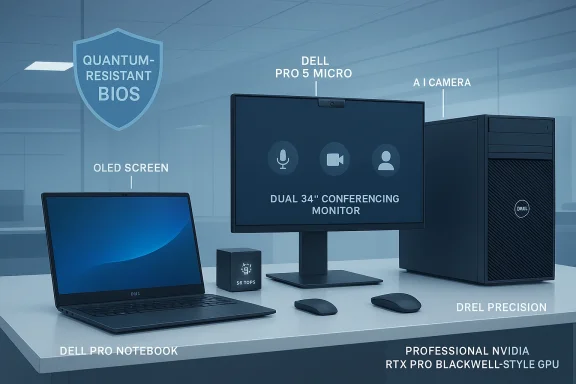
Dell’s 2026 business PC refresh is less about one flashy desktop and more about a coordinated push across the entire commercial portfolio: slimmer Pro notebooks, the compact Pro 5 Micro desktop, updated Precision workstations, conferencing monitors, and security-focused peripherals. The headline for many readers will be the Micro system, which Dell says delivers 50 TOPS of AI performance in a tiny footprint, enough to support Copilot+ experiences while still fitting into crowded offices. But the broader story is bigger than one box on a desk: Dell is betting that enterprises now want AI-ready hardware, stronger device security, and fewer compromises between portability and manageability. The new lineup is scheduled to begin rolling out in phases starting March 31, giving Dell a fresh offensive in a market where AI branding, workplace flexibility, and endpoint protection are all colliding.
Dell has spent the last several product cycles reworking its commercial identity around cleaner naming, tighter segmentation, and more explicit AI positioning. That shift is not happening in a vacuum. PC buyers have been moving away from generic “good enough” machines and toward devices that clearly signal what they are for: mobile work, local AI, heavy creative work, or secure office deployment. Dell’s 2025 lineup already laid much of the groundwork for that message, with refreshed laptop tiers and stronger emphasis on AI-capable silicon and professional workflows.
The new 2026 lineup appears to extend that logic into a more mature commercial ecosystem. Dell is not merely launching new notebooks and calling it a day. It is pairing devices with smart monitors, biometric accessories, and a new Quantum-resistant BIOS protection layer, which is a notably forward-looking phrase in a year when supply chains, firmware attacks, and endpoint hardening are top of mind for IT teams. The combination suggests that Dell sees the commercial PC market as a systems problem, not just a CPU-and-screen problem. That is a meaningful distinction for enterprise buyers who want fleets that are simpler to manage and harder to compromise.
The small-form-factor desktop angle is especially important because office layouts are changing. Hybrid work has normalized smaller desks, hot-desk environments, shared collaboration zones, and compact home offices. In that context, a Micro desktop is not a niche novelty; it is a practical answer to spatial constraints. Dell’s stated emphasis on performance in a mini chassis mirrors the broader industry movement toward compact PCs with on-device AI acceleration, a trend that has become one of the defining themes of 2026.
At the same time, Dell’s Precision line still matters because not every buyer wants AI-first branding. Creative professionals, engineers, and data teams still care about raw throughput, GPU capability, memory ceilings, and system reliability. The company’s workstation strategy signals that it intends to serve both ends of the commercial spectrum: the everyday office employee who benefits from a compact AI PC and the specialist who needs a machine built for sustained high-load work. That dual-track strategy is smart, but it also creates pressure to make each device class clearly distinct so buyers do not get lost in the marketing.
There is also a more subtle message here. By reducing thickness while still adding advanced silicon, Dell is trying to prove that business laptops no longer need to look utilitarian to be secure or powerful. That is an important psychological shift for buyers who still associate enterprise devices with beige-era compromises. The new Pro line is designed to feel modern, not merely functional.
The broader implication is that Dell is trying to collapse the gap between consumer polish and enterprise practicality. For years, business devices often lagged consumer models in screen quality and webcam hardware. That gap is shrinking fast, and Dell clearly wants the Pro brand to look like a premium choice rather than a compliance obligation. In a competitive market, that kind of polish can be the difference between a shortlist and an ignored bid.
The key question, as always, is whether these gains hold up under real-world load. Slimmer systems can look excellent on a spec sheet but still disappoint if fan noise, thermals, or battery drain under AI workloads are poorly balanced. Dell seems aware of that risk, which is why the Pro line is being marketed around a blend of portability, longevity, and manageability rather than just raw benchmarks.
That positioning matters because a lot of office buyers are tired of “mini PC” products that promise more than they can realistically deliver. The Pro 5 Micro appears aimed at a more serious audience. Dell’s emphasis on AI performance suggests that it wants this machine to be relevant not only for spreadsheets and email, but also for local transcription, image features, meeting assistance, and whatever Microsoft continues to build into Windows around AI processing.
The device also fits well into staged refresh programs. Companies that do not want to replace every endpoint at once can pilot a compact AI desktop in specific roles, measure value, and then expand if the results justify it. That is much easier to do with a tiny desktop than with a full tower, especially in offices where square footage is already at a premium.
Still, the value of those 50 TOPS will depend on software support. If the workloads are well-optimized, the Pro 5 Micro could punch far above its size. If not, the number risks becoming another marketing badge that sounds impressive but is hard to feel in daily use. That tension is one of the defining challenges of the AI PC era.
That distinction is especially useful for procurement teams. A workstation purchase is easier to justify when the vendor can clearly explain why the machine is different from a premium laptop or a high-end office desktop. Dell appears to be leaning into that logic by pairing workstation identity with new-generation professional graphics and enough memory headroom for demanding workloads.
That said, GPU branding alone is not enough. Buyers will want to know thermal limits, actual configurations, and whether the machine can maintain performance over long sessions without throttling. A workstation earns its reputation in the details, and Dell will need field results to back up the promise.
That is where Precision has always had an advantage. It is built for confidence. The machine is supposed to be boring in the best possible way: dependable, predictable, and strong enough that the user forgets about the hardware and focuses on the work. That remains Dell’s strongest workstation argument.
This also gives Dell another way to lock in commercial buyers. A monitor that integrates better with Dell PCs, Dell security tools, and Dell deployment workflows becomes part of a managed ecosystem. That is appealing to IT teams that want fewer moving parts and fewer support tickets.
There is a broader lesson here. Enterprise security is increasingly about layered trust, not single controls. A secure BIOS, a biometric login path, modern OS protections, and managed peripherals all reinforce each other. Dell seems to understand that a secure environment is built from many small decisions, not one big one.
There is also a procurement advantage. Companies buying in volume often prefer vendors who can supply a coherent stack rather than a patchwork of mismatched accessories. If Dell can make its monitors and peripherals feel like natural extensions of the PC lineup, it may increase the odds of larger multi-category deals.
The challenge is that buyers will want specifics. Which algorithms are used? How is update authenticity preserved? What parts of the boot flow are protected? Without that detail, the feature risks being seen as a brand-forward phrase rather than a fully explained defense model. Dell will need clear documentation if it wants this to be taken seriously by security teams.
This is also a competitive move. If Dell can credibly claim a stronger boot-chain security posture than rivals, it may win more enterprise refresh deals. Security buyers do not just compare hardware specs; they compare risk narratives. A better risk narrative can be as powerful as a faster CPU.
That is why Dell will need to balance ambition with clarity. The right message is not that quantum threats are already here for every office. The right message is that the boot chain is being designed with more durable assumptions than older firmware models allowed. That is a much more credible and useful position.
The downside is that competitors can focus more narrowly and sometimes look sharper. Rival vendors may win on design flair, price, or a single category’s best-in-class specs. Dell’s challenge is to make its broad lineup feel intentional rather than sprawling.
This is especially true in enterprises, where buying decisions depend on supportability and standardization. Dell has long been strong there, and this lineup reinforces that strength by tying modern silicon, security, and accessories into one story. If the execution matches the pitch, rivals will have to work harder to dislodge it.
That is a subtle but important market effect. The line between business and consumer hardware has blurred, and Dell is using that blur to its advantage. A machine that feels secure and modern in the office often feels like a better purchase at home too.
The phased rollout starting March 31 gives Dell time to build momentum, but it also gives competitors a chance to react. If rival vendors answer with better pricing, better batteries, or more transparent AI implementation, Dell may need to lean even harder on its security and manageability story. In that sense, this launch is not a finish line. It is the opening move in a much larger contest over what the modern business PC should be.
Source: Mena FN Dell Launches 2026 PC Lineup: Check Out The Ultra-Compact Pro 5 Micro Desktop
 Background
Dell has spent the last several product cycles reworking its commercial identity around cleaner naming, tighter segmentation, and more explicit AI positioning. That shift is not happening in a vacuum. PC buyers have been moving away from generic “good enough” machines and toward devices that clearly signal what they are for: mobile work, local AI, heavy creative work, or secure office deployment. Dell’s 2025 lineup already laid much of the groundwork for that message, with refreshed laptop tiers and stronger emphasis on AI-capable silicon and professional workflows.The new 2026 lineup appears to extend that logic into a more mature commercial ecosystem. Dell is not merely launching new notebooks and calling it a day. It is pairing devices with smart monitors, biometric accessories, and a new Quantum-resistant BIOS protection layer, which is a notably forward-looking phrase in a year when supply chains, firmware attacks, and endpoint hardening are top of mind for IT teams. The combination suggests that Dell sees the commercial PC market as a systems problem, not just a CPU-and-screen problem. That is a meaningful distinction for enterprise buyers who want fleets that are simpler to manage and harder to compromise.
The small-form-factor desktop angle is especially important because office layouts are changing. Hybrid work has normalized smaller desks, hot-desk environments, shared collaboration zones, and compact home offices. In that context, a Micro desktop is not a niche novelty; it is a practical answer to spatial constraints. Dell’s stated emphasis on performance in a mini chassis mirrors the broader industry movement toward compact PCs with on-device AI acceleration, a trend that has become one of the defining themes of 2026.
At the same time, Dell’s Precision line still matters because not every buyer wants AI-first branding. Creative professionals, engineers, and data teams still care about raw throughput, GPU capability, memory ceilings, and system reliability. The company’s workstation strategy signals that it intends to serve both ends of the commercial spectrum: the everyday office employee who benefits from a compact AI PC and the specialist who needs a machine built for sustained high-load work. That dual-track strategy is smart, but it also creates pressure to make each device class clearly distinct so buyers do not get lost in the marketing.
The Pro Series Refresh
Dell says its Pro notebooks are now up to 18% slimmer, which is the kind of specification that sounds modest until you think about how much it affects the daily experience of carrying, docking, and using a laptop. Slimmer chassis do not just improve aesthetics; they influence bag fit, desk clutter, and the perceived modernity of the device. In enterprise procurement, those small ergonomic details often matter more than raw benchmark gains because they affect thousands of hours of use across a fleet.Why slimness still matters
The new Pro machines are built around the latest Intel Core Ultra or AMD Ryzen AI processors, which puts them squarely in the current wave of AI PC marketing. That matters because the NPU is no longer a novelty checkbox. Dell is positioning these notebooks as practical endpoints for local inference, collaboration tools, and future Windows AI features rather than as traditional laptops with a little extra branding on the side. If the slimmer design also keeps the premium models quiet and cool, that could make the Pro line more attractive than a lot of bulkier business machines.There is also a more subtle message here. By reducing thickness while still adding advanced silicon, Dell is trying to prove that business laptops no longer need to look utilitarian to be secure or powerful. That is an important psychological shift for buyers who still associate enterprise devices with beige-era compromises. The new Pro line is designed to feel modern, not merely functional.
Display and camera upgrades
Dell’s premium Pro models can be configured with an OLED display, and the top variants include an 8MP HDR camera. Those are not trivial luxuries in a world where video meetings, screen sharing, and remote collaboration remain routine. A better camera matters because it reduces the “washed out and grainy” effect that still plagues too many business laptops, and OLED matters because users now expect better contrast and color in everyday work, not just creative workflows.The broader implication is that Dell is trying to collapse the gap between consumer polish and enterprise practicality. For years, business devices often lagged consumer models in screen quality and webcam hardware. That gap is shrinking fast, and Dell clearly wants the Pro brand to look like a premium choice rather than a compliance obligation. In a competitive market, that kind of polish can be the difference between a shortlist and an ignored bid.
Connectivity and battery life
Wi‑Fi 7 support and improved battery life round out the Pro pitch. In enterprise terms, that is about more than speed. Better wireless standards reduce friction in dense office environments, and better endurance lowers the number of machines tethered to chargers all day. That can improve mobility, reduce desk cable clutter, and cut down on support complaints from users who expect a laptop to survive a full workday.The key question, as always, is whether these gains hold up under real-world load. Slimmer systems can look excellent on a spec sheet but still disappoint if fan noise, thermals, or battery drain under AI workloads are poorly balanced. Dell seems aware of that risk, which is why the Pro line is being marketed around a blend of portability, longevity, and manageability rather than just raw benchmarks.
The Pro 5 Micro Desktop
The Pro 5 Micro is the most interesting device in the announcement because it embodies the direction the market is heading: smaller footprints, local AI capability, and a desktop form factor that does not behave like yesterday’s desktop. Dell’s claim of 50 TOPS is especially important because it puts the machine into the conversation around Copilot+-style experiences, which increasingly depend on dedicated AI acceleration rather than general CPU horsepower alone.A tiny box with real ambition
Micro desktops succeed when they disappear into the workspace while still feeling responsive under load. That is the core promise here. Dell is signaling that offices with limited space do not have to choose between capability and compactness, and that a small chassis can still support modern productivity, AI-assisted features, and everyday multitasking. In other words, the Micro is not being sold as a compromise machine; it is being sold as a clever one.That positioning matters because a lot of office buyers are tired of “mini PC” products that promise more than they can realistically deliver. The Pro 5 Micro appears aimed at a more serious audience. Dell’s emphasis on AI performance suggests that it wants this machine to be relevant not only for spreadsheets and email, but also for local transcription, image features, meeting assistance, and whatever Microsoft continues to build into Windows around AI processing.
Enterprise use cases
This is where the Pro 5 Micro could become a quiet hit. For desk-heavy environments like finance, operations, healthcare administration, front-office kiosks, and educational labs, a machine that can tuck behind a monitor while still carrying modern AI features is genuinely attractive. Space savings can also reduce shipping volume, simplify deployment, and make standardized desk builds easier to manage. Those are boring wins, but boring wins are what make enterprise buyers sign purchase orders.The device also fits well into staged refresh programs. Companies that do not want to replace every endpoint at once can pilot a compact AI desktop in specific roles, measure value, and then expand if the results justify it. That is much easier to do with a tiny desktop than with a full tower, especially in offices where square footage is already at a premium.
What 50 TOPS really signals
The headline number matters because AI hardware is becoming a procurement filter. Buyers may not know exactly how to translate TOPS into real workflow gains, but they do understand that higher numbers mean more room for local processing. For Microsoft’s AI-driven features, this can help reduce dependence on the cloud for certain tasks, improve responsiveness, and make the machine feel more future-facing.Still, the value of those 50 TOPS will depend on software support. If the workloads are well-optimized, the Pro 5 Micro could punch far above its size. If not, the number risks becoming another marketing badge that sounds impressive but is hard to feel in daily use. That tension is one of the defining challenges of the AI PC era.
Precision Workstations Remain the Heavy Hitters
Dell’s Precision series remains the company’s answer to users who need more than AI-assisted productivity. These systems are built for data science, AI research, video editing, engineering, and other heavy workloads that demand predictable performance over long periods. Dell says the new workstations use NVIDIA RTX Pro Blackwell graphics and support up to 64GB of RAM, which keeps them firmly in professional territory.Workstation identity still matters
The workstation market has not disappeared just because consumer laptops can now do more. In fact, the rise of AI workloads has made workstation clarity more important, not less. A proper workstation is still expected to handle larger datasets, sustained rendering, multi-app workflows, and application stacks that stress both CPU and GPU simultaneously. Dell’s Precision branding continues to communicate that this is a machine for people whose output matters more than aesthetics.That distinction is especially useful for procurement teams. A workstation purchase is easier to justify when the vendor can clearly explain why the machine is different from a premium laptop or a high-end office desktop. Dell appears to be leaning into that logic by pairing workstation identity with new-generation professional graphics and enough memory headroom for demanding workloads.
The GPU story
The mention of RTX Pro Blackwell graphics is a significant signal because GPU architecture is increasingly the bottleneck in professional AI and creative work. Video editors, 3D artists, simulation users, and data teams all benefit when the graphics subsystem is designed for sustained professional use rather than occasional gaming bursts. Dell’s emphasis here suggests that it wants Precision systems to sit at the center of a modern creator-and-AI workflow.That said, GPU branding alone is not enough. Buyers will want to know thermal limits, actual configurations, and whether the machine can maintain performance over long sessions without throttling. A workstation earns its reputation in the details, and Dell will need field results to back up the promise.
Memory and workflow headroom
Up to 64GB of RAM may sound modest compared with extreme workstation towers, but it remains a meaningful ceiling for many business and creator users. It gives plenty of room for heavy multitasking, local models, big projects, and multiple professional applications running at once. For a great many users, the important question is not whether the system supports absurd memory sizes, but whether it will stay stable and fast under day-to-day pressure.That is where Precision has always had an advantage. It is built for confidence. The machine is supposed to be boring in the best possible way: dependable, predictable, and strong enough that the user forgets about the hardware and focuses on the work. That remains Dell’s strongest workstation argument.
Monitors, Accessories, and the Security Stack
Dell’s lineup is not just about endpoints. The company also introduced 34-inch conferencing monitors with a built-in AI camera, noise cancellation, and new keyboards and mice with biometric security. That may look like a supporting cast, but it is actually central to the strategy because modern workplace computing is increasingly about the whole station, not just the computer box.Smart monitors as collaboration hubs
The conferencing monitor is a telling product category because it reflects how offices now work. If a display includes a camera, microphones, and audio processing, it stops being a passive peripheral and becomes part of the collaboration platform. That can simplify desk setups, improve call quality, and reduce the need for extra accessories in meeting-heavy environments.This also gives Dell another way to lock in commercial buyers. A monitor that integrates better with Dell PCs, Dell security tools, and Dell deployment workflows becomes part of a managed ecosystem. That is appealing to IT teams that want fewer moving parts and fewer support tickets.
Biometric input hardware
Keyboards and mice with biometric security are a smaller but still meaningful part of the launch. Peripherals are often overlooked in product coverage, but they are one of the last physical touchpoints between user and endpoint. If Dell can make authentication more seamless at the desk, it reduces friction without sacrificing security.There is a broader lesson here. Enterprise security is increasingly about layered trust, not single controls. A secure BIOS, a biometric login path, modern OS protections, and managed peripherals all reinforce each other. Dell seems to understand that a secure environment is built from many small decisions, not one big one.
Why peripherals now matter more
The biggest reason these accessories matter is that hybrid work has blurred the boundary between individual device and workspace. A monitor, keyboard, and mouse are no longer generic commodities when they influence sign-in, collaboration, and endpoint visibility. By bundling smarter peripherals into the story, Dell strengthens its value proposition for companies trying to standardize modern desks.There is also a procurement advantage. Companies buying in volume often prefer vendors who can supply a coherent stack rather than a patchwork of mismatched accessories. If Dell can make its monitors and peripherals feel like natural extensions of the PC lineup, it may increase the odds of larger multi-category deals.
Quantum-Resistant BIOS: Promise and Practicality
Dell’s introduction of Quantum-resistant BIOS protection is arguably the most attention-grabbing security claim in the announcement. The phrase sounds futuristic, but it also raises the obvious question: what exactly is protected, and how much of the benefit is immediate versus speculative? In 2026, security marketing has to do more than sound impressive; it has to survive scrutiny from IT teams that have seen every buzzword in the book.What the term implies
At a high level, quantum-resistant protection suggests an effort to prepare firmware and boot-chain security for cryptographic methods that should remain resilient against future quantum computing threats. That is important because BIOS and firmware trust are foundational. If the boot path is compromised, a machine can be vulnerable long before the operating system loads. A more resilient BIOS layer is therefore one of the smartest places for vendors to invest.The challenge is that buyers will want specifics. Which algorithms are used? How is update authenticity preserved? What parts of the boot flow are protected? Without that detail, the feature risks being seen as a brand-forward phrase rather than a fully explained defense model. Dell will need clear documentation if it wants this to be taken seriously by security teams.
Why enterprises will care
Even if the quantum aspect is partly future-proofing, the underlying message is strong: firmware security matters, and Dell wants to be seen as proactive. That is useful in sectors where device integrity is a compliance issue, not just a convenience. Finance, government, healthcare, and critical infrastructure buyers increasingly expect vendors to treat firmware as part of the security perimeter.This is also a competitive move. If Dell can credibly claim a stronger boot-chain security posture than rivals, it may win more enterprise refresh deals. Security buyers do not just compare hardware specs; they compare risk narratives. A better risk narrative can be as powerful as a faster CPU.
The marketing risk
The risk, of course, is overpromising. If the phrase is interpreted as “quantum-safe now” rather than “better prepared for the future,” it could create confusion or skepticism. Security claims that sound too far ahead of practical deployment can alienate the exact audience they are meant to persuade.That is why Dell will need to balance ambition with clarity. The right message is not that quantum threats are already here for every office. The right message is that the boot chain is being designed with more durable assumptions than older firmware models allowed. That is a much more credible and useful position.
Market Positioning and Competitive Pressure
Dell’s 2026 refresh is happening in a market where every major PC maker is trying to define what the AI PC era actually means. Some are leaning into ultralights, some into mini desktops, and some into workstation and gaming overlap. Dell’s approach is broader than most because it is trying to own the commercial stack from notebook to monitor to accessory. That breadth is a strength, but it also increases the burden of consistency.Competing on breadth, not just speed
One obvious competitive advantage is portfolio depth. Dell can sell a slim Pro notebook to one employee, a Pro 5 Micro to another, and a Precision workstation to a power user, all under a coherent brand story. That is much easier for large organizations to manage than a collection of unrelated device families.The downside is that competitors can focus more narrowly and sometimes look sharper. Rival vendors may win on design flair, price, or a single category’s best-in-class specs. Dell’s challenge is to make its broad lineup feel intentional rather than sprawling.
The AI PC battlefield
The real competitive arena is not merely hardware. It is the right to define what meaningful AI readiness looks like in everyday computing. If Dell can make its devices feel ready for Microsoft’s evolving local AI features, then it can claim practical relevance instead of abstract novelty. That will matter more than marketing copy over the next two product cycles.This is especially true in enterprises, where buying decisions depend on supportability and standardization. Dell has long been strong there, and this lineup reinforces that strength by tying modern silicon, security, and accessories into one story. If the execution matches the pitch, rivals will have to work harder to dislodge it.
Consumer spillover
Although this is a commercial launch, consumer perception still matters. Business-class products increasingly influence enthusiast buying because people want quiet, compact, secure machines with enough power to last several years. The better Dell does in offices, the more likely it is to influence broader expectations about what a premium PC should feel like.That is a subtle but important market effect. The line between business and consumer hardware has blurred, and Dell is using that blur to its advantage. A machine that feels secure and modern in the office often feels like a better purchase at home too.
Strengths and Opportunities
Dell’s 2026 lineup has several clear strengths, especially for buyers who care about deployment simplicity, endpoint security, and forward compatibility with AI-driven workflows. The company is not just refreshing hardware; it is trying to make its commercial portfolio feel coherent across multiple use cases. That kind of platform thinking is valuable because it reduces procurement friction and gives IT teams more consistent expectations.- Slimmer Pro notebooks should appeal to mobile workers who want less bulk without sacrificing modern features.
- OLED and 8MP HDR camera options make the premium notebook experience feel more polished and collaboration-friendly.
- The Pro 5 Micro offers a strong answer for space-constrained offices that still want AI-capable desktops.
- 50 TOPS gives Dell a credible story for local AI workloads and Copilot+ readiness.
- Precision workstations keep Dell relevant for creators, engineers, and data professionals who need sustained performance.
- Biometric peripherals can simplify secure logins while reinforcing Dell’s ecosystem approach.
- Quantum-resistant BIOS messaging may resonate with security-conscious enterprises seeking future-looking firmware protection.
Risks and Concerns
The biggest risk is that the lineup’s AI story outruns the actual user experience. Enterprise buyers have seen enough “AI-ready” branding to know that not every NPU-heavy device produces a visible daily benefit. If software support lags, the Pro 5 Micro and the slimmer Pro notebooks may feel more like proof-of-concept devices than indispensable tools.- AI marketing fatigue could make buyers skeptical of headline specs without strong software examples.
- Slimmer chassis can create thermal or battery compromises if Dell does not tune them carefully.
- The quantum-resistant BIOS claim will need technical clarity to avoid sounding like hype.
- Micro desktop limits may frustrate users who expect workstation-style expansion in a tiny case.
- Precision pricing could put the workstations out of reach for smaller organizations.
- Accessory adoption may be limited if businesses already standardized on other monitor and peripheral vendors.
- Feature fragmentation across Pro, Pro 5, and Precision could confuse buyers if Dell does not explain the tiers clearly.
Looking Ahead
The most important thing to watch is how Dell’s 2026 devices perform once they move from announcement to deployment. Marketing can make a tiny desktop sound revolutionary, but IT departments will judge it by thermals, firmware quality, and whether the promised AI features actually improve daily work. The same is true for the slimmer Pro notebooks: if they feel fast, cool, and reliable, the lineup will land well; if not, the launch will be remembered as another AI-era refresh with good slides and average reality.The phased rollout starting March 31 gives Dell time to build momentum, but it also gives competitors a chance to react. If rival vendors answer with better pricing, better batteries, or more transparent AI implementation, Dell may need to lean even harder on its security and manageability story. In that sense, this launch is not a finish line. It is the opening move in a much larger contest over what the modern business PC should be.
- Watch for independent testing of the Pro 5 Micro to validate the 50 TOPS claim in real workloads.
- Monitor whether Dell publishes more detail on Quantum-resistant BIOS protections and cryptographic design.
- Compare battery life and thermal performance on the new Pro notebooks against rival business ultrabooks.
- Track workstation pricing and availability for the Precision refresh, especially in enterprise channels.
- See whether Dell’s conferencing monitors and biometric peripherals gain traction as part of bundled workplace refreshes.
Source: Mena FN Dell Launches 2026 PC Lineup: Check Out The Ultra-Compact Pro 5 Micro Desktop
