

Dell Technologies led the worldwide external enterprise storage market in the first quarter of 2026 with 31.2% revenue share, growing 40.8% year over year, according to IDC’s Worldwide Quarterly Enterprise Storage Systems Tracker. Dell also claimed that its revenue exceeded the combined sales of every other vendor in IDC’s top-five ranking.
IDC’s public market summary puts Q1 external OEM enterprise storage spending at $9.9 billion, up 22.9% from a year earlier. That makes Dell’s reported growth notably faster than the market, although the detailed vendor table behind the tracker is not public. Dell’s figures were published in a June 18 company blog post based on IDC’s June 11 historical release.
The result is a useful indicator of storage demand returning after a slower 2025, but it should not be read as a direct measure of hardware shipments. IDC said deferred refreshes, AI-driven demand, and higher NAND flash and DRAM prices all contributed to the revenue increase.
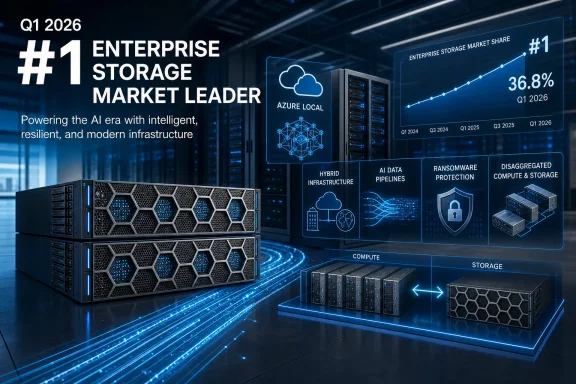
Dell is tying the market result to a broader infrastructure strategy rather than to a single array family. Its Dell Private Cloud platform uses disaggregated compute and storage, with the Dell Automation Platform supporting software stacks from Broadcom, Microsoft, Nutanix, and Red Hat.
For Windows-heavy shops, the relevant addition is support for Microsoft Azure Local alongside VMware Cloud Foundation 9.1 and Nutanix AHV integration for PowerStore. The idea is familiar: separate storage from compute so each can scale independently, while retaining lifecycle automation and avoiding a hard commitment to a single hyperconverged stack.
Dell claims this approach can cut costs by up to 65% against traditional HCI configurations, but that figure comes from Dell’s own comparison and depends heavily on cluster sizing, compression assumptions, software licensing, and support costs. Administrators should treat it as a sizing conversation, not a procurement benchmark.
PowerStore remains the central midrange platform in the pitch. Dell says its current PowerStore generation supports block, file, VM, and container workloads; offers mixed-generation clustering; and permits non-disruptive upgrades. Those are practical features for organizations trying to refresh storage without scheduling a wholesale migration or tying workloads exclusively to VMware.
The company said its ObjectScale X7700 appliance provides up to 45% more hard-drive capacity than its predecessor, while support for 245TB all-flash drives is planned for the second half of 2026. Those claims are product-roadmap targets, not shipping specifications.
Cyber resilience is the third component. Dell’s PowerProtect One combines data-protection orchestration and storage management, while Cyber Detect adds ransomware detection integrations for PowerStore and PowerMax. Dell’s management-reduction and detection-confidence figures are vendor claims, including results tied to commissioned validation.
For Windows and infrastructure administrators, Dell’s Q1 lead matters less as a scoreboard than as confirmation that refresh budgets are flowing back into storage, particularly where Azure Local, mixed virtualization, AI data estates, and ransomware recovery are being planned together.
IDC’s public market summary puts Q1 external OEM enterprise storage spending at $9.9 billion, up 22.9% from a year earlier. That makes Dell’s reported growth notably faster than the market, although the detailed vendor table behind the tracker is not public. Dell’s figures were published in a June 18 company blog post based on IDC’s June 11 historical release.
The result is a useful indicator of storage demand returning after a slower 2025, but it should not be read as a direct measure of hardware shipments. IDC said deferred refreshes, AI-driven demand, and higher NAND flash and DRAM prices all contributed to the revenue increase.
 Dell’s pitch: choice above the storage layer
Dell is tying the market result to a broader infrastructure strategy rather than to a single array family. Its Dell Private Cloud platform uses disaggregated compute and storage, with the Dell Automation Platform supporting software stacks from Broadcom, Microsoft, Nutanix, and Red Hat.For Windows-heavy shops, the relevant addition is support for Microsoft Azure Local alongside VMware Cloud Foundation 9.1 and Nutanix AHV integration for PowerStore. The idea is familiar: separate storage from compute so each can scale independently, while retaining lifecycle automation and avoiding a hard commitment to a single hyperconverged stack.
Dell claims this approach can cut costs by up to 65% against traditional HCI configurations, but that figure comes from Dell’s own comparison and depends heavily on cluster sizing, compression assumptions, software licensing, and support costs. Administrators should treat it as a sizing conversation, not a procurement benchmark.
PowerStore remains the central midrange platform in the pitch. Dell says its current PowerStore generation supports block, file, VM, and container workloads; offers mixed-generation clustering; and permits non-disruptive upgrades. Those are practical features for organizations trying to refresh storage without scheduling a wholesale migration or tying workloads exclusively to VMware.
AI and recovery are attached to the same platform story
Dell is also using the storage result to reinforce its AI infrastructure narrative. Its AI Data Platform and Dell AI Factory messaging centers on indexing internal unstructured data and feeding governed pipelines for enterprise AI workloads. PowerScale and ObjectScale are positioned as the file and object storage layers for that data.The company said its ObjectScale X7700 appliance provides up to 45% more hard-drive capacity than its predecessor, while support for 245TB all-flash drives is planned for the second half of 2026. Those claims are product-roadmap targets, not shipping specifications.
Cyber resilience is the third component. Dell’s PowerProtect One combines data-protection orchestration and storage management, while Cyber Detect adds ransomware detection integrations for PowerStore and PowerMax. Dell’s management-reduction and detection-confidence figures are vendor claims, including results tied to commissioned validation.
For Windows and infrastructure administrators, Dell’s Q1 lead matters less as a scoreboard than as confirmation that refresh budgets are flowing back into storage, particularly where Azure Local, mixed virtualization, AI data estates, and ransomware recovery are being planned together.
References
- Primary source: storagereview.com
Published: 2026-07-18T16:30:09.683795
Dell Outsells the Rest of IDC's Top Five Combined in Q1 External Storage - StorageReview.com
Dell tops IDC's Q1 2026 external storage tracker with 31.2% share and 40.8% growth, leaning on PowerStore, AI data, and cyber tools. www.storagereview.com
- Related coverage: dell.com
Why Dell Technologies is Ranked #1 in Enterprise Storage | Dell
Dell finished Q1 2026 as the world's #1 enterprise storage vendor — 31.2% share, 40.8% growth. See what's driving it and why customers keep expanding with Dell.www.dell.com