

Dell’s blunt message in its latest earnings call — that the transition to Windows 11 is trailing the pace of past OS migrations — is more than a corporate talking point; it reframes the near-term outlook for PC demand, enterprise migration planning, and how OEMs and channel partners will monetize a stretched-out refresh cycle. The company’s claim that the migration is roughly 10–12 percentage points behind the comparable Windows 10 transition, and its estimate of a 1.5 billion installed Windows base with large pockets of upgradeable and non-upgradeable devices, has immediate implications for sales, security planning, and the narrative around AI PCs.
Windows 11 launched as Microsoft’s modernized client OS, emphasizing hardware-backed security (TPM 2.0, Secure Boot, UEFI) and, later, on-device AI features. The operating system’s stricter baseline, however, created a compatibility cliff that excluded many otherwise functional machines from an official upgrade path. Microsoft formally ended mainstream support for Windows 10 on October 14, 2025, and offered a consumer Extended Security Updates (ESU) bridge through October 13, 2026, but that calendar milestone has not produced an immediate, market-wide replacement spike. The market picture is nuanced. Public telemetry from pageview-weighted trackers showed Windows 11 surpassing Windows 10 in desktop share in 2025, with StatCounter reporting Windows 11 at roughly 55% and Windows 10 at ~42% in October 2025. Those headline numbers signal adoption momentum but do not, by themselves, resolve the provider- and channel-level picture Dell presented about an unfinished migration and a large installed base yet to flip.
Critical assessment:
Strengths of the present situation include a clearer hardware baseline and fresh services opportunities. Real risks include operational fragmentation, the environmental and reputational costs of hardware-driven replacements, and the challenge of translating AI marketing into mass-market replacement economics.
The pragmatic conclusion for IT leaders and buyers: validate internal asset inventories, use ESU strategically as a controlled bridge, prioritize business-critical migrations, and align refresh programs with measurable business outcomes (security posture improvements or AI-driven productivity gains). Dell’s numbers should be treated as directional industry guidance — essential for strategic planning but to be reconciled with your own telemetry before making procurement commitments.
The Windows 11 migration is not a sprint; it’s a multi-year program that will reward disciplined planning, clear cost-benefit analysis, and targeted investments in the segments where on-device features and security baselines deliver measurable value.
Source: gHacks Technology News Dell says the transition to Windows 11 is slower than Windows 10 - gHacks Tech News
 Background / Overview
Windows 11 launched as Microsoft’s modernized client OS, emphasizing hardware-backed security (TPM 2.0, Secure Boot, UEFI) and, later, on-device AI features. The operating system’s stricter baseline, however, created a compatibility cliff that excluded many otherwise functional machines from an official upgrade path. Microsoft formally ended mainstream support for Windows 10 on October 14, 2025, and offered a consumer Extended Security Updates (ESU) bridge through October 13, 2026, but that calendar milestone has not produced an immediate, market-wide replacement spike. The market picture is nuanced. Public telemetry from pageview-weighted trackers showed Windows 11 surpassing Windows 10 in desktop share in 2025, with StatCounter reporting Windows 11 at roughly 55% and Windows 10 at ~42% in October 2025. Those headline numbers signal adoption momentum but do not, by themselves, resolve the provider- and channel-level picture Dell presented about an unfinished migration and a large installed base yet to flip. What Dell Actually Said — The Earnings Call Takeaways
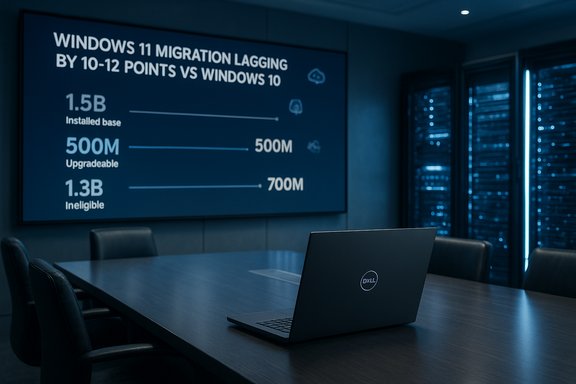
During the Q3 fiscal 2026 earnings call, Dell’s Vice Chairman and COO Jeffrey (Jeff) Clarke described the migration as incomplete and estimated the following installed-base breakdown:- Roughly 1.5 billion Windows PCs in the field (company estimate).
- About 500 million devices that can run Windows 11 but haven’t been upgraded.
- Another ~500 million devices that are about four years old or older and cannot run Windows 11 without hardware replacement.
- Total Q3 revenue was about $27.0 billion, up roughly 11% year-over-year.
- Servers & Networking (ISG) revenue: $10.1 billion, up ~37% YoY.
- AI server orders and shipments were highlighted as a major growth driver, supporting raised guidance for AI infrastructure.
Why Dell’s Read Matters: Channel Visibility and Market Signaling
Dell is not an impartial observer: as one of the largest global PC OEMs, its earnings commentary is grounded in shipment telemetry, channel feedback, and enterprise procurement patterns. When Dell tells investors the migration is behind the historical curve, it signals:- Inventory and procurement tactics that will favor targeted refresh programs rather than a broad OS-driven boom.
- A longer runway for trade-in, financing, and managed migration services — opportunities for OEMs and channel partners to monetize a multi-year upgrade cycle.
- That Microsoft’s usual end-of-support leverage (which historically pushed large volumes of replacements) may be less forceful this cycle, partially due to hardware gating and the availability of ESU options.
The Data Landscape: Adoption vs. Installed Base
There are two distinct ways to measure “who’s on which OS”:- Traffic/pageview-weighted trackers (StatCounter, similar services) measure the OS versions generating web traffic in their panels. They can show rapid changes as user behavior shifts and new OEM preloads hit the market.
- Installed-base inventories and OEM telemetry (what Dell references) attempt to estimate the number of actual devices in use, including those that don’t generate frequent web traffic or which live behind corporate firewalls.
Why Adoption Has Slowed: Four Converging Frictions
- Hardware eligibility and the compatibility cliff
- Windows 11’s baseline requirements (TPM 2.0, Secure Boot, specific CPU-family cutoffs) intentionally raised the security and platform baseline, but they left millions of still-serviceable PCs either blocked or requiring intrusive hardware changes. For many laptops and thin-form-factor machines the only practical path is a full system replacement, raising both cost and environmental concerns.
- Enterprise risk management and migration economics
- Large organizations do not flip OSes overnight. Application compatibility, vendor certification, and compliance testing stretch migration windows. Enterprises often align OS upgrades with existing refresh budgets, lengthening aggregate adoption timelines. That institutional conservatism dampened an immediate widescale migration.
- Microsoft’s ESU policy and consumer choices
- Microsoft’s consumer Extended Security Updates (ESU) program offers a temporary bridge through October 13, 2026, with free and paid enrollment options. That pragmatic safety valve reduced immediate purchase urgency for households and SMBs, letting many defer replacements or remain on Windows 10 while they plan. However, ESU is explicitly limited (security-only updates) and is not a permanent alternative.
- Perception of value and software quality concerns
- For many users, Windows 11’s benefits felt incremental compared with the friction of changing workflows. Reported performance regressions on some hardware and early visibility of certain UI issues created negative impressions that reduce the voluntary upgrade pull. That reputational friction compounds hardware and enterprise blockers.
The AI Factor: Will Copilot, NPUs and “AI PCs” Drive Replacements?
OEMs and Microsoft are positioning AI-capable systems — Copilot+ PCs and devices with on-device NPUs (neural processing units) — as the next major differentiator in refresh promotions. Dell sees this as a reason the PC market will remain durable because certain workloads (local inference, privacy-sensitive AI, low-latency agents) benefit from on-device acceleration.Critical assessment:
- Strength: On-device AI and NPUs can deliver real, measurable latency and privacy advantages for specific workflows (e.g., real-time transcription, image processing, local model inference). Those are legitimate upgrade drivers for enterprise creative, developer, and productivity segments.
- Risk: Most consumer and many business AI services remain cloud-powered; a web browser or thin client is sufficient for many users. Convincing mainstream buyers to replace otherwise serviceable devices purely for on-device AI will require clear, immediately useful features, credible benchmarks, and affordable price points. Dell’s optimism about AI PCs is reasonable, but the pace at which these features convert to uplift in consumer or SMB sales is uncertain.
Supply-Chain and Pricing Realities
Another pragmatic constraint: component cost inflation. Memory (DRAM) and NAND prices rose across 2024–2025, lifting the BOM cost of new systems. Higher component prices compress OEM margin flexibility and make promotional pricing for midrange systems harder to sustain. Dell referenced these macro pressures when discussing flat PC market guidance, emphasizing the company’s supply-chain management strengths as a competitive lever. That dynamic affects the buyer’s calculus: a higher price for a new Windows 11-capable PC reduces the likelihood of impulse or near-term replacements for many households and small businesses.Enterprise Risks: Security, Compliance, and Fragmentation
Running a mixed fleet of Windows 10 and Windows 11 machines introduces operational costs:- Fragmented patching windows and testing matrices increase helpdesk complexity.
- Compliance and regulatory risk can rise if critical systems remain on unsupported OS builds.
- Delaying migration without compensating mitigations (network segmentation, endpoint protection, vulnerability management) can materially increase exposure.
Tactical Recommendations for IT Leaders (Short, Practical Steps)
- Inventory first — run an application and hardware compatibility audit and label devices as:
- Windows 11-ready
- Upgradeable with firmware or BIOS changes
- Replacement required
- Prioritize business-critical workloads — identify LOB apps that need vendor certification and schedule pilot projects.
- Stage migrations — use pilot cohorts (IT, power users, non-mission-critical groups) to validate imaging, policy, and rollback.
- Budget for mixed-mode support — allocate helpdesk and testing resources for a parallel-support window.
- Consider procurement levers — bulk trade-ins, certified refurbished machines, and financing programs can reduce per-seat replacement cost.
- Evaluate AI value propositions — only buy “Copilot/AI” machines when the feature set delivers measurable process improvements.
Strengths and Weaknesses of the Current Market Approach
Strengths- Higher hardware baseline (TPM, Secure Boot) increases minimum security posture for the next OS lifecycle.
- OEM and silicon alignment around a modern baseline can improve long-term driver and firmware stability.
- Services opportunity for managed migration, trade‑ins, and certified refurbishing creates new revenue avenues for channel partners.
- Front-end friction: the hardware gate leaves many functional machines stranded, creating environmental and customer-relations pressure.
- Economic timing: component inflation and macro budgets constrict the ability to incentivize mass replacements.
- Messaging mismatch: marketing claims about “nearly a billion users” and OEM installed-base numbers can create confusing narratives unless carefully contextualized; customers need operational clarity rather than slogans.
Cross-Checking the Key Claims (Verification and Caveats)
- Dell’s “10–12 points behind” claim is a management-level observation reported during the Q3 earnings call and reflected in multiple transcripts and press accounts. It should be treated as a vendor read of its channel and sales telemetry rather than an incontrovertible industry-wide metric.
- StatCounter’s October 2025 snapshot showing Windows 11 ≈ 55.17% and Windows 10 ≈ 41.74% is public and corroborated across several reporting outlets; however, StatCounter’s pageview methodology is different from installed-base census approaches and can move faster with OEM preload and consumer browsing behavior. Use these numbers for trend signals, not exact inventory counts.
- Microsoft’s Windows 10 end-of-support date (October 14, 2025) and consumer ESU program details (security updates through October 13, 2026) are documented on Microsoft’s official support pages; these are authoritative and should anchor planning calendars.
The Channel Opportunity: Services, Refurbs, and Trade‑Ins
A longer migration timeline creates recurring opportunities for:- Migration services and managed deployments.
- Certified refurbished programs that reduce sticker shock and environmental impact.
- Financing and trade-in programs that lower per-seat replacement costs.
- Bundled AI/management packages that target specific vertical workflows.
Consumer Angle: Practical Choices After October 2025
For consumers with a Windows 10 machine after its EoL:- If the device is Windows 11-capable and the user wants current features and long-term support, upgrade or plan for replacement.
- If the device is ineligible and security is a concern, ESU provides a one-year bridge (free in many cases with Microsoft account sync, or a paid one-time option covering up to 10 devices). Use ESU as a stopgap, not an indefinite solution.
- Consider certified refurbished Windows 11 machines or budget-finance options before buying brand-new hardware if cost is the primary barrier.
Long View: What to Expect Over the Next 12–36 Months
- A protracted, multi-year migration rather than a quick flip. Expect periodic spikes tied to fiscal-year procurements and OEM promotions.
- Continued strength in AI server and infrastructure revenue, which will likely outpace client PC growth in the near term. Dell’s Q3 results and raised guidance for AI infrastructure underscore this decoupling between server and client demand.
- Growth in managed migration services, refurb channels, and targeted AI-hardware refreshes for users who benefit from on-device inference.
- Persistent fragmentation costs for enterprises maintaining mixed Windows 10/11 fleets, which will drive a slow-but-steady professional services market for migration and remediation.
Final Analysis — Strengths, Risks, and a Clear Takeaway
Dell’s public assessment of the Windows 11 transition as “slower than Windows 10” is credible and consequential. The company’s combined view of an unfinished migration, a large installed base of upgradeable-but-unmigrated devices, and a significant pool of hardware-ineligible systems reframes the OS transition from an immediate demand accelerator into a stretched commercial runway. That runway benefits OEMs and service providers that can convert deferred demand into structured refresh programs — but it also creates short-term headwinds for PC shipment growth and complicates enterprise security postures.Strengths of the present situation include a clearer hardware baseline and fresh services opportunities. Real risks include operational fragmentation, the environmental and reputational costs of hardware-driven replacements, and the challenge of translating AI marketing into mass-market replacement economics.
The pragmatic conclusion for IT leaders and buyers: validate internal asset inventories, use ESU strategically as a controlled bridge, prioritize business-critical migrations, and align refresh programs with measurable business outcomes (security posture improvements or AI-driven productivity gains). Dell’s numbers should be treated as directional industry guidance — essential for strategic planning but to be reconciled with your own telemetry before making procurement commitments.
The Windows 11 migration is not a sprint; it’s a multi-year program that will reward disciplined planning, clear cost-benefit analysis, and targeted investments in the segments where on-device features and security baselines deliver measurable value.
Source: gHacks Technology News Dell says the transition to Windows 11 is slower than Windows 10 - gHacks Tech News
