

Dell’s blunt investor math — “about 500 million PCs capable of running Windows 11 that haven’t been upgraded” — has forced a much larger industry truth into the open: the Windows 11 migration is not a single technical flip of a switch but a costly, multi-year program with security, economic, and environmental consequences.
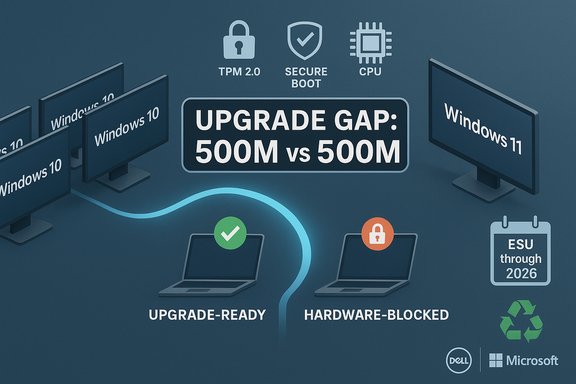
Since Windows 11 launched in 2021 Microsoft deliberately raised the hardware baseline: UEFI firmware with Secure Boot, a Trusted Platform Module (TPM 2.0 or firmware TPM), supported CPU generations, and minimum RAM and storage thresholds became part of the official requirements. That change improved platform security and enabled new features — particularly the on-device AI and virtualization-based protections at the heart of Microsoft’s modern strategy — but it also created a compatibility cliff for many otherwise functional PCs. Microsoft formally ended mainstream support for consumer editions of Windows 10 on October 14, 2025, and published a time-limited consumer Extended Security Updates (ESU) program that extends critical security patches through October 13, 2026 for eligible devices. Those calendar and product signals turned what might have been a gradual adoption curve into a hard planning horizon for enterprises and households. Against that backdrop, Dell’s Q3 earnings commentary crystallized two separate but related problems: roughly half a billion PCs that meet Windows 11’s requirements but haven’t upgraded, plus another half billion machines that are effectively barred by hardware and therefore need replacement. Dell framed these numbers as both a challenge for Microsoft’s migration narrative and a commercial opportunity for OEMs selling “AI PCs” and refresh services.
There’s also a small but visible migration toward Linux distributions among niche groups: some end-users and hobbyists prefer a clean, free route rather than pay for ESU or invest in a new Windows 11-capable machine. Those movements are notable but limited in scale for general-purpose users because software compatibility (games, business apps, anti-cheat) still anchors most users to Windows.
The practical response is straightforward and urgent: inventory devices, prioritize risk, and treat ESU as a short-term bridge, not a destination. OEMs, channel partners, and Microsoft must make the business case for upgrades clearer and materially easier — through trade-in programs, financing, services, and transparent metrics — if the migration is to be orderly, equitable, and sustainable. Failure to do so leaves a sizable population exposed on an unsupported platform and risks turning a software transition into a security and supply-chain crisis.
The numbers Dell cited are a wake-up call; the industry now has a choice between a managed, responsible modernization or an expensive scramble that costs money, data, and consumer trust.
Source: News18 https://www.news18.com/tech/500-mil...ndows-11-and-thats-a-big-problem-9749587.html
 Background / Overview
Since Windows 11 launched in 2021 Microsoft deliberately raised the hardware baseline: UEFI firmware with Secure Boot, a Trusted Platform Module (TPM 2.0 or firmware TPM), supported CPU generations, and minimum RAM and storage thresholds became part of the official requirements. That change improved platform security and enabled new features — particularly the on-device AI and virtualization-based protections at the heart of Microsoft’s modern strategy — but it also created a compatibility cliff for many otherwise functional PCs. Microsoft formally ended mainstream support for consumer editions of Windows 10 on October 14, 2025, and published a time-limited consumer Extended Security Updates (ESU) program that extends critical security patches through October 13, 2026 for eligible devices. Those calendar and product signals turned what might have been a gradual adoption curve into a hard planning horizon for enterprises and households. Against that backdrop, Dell’s Q3 earnings commentary crystallized two separate but related problems: roughly half a billion PCs that meet Windows 11’s requirements but haven’t upgraded, plus another half billion machines that are effectively barred by hardware and therefore need replacement. Dell framed these numbers as both a challenge for Microsoft’s migration narrative and a commercial opportunity for OEMs selling “AI PCs” and refresh services. Why Dell’s 500M / 500M Split Matters
The numbers, and how to read them
Dell’s remark — that the installed base is roughly 1.5 billion PCs and “about 500 million of them capable of running Windows 11 haven’t been upgraded” while “another 500 million are four years old and can’t run Windows 11” — is not an audited census but a commercially informed estimate from an OEM with broad channel visibility. Treat the figures as directional: powerful market telemetry but not a device-by-device audit. Why it matters:- The first 500 million (the upgrade-capable group) represent a behavioral and economic problem: these devices could be upgraded but are not. That means Microsoft’s free upgrade prompts, marketing, and security messaging are not sufficient to overcome inertia, compatibility concerns, or perceived cost.
- The second 500 million (the hardware-blocked group) represent a structural problem: they need hardware replacement to be eligible for Windows 11, which turns an OS transition into a hardware refresh cycle with cost, logistics, and environmental implications.
Consequences for Microsoft and OEMs
For Microsoft, a large installed base remaining on Windows 10 weakens the company’s ability to uniformly raise the platform’s security baseline and to deploy features that rely on modern silicon and hardware-backed protections. For OEMs like Dell, the split defines both risk and runway: near-term PC demand can stay flat while services, trade-in programs, and targeted refresh offerings can become a multi-year revenue stream — if customers can be persuaded to act.The Technical Gatekeepers: TPM 2.0, Secure Boot, and Supported CPUs
What Windows 11 requires, in plain terms
Microsoft’s baseline for a supported Windows 11 installation is explicit:- UEFI firmware with Secure Boot enabled.
- Trusted Platform Module (TPM) version 2.0 — discrete or firmware (Intel PTT / AMD fTPM).
- A supported 64‑bit CPU from Microsoft’s compatibility list.
- Minimum RAM (4 GB) and storage (64 GB), DirectX 12-compatible graphics, and UEFI/secure boot capable firmware.
Why many PCs are excluded
- Some systems lack TPM 2.0 entirely or have it disabled in firmware.
- Others have legacy BIOS or legacy boot modes rather than UEFI with Secure Boot.
- Crucially, many consumer and business CPUs older than the whitelisted generations are simply not included in Microsoft’s supported processor lists — even if they otherwise meet the RAM and storage numbers.
Adoption Reality: Metrics Paint a Nuanced Picture
Public telemetry vs. installed-base estimates
Web-traffic and usage trackers (StatCounter, Steam Hardware Survey) showed Windows 11 gaining ground through 2025 and in some windows overtaking Windows 10 on market-share metrics, particularly in July 2025 when StatCounter reported Windows 11 capturing a slight lead. But those snapshots measure active web-tracked usage or specific user populations — not the global installed base, which includes dormant machines, enterprise-managed devices, and regions with different upgrade behaviours. At the same time, population-weighted metrics such as Dell’s installed-base estimate highlight a persistent tail of Windows 10 devices that remain operational and often untouched by upgrade prompts. That divergence — trackers indicating Windows 11’s reach while OEM telemetry highlights a stubborn Windows 10 tail — is what created the headline tension in late 2025.Gamers and heavy users show different behaviour
Steam’s monthly Hardware & Software Survey (a gamer-centric panel) still showed a substantial Windows 10 presence well after the EoS date — roughly 29% of surveyed Steam users in November 2025 remained on Windows 10 — underscoring the point that different user cohorts upgrade on different schedules. Gamers, enterprises, and price-sensitive consumer segments vary greatly in their migration timing.Economics and Behaviour: Why Half a Billion Users Are Holding Back
Cost and perceived value
Upgrading an OS is only truly painless when the user perceives clear value. For many consumers and small businesses, the calculus is simple: if the PC runs what they need, why risk driver incompatibility, lost settings, or the cost and time of a migration? That calculus is amplified by macroeconomic pressure and the rising price of AI-capable hardware components (NPUs, higher RAM and faster storage). Dell and others warned that premium AI PCs and component price increases raise the cost of a meaningful refresh, prolonging the status quo.Enterprise timetables and compatibility testing
Large organizations manage OS changes as projects: compatibility testing for line-of-business apps, staged pilots, help-desk training, image and provisioning updates, security policy validation, and procurement cycles. Even when a device is technically eligible for Windows 11, the organizational friction can delay upgrades by quarters or years. Microsoft’s ESU program for enterprises and consumers softens the deadline pressure, enabling more deliberate planning.Risk calculation: ESU as a pressure valve
Microsoft’s consumer ESU program gives households a one‑year safety valve through October 13, 2026 with multiple enrollment paths (free if certain settings are synced; redeemable Microsoft Rewards or a one‑time paid purchase). That pragmatic grace period reduces urgency for price‑sensitive users but also creates a predictable cliff: the ESU window is temporary and security‑only, not a long-term substitute for a supported OS.The Competitive Question: Could Users Switch Instead of Upgrade?
The Windows 11 compatibility gate — combined with the cost of new hardware — opens windows of opportunity for alternative platforms. Apple has long marketed device ecosystem benefits to switchers, and for some consumers a Mac or a refurbished modern Windows PC with Windows 11 preinstalled could look more attractive than a DIY upgrade that risks support issues.There’s also a small but visible migration toward Linux distributions among niche groups: some end-users and hobbyists prefer a clean, free route rather than pay for ESU or invest in a new Windows 11-capable machine. Those movements are notable but limited in scale for general-purpose users because software compatibility (games, business apps, anti-cheat) still anchors most users to Windows.
Security & Compliance Risks: The Real Cost of Delay
Running an unsupported OS increases exposure to exploit vectors. After October 14, 2025 Microsoft stopped issuing routine security fixes for Windows 10, except for enrolled ESU devices. That means unmanaged Windows 10 PCs become progressively more attractive targets for attackers as unpatched vulnerabilities accumulate. For enterprises, regulators and insurers, the delta between “supported” and “unsupported” environments is measurable in risk metrics and potential compliance liability. Key points to internalize:- Devices left on Windows 10 without ESU are at elevated risk and should be isolated, segmented, or upgraded.
- ESU is security-only and a stopgap, not an alternative to long-term modernization.
- Attackers will prioritize endpoints that remain exposed; cost of an incident often dwarfs planned refresh budgets.
Practical Paths Forward — For IT Teams and Consumers
Immediate checklist (priority actions)
- Inventory every device now: CPU model, firmware (UEFI/BIOS), TPM presence and version, RAM, and storage. This is non-negotiable for accurate planning.
- Categorize into three buckets: upgrade-ready (can move to Windows 11), hardware-blocked (requires replacement), and mission-critical holdouts (which must be enrolled in ESU or moved to secure enclaves).
- For upgrade-ready machines: pilot Windows 11 in representative environments, validate driver compatibility, and schedule staged rollouts.
- For blocked machines: evaluate refurbished Windows 11 machines or targeted hardware replacements; consider cloud or DaaS (Desktop as a Service) for legacy workloads.
- Use ESU as a bridge only: plan to transition before the ESU window closes on October 13, 2026, not after.
For OEMs and channel partners
- Build clear, low-friction trade‑in and refurbishment programs that minimize e‑waste and spread costs across financing or subscription models.
- Offer migration services that reduce the time-to-upgrade for enterprises: application compatibility assessment, user state migration, and managed rollout.
- Make the security and productivity ROI of Windows 11 tangible for buyers; point to features that matter in real workflows (hardware-backed credential protection, BitLocker improvements, and on-device AI acceleration).
Strengths, Risks, and Where the Story Is Unclear
Strengths of the current Microsoft/OEM approach
- Raising the hardware baseline has clear security benefits and enables higher-assurance features, especially as on-device AI and hardware-backed protections become foundational.
- ESU and staged messaging gave enterprises and consumers practical breathing room to plan migrations responsibly.
Key risks and downsides
- The compatibility gate produced a large tail of functional but unsupported devices, creating a persistent, measurable attack surface.
- OEMs risk reputational blowback if migration is framed as coercive or if consumers perceive forced obsolescence without affordable pathways.
- Environmental costs: a poorly managed refresh cycle can generate significant e‑waste unless robust refurbishment and recycling programs are prioritized.
Unverifiable or ambiguous claims to treat cautiously
- Corporate soundbites such as “nearly a billion people rely on Windows 11” are marketing language with unclear measurement definitions (monthly active users, licensed seats, or signed-in users). Treat such phrasing as imprecise unless the company releases an auditable metric. Dell’s 500M and 500M figures are credible vendor telemetry but remain estimates rather than a device-by-device census.
What This Means for the Next 12–24 Months
- The migration will be multi-year and uneven. Expect pockets of accelerated enterprise upgrades, slower consumer adoption in price-sensitive markets, and ongoing demand for refurbished devices and migration services.
- The PC market is likely to remain bifurcated: strong growth in premium AI-capable devices and servers, with flat-to-moderate volumes in the mainstream consumer hardware segment. OEMs that can lower upgrade friction, subsidize refreshes, and provide competence in migration services will win share.
- Security will be the decisive risk metric. Organizations and households that treat ESU as a path to procrastination rather than as a tactical bridge risk incidents that cost far more than planned refresh budgets.
Conclusion
Dell’s blunt framing — half a billion PCs that could upgrade but haven’t, plus half a billion that cannot — is more than a headline; it is a market map. It reveals the migration as a complex interplay of hardware rules, economics, behavior, and policy. Microsoft built Windows 11 with stricter hardware requirements to deliver stronger security and on-device capabilities; those design choices are defensible, but they carry real costs when applied at global scale.The practical response is straightforward and urgent: inventory devices, prioritize risk, and treat ESU as a short-term bridge, not a destination. OEMs, channel partners, and Microsoft must make the business case for upgrades clearer and materially easier — through trade-in programs, financing, services, and transparent metrics — if the migration is to be orderly, equitable, and sustainable. Failure to do so leaves a sizable population exposed on an unsupported platform and risks turning a software transition into a security and supply-chain crisis.
The numbers Dell cited are a wake-up call; the industry now has a choice between a managed, responsible modernization or an expensive scramble that costs money, data, and consumer trust.
Source: News18 https://www.news18.com/tech/500-mil...ndows-11-and-thats-a-big-problem-9749587.html
