

Dell’s blunt admission — that most buyers aren’t choosing laptops because of AI — landed like a splash of cold water across the CES 2026 stage, and the timing couldn’t have been worse for the Windows 11 AI story: while Dell quietly pulls back AI-first marketing, a highly visible Copilot fail in Windows 11’s Settings app has gone viral and reinforced growing consumer skepticism. The optics are simple and corrosive: hardware vendors are shipping machines with neural engines, but mainstream users don’t yet perceive enough everyday value to pay attention — and when on-device AI shows brittle behavior in public demonstrations, trust erodes fast.
If 2026 is the year AI either makes or breaks its mainstream PC promise, it will do so not through silicon spec wars but through product execution: consistent, trustworthy AI features that save time, respect privacy, and behave predictably in everyday scenarios. Until that demonstrated value appears at scale, expect OEMs to keep NPUs in the box — and keep the AI message out of the headline.
Source: TechRadar https://www.techradar.com/computing...truly-embarrassing-windows-11-fail-shows-why/
 Background
Why CES 2026 matters for PCs and AI
CES remains the moment OEMs set product and marketing tones for the year. This year Dell used the stage to revive XPS and to signal a strategic reset: premium XPS models (the XPS 14 and XPS 16) were relaunched with modern Intel Core Ultra processors and ambitious battery claims, yet Dell’s consumer messaging deliberately de-emphasized AI as the lead selling point. That repositioning is notable because OEMs — and Microsoft, with its Copilot+ PC initiative — have spent the last 18 months trying to make on-device AI a key upgrade pillar. Dell’s announcement confirmed hardware commitments (modern processors and local acceleration) while stepping away from AI-centric consumer copy.The public lines from Dell’s leadership
Two Dell executives framed the pivot succinctly. Jeff Clarke, Dell’s COO, described an “un‑met promise of AI” and flagged it as a headwind to near-term consumer demand. Kevin Terwilliger, head of product, explicitly said the company’s new consumer messaging is not “AI‑first,” adding that while the new devices include NPUs, consumers “are not buying based on AI” and sometimes find AI positioning confusing rather than clarifying. Those direct statements represent a rare instance of an OEM publicly tempering the industry’s hype narrative.Overview: What Dell’s move actually signals
Hardware ≠ marketing
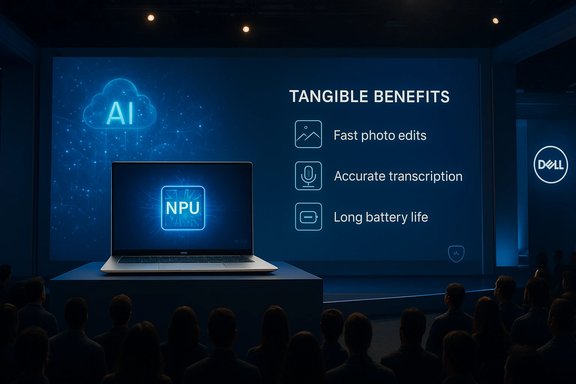
Dell’s machines will ship with neural processing capabilities and modern silicon, but the company’s decision to not lead with AI in consumer marketing is practical. OEMs can simultaneously ship devices capable of local inference while focusing on attributes that buyers notice day-to-day: battery life, display quality, sustained CPU/GPU performance, and price. For mass-market buyers, “AI” remains abstract unless tied to concrete outcomes — faster photo edits, reliable transcription, or clear productivity gains — that users can both understand and easily reproduce.The disconnect between vendor promises and buyer priorities
Dell’s internal sales signals and market telemetry point to a simple reality: most consumers make purchasing decisions based on visible, immediate benefits. AI as a headline is less effective when:- The features are incremental or awkwardly integrated;
- Privacy concerns overshadow usefulness (Windows Recall is a prominent example); or
- Demonstrations expose brittle or inconsistent behavior that undermines trust.
Product reality: what’s shipping and what it actually does
NPUs on modern consumer laptops
Most modern premium laptop platforms include dedicated acceleration for AI workloads — whether marketed as NPUs, ML accelerators, or matrix engines embedded in CPUs (Intel, AMD, Qualcomm variants). Dell confirmed its new XPS machines will support local acceleration and higher AI performance in their configurations, even while shifting messaging away from AI-first positioning. That means the hardware baseline for on-device AI is becoming standard on upper-tier Windows laptops, but the user-visible applications that take advantage of that silicon are still maturing.Where current Windows 11 AI features land in practice
Windows 11’s Copilot and associated Copilot+ features represent Microsoft’s bet on agentic, hybrid local/cloud AI. In practice today, many AI-enabled experiences are hybrid: simple tasks (speech-to-text, image filters, small-context summarization) can benefit from local inference, but heavy generative workloads still fall back to cloud models. That hybrid model dilutes the premium argument for NPU-equipped devices when end users can access similar results via cloud services on older hardware. The upshot: devices with NPUs are technically meaningful, but their advantage is often invisible to mainstream workflows.The viral fail: why one clip hurts more than it should
What happened and why it matters
A short clip showing Copilot in Windows 11’s Settings app freezing and failing to respond to a suggested query has racked up millions of views. The offending example is especially damaging because it’s the exact interaction Windows recommended users try; an assisted demo failing on a scripted, easy task makes the feature seem immature and unreliable. In the eyes of many observers, repeated demonstration failures hint at a bigger problem: AI features that appear polished in marketing are brittle in the real world.Trust damage is asymmetric
Consumers are forgiving of small UI bugs, but AI failures cut deeper. An assistant that hallucinates, freezes, or fails to follow simple instructions undermines user confidence in the feature set and by extension in the vendor pushing it. Trust is hard to build and easy to lose — particularly for agentic features that can act on users’ behalf or access personal data. Viral failures accelerate distrust because social platforms amplify the negative signal far more quickly than measured reviews amplify the positives.Strengths in the current landscape
1. Real technical progress
There’s no denying progress: NPUs, improved on-device runtimes, and more efficient small models reduce latency and enable offline capabilities that weren’t feasible a couple of years ago. For specialized users — creators, journalists, regulated enterprises — those local capabilities are felt immediately and can be transformative in constrained environments. Vendors are correctly investing in silicon and thermal designs to support those workloads.2. A clear enterprise use case
Enterprises and creators are already demonstrating real ROI from local AI: faster transcription workflows, secure local processing for sensitive assets, and offline content generation that preserves privacy. That concentrated value is why OEMs are still bullish on NPUs for commercial SKUs even if consumer marketing is scaled back. Dell’s strategy — push AI where it’s clearly valuable while keeping consumer messaging pragmatic — aligns with this segmentation.3. Better performance and battery life narratives
Many of the wins OEMs attribute to AI-capable silicon come paired with genuine improvements in battery life, thermal efficiency, and graphics performance. Those are easy-to-sell attributes outside the AI narrative and can act as Trojan horses for adoption: buyers who buy for battery life or display may later appreciate the AI features bundled in their systems.Major risks and downside scenarios
1. Hallucinations and reliability problems
Agentic AI can be useful — but only when it’s reliable. Repeated public failures (freezes, incorrect actions, hallucinations) will make customers and IT departments wary of enabling agent features by default. That could slow enterprise pilots and consumer acceptance, and increase support overhead for OEMs and Microsoft.2. Privacy backlash
Windows Recall and other features that index local activity raised serious privacy questions, and public pushback forced product changes and delays. Privacy fears can outweigh technical benefits quickly; vague assurances won’t cut it when features are perceived to collect or expose personal information. Vendors must adopt clear, easily understood defaults and receipts for what’s processed where.3. Perception of vendor opportunism
A narrative has grown in some corners that Microsoft is prioritizing AI marketing over core OS stability. Critics argue the company should focus on fixing long-term platform issues rather than pushing new agent features that “no one asked for.” Whether fair or not, that perception affects sentiment and can erode goodwill toward AI initiatives embedded in Windows. Public demo fails only amplify this view.4. Economic headwinds and price sensitivity
AI-capable hardware increases BOM costs — more RAM, better cooling, NPUs — and those costs collide with broader price sensitivity. With component cost pressures and a slower-than-expected Windows 11 upgrade cycle, consumers are less likely to pay a premium for speculative AI benefits. Dell explicitly mentioned memory pricing and other supply pressures as part of the headwinds shaping its guidance.Practical guidance for OEMs, Microsoft, and IT leaders
For OEMs
- Shift messaging from vague AI promises to specific outcomes: highlight scenarios where on-device AI saves time, preserves privacy, or significantly improves a workflow.
- Build easy, demonstrable, frictionless features that show consistent behavior in the hands of normal users.
- Pair AI positioning with the tangible, visible advantages buyers notice every day: battery life, display quality, and performance.
For Microsoft
- Prioritize reliability and clarity of defaults for Copilot and agentic features; every public demo should be conservative rather than aspirational.
- Provide administrators and users with clear privacy controls and consent receipts for agent actions.
- Focus rollout cadence on stable, high-impact features rather than breadth-first launches that risk public failures.
For IT leaders and consumers
- Inventory: classify which devices require replacement for security vs. which would only benefit marginally from on-device AI.
- Pilot: test AI features in controlled pilots with clear KPIs before broad rollout.
- Defend: require clear privacy guarantees and rollback paths for agentic features that interact with enterprise systems.
- Shop smart: evaluate trade-in and refurbished options rather than reflexively replacing hardware for speculative AI gains.
The marketing calculus: why Dell’s restraint is pragmatic
Dell’s move is less a retreat from AI than a smart repositioning. By shipping hardware capable of AI while trimming the AI-first sales message, Dell preserves optionality: the devices are future-proof for those who care while keeping the purchase rationale tightly tied to immediate, comprehensible benefits. That reduces confusion in mass channels and avoids alienating buyers who are suspicious of AI hype. In short: deliver the capabilities, but sell the things buyers actually notice.What to watch in 2026
- Microsoft’s Copilot reliability and rollout: will agentic features mature into trustworthy helpers or continue to produce high-visibility failures that undermine adoption?
- Feature-level proof: vendors and Microsoft must produce compelling, independently verifiable demos (benchmarks, longitudinal user studies) showing real productivity or privacy benefits from on-device AI.
- Pricing and SKU rationalization: will OEMs absorb AI-capable BOM increases, or will premium AI options fragment product lines further?
- Regulatory and privacy signals: whether global regulators push back on indexing or agentic behaviors will materially shape consumer adoption and enterprise risk calculus.
Conclusion
The headline is straightforward: AI in the PC is real, but not yet a consumer purchase driver. Dell’s candid messaging at CES 2026 — ship the hardware, but don’t overpromise the AI — is a corrective to the industry’s hype cycle. It acknowledges an essential truth: buyers make choices based on visible, reliable gains, not abstract promises about inference TOPS or marketing buzzwords. Meanwhile, high‑visibility AI failures in Windows 11’s Copilot demos have punctured confidence at an unfortunate moment, reminding vendors that reliability and clear privacy controls must come before agentic ambition.If 2026 is the year AI either makes or breaks its mainstream PC promise, it will do so not through silicon spec wars but through product execution: consistent, trustworthy AI features that save time, respect privacy, and behave predictably in everyday scenarios. Until that demonstrated value appears at scale, expect OEMs to keep NPUs in the box — and keep the AI message out of the headline.
Source: TechRadar https://www.techradar.com/computing...truly-embarrassing-windows-11-fail-shows-why/
