

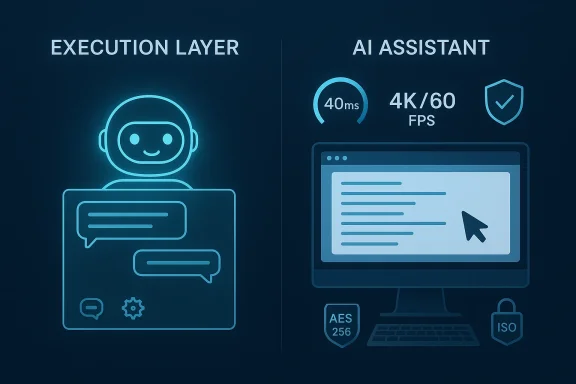
DeskIn is betting that the next wave of AI will need something more grounded than a chat box and more reliable than a generic “click the screen for me” feature. In its March 18, 2026 positioning push, the Singapore-based remote desktop company framed itself not as a rival to AI assistants, but as the execution layer those assistants still lack. That distinction matters because the market is quickly moving from recommendation to action, and the winners may be the platforms that can bridge the gap between intent and actual work. DeskIn’s argument is simple: AI can advise, but DeskIn can do. (prnewswire.com)
Background — full context
The claim arrives at a moment when AI products are no longer content to merely summarize, draft, or brainstorm. Increasingly, AI assistants are being asked to interact with real interfaces, move the cursor, launch apps, and trigger workflows that once required direct human control. DeskIn is positioning itself inside that transition, arguing that “basic remote control” embedded in broader AI ecosystems is useful, but not sufficient for professional workloads that depend on speed, fidelity, and dependable device access. (prnewswire.com)DeskIn’s public narrative is anchored in scale. The company says it serves more than 40 million users across 180 million devices, a number it repeated in multiple recent releases this year. That matters because remote desktop is not a speculative category; it is a mature utility market where differentiation comes from the quality of the connection, the responsiveness of the session, security controls, and the breadth of device compatibility. DeskIn wants to reframe that utility as a foundational layer for AI-era work, gaming, family support, and creative collaboration. (prnewswire.com)
The company’s recent messaging also reveals a broader strategic pattern: DeskIn is not talking only about business continuity or IT support. It has been pitching remote desktop as a “lifestyle app” for the AI generation, with separate campaigns around gaming, creative production, family access, and work-from-anywhere use cases. That is not accidental branding fluff. It suggests DeskIn is trying to occupy a different mental category than legacy remote control tools, one that combines high-performance streaming, cross-platform access, and security-first device ownership. (prnewswire.com)
The March 18 release sharpens the pitch by introducing a contrast between AI-integrated remote actions and DeskIn’s own feature set. The company says its platform delivers 4K at 60 FPS or 2K at 240 FPS with latency below 40ms, supports Windows, macOS, Android, iOS, and web, and includes AES-256 encryption plus ISO 27001 and ISO 9001 certifications. In other words, DeskIn is arguing that if remote action becomes a serious production workload, then the underlying transport layer has to behave like infrastructure, not a convenience add-on. (prnewswire.com)
This is also happening in a fast-moving competitive landscape. Other vendors are increasingly using language like “execution,” “orchestration,” and “control layer” to describe AI systems that can connect reasoning to real-world outcomes. DeskIn’s move is notable because it applies that framing to a category many people still think of as simple screen sharing. The result is a sharper value proposition: AI may tell you what to do, but a dedicated remote desktop platform can provide the direct, real-time access needed to actually finish the job. (prnewswire.com)
Why the execution-layer argument matters
The idea of an “execution layer” is not just marketing language; it captures a real technical divide. AI assistants can infer, recommend, and even attempt limited actions inside software environments, but those actions are often constrained by the assistant’s host platform, the reliability of its automation hooks, and the quality of its session visibility. A specialized remote desktop tool, by contrast, is designed to preserve the full state of a machine and expose it with minimal loss of fidelity. (prnewswire.com)AI can interpret, but remote desktop can complete
DeskIn’s core premise is that a remote assistant may be able to click through a web page or trigger a small workflow, but professional users need more than a best-effort approximation. They need:- full-desktop visibility
- fine-grained mouse and keyboard control
- stable multi-device connectivity
- performance suitable for graphics-heavy or time-sensitive tasks
- reliable access to the actual machine where the files and applications live (prnewswire.com)
Performance is the differentiator
DeskIn’s headline performance claims are aggressive: 4K at 60 FPS, 2K at 240 FPS, and latency below 40ms. Whether every user experiences those numbers in the wild will vary by network, device, and workload, but the strategic point is clear. For the company, low latency and high frame rates are not luxury features; they are the difference between a useful session and a frustrating one. (prnewswire.com)That performance orientation is why DeskIn keeps returning to creative and gaming scenarios. High refresh rates matter when:
- a creator is scrubbing a timeline,
- a designer is editing high-resolution assets,
- a gamer is streaming gameplay remotely,
- a developer is navigating a build environment,
- or a team member is controlling a machine from a phone or tablet while traveling. (prnewswire.com)
The market is shifting from “assist” to “act”
The broader industry trend is easy to miss if you focus only on chatbots. AI products are increasingly being designed to initiate actions, not just produce text. That means the market is implicitly defining a second layer beneath the model: the thing that actually carries out the work. DeskIn is trying to be that layer for desktop access. (prnewswire.com)- Advice is cheap.
- Automation is helpful.
- Execution is where users feel the result.
- Remote control becomes critical once the task depends on the actual device state.
- Infrastructure-quality remote access can become sticky because it sits under many workflows at once. (prnewswire.com)
DeskIn’s feature stack in plain English
DeskIn’s materials emphasize a set of practical advantages rather than abstract AI novelty. That’s smart. A remote desktop product lives or dies on whether it feels instant, secure, and broadly available. DeskIn’s current pitch centers on exactly those fundamentals. (prnewswire.com)Streaming quality as a product promise
The company repeatedly points to high-quality visual streaming and ultra-low latency. In a remote desktop market, those phrases translate into something concrete: the session should feel like you are sitting in front of the target machine, not watching a choppy compressed feed. That is especially important for:- video production,
- graphic design,
- engineering workflows,
- and any task where visual precision matters. (prnewswire.com)
Security as part of the architecture
DeskIn says it uses AES-256 encryption, and its website highlights E2E 256-bit encryption, identity access controls, and MFA. It also references ISO 27001 and ISO 9001, which are useful signals for buyers who care about compliance, process rigor, and vendor trust. Security is not a bonus feature in this category; it is the category. If the tool controls a machine, it has to protect the machine. (prnewswire.com)Cross-platform access is a necessity, not a perk
The company says DeskIn works across Windows, macOS, Android, iOS, and web. That breadth matters because real-world teams do not live on a single operating system. Remote access must follow the user, the device, and the use case. A strong remote desktop platform has to be where the user is, not just where IT wishes they were. (prnewswire.com)Multi-device access reflects modern work patterns
DeskIn also emphasizes simultaneous or multi-device access. That is particularly relevant for distributed teams, freelancers managing several endpoints, and businesses with mixed environments. When the target user might need to jump between office PCs, home machines, and mobile devices, the software has to handle transitions cleanly. (prnewswire.com)- Windows to Windows
- Mac to Windows
- Mobile to desktop
- Desktop to mobile
- Web-based emergency access
- Team access across time zones (prnewswire.com)
Use cases where the pitch is strongest
DeskIn’s messaging works best when the task is clearly tied to a real machine, a real timeline, and a real performance requirement. That is where AI “help” can quickly become insufficient and direct control becomes the differentiator. (prnewswire.com)Creative production
Remote creative work is unforgiving. Editors, designers, and motion graphics professionals do not want a chatbot trying to approximate their workflow; they want the machine with the project files, the color settings, the plugins, and the render queue. DeskIn’s recent creative-focused positioning explicitly targets this pain point by emphasizing borderless design and video production workflows. (prnewswire.com)Relevant benefits include:
- real-time timeline scrubbing
- low-latency visual review
- direct access to large assets
- remote rendering workflows
- full-fidelity desktop interaction (prnewswire.com)
Software development
Developers often need direct access to a machine that hosts source code, build tools, credentials, and test environments. In that setting, an AI assistant can draft code or explain errors, but it cannot replace the need to interact with the actual environment. DeskIn’s execution-layer framing is particularly persuasive here because development work is often a chain of small actions that depend on stateful access. (prnewswire.com)Remote support and family care
The company’s family-focused release shows that the product is also being sold for practical support use cases, where one person helps another manage devices from afar. The appeal is obvious: whitelist access, privacy protections, and controlled permissions make the software useful for non-technical users too. This is a good reminder that remote desktop does not only serve enterprise IT; it also serves everyday life. (prnewswire.com)Gaming and interactive media
DeskIn has also highlighted remote gaming. That matters because gaming is a brutal stress test for latency, frame pacing, and input responsiveness. If a platform can support that kind of interactivity well, it builds credibility for more ordinary productivity tasks. In effect, gaming becomes the proof point for performance engineering. (prnewswire.com)- Game streaming
- Remote play
- Workstation access for developers
- Creative review on the move
- Home machine access while traveling
- Family tech support
- Multi-location office operations (prnewswire.com)
How DeskIn differs from AI-native remote features
A big part of DeskIn’s argument is that AI-native remote control features live inside a broader product vision, while DeskIn itself is built around the access problem first. That is a meaningful distinction. A general AI assistant may add remote actions as one capability among many, but a dedicated remote desktop company optimizes for the connection itself. (prnewswire.com)Different priorities, different trade-offs
AI ecosystems generally prioritize:- natural language interaction,
- general-purpose automation,
- task orchestration,
- and assistant-driven convenience. (prnewswire.com)
- session quality
- frame rate
- latency
- device compatibility
- access control
- stability under real-world workloads (prnewswire.com)
The hidden cost of general-purpose control
A general AI assistant that touches your desktop still has to solve the same hard problems:- maintaining session continuity,
- handling multiple monitors,
- coping with network variation,
- protecting credentials,
- and preserving user trust. (prnewswire.com)
Execution is not the same as automation
This is the philosophical heart of the pitch. Automation is about reducing human effort. Execution is about making sure the task finishes correctly on the real device, in the real environment, with the real constraints attached. DeskIn wants to own the latter. (prnewswire.com)- AI can suggest
- AI can draft
- AI can initiate
- DeskIn can operate the endpoint
- DeskIn can maintain the session
- DeskIn can preserve the machine context (prnewswire.com)
Market positioning and brand strategy
DeskIn is not only selling software; it is selling a category story. The company wants buyers to believe that remote desktop is entering a new phase, one where AI accelerates demand rather than replacing the core product. That is a clever positioning move because it turns a potential threat into a reason to buy. (prnewswire.com)Turning AI into a tailwind
Instead of treating AI assistants as competitors, DeskIn frames them as upstream demand generators. If assistants become more useful at initiating action, then users will need a reliable execution target. In that logic, DeskIn is not a legacy tool defending its turf; it is the specialist layer that AI makes more important. (prnewswire.com)The “lifestyle app” framing
DeskIn’s recent releases repeatedly describe the product as more than a work utility. That language may sound broad, but it serves a strategic purpose. If a user needs remote access for gaming, family support, work, and travel, the product becomes sticky across contexts. The more scenarios it covers, the harder it is to displace. (prnewswire.com)Scale as trust signaling
Repeated references to 40 million+ users and 180 million devices are not incidental. In infrastructure-like categories, scale implies maturity, adoption, and confidence. Even if buyers do not verify every number immediately, the sheer repetition of the claims tells the audience that DeskIn wants to be perceived as a global platform, not a niche utility. (prnewswire.com)The broader industry trend: from copilots to controllers
The technology industry is moving toward systems that can do more than generate content. They are becoming agents, orchestrators, and increasingly, operators. In that environment, the question becomes not “Can the AI think?” but “What happens after it decides?” DeskIn is aiming to answer that second question for remote device access. (prnewswire.com)Why this matters for enterprise buyers
Enterprises rarely buy on hype alone. They buy on:- governance,
- repeatability,
- compliance,
- security,
- and operational reliability. (prnewswire.com)
Why this matters for individuals
For freelancers, travelers, and solo professionals, the value proposition is more immediate. They may not care about architecture diagrams, but they care whether they can reach their machine, keep working, and avoid delay. If AI can remind them what to do and DeskIn can let them do it, then the combination becomes practical rather than abstract. (prnewswire.com)The new software stack
A likely emerging pattern looks like this:- AI understands the goal
- AI chooses the action
- The execution layer carries it out
- The remote access layer preserves the environment
- The user verifies the result (prnewswire.com)
Strengths and Opportunities
DeskIn’s timing is excellent. AI tools are expanding into action, but they still need reliable pathways to the real machine. That gives DeskIn a chance to define itself as the place where assistant-driven intent becomes tangible work. (prnewswire.com)Strengths
- Clear positioning as the execution layer rather than a generic remote tool.
- Strong performance claims that suit demanding workflows.
- Cross-platform coverage that matches modern device fragmentation.
- Security messaging aligned with compliance-sensitive buyers.
- Broad use-case storytelling across work, gaming, family support, and creation.
- Large stated installed base, which supports credibility and brand recognition. (prnewswire.com)
Opportunities
- AI-agent integration without surrendering product identity.
- Enterprise expansion through security and governance.
- Creator workflows that demand low-latency interaction.
- Managed device fleets for distributed organizations.
- Mobile-first remote work for increasingly on-the-go professionals.
- Consumer stickiness through family and personal support scenarios. (prnewswire.com)
Strategic upside
- Own the “do” layer
- Become infrastructure for agentic workflows
- Turn performance into a moat
- Use AI as a demand catalyst, not a threat
- Expand from utility into platform (prnewswire.com)
Risks and Concerns
DeskIn’s vision is compelling, but the execution-layer story still faces real challenges. The first is that its performance claims will be judged against messy real-world conditions, not demo environments. Ultra-low latency and high frame rates sound excellent on paper, but users will care about how the product behaves across different networks, hardware profiles, and geographies. (prnewswire.com)Risks
- Expectation gap between marketing claims and day-to-day experience.
- Competition from AI platforms that may deepen their remote capabilities quickly.
- Category confusion if users still view it as “just another remote desktop app.”
- Security scrutiny as remote access products remain sensitive targets.
- Feature commoditization if rivals match core connectivity features.
- Dependence on device ecosystems that DeskIn does not control. (prnewswire.com)
Market risks
The biggest strategic risk may be simple compression. If AI-native platforms improve their remote control features quickly enough, the gap DeskIn is exploiting could narrow. At the same time, if traditional remote desktop rivals sharpen their own performance and security messaging, DeskIn may face pressure from both directions. (prnewswire.com)Trust risks
Remote access software handles sensitive sessions by definition. That means any misstep around authentication, access control, or session privacy can damage the brand quickly. DeskIn’s emphasis on encryption and certifications is therefore not just branding; it is defensive positioning in a category where trust can evaporate fast. (prnewswire.com)Messaging risks
There is also a subtle challenge in selling a product as both a serious professional platform and a broad lifestyle tool. The more use cases a company claims, the harder it can become to dominate any single one. DeskIn will need to keep proving that its “one platform for everything” pitch is more than a slogan. (prnewswire.com)What to Watch Next
The most important question is whether DeskIn can turn this positioning into measurable market momentum. The next few quarters will likely reveal whether the execution-layer message resonates outside press releases and product pages. (prnewswire.com)Indicators worth watching
- Enterprise adoption trends and the number of disclosed business deployments.
- Product updates that improve AI-assisted workflows without weakening core remote control.
- Evidence of sustained performance claims in diverse user environments.
- Security disclosures, audits, or certification updates that reinforce buyer trust.
- Competitive responses from remote access rivals and AI platforms.
- Pricing and promotion strategy as DeskIn tries to convert interest into subscriptions. (prnewswire.com)
The next strategic test
The real test is whether users start thinking of DeskIn not as software they occasionally use, but as the dependable layer beneath their AI-augmented workflows. If that happens, the company may have found a durable position in the emerging stack. If not, the execution-layer story risks becoming a smart slogan attached to a crowded category. (prnewswire.com)Questions the market will answer
- Can AI-driven remote control satisfy serious professional workloads?
- Will users prefer a specialist execution platform over general-purpose automation?
- Can DeskIn preserve its speed and fidelity advantage as expectations rise?
- Will security-conscious buyers accept its claims of compliance-ready infrastructure?
- Can the company keep expanding beyond IT into everyday consumer scenarios? (prnewswire.com)
Source: bolsamania.com DeskIn Positions Itself as the Execution Layer AI Remote Control Can't Replace
Last edited:
