

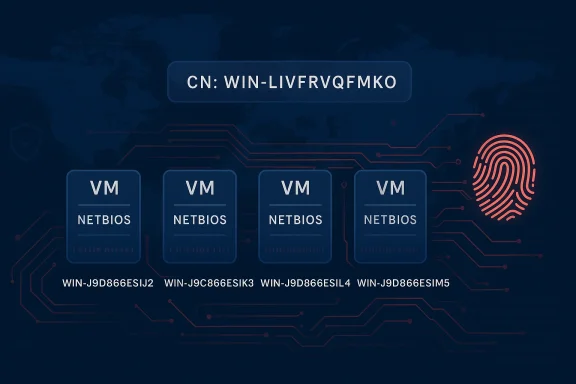
Sophos’ Counter Threat Unit (CTU) uncovered a deceptively simple but operationally dangerous pattern: widely distributed Windows virtual machine templates shipped by a mainstream hosting control panel embed static NetBIOS hostnames, certificate subjects, and other system identifiers, producing thousands of internet‑facing VMs that all present the same “fingerprint.” This deterministic template behavior has been observed in multiple ransomware and malware incidents and is being actively rented and resold through abuse‑tolerant hosting ecosystems — creating an inexpensive, scalable surface for criminals and a persistent headache for defenders and investigators. //www.sophos.com/en-us/blog/malicious-use-of-virtual-machine-infrastructure)
The CTU’s investigation began in late 2025 after analysts traced a set of WantToCry remote‑access ransomware incidents to virtual machines whose autogenerated NetBIOS hostnames matched static values embedded in VM images distributed by ISPsystem’s VMmanager control panel. Rather than one attacker reusing servers, the pattern suggested a systemic supply‑chain artifact: templates containing hard‑coded identifiers are deployed en masse by hosting provide providers tolerate or actively enable criminal use.
Key takeaways from the CTU’s original findings:
Independent reporting confirms the Stolker: Stark Industries was explicitly targeted in EU restrictive measures in May 2025, and analysts documented Stark’s role in enabling abusive and state‑aligned operations. Recorded Future, Krebs, and the EU Council record corroborate both the provider’s prominence and the sanctioning timeline.
Qurium and other infrastructure‑tracking researchers connected several of the network prefixes and hosting projects supporting the Doppelganger disinformation architecture to providers such as FIRST SERVER LIMITED, indicating overlapping use of UK‑registered hosting resources in disinformation and malware supply chains. That independent infrastructure analysis supports Sophos’ assertion that certain hosting groups play outsized roles in the ecosystem being abused.
Kaspersky’s technical reporting on the FortiClient EMS exploitation explicitly observed the certificate common name WIN‑LIVFRVQFMKO on the attacked service and detailed the SQL‑injection‑style exploitation and post‑compromise behaviors the intruders used. That independent confirmation strengthens the observation that template hostnames are present in real incidents beyond Sophos’ telemetry.
Trust and review sites show rdp.monster as an active consumer brand in the RDP market; while customer reviews are not proof of illicit activity, combined with CTU’s underground monitoring, they demonstrate how these services present themselves to buyers. The business model is straightforward: cheap hosted VMs, disposable lifetimes, and tolerance for abuse make for a compelling product in the criminal ecosystem.
For defenders, the immediate priority is pragmatic: treat template hostnames as a lead, not proof; hunt for control‑plane ownership and login artifacts; rebuild suspect VMs from trusted goldown RDP and remote management surfaces. For vendors and hosting providers, the obligation is clear: harden templates, protect image provenance, and be rigorous about abuse response. For policy makers, targeted action against clearly abusive providers is necessary but cannot be the only lever — sustained operational transparency and platform changes are the durable solution.
If there is one persistent lesson from this investigation, it is that automation and convenience on infrastructure platforms must be designed with hostile use cases in mind. In the cloud and hosting era, a convenience that creates deterministic, reusable fingerprints at scale can become a weapon. The remedy lies in engineering, governance, and collective willingness to remove convenient defaults that help criminals hide in plain sight.
Source: Sophos Malicious use of virtual machine infrastructure
 Background / Overview
The CTU’s investigation began in late 2025 after analysts traced a set of WantToCry remote‑access ransomware incidents to virtual machines whose autogenerated NetBIOS hostnames matched static values embedded in VM images distributed by ISPsystem’s VMmanager control panel. Rather than one attacker reusing servers, the pattern suggested a systemic supply‑chain artifact: templates containing hard‑coded identifiers are deployed en masse by hosting provide providers tolerate or actively enable criminal use. Key takeaways from the CTU’s original findings:
- Static template identifiers: VM images distributed by VMmanager contained explicit NetBIOS names n names that are not randomized at provisioning. When deployed under default conditions, the guest reports those embedded names.
- Large, concentrated footprint: Shodan scans captured thousands of hosts advertising the same NetBIOS names; S025 snapshot showed multiple hostnames each present on the order of thousands of internet‑exposed machines.
- Malicious reuse and resale: The tempvisible in ransomware, infostealer, and RAT campaigns and are advertised in underground markets and RDP shops; dedicated bulletproof hosting (BPH) providers resell or lease such VMs.
The mechanics: how VM templates became shared internet fingerprints
What the CTU found in the templates
VMmanager’s public image repository contains prebuilt Windows Server and desktop images (Windows Server 2012 R2 through Windows Server 2025; Windows 10/11 variants) and associated deployment scripts. Sophos CTU unpacked and inspected those images and the template provisioning scripts and found embedded hostnames, self‑signed certificate subjects, and other static identifiers that are not randomized at provisioning time. When a customer deploys a VM from such a template under default settings, the new VM boots with the template’s original NetBIOS name and certificate subject intact. with two independent tests: buying a VM from a provider that uses VMmanager and installing VMmanager in a controlled test environment to reproduce the behavior.Why this matters technkage:* Identical hostnames and CNs create the appearance* of shared infrastructure across unrelated incidents. Investigators relying on these artifacts can incorrectly aggregate events, misattribute campaigns, and waste triage cycles.
- age:** Criminals renting template VMs benefit from “blending” into thousands of legitimate‑looking instances that share the same fingerprint, making it harder to single out abused hosts in scans or reputation lists.
- Scale for criminals: Low‑cost, turnk with KMS‑enabled Windows images (which run for 180 days without activation) give bad actors an economical way to spin up disposable fleets for staging, RDP access, C2, and payload distribution.
Scale and prevalence: what the internet snapshot shows
Sophos’ CTU used Shodan to quantify the phenomenon. A December 19, 2025 snapshot reported:- 3,645 live hosts advertising the NetBIOS name WIN‑J9D866ESIJ2 (predominantly Russia).
- 7,937 live hosts advertising WIN‑LIVFRVQFMKO (Russia, some CIS, Europe, U.S., and a few in Irtemplate names (WIN‑BS656MOF35Q, WIN‑344VU98D3RU, etc.) together account for the vast majority of ISPsystem‑derived VMs observed on the public internet.
Which hosting providers matter
Sophos identified a small set of providers that host large numbers of template‑derived VMs. Two providers — Stark Industries Solutions Ltd and First Server Limited — appeaelemetry and third‑party research as operators or enablers with poor abuse hygiene or worse. Sophos and other analysts flagged links between those providers and larger criminal or disinformation ecosystems.Independent reporting confirms the Stolker: Stark Industries was explicitly targeted in EU restrictive measures in May 2025, and analysts documented Stark’s role in enabling abusive and state‑aligned operations. Recorded Future, Krebs, and the EU Council record corroborate both the provider’s prominence and the sanctioning timeline.
Qurium and other infrastructure‑tracking researchers connected several of the network prefixes and hosting projects supporting the Doppelganger disinformation architecture to providers such as FIRST SERVER LIMITED, indicating overlapping use of UK‑registered hosting resources in disinformation and malware supply chains. That independent infrastructure analysis supports Sophos’ assertion that certain hosting groups play outsized roles in the ecosystem being abused.
Malicious associations and historic incidents
Sophos’ telemetry links the template hostnames to a range of malware families and incidents spanning multiple years: WantToCry, LockBit, Qilin, ALPHV/BlackCat, NetSupport RAT, Ursnif, and others. Notable datapoints include a 2021 Jabber login from a host named WIN‑LIVFRVQFMKO by a user known as “Bentley” (later attributed to Maksim Galochn Conti/TrickBot chat leaks, an Ursnif campaign in 2023, and Kaspersky’s December 2024 reporting on exploitation of a FortiClient EMS vulnerability where the same hostname appeared in SSL certs and telemetry. Sophos’ CTU cautions that these links do not necessarily imply single‑actor continuity; the template‑reuse model explains how the same hostnames show up in disparate incidents.Kaspersky’s technical reporting on the FortiClient EMS exploitation explicitly observed the certificate common name WIN‑LIVFRVQFMKO on the attacked service and detailed the SQL‑injection‑style exploitation and post‑compromise behaviors the intruders used. That independent confirmation strengthens the observation that template hostnames are present in real incidents beyond Sophos’ telemetry.
The bulletproof hosting economy: how template VMs feed criminal markets
CTU researchers found multiple underground advertisements and Telegram posts offering VPS/RDP access to ISPsystem‑derived VMs andch as MasterRDP / rdp.monster operating in datasets tied to template hostnames. These services — often labelled “bulletproof” — explicitly tolerate illegal activity and provide a rental ecosystem for illicit use: ransomware C2, malware staging, phishing, botnet management, and reselling of RDP credentials. Sophos concludes that many BPH providers lease or resell ISPsystem VMs hosted on abuse‑tolerant infrastructure, creating a turnkey criminal product.Trust and review sites show rdp.monster as an active consumer brand in the RDP market; while customer reviews are not proof of illicit activity, combined with CTU’s underground monitoring, they demonstrate how these services present themselves to buyers. The business model is straightforward: cheap hosted VMs, disposable lifetimes, and tolerance for abuse make for a compelling product in the criminal ecosystem.
Attribution and investigative caveats: what not to assume
One of Sophos’ most important analytic cautions is also a practical one: shared NetBIOS names or certificate CNs are low‑fidelity linkage signals. In an effort to avoid misattribution, responders and analysts should treat such matches as investigative leads — not proofs — and seek stronger telemetry before attributing activity to a single actor. Useful corroborating signals includol plane ownership and login artifacts.- Unique malware toolsets and cryptographic keys.
- Infrastructure ownership and payment trails.
- Temporal patterns and operational error reuse.
Deft, medium, and long‑term actions
The problem spans host configuration, vendor defaults, hosting provider policies, and law enforcement/sanctions. Below is a prioritized, actionable playbook for defenders:Immediate (0–30 days)
- Scan for template hostnames: Hunt your estate and peripherals for NetBIOS/SMB/RDP services reporting known ISPsystem template hostnames (for example, the most prevalent names Sophos lists). Isolate any internet‑exposed matches.
- Block direct internet RDP: Enforce jump hosts, VPN access, and MFA for all remote desktop access; block inbound 3389 at the perimeter for non‑essential systems.
- Rebuild suspect VMs: If a VM was created from an untrusted marketplace/image, rebuild from a verified golden image and rotate credentials and keys.
- Harden credentials and detection: Implement strong passwords, privileged access controls, and multi‑factor authentication on management interfaces.
Short to medium (30–90 days)
- Parameterize provisioning: Ensure VM provisiounique hostnames and do not ship with embedded certs or static identifiers.
- Catalog image provenance: Maintain an internal image registry with cryptographic hashes and provenance metadata; refuse to trust unsigned or anonymous marketplace images.
- Share indicators responsibly: Coordinate with ISACs and upstream hosting providers on abused accounts; share high‑confidence indicators without over‑attributing based solely on hostnames.
Long term / policy and vendor engagement
- Secure‑by‑default templates: Platform vendors (including control‑panel and image repository maintainers) should ship templates that randomize hostnames, do not include embedded certs, and require per‑customer inputs at provisioning.
- Marketplace transparency: Image repositories should publish builder metadata, cryptographic hashes, and a chain‑of‑custody for images.
- Regulatory focus on abuse‑tolerant hosting: Government and industry bodies should maintain targeted transparency and enforcement against hosting providers that persistently enable criminal operations while avoiding undue collateral harm to legitimate providers. Published sanctions and restrictive measures (e.g., actions against Stark Industries) set regulatory precedent for addressing blatant abuse.
What hosting vendors and ISPsystem must fix
- Remove embedded artifacts from public images. Vendors must audit their image repositories and scrub static identifiers and secrets.
- Enforce per‑customer randomization. Provisioning pipelines should inject randomized hostnames, ephemeral certs, and require account‑specific metadata.
- Offer provenance and signing. Images should be signed and verifiable; hosting control panels and marketplaces should reject unsigned community images by default.
- Improve abuse triage. Hosting providers must strengthen abuse teams, reduce time to suspension of malicious customers, and publish transparency reports to demonstrate actionability.
Policy, sanctions, and the limits of enforcement
Sophos’ analysis shows an uncomfortable intersection between legitimate tooling and criminal ecosystems. International action has already targeted some players: the EU imposed restrictive measures on entities connected to Stark Industries in May 2025, and the Doppelganger disinformation network was sanctioned by the UK in October 2024. Independent infrastructure researchers have documented how actors shift re reconstitute under new legal entities to evade enforcement — making sanctions necessary but not sufficient. Effective remediation requires a combination of vendor fixes, hosting provider accountability, andtive pressure.Strengths and limitfindings
Strengths
- Empirical validation: Sophos’ controlled provisioning tests and template extraction provide strong, reproducible evidence linking template content to observed internet fingerprints. That reduces the risk s an artifact of telemetry noise.
- Operational context: Mapping multiple malware families, hosting providers, and underground resale activity turns an interesting technical quirk into a clear operational problem with real world abuse.
Limitations and caveats
- Snapshot nature of scans: Internet exposed counts from Shodan are a point‑in‑time measurement; the exposed surface evolves daily. Responders must re‑scan to assess current risk. Sophos documents the snapshot date to help contextualize this.
- Attribution ambiguity: The presence of a given hostname in multiple incidents does not prove continuous control by a single actor. Sophos explicitly warns against simplistic attribution. Corroborating signals remain essential.
- Potential for false positives in historic incidents: Not every observation of a template name implies malicious intent — legitimate customers and benign deployments exist within the same footprint.
Practical detection recipes and forensic checks
Below are concrete hunts and checks defenders can run now:- Run network scans for RDP/SMB hosts that return known template NetBIOS names. Isolate any internet‑facing matches.
- Inspect TLS certificate subjects presented on unusual ports (ports like 7777, 3389 proxies, or manaed CNs matching template names. Kaspersky’s FortiClient EMS analysis found WIN‑LIVFRVQFMKO used in a certificate during an exploitation incident — a high‑value forensic lead.
- Correlate login records to the control plane: which accounts created the VM, which payment methods were used, and whether accounts show quick turnover characteristic of BPH rentals.
- Hunt for newly created VHD/VHDX files, unregistered VM imports, or unexpected Hyper‑V activation on endpoints (if attackers use guests for stealthy execution).
- Look for long‑lived or repeating small POST/GET TLS flows that coincide with vmms.exe or similar virtualization host processes — an indicator of guest‑level tunnelling or session replay.
Conclusion: a systemic fix is possible — but it will require cooperation
Sophos CTU’s investigation exposes a deceptively powerful operational failure: the combination of low‑cost, prebuilt VM images and permissive hosting markets produces a commodity for criminal infrastructure. The technical fix is straightforward in concept — remove embedded identifiers from images, sign and verify images, randomize hostnames at provisioning, and enforce secure defaults — but it requires coordination between platform vendors, hosting providers, enterprise customers, and regulators.For defenders, the immediate priority is pragmatic: treat template hostnames as a lead, not proof; hunt for control‑plane ownership and login artifacts; rebuild suspect VMs from trusted goldown RDP and remote management surfaces. For vendors and hosting providers, the obligation is clear: harden templates, protect image provenance, and be rigorous about abuse response. For policy makers, targeted action against clearly abusive providers is necessary but cannot be the only lever — sustained operational transparency and platform changes are the durable solution.
If there is one persistent lesson from this investigation, it is that automation and convenience on infrastructure platforms must be designed with hostile use cases in mind. In the cloud and hosting era, a convenience that creates deterministic, reusable fingerprints at scale can become a weapon. The remedy lies in engineering, governance, and collective willingness to remove convenient defaults that help criminals hide in plain sight.
Source: Sophos Malicious use of virtual machine infrastructure
