

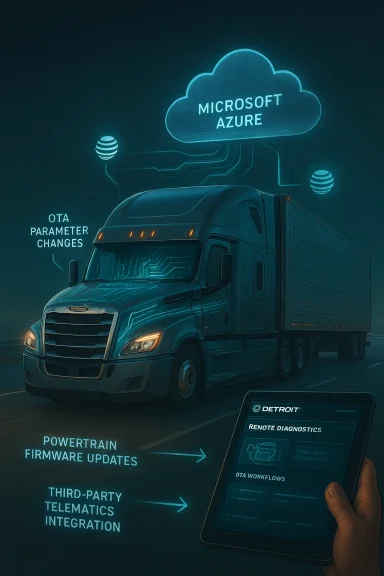
Microsoft and AT&T’s partnership with Detroit Diesel (Daimler Trucks North America) to power the Detroit Connect Truck Data Center and its suite of connected services marked a clear turning point for heavy‑duty telematics: factory‑installed IoT connectivity, cloud at the core, and the ability to push vehicle behavior and firmware changes remotely. The initiative—rolled into the all‑new Freightliner Cascadia beginning production in January 2017—paired AT&T’s cellular IoT network with Microsoft Azure cloud services and introduced over‑the‑air (OTA) engine parameter changes, powertrain firmware updates, and third‑party telematics integration as standard elements of a five‑year connectivity package. What started as a productivity and uptime play for fleets has since become a case study in how telematics, cloud platforms, and OTA capabilities reshape vehicle lifecycle management, business models, and the security surface of modern trucks.
Detroit Connect is the branded telematics and connected‑vehicle ecosystem developed by Detroit (the powertrain brand within Daimler Trucks North America). Over several generations it evolved from a remote diagnostics service into a full connectivity platform that bundles remote diagnostic telemetry (Virtual Technician), analytics, a portal and mobile access, and OTA functionality for certain vehicle subsystems. The 2016–2017 announcement that AT&T would provide the cellular link and Microsoft Azure would host back‑office processing elevated Detroit Connect from an OEM remote‑diagnostics tool into a factory‑installed industrial IoT platform built into the Freightliner Cascadia starting with the 2018 model cycle.
The hardware anchor for this architecture is the Truck Data Center: a factory‑fitted communications and compute module that connects vehicle electronic control units (ECUs) to cellular networks and cloud back ends. The announced capabilities at launch included:
Expect these trends going forward:
But with those benefits come nontrivial responsibilities. OTA updates and built‑in connectivity turn trucks into software‑defined assets—powerful, but potentially brittle if the security, governance, and operational controls are inadequate. Fleets and OEMs must treat the entire update pipeline and data lifecycle as a safety‑critical system: design updates for resilience, enforce cryptographic best practices, and implement staged deployment and rollback mechanisms that prioritize safety and uptime.
If the Detroit Connect program’s early lessons are any guide, the future will belong to those who can combine cloud scale, robust connectivity, and airtight security with transparent data practices—delivering the productivity gains fleets expect while keeping drivers, trucks, and the public safe.
Source: Heavy Duty Trucking Microsoft and AT&T Collaborate With Detroit Diesel on Detroit Connect
 Background / Overview
Detroit Connect is the branded telematics and connected‑vehicle ecosystem developed by Detroit (the powertrain brand within Daimler Trucks North America). Over several generations it evolved from a remote diagnostics service into a full connectivity platform that bundles remote diagnostic telemetry (Virtual Technician), analytics, a portal and mobile access, and OTA functionality for certain vehicle subsystems. The 2016–2017 announcement that AT&T would provide the cellular link and Microsoft Azure would host back‑office processing elevated Detroit Connect from an OEM remote‑diagnostics tool into a factory‑installed industrial IoT platform built into the Freightliner Cascadia starting with the 2018 model cycle.The hardware anchor for this architecture is the Truck Data Center: a factory‑fitted communications and compute module that connects vehicle electronic control units (ECUs) to cellular networks and cloud back ends. The announced capabilities at launch included:
- Remote diagnostics via Detroit Connect Virtual Technician.
- A Detroit Connect portal and mobile app for fleet managers to view vehicle health and telematics.
- Detroit Connect Remote Updates—an OTA mechanism for changing engine parameters (road speed, idle shutdown, cruise settings) and delivering powertrain firmware updates.
- Factory‑level support for third‑party telematics applications (so fleets can integrate partner solutions without secondary boxes or retrofit hardware).
- A five‑year base connectivity package for new Cascadia trucks that included Virtual Technician, portal access, and scheduled roll‑outs of Remote Updates and third‑party integration.
Why the Announcement Mattered: The Convergence of IoT, Cloud, and Fleet Operations
Three themes underpinned the importance of this partnership:- IoT connectivity as a built‑in vehicle feature. Historically, many fleets added telematics via aftermarket modems and third‑party hardware. Factory integration simplifies fitment, warranty coverage, and long‑term support while providing a consistent data model across a manufacturer’s fleet line.
- Cloud processing and scale. Offloading vehicle performance analysis and OTA orchestration to a hyperscale cloud platform enables near‑real‑time telemetry ingestion, heavy analytics workloads, and a centralized delivery mechanism for millions of telemetry events that would otherwise overwhelm on‑premises servers.
- Remote updates moving from infotainment into safety and powertrain domains. Updating infotainment or navigation systems is one thing; remotely changing engine parameters and delivering powertrain firmware is another—it brings software delivery control to safety‑critical and regulatory‑sensitive vehicle subsystems.
The Truck Data Center: What it Brigs to a Fleet
Hardware and connectivity
The Truck Data Center is the on‑vehicle communications hub that aggregates sensor and ECU data and mediates communications with the cloud. When factory‑installed it provides several advantages:- Unified telematics without extra retrofits. Fleets buying a new Cascadia with Detroit Connect have connectivity and the back‑end link already in place.
- Built for multiple ECUs and data types: fault codes, DDEC (Detroit Diesel Electronic Control) reports, fuel and drive cycle metrics, and driver behavior indicators.
- Cellular IoT connectivity optimized for fleet deployments, billing, and coverage management through an established carrier partner.
Cloud and data processing
Microsoft Azure served as the back‑office environment to store, process, and transform vehicle telemetry into actionable insights. The cloud layer centralizes heavy analytics and supports scale requirements (ingesting high‑volume telemetry from thousands of trucks), secure storage of historical vehicle performance data, and orchestration of update packages for vehicles in the field.Software services and portal
The Detroit Connect portal and mobile application provide:- Remote diagnostic access and fault event details for service teams.
- OTA parameter change orchestration and reporting dashboards.
- Fleet‑level analytics—fuel efficiency trends, time‑in‑gear metrics, and safety reporting.
- Integration endpoints for third‑party telematics providers, eliminating redundant hardware and simplifying multi‑vendor workflows.
Practical Benefits for Fleets and Operators
For fleet managers, the practical and measurable benefits of an integrated Detroit Connect platform include:- Reduced downtime: Remote diagnostics and targeted parameter changes remove many minor trips to the service bay. Fleets can implement fixes or collect detailed DDEC reports for troubleshooting without physically pulling a truck into a dealer.
- Faster feature deployment: OTA parameter adjustments (e.g., road speed or idle shutdown thresholds) let fleets tune performance for regional regulations, operational policies, or seasonal requirements.
- Consolidated data: A single factory channel reduces variability in data feeds and standardizes event formats, making analytics and reporting easier.
- Lower truck‑level complexity: Factory integration and native support for third‑party telematics reduce the need for additional on‑board modems, wiring harnesses, or aftermarket retrofits.
- Potential cost savings: Less shop time and fewer unscheduled repairs translate into lower operating losses and less driver downtime.
Security, Risk, and the OTA Attack Surface
Introducing OTA updates and factory IoT connectivity into safety‑critical vehicles introduces a materially different threat model. The same channels that allow fleets to deploy beneficial updates can be abused if not secured end‑to‑end. Key security considerations include:- Update authenticity and integrity. Every OTA package must be cryptographically signed and verified on the vehicle before installation. Weak signing processes or unprotected signing keys are a prime target for attackers seeking to deliver malicious firmware.
- Secure transport and endpoint authentication. Communications must be encrypted with strong modern cryptography and mutual authentication between vehicle and cloud. Cellular connectivity reduces some attack vectors but does not eliminate risks like IMSI catchers, rogue base stations, or compromised infrastructure.
- Lifecycle management of keys and credentials. Revocation, secure key storage on‑vehicle, and rotation policies are essential; a leaked signing key undermines the entire update pipeline.
- Supply chain and CI/CD security. The OTA delivery pipeline—from build servers to staging to production—must be protected against injection attacks. A compromised CI pipeline can build and sign malicious updates that appear legitimate.
- Robust rollback and validation. Updates must include atomic installation, integrity checks, health monitoring, and automated rollback to a safe state if an update corrupts an ECU or causes unexpected behavior.
- Access controls, auditability, and operational monitoring. Who can schedule an update? What approvals are required? Audit logs, alerts for abnormal update rates, and rate limiting are critical operational controls.
Privacy, Data Ownership and Compliance
A modern connected truck collects detailed telemetry: location traces, driver behavior, engine status, and operational metrics. That data has high value for maintenance optimization but also presents privacy and legal considerations:- Data ownership and access. Manufacturers, fleet operators, and service providers need clear contractual arrangements about who owns, controls, and can share or monetize the data.
- Driver privacy. Location, speed, and behavior metrics can identify individual drivers; policies and technical controls are required to anonymize or restrict sensitive fields where appropriate.
- Regulatory compliance. Fleets operating across jurisdictions must reconcile local data protection rules, retention policies, and lawful access obligations.
- Cloud residency and cross‑border flows. Using a global cloud provider simplifies scale and resilience but requires disciplined data residency planning for multinational fleets.
Business Model and Industry Impact
The Detroit Connect setup signaled multiple business model shifts for OEMs and service partners:- Connectivity as included value. The five‑year connectivity package shifted connectivity from an optional add‑on to a standard component of the vehicle purchase for Cascadia buyers, changing the economics of subscription and aftermarket telematics.
- New recurring revenue streams. Analytics, premium OTA services, and integration with third‑party telematics providers become monetizable services that sit on top of the basic connectivity package.
- Platform play vs point solutions. By enabling third‑party integrations via the Truck Data Center, Detroit positioned itself as a platform: fleets could pick specialized telematics partners without installing external hardware, potentially reducing friction and time‑to‑service.
- Competitive response. Other OEMs accelerated their own OTA and connected services offerings—some focused primarily on infotainment and non‑safety systems, others pursued more aggressive OTA coverage across powertrain and ADAS domains.
Where Detroit Connect Succeeded — Strengths
- Seamless factory integration: providing a consistent, supported hardware and software stack reduces installation complexity and warranty disputes.
- Robust carrier support: partnering with a major carrier simplified global SIM management, billing, and coverage for fleet operations.
- Cloud scale and analytics: leveraging a hyperscale cloud provided the elasticity to ingest and analyze large telemetry volumes and deliver near‑real‑time services.
- OEM knowledge embedded in analytics: vehicle OEMs can deliver domain‑specific insights (engine behavior, effective maintenance windows) that generic telematics vendors may miss.
Where the Risks and Gaps Remain
- Security is a moving target. OTA capabilities broaden the attack surface and demand continuing investments in secure development, key management, and incident response.
- Operational complexity for fleets. While data consolidation simplifies analytics, it also concentrates failure modes: a misconfigured fleet policy or a bungled update can affect many trucks at once.
- Vendor lock‑in and ecosystem control. Factory integrations make switching telematics vendors more complex; fleets need clear interoperability and data export options.
- Liability and regulation. OTA changes to vehicle behavior raise liability questions—who is accountable if a parameter change contributes to an incident? Expect regulators and insurers to scrutinize OTA practices closely.
- The human element. Operational errors, inadequate change controls, or weak role‑based access to update systems remain common root causes in incidents across industries.
Practical Implementation Checklist for Fleets
- Governance and policies
- Establish an OTA governance board with engineering, operations, and security representation.
- Define approval workflows for parameter changes and firmware deployments.
- Test and staging
- Maintain a staged roll‑out: lab builds → internal fleet (canary) → small subset of live trucks → wider fleet.
- Validate rollback procedures and perform post‑update health checks.
- Security measures
- Require supplier evidence of cryptographic signing, hardware key protection, and CI/CD security for update pipelines.
- Insist on mutual TLS, certificate pinning, and device attestation where feasible.
- Operational controls
- Use execution windows that minimize service disruption and avoid updating when trucks are in critical operational states.
- Maintain offline/update‑via‑service alternatives for trucks operating in coverage sparse areas.
- Monitoring and auditability
- Collect comprehensive logs and telemetry about update progress, success rates, and installation anomalies.
- Set alerts for abnormal update failure rates, unexpected revision rollbacks, or unusual scheduling patterns.
- Data and privacy safeguards
- Demand contractual clarity on telemetry retention and third‑party access.
- Implement anonymization or minimization for driver‑identifiable telemetry where not operationally necessary.
The Competitive and Regulatory Horizon
The Detroit Connect rollout was a notable early mainstream effort to industrialize OTA and factory IoT in heavy vehicles. Since then, most major OEMs have accelerated OTA and connectivity programs, and a broader industry conversation has emerged about standardizing security practices, update verification, and data governance—led by industry groups and standards bodies.Expect these trends going forward:
- Stronger industry standards and best practices for OTA security and risk management.
- Increased regulatory and insurance scrutiny over OTA practices that affect safety‑critical systems.
- Greater demand from fleets for open integration points and data portability.
- More sophisticated cyber‑resilience features on‑vehicle (hardware‑rooted key stores, secure boot, runtime integrity checks).
Conclusion
The 2016–2017 collaboration between Detroit (Daimler Trucks North America), AT&T, and Microsoft was more than a PR moment; it reflected how heavy‑duty trucking began to embrace factory‑installed IoT, cloud processing, and remote update capabilities as core features rather than optional extras. For fleets, the benefits—reduced downtime, centralized diagnostics, and the ability to tune trucks remotely—are tangible and business‑critical. For manufacturers and cloud/telecom partners, those same capabilities create recurring‑revenue opportunities, control over the vehicle lifecycle, and new productization paths.But with those benefits come nontrivial responsibilities. OTA updates and built‑in connectivity turn trucks into software‑defined assets—powerful, but potentially brittle if the security, governance, and operational controls are inadequate. Fleets and OEMs must treat the entire update pipeline and data lifecycle as a safety‑critical system: design updates for resilience, enforce cryptographic best practices, and implement staged deployment and rollback mechanisms that prioritize safety and uptime.
If the Detroit Connect program’s early lessons are any guide, the future will belong to those who can combine cloud scale, robust connectivity, and airtight security with transparent data practices—delivering the productivity gains fleets expect while keeping drivers, trucks, and the public safe.
Source: Heavy Duty Trucking Microsoft and AT&T Collaborate With Detroit Diesel on Detroit Connect
