

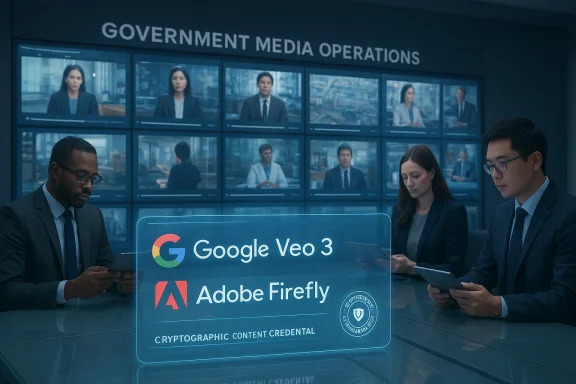
The Department of Homeland Security has quietly added commercial AI video-generation tools from Google and Adobe to the list of software it uses to produce public-facing content — a revelation that raises immediate questions about government use of generative AI, content provenance, and the risk of automated influence campaigns.
The disclosure comes via DHS’s own AI use‑case inventory and was reported by multiple outlets after journalists analysed a newly available document summarizing the department’s non-classified AI deployments. The inventory confirms DHS maintains a formal catalogue of commercial AI tools used across its enterprise, and — according to reporting that cites the document — includes mentions of Google’s Veo 3/Flow video toolset and Adobe Firefly among systems used for “editing images, videos or other public affairs materials using AI.” The same reporting gives an estimate — drawn from the inventory — that DHS holds roughly 100 to 1,000 licenses for those creative tools.
At the same time the inventory lists other commercial AI products used internally for drafting and productivity tasks — Microsoft Copilot Chat for drafting and summarization and a development-assistance tool called Poolside for coding tasks — reflecting the broad ways generative models are being piloted inside a major government agency.
This story matters because DHS components — notably Immigration and Customs Enforcement (ICE) and U.S. Customs and Border Protection (CBP) — have been rapidly scaling public communications on social platforms. Several videos and posts produced by immigration agencies have drawn scrutiny for their tone, their use of arrested subjects’ images, their reuse of music without clear licensing, and in some cases for a clearly synthetic or “AI‑generated” look. The new inventory gives a concrete mechanism for how some of that content could be produced at scale.
Key points the inventory confirms:
Important caveat: the inventory itself is an administrative document that describes authorized use cases and procured capabilities; it does not — and cannot practically — tie a specific piece of public content (a given X/Twitter video clip, for example) to the chain of creation at the tool level. In short: the document supports the claim that DHS has licensed and authorized use of these tools, but it does not prove that any one published DHS video was created by Veo 3 or Firefly.
Strengths
Generative video is now a tool in the modern public‑affairs toolbelt. That is not inherently good or bad — it depends on the guardrails. The DHS disclosures remove one layer of mystery about how some government media is being produced; they should be the start of a wider public conversation about governance, technical controls, and the transparency needed to preserve trust in official communications.
Source: MIT Technology Review DHS is using Google and Adobe AI to make videos
 Background / Overview
The disclosure comes via DHS’s own AI use‑case inventory and was reported by multiple outlets after journalists analysed a newly available document summarizing the department’s non-classified AI deployments. The inventory confirms DHS maintains a formal catalogue of commercial AI tools used across its enterprise, and — according to reporting that cites the document — includes mentions of Google’s Veo 3/Flow video toolset and Adobe Firefly among systems used for “editing images, videos or other public affairs materials using AI.” The same reporting gives an estimate — drawn from the inventory — that DHS holds roughly 100 to 1,000 licenses for those creative tools. At the same time the inventory lists other commercial AI products used internally for drafting and productivity tasks — Microsoft Copilot Chat for drafting and summarization and a development-assistance tool called Poolside for coding tasks — reflecting the broad ways generative models are being piloted inside a major government agency.
This story matters because DHS components — notably Immigration and Customs Enforcement (ICE) and U.S. Customs and Border Protection (CBP) — have been rapidly scaling public communications on social platforms. Several videos and posts produced by immigration agencies have drawn scrutiny for their tone, their use of arrested subjects’ images, their reuse of music without clear licensing, and in some cases for a clearly synthetic or “AI‑generated” look. The new inventory gives a concrete mechanism for how some of that content could be produced at scale.
What the government document actually says (and what it doesn’t)
The DHS AI Use Case Inventory: what is it?
DHS publishes an annual AI Use Case Inventory required by federal guidance. The inventory is explicitly intended to document unclassified, non‑sensitive AI use cases across DHS components — what the tool is used for, the intended purpose, and some operational details. The web‑posted inventory and library of attachments constitute DHS’s public disclosure of those non-sensitive uses.Key points the inventory confirms:
- DHS maintains an enterprise inventory of AI use cases and updates it on a defined schedule.
- The inventory covers a range of activities: document drafting, image generation, code generation, cybersecurity tooling and more.
What the recent reporting adds
Independent reporting about the inventory — chiefly the coverage that revealed vendor names and license estimates — indicates DHS is using commercial video-generation stacks and design‑oriented generative tools for public‑facing creative work. The reporting identifies Google Flow/Veo 3 and Adobe Firefly as specific vendors/models at work, and claims the inventory lists between 100 and 1,000 licenses for those creative tools across the department. That same reporting notes Copilot Chat and Poolside for drafting and coding roles respectively.Important caveat: the inventory itself is an administrative document that describes authorized use cases and procured capabilities; it does not — and cannot practically — tie a specific piece of public content (a given X/Twitter video clip, for example) to the chain of creation at the tool level. In short: the document supports the claim that DHS has licensed and authorized use of these tools, but it does not prove that any one published DHS video was created by Veo 3 or Firefly.
Verifying the vendor claims: Veo, Flow, and Firefly
To evaluate the technical claims in the reporting — that DHS is using Veo/Flow and Firefly — we cross‑checked the inventory reporting with vendor documentation and independent technical coverage.- Adobe Firefly: Adobe’s official documentation confirms that Firefly’s creative tools include text‑to‑video and image‑to‑video capabilities and that partner models (including Google Veo variants) are exposed inside Firefly’s video editor as selectable models. Adobe’s documentation pages explicitly list Veo 2, Veo 3.1 and Veo 3.1 Fast as available model options within the Firefly video workflow. Those docs also describe generation settings and formats available for client use.
- Google Veo / Flow: Google’s Flow is a filmmaking suite that pairs the Veo video-generation family with editing and assembly tools. Technical and product reporting about Veo 3 and the Flow environment describes features that make generated clips more realistic — including audio and dialogue generation, scene composition controls, and image‑to‑video bridging. Independent reviews and hands‑on pieces confirm Veo’s rapid evolution and its availability through Flow and Gemini‑branded product tiers.
- Product behaviour and limits: third‑party testing (reviews and hands-on pieces) shows Veo produces short, cinematic clips with strengths in visual realism but known weaknesses around text handling and occasional artefacts. Flow and Veo are being positioned as end‑to‑end creative workflows that can produce clips with realistic soundscapes and dialogue — features that matter tremendously when users publish short social videos.
Why this matters: the technical and ethical stakes
1) Scale and speed change risk equations
Generative video tools dramatically lower the cost and time required to produce short, attention‑grabbing clips. Where a social‑media shop once needed a camera crew, actors, licensing for music, and post‑production, an organization can now sketch an idea in text and iterate to completion in minutes. That speed is a double‑edged sword: it lets public agencies reach audiences quickly, but it also makes it far easier to produce repetitive, high‑volume messaging campaigns that can flood information channels. DHS’s inventory — including draft‑generation tools and video‑creation tools — indicates the department is building the capability to mass‑produce media.2) Realism invites credibility problems
Veo 3 and similar modern video generators can include synchronized audio, background noise, and dialogue, which makes produced clips much more convincing than early stylized deepfakes. The more realistic the output, the hard public to spot synthetic content, especially on small‑screen social feeds where short clips and vertical formats predominate. Independent testing shows Veo is already capable of hyperrealism — particularly in short bursts — and Flow adds editing controls that can make those bursts feel like produced sequences. That raises legitimate misinformation and ethics concerns when government agencies deploy such technology for persuasive communication.3) Provenance and disclosure are brittle
Vendors offer provenance tools — Adobe promotes content credentials and optional watermarking, for example — but provenance metadata and visible “AI generated” markers can be lost or stripped when content is exported or transcoded across platforms. Reporting notes Adobe offers watermarking options that can declare a file was produced with Firefly, yet those markers “do not always stay intact when the content is uploaded and shared across different sites.” In practice, a video uploaded to a short‑form platform, re‑posted, and edited may carry none of the original provenance. That gap makes independent verification of origin difficult.4) Legal and copyright exposure
There are two separate copyrights issues here. First, agencies must ensure they have the right to use music and stock assets in public messaging; several immigration videos have used music without permission, prompting takedowns and complaints. Second, vendor training‑data claims matter: Adobe has repeatedly said Firefly was trained on Adobe‑licensed, public‑domain, and openly licensed content and offers enterprise options to reduce legal risk. Vendors’ non‑training claims and indemnities are important legal mitigations — but they are not ironclad shields against litigation or reputational risk. For government bodies, procurement contracts and legal reviews should explicitly address training data provenance and indemnities.What remains uncertain (and how to think about unverifiable claims)
- Can we link a specific DHS video to a specific vendor or model? No. The inventory documents procurement and authorized uses, not forensic creation metadata for content posted to social platforms. That means the practical attribution of any particular clip to Veo, Firefly, or a human editor on staff remains unverifiable without metadata or vendor cooperation. Responsible reporting therefore must distinguish between procurement/authorization and forensic attribution.
- Are the license numbers precise? The “100 to 1,000 licenses” figure reported in the press is an inventory‑derived estimate; it is a broad range and should be treated as an administrative snapshot rather than a precise seat count. Procurement spreadsheets and centralized license servers can report exact counts, but public summaries often use ranges for aggregated disclosures. Treat any rounded or bracketed license counts as indicative.
- Are vendor watermarks reliable proof of AI origin? Not always. Vendors may embed machine‑readable provenance or visible watermarks, but those markers can degrade or be removed during re‑encoding, platform transcoding, or human editing. For reliable provenance, agencies must preserve and publish creation metadata, or use cryptographic content credentials that survive reposting workflows — something not yet standard across social platforms.
The policy and governance angle: what DHS should do (and what IT teams should demand)
Government use of generative AI should be governed by clear rules and technical controls. For Windows‑focused IT teams and public‑sector tech leads, the following are practical governance steps that can (and should) be implemented immediately.- Procurement and contracts
- Require written, vendor‑signed non‑training and data‑retention clauses for any generative model used on sensitive staff inputs. Demand clear subprocessor lists and data‑flow diagrams.
- Insist on enterprise content‑credentialing features and contractual commitments to make provenance metadata available for audit.
- Technical controls
- Enforce Data Loss Prevention (DLP) rules to block uploads of personally identifiable information (PII), migrant case files, or unredacted arrest photos into public cloud generative tools without legal sign‑off.
- Use tenant‑grounded options (where possible) that keep prompts and inputs inside a government‑controlled environment rather than sending them to general consumer models. Microsoft Copilot enterprise offers tenant grounding; Google and Adobe have enterprise offerings that can be negotiated.
- Provenance and auditability
- Embed cryptographic content credentials into creative workflows at the point of export and require platforms to preserve that metadata when content is posted by official accounts.
- Maintain an internal content registry that logs creation date, tool used, prompt/asset provenance, and approvals for every public post.
- Human‑in‑the‑loop controls
- Treat AI outputs as first drafts — every generated video, script, or image destined for public release should pass a documented editorial review that assesses legal, ethical, and operational risk.
- Create a multi‑disciplinary review panel for high‑impact public affairs content: legal counsel, communications leads, privacy officers, and technical reviewers.
- Transparency and public trust
- Proactively publish a machine‑readable log of creative tools used for public communications and provide human‑readable provenance statements on posts where AI materially contributed to creation.
Technical takeaways for WindowsForum readers and IT pros
If you manage Windows workstations, creative suites, or enterprise endpoint environments, here are concrete steps to reduce organizational risk while enabling legitimate productivity gains from AI:- Inventory: Map who can install or access Firefly, Flow, or other creative cloud tools from managed devices. Log license keys and admin accounts.
- DLP on endpoints: Configure Windows DLP policies and Microsoft Purview to prevent sensitive file uploads to public generative services. Use Conditional Access to limit service access to approved devices and networks.
- Audit logs: Ensure creative workflows write immutable audit records (who exported what, to which social account, and with what prompt/asset references). Store those ltant archive.
- Update policies: Revise acceptable‑use policies to require clearance before publishing images or videos that include detainees, law‑enforcement operations, or copyrighted music.
- Provide approved alternatives: Where possible, provide pre‑approved, enterprise‑configured tools that include non‑training guarantees or run on government cloud contracts so staff have a safe, sanctioned path for generating drafts.
Broader implications: civil‑liberties, public discourse, and the future of government communications
Government adoption of generative media tools will not stop; the better question is how public administrations will adopt them. The DHS example is a case study in the tension between operational efficacy and democratic safeguards.- When agencies use these tools for lawful public‑safety messaging and education, they can scale multilingual outreach and cost‑effectively produce accessibility assets. That’s the optimistic case.
- When tools are used for persuasive campaigns aimed at politically sensitive topics — especially where vulnerable populations or law‑enforcement actions are involved — the potential for perceived or actual manipulation rises dramatically. That’s the risk case.
Final assessment and recommendations
The DHS AI use‑case inventory and the vendor documentation we reviewed show that major generative AI vendors — Google (Flow + Veo family) and Adobe (Firefly) — now offer production‑grade video tools that are accessible to enterprise and government customers, and DHS has authorized and procured those capabilities.Strengths
- Rapid content production and iteration, enabling agencies to respond quickly with multimedia messaging.
- Enterprise vendor options exist that include contractual protections and content‑credential features to help provenance.
- High‑fidelity synthetic media erodes the public’s ability to distinguish real from generated content, especially on small screens and in rapid‑scroll social feeds.
- Provenance metadata is often fragile and can be stripped during reposting or transcoding, leaving the public without a reliable trace of origin.
- Contractual claims (e.g., training‑data assurances) reduce legal risk but do not eliminate operational or reputational risk; agencies must bake governance into procurement and daily practice.
- Publish a public, machine‑readable provenance ledger for all official media where AI was materially used.
- Harden procurement contracts to require non‑training clauses, exportable provenance metadata, and enterprise‑grade admin controls.
- Implement mandatory human‑review sign‑offs for any public affair materials that include images of people, operational detail, or arrest records.
- Partner with platforms to preserve embedded content credentials and visible disclosure tags when content is posted from official accounts.
Generative video is now a tool in the modern public‑affairs toolbelt. That is not inherently good or bad — it depends on the guardrails. The DHS disclosures remove one layer of mystery about how some government media is being produced; they should be the start of a wider public conversation about governance, technical controls, and the transparency needed to preserve trust in official communications.
Source: MIT Technology Review DHS is using Google and Adobe AI to make videos
