

Dickinson County’s recent technology refresh has produced an unwelcome and increasingly familiar headline for local government: the upgrade itself was only the start — unexpected, recurring and contractual costs have emerged that materially change the project’s budget and risk profile. Commissioners acknowledged higher-than-anticipated line items tied to software subscriptions, vendor retrofit fees and ongoing licensing obligations; the meeting materials available from the county show the issue sits squarely on the agenda as staff and elected officials work to reconcile capital expectations with operating realities.
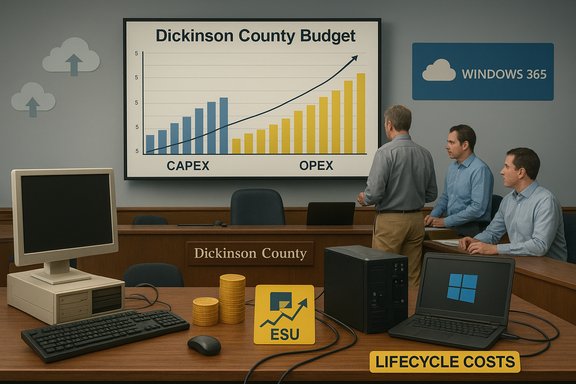
Modernizing county technology is rarely a single-line purchase. Upgrades typically stitch together hardware replacement, operating-system migration, application rationalization, vendor services and multi-year licensing commitments. That complexity creates two broad cost vectors: upfront capital (CapEx) and ongoing operating expenditures (OpEx). When procurement, contract language or lifecycle assumptions are incomplete, scheduled one-off capital projects can convert into a longer-term financial obligation — sometimes sharply and unexpectedly. Public-sector examples in other jurisdictions underscore this dynamic and show how lifecycle timing, ESU (Extended Security Updates) choices and vendor behavior can create budget shock.
Source: abilene-rc.com Technology upgrades incur unexpected expenses for Dickinson County
 Background
Modernizing county technology is rarely a single-line purchase. Upgrades typically stitch together hardware replacement, operating-system migration, application rationalization, vendor services and multi-year licensing commitments. That complexity creates two broad cost vectors: upfront capital (CapEx) and ongoing operating expenditures (OpEx). When procurement, contract language or lifecycle assumptions are incomplete, scheduled one-off capital projects can convert into a longer-term financial obligation — sometimes sharply and unexpectedly. Public-sector examples in other jurisdictions underscore this dynamic and show how lifecycle timing, ESU (Extended Security Updates) choices and vendor behavior can create budget shock.Why local IT upgrades surprise budgets
- Hardware refresh costs (replacement, imaging, disposal) are visible; recurring costs often are not.
- Software-as-a-Service (SaaS) and subscription licensing convert what used to be a discrete purchase into a permanent line item.
- OS lifecycle constraints (e.g., Windows 10 end-of-support and ESU mechanics) force either migration or paid support.
- Vendor-side retrofit costs, re-certification for line-of-business apps and peripheral compatibility can be unpredictable.
What the public record shows
The Dickinson County commission summaries show routine project updates, approvals and budget discussion items for the period when the upgrades were planned and executed. Those minutes confirm that IT modernization and related purchases were discussed in the commissioned meeting material and that staff raised implementation and budget questions for the board to resolve. The county’s online meeting summaries are the primary public record for these deliberations. Because the published local reporting link supplied for this story is behind a subscription wall and was not available for direct extraction at the time of this analysis, the conclusions below explicitly rely on the county’s own meeting pages, broader industry reporting, and Microsoft lifecycle documentation to verify the most consequential financial mechanics (ESU pricing and forced lifecycle decisions). Where the county’s public material left gaps or used non‑specific figures, this piece flags those areas as unverifiable in the absence of the original paid article text and recommends exact steps the board should take to close them.The most important technical and financial facts (verified)
- Extended Security Updates (ESU) for Windows 10 are available to organizations through Microsoft’s Volume Licensing program at a published list price that starts at approximately $61 USD per device for Year One and is structured to double in subsequent years if used as a multi‑year bridge. This pricing model is explicitly intended to nudge customers toward migration rather than to subsidize indefinite maintenance of an unsupported OS.
- Misclassified or mis‑labeled updates can create sudden technical and licensing costs. Industry reporting elsewhere has documented cases where an update metadata error led to unintended server upgrades — a reminder that the mechanics of vendor patching and third‑party patch managers can themselves create fiscal exposure for organizations that rely on automated distribution tools. The November 2024 Windows Server incident, widely reported in IT outlets, is a cautionary example: an update metadata error produced unintended upgrade activity that left some organizations dealing with licensing and rollback complexity.
How these dynamics typically generate “unexpected” expenses
1) Lifecycle timing mismatch
A common scenario: project leaders approve a hardware or OS refresh to remediate immediate security risk, choose a short‑term OS (for example Windows 10) to move users off a critically vulnerable platform, then learn that the chosen OS is itself nearing end‑of‑support. That decision creates either an immediate follow‑on project (migrate to Windows 11 or cloud desktops) or an OpEx commitment (buy ESU) that was not included in the original capital request. Microsoft’s documented ESU pricing makes the magnitude of that choice explicit.2) Subscription creep
License models have shifted: many software vendors now price per-seat subscription models, with annual renewals and usage‑based add‑ons. Where procurement thought it was buying a perpetual license — or where the RFP quoted only initial implementation costs — the subsequent annual subscription bills can double or triple the total cost of ownership if they weren’t anticipated in five‑year budget planning.3) Vendor retrofit and re‑validation charges
Specialist vendors of line‑of‑business (LOB) or embedded software sometimes charge for re‑validation or driver updates to make older hardware compatible with a new OS. These are often ad‑hoc and can be expensive, because the vendor may treat the work as engineering effort outside standard support. Public‑service programs elsewhere have seen five‑figure retrofit quotes for a single device in specialist contexts; ignoring these possibilities risks undercounting total program cost.4) Patching and automation surprises
Automated patch management is best practice for security, but it depends on correct metadata and conservative patch policies. Errors in update classification at scale — or misconfigured third‑party tools — can lead to mass installations, forced licensing needs, and substantial remediation labor. The server upgrade incidents reported across the admin community illustrated this exact failure mode.Fiscal impact scenarios — what the numbers mean
To ground the discussion, here are illustrative scenarios using public ESU pricing and common fleet sizes for a small county:- Example: 500 upgraded devices enrolled in ESU at list Year‑One price (~$61/device).
- Year‑One ESU cost ≈ $30,500.
- Year‑Two (doubling) ≈ $61,000; Year‑Three ≈ $122,000.
- Cumulative ESU expense (3 years, list) ≈ $213,500.
- Hardware refresh alternative: replacing 500 devices at a mid-range procurement, imaging and disposal cost of $650/device ≈ $325,000 one‑time CapEx.
- ESU as a short bridge can be economical for targeted, high‑value devices, but the year‑on‑year doubling makes it a poor long‑term strategy for whole‑fleet coverage. The math forces a decision: migrate (CapEx) or insure temporarily (OpEx) for a limited cohort. Microsoft documentation supports this pricing model and the strategic intent behind it.
Strengths shown by Dickinson County’s approach
- Risk recognition and transparency: public meeting minutes confirm the county is discussing IT modernization at the commission level rather than quietly incurring costs. That governance posture is essential; flagging tech items for the board shows the county is attempting to align policy, procurement and finance oversight.
- Tactical prioritization potential: focusing limited capital on the highest‑risk endpoints (servers and critical staff devices) while using conservative compensating controls elsewhere is a defensible short‑term risk‑management approach. Where the county can demonstrate prioritization by service criticality, it buys time to negotiate better licensing or staged replacement.
Key weaknesses and risks
- Budgeting for TCO (total cost of ownership) appears incomplete. If the county’s procurement assumed a one‑time capital spend and did not model multi‑year SaaS renewals, ESU or vendor retrofit fees, the budget was incomplete by design and needs remediation.
- Contractual and procurement exposure. Lack of explicit lifecycle clauses that require vendor compatibility, back‑porting, or cost caps for revalidation creates a structural risk that the vendor can transfer lifecycle costs to the public buyer.
- Operational risk from automated updates. The industry example where patch metadata triggered unwanted server upgrades highlights a real risk if the county uses automated third‑party patching tools without strict feature‑update gating rules. That class of failure can create unplanned licensing and remedial labor costs.
- E‑waste and sustainability risk. An aggressive hardware refresh without circular procurement or trade‑in planning can increase disposal costs and undermine stated cost‑efficiency claims; environmental compliance and disposal costs are frequently underbudgeted.
Practical recommendations (immediate, short, medium)
Immediate (within 7–30 days)
- Publish a concise line‑item reconciled report to the commission that compares original budget estimates to actual committed costs and outstanding change orders. This removes ambiguity and restores public trust.
- Conduct an inventory audit (MDM/PC Health Check) that returns exact counts for:
- Devices eligible for in‑place OS upgrade to the target platform.
- Devices that require full replacement.
- Devices tied to critical LOB applications requiring vendor revalidation.
- Freeze non‑critical discretionary IT spending pending reconciliation and vendor negotiations.
Short term (30–90 days)
- Negotiate with vendors for:
- Firm, capped retrofit/revalidation fees or multi‑year support packages with predictable pricing.
- Trade‑in or refurbishment credits to reduce net CapEx.
- Produce at least three procurement/finance scenarios for the next 1–3 years:
- Full hardware refresh (CapEx heavy).
- ESU for targeted devices + staged refresh (hybrid).
- Cloud PC / DaaS model for certain user cohorts (OpEx heavy).
- Require legal to review any sole‑source or single‑vendor renewal and to ensure lifecycle and compatibility clauses are explicit in future contracts.
Medium term (3–18 months)
- Adopt a multi‑year TCO model that includes: hardware refresh cycles, ESU and SaaS costs, staging and imaging labor, training and helpdesk load projections, and environmental disposal.
- Build an identity and endpoint governance roadmap (e.g., Entra ID/Intune + Autopilot) that reduces operational overhead for device provisioning and lifecycle management.
- Consider pilot programs for cloud PCs or Windows 365 where appropriate — Microsoft documents that ESU may be included for Windows 10 virtual desktops in specific cloud services, which can shift some ESU cost exposure into subscription models.
Technical remediation choices explained
- Quarantine and microsegmentation: for devices that cannot be upgraded immediately, network segmentation reduces attack surface and buys migration time. This is a useful short‑term compensating control.
- ESU enrollment: sensible when the device is mission‑critical and cannot be replaced quickly. Use ESU as a time‑boxed bridge for targeted cohorts, not a fleet‑wide perpetual strategy. Microsoft’s ESU pricing mechanics make the cost profile explicit; the doubling structure makes multi‑year ESU expensive at scale.
- Cloud desktop (Windows 365/Azure Virtual Desktop): moving certain user profiles to cloud-hosted Windows experiences can remove ESU exposure for virtualized endpoints in eligible Microsoft services, and can be an operational model for extending device life without leaving users on unsupported OS versions. Microsoft documentation outlines these entitlements for cloud-hosted Windows workloads.
- Vendor negotiation and re‑validation: contractually require LOB vendors to support OS compatibility for a defined period or include clear revalidation pricing in procurement documents going forward.
Procurement best practices counties should adopt
- Include lifecycle and compatibility clauses in all major procurement solicitations that clearly allocate upgrade/retrofit costs or require a vendor to provide back‑ports for a bounded time window.
- Use staged RFPs and require vendors to provide line‑item pricing for implementation and for subsequent support and certification tasks (avoid “TBD” pricing).
- Demand vendor SLAs that include rollback support and a tested migration plan, particularly for server and infrastructure components.
- Insist on multi‑vendor pilots where practical; vendor lock‑in increases risk and can obscure hidden retrofit costs.
External lessons and corroborating examples
The national and international record shows this is not a local anomaly. Major public bodies have faced the same timing and lifecycle mismatches and have paid substantial sums for either ESU support or accelerated refreshes rather than absorbing long certification processes. Industry reporting on mis‑labeled Microsoft updates that triggered unwanted server upgrades is a useful cautionary example of how automated updating processes can lead to unexpected costs and licensing obligations. Microsoft’s published guidance on ESU pricing and entitlements is unambiguous and should be treated as a planning input when a local government schedules multi‑year IT modernization.What remains unverified and what the county should publish
- Exact dollar amounts for Dickinson County’s itemized overruns remain unclear in the public record accessible at the time of this analysis. The Abilene-rc.com article referenced in the prompt was behind a subscription wall and could not be retrieved for verification; the county’s meeting pages confirm discussion of the upgrades but do not enumerate every vendor invoice, renewal contract or change order in the public summary. The county should publish a reconciled, line‑item pdf of the technology project’s budget vs. actuals to remove ambiguity.
- Any vendor quotes cited in open press coverage that are not present in public procurement files require verification against the purchase orders and invoices. The board should instruct the finance office to produce (redacted as needed) copies that show the commitments and renewal terms.
A pragmatic checklist for commissioners right now
- Request an immediate, audit‑ready TCO report covering all technology line items for the current fiscal year.
- Direct procurement to withhold non‑critical renewals until the TCO is approved and long‑term funding is identified.
- Authorize legal to retro‑review key vendor contracts for lifecycle and retrofit fee exposure.
- Order an inventory and device‑compatibility report for Windows 11 and cloud‑PC eligibility.
- Approve a small contingency to purchase ESU coverage for a narrowly defined cohort of critical devices while the migration plan is executed — and demand explicit timelines for ESU expiration and device replacement.
Conclusion
Dickinson County’s experience is a contemporary case study in the mismatch between procurement cycles, vendor licensing models and vendor roadmap events. The headline — technology upgrades that generate unexpected expenses — is frustrating but avoidable with the right combination of transparency, disciplined procurement language, and multi‑year budgeting. The county has the levers to fix this: publish exact numbers, demand vendor accountability for lifecycle costs, and choose a clear, time‑boxed path for migration versus temporary insurance (ESU). Doing so will convert an uncomfortable surprise into a predictable, managed modernization program that protects services, the public purse and citizen trust.Source: abilene-rc.com Technology upgrades incur unexpected expenses for Dickinson County
