

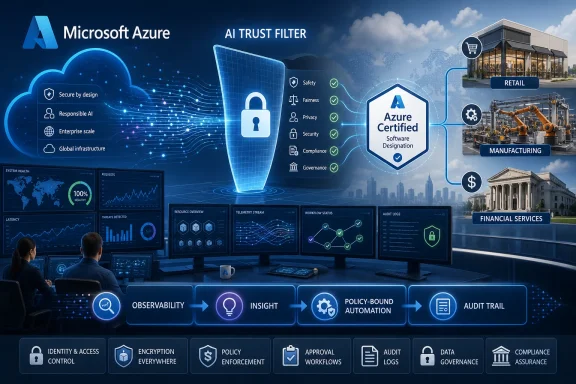
Digitate announced in May 2026 that its ignio platform has received Microsoft’s Solutions Partner with certified software designation for Azure, along with industry AI designations for retail, manufacturing, and financial services. The achievement is not just another partner-program badge; it is a sign of how Microsoft is turning Azure Marketplace into a trust filter for enterprise AI software. For Digitate, the designation gives its autonomous IT operations pitch a stronger Microsoft imprimatur. For buyers, it raises the larger question of whether certification can keep pace with the promises now being made around agentic AI.
Microsoft’s partner ecosystem used to be easier to read and easier to dismiss. Gold and Silver partner labels were familiar, broad, and often more useful as procurement shorthand than as a precise measure of product quality. The newer Microsoft AI Cloud Partner Program is different in both tone and mechanism: it is more closely tied to cloud consumption, marketplace participation, technical validation, and industry-specific positioning.
That makes Digitate’s announcement more interesting than the usual press-release boilerplate. The company says ignio has earned four certified software designations: Technical – Azure, Technical – Retail AI, Manufacturing AI, and Financial Service AI. In plain English, Microsoft is not merely acknowledging that Digitate is a friendly member of the partner channel. It is placing ignio into a narrower class of software that has cleared Microsoft’s checks for integration, marketplace readiness, customer success, and technical criteria.
The practical effect is visibility. Microsoft Marketplace is no longer just a catalog where ISVs park listings and wait for buyers to stumble across them. It is becoming the commercial plumbing for co-sell motions, Azure-aligned procurement, and enterprise software discovery. A certified software designation helps Microsoft sellers, partners, and customers identify which products Microsoft is prepared to stand behind in a more formal way.
That does not mean Microsoft is guaranteeing business outcomes, and buyers should not read it that way. But in a market crowded with AI operations platforms, AIOps suites, automation frameworks, and now “agentic” overlays, formal designation creates a sorting mechanism. The badge matters because the ecosystem has become too noisy for buyers to evaluate purely on vendor claims.
The company describes ignio as an agentic AI platform for autonomous IT operations, combining observability, AI-powered insight, automation, and enterprise context. That wording tracks the broader industry shift away from dashboards and toward closed-loop operations — systems that do not merely tell an operator what has broken, but can recommend or execute remediation.
This is where the agentic AI label becomes both useful and dangerous. Useful, because the next meaningful step in IT operations is not another screen full of red alerts. Dangerous, because every vendor with a workflow engine and an LLM integration is now tempted to call the result an agent.
Digitate’s differentiation claim is that ignio blends deterministic automation, predictive AI, and generative AI rather than relying on a chatbot interface bolted onto existing tooling. That matters because enterprise IT cannot run on probabilistic improvisation alone. If an AI system is going to restart services, suppress alerts, correlate incidents, or act against production infrastructure, it needs guardrails, context, policy, auditability, and a clear understanding of blast radius.
Microsoft’s recognition does not settle whether ignio delivers that better than its rivals. It does, however, place Digitate’s platform inside a cloud ecosystem where those questions are increasingly being asked by customers before the proof-of-concept begins.
Microsoft’s certified software designations are built around the idea that partner solutions should interoperate with Microsoft Cloud services, meet marketplace requirements, demonstrate customer success, and satisfy technical standards. For Azure-oriented software, that can include marketplace readiness and co-sell eligibility. For industry AI designations, the bar is shaped around sector-specific value, which is why Digitate is highlighting retail, manufacturing, and financial services rather than only generic cloud operations.
That framing is useful for Microsoft because it tightens the partner funnel. It is useful for Digitate because it gives the company a more credible route into enterprise accounts already standardized on Azure. And it is useful for buyers because it provides a baseline signal that the product has been reviewed in a structured Microsoft program.
But baseline is the operative word. A certified software designation does not say an implementation will be easy, that automation will be safe in every environment, or that an AI agent will understand the tribal knowledge buried in a 15-year-old enterprise stack. The work of integrating an autonomous operations platform remains stubbornly local. Every enterprise has its own naming conventions, escalation habits, compliance constraints, brittle dependencies, and sacred systems no one wants touched after 5 p.m.
The most realistic reading is that Microsoft’s badge reduces one category of uncertainty while leaving the hard operational questions intact. It tells buyers that ignio has cleared a Microsoft-recognized threshold. It does not tell them whether their own runbooks, change windows, identity policies, data classifications, and incident response practices are mature enough to let autonomous tooling do useful work.
That makes AIOps one of the places where agentic AI can plausibly become more than a demo. An operations platform can observe telemetry, correlate events, detect known failure patterns, open or enrich tickets, trigger remediation workflows, and learn from repeated incidents. In mature environments, some of this already happens without generative AI. The new pitch is that AI agents can expand the range of tasks that can be handled with less human supervision.
The problem is that autonomy in IT is not a binary state. Enterprises do not leap from manual ticket queues to self-healing infrastructure overnight. They move through layers: recommendation, assisted remediation, supervised execution, policy-bound automation, and only then broader autonomous action.
That progression is why the Microsoft designation matters commercially. Enterprises interested in agentic operations will want proof that the platform can live inside an Azure-centered environment without creating governance nightmares. They will also want evidence that the vendor can support industry-specific needs, because operational risk looks different in a bank, a manufacturer, and a retailer.
In financial services, the tolerance for unexplained autonomous action is low because auditability, resilience, and regulatory obligations are central. In manufacturing, downtime can hit physical production lines and supply chains, making operational context more important than generic cloud telemetry. In retail, seasonal spikes, point-of-sale dependencies, inventory systems, and customer-facing performance all shape what “autonomous operations” should mean.
Digitate’s four designations are therefore less about a single Azure integration and more about a sector-by-sector attempt to make agentic IT sound operationally credible.
Marketplace certification helps Microsoft solve that problem on its own terms. If enterprise buyers are already buying Azure services, Microsoft wants AI and automation products to be discovered, evaluated, transacted, and co-sold through Microsoft-controlled channels. Certified designations make that channel more legible.
For ISVs, the incentive is obvious. A marketplace listing alone is not enough when tens of thousands of offers compete for attention. A designation can help a product stand out, qualify for benefits, and become more attractive to Microsoft field sellers who need confidence before introducing third-party software to enterprise customers.
Digitate’s claim that only about 50 of more than 41,000 Azure Marketplace solutions hold the relevant certified software designation is striking, though it should be read carefully. Marketplace counts change, eligibility categories differ, and not every marketplace solution is trying to earn the same designation. Still, the basic point is sound: Microsoft is creating a more selective tier inside a very large marketplace.
That selectivity is good for vendors that make the cut. It is also good for Microsoft, which can point customers toward validated software while keeping more commercial activity inside its cloud orbit. The more strategic question is whether this concentrates too much power in the hands of platform owners. When the same company runs the cloud, the marketplace, the partner program, and the co-sell machinery, its definition of “validated” inevitably shapes which vendors get oxygen.
That means the operations layer matters more than ever. The Windows administrator’s world is no longer just patch cadence, Group Policy, endpoint imaging, and server health. It is identity telemetry, cloud policy, hybrid connectivity, endpoint detection signals, service dependencies, SaaS performance, and automated remediation across environments that were never designed as one neat system.
Agentic IT operations platforms are trying to insert themselves into that complexity. They promise to connect signals from across the estate, understand business impact, and act before human teams are overwhelmed. If they work, they could reduce noise and accelerate recovery. If they are deployed poorly, they could automate bad assumptions at machine speed.
For Windows-heavy shops, the key issue is control. Any autonomous platform touching Microsoft infrastructure must be evaluated against identity boundaries, least-privilege access, privileged access workflows, logging, change management, and rollback procedures. The question is not whether AI can help operations teams. It is whether the organization can define the limits of that help precisely enough to trust it.
That is where Microsoft-aligned certification becomes useful but incomplete. It may reassure buyers that the product fits into the Azure ecosystem. It does not absolve IT teams from testing how the platform behaves when a domain controller is degraded, a conditional access policy changes, a Defender alert spikes, or an Azure region dependency starts failing.
IT operations is especially vulnerable to inflated language because the outcomes are easy to promise and hard to prove. Vendors can say they reduce tickets, prevent outages, improve service-level performance, and enable self-healing operations. Customers then discover that results depend heavily on data quality, integration depth, process maturity, and how many exceptions live inside their environment.
Digitate is not alone in using the agentic framing. The entire enterprise software market is racing to rebrand automation as agency. Microsoft itself is doing the same across Copilot, Azure AI, security, developer tooling, and business applications. The difference is that operational AI faces a more immediate test than productivity AI. If an email summary is mediocre, someone edits it. If an autonomous remediation action is wrong, a service may go down.
That does not make agentic IT a fantasy. It means the governance model has to be treated as part of the product, not an afterthought. Approval chains, dry-run modes, policy scopes, human override, explainability, incident records, and post-action audit trails are not boring enterprise checkboxes. They are the difference between useful autonomy and a faster way to create outages.
This is the standard Digitate and its peers will increasingly be judged against. Microsoft’s designation helps establish credibility at the marketplace and ecosystem level. The production test will happen in change advisory boards, incident reviews, audit meetings, and the daily lived experience of operations teams.
Microsoft’s partner designations give the company a way to say that its ecosystem is not just a swarm of AI experiments. It can point to certified software in specific industries and argue that Azure is the place where enterprise-grade AI solutions can be discovered and deployed with more confidence. That is a powerful message at a time when CIOs are being pushed by boards to adopt AI while also being warned by security teams not to adopt it recklessly.
For Digitate, the sector designations help turn a horizontal operations platform into a more targeted proposition. Retail AI, Manufacturing AI, and Financial Service AI are not merely labels; they are buying contexts. They allow sales teams to talk about business continuity, transaction reliability, plant uptime, customer experience, and compliance in the language of the buyer.
That said, industry designation should not be confused with industry transformation. A certified AI operations platform may be better positioned to serve a bank or manufacturer, but each customer still has to validate the system against its own operational model. In heavily regulated environments, internal validation will often matter more than external recognition.
The more Microsoft leans into industry AI, the more its partner ecosystem will become a battleground for credibility. Vendors will need to prove not only that their software runs on Azure, but that it understands the workflows and constraints of the industries it claims to serve.
That is the job Microsoft’s certified software designation is increasingly designed to perform. It gives Microsoft sellers a shorter path to confidence. It gives procurement teams a cleaner justification for considering a vendor. It gives ISVs a badge that is more specific than broad partner membership. And it gives customers a signal that the product has passed through a vendor-controlled validation framework.
The cynic will say this is just channel strategy dressed up as quality assurance. There is some truth in that. Microsoft benefits when software partners align more tightly with Azure Marketplace, Azure consumption, and Microsoft’s co-sell engine. Partner designations are not charity; they are ecosystem architecture.
But the cynic’s view is incomplete. Enterprise buyers do need better filters, especially in AI. A marketplace filled with thousands of solutions is not a marketplace in any useful sense unless customers can distinguish mature products from opportunistic listings. Certification, if rigorous and transparent enough, can reduce friction.
The burden now shifts to Microsoft and its partners to ensure the badge remains meaningful. If certified software designations become too easy to obtain, they will decay into the kind of partner-label noise Microsoft has been trying to leave behind. If they remain selective and tied to real technical and customer-success requirements, they could become one of the more important trust signals in enterprise AI procurement.
For IT leaders, that matters most at the shortlist stage. A Microsoft certified software designation can move a product from “interesting vendor claim” to “credible candidate worth deeper review.” That is a real advantage in a category crowded with tools that sound similar from 30,000 feet.
The next step is due diligence. Buyers should ask how ignio integrates with their telemetry sources, how it models dependencies, how it handles Microsoft identity and access controls, and how remediation actions are approved, logged, reversed, and constrained. They should also ask which customer outcomes are independently measurable and which are vendor-reported.
The question for Digitate is whether it can turn Microsoft-backed credibility into repeatable operational proof. Agentic AI is moving quickly, but enterprise trust moves slowly. The companies that win this market will not be the ones with the loudest autonomy claims. They will be the ones that can show boring, repeatable, auditable improvements in uptime, incident response, and operational efficiency.
 Microsoft’s Badge Is Really a Marketplace Control Point
Microsoft’s partner ecosystem used to be easier to read and easier to dismiss. Gold and Silver partner labels were familiar, broad, and often more useful as procurement shorthand than as a precise measure of product quality. The newer Microsoft AI Cloud Partner Program is different in both tone and mechanism: it is more closely tied to cloud consumption, marketplace participation, technical validation, and industry-specific positioning.That makes Digitate’s announcement more interesting than the usual press-release boilerplate. The company says ignio has earned four certified software designations: Technical – Azure, Technical – Retail AI, Manufacturing AI, and Financial Service AI. In plain English, Microsoft is not merely acknowledging that Digitate is a friendly member of the partner channel. It is placing ignio into a narrower class of software that has cleared Microsoft’s checks for integration, marketplace readiness, customer success, and technical criteria.
The practical effect is visibility. Microsoft Marketplace is no longer just a catalog where ISVs park listings and wait for buyers to stumble across them. It is becoming the commercial plumbing for co-sell motions, Azure-aligned procurement, and enterprise software discovery. A certified software designation helps Microsoft sellers, partners, and customers identify which products Microsoft is prepared to stand behind in a more formal way.
That does not mean Microsoft is guaranteeing business outcomes, and buyers should not read it that way. But in a market crowded with AI operations platforms, AIOps suites, automation frameworks, and now “agentic” overlays, formal designation creates a sorting mechanism. The badge matters because the ecosystem has become too noisy for buyers to evaluate purely on vendor claims.
Digitate Is Selling Autonomy at the Moment Enterprises Want Less Chaos
Digitate’s flagship product, ignio, sits in one of the most crowded but strategically important parts of enterprise software: IT operations automation. The pitch is familiar to anyone who has spent time in a network operations center, a cloud operations review, or a post-incident meeting. Enterprises have too many alerts, too many dependencies, too many fragile integrations, and not enough humans who understand the full estate.The company describes ignio as an agentic AI platform for autonomous IT operations, combining observability, AI-powered insight, automation, and enterprise context. That wording tracks the broader industry shift away from dashboards and toward closed-loop operations — systems that do not merely tell an operator what has broken, but can recommend or execute remediation.
This is where the agentic AI label becomes both useful and dangerous. Useful, because the next meaningful step in IT operations is not another screen full of red alerts. Dangerous, because every vendor with a workflow engine and an LLM integration is now tempted to call the result an agent.
Digitate’s differentiation claim is that ignio blends deterministic automation, predictive AI, and generative AI rather than relying on a chatbot interface bolted onto existing tooling. That matters because enterprise IT cannot run on probabilistic improvisation alone. If an AI system is going to restart services, suppress alerts, correlate incidents, or act against production infrastructure, it needs guardrails, context, policy, auditability, and a clear understanding of blast radius.
Microsoft’s recognition does not settle whether ignio delivers that better than its rivals. It does, however, place Digitate’s platform inside a cloud ecosystem where those questions are increasingly being asked by customers before the proof-of-concept begins.
The Certified Software Designation Is a Sales Asset, Not a Magic Wand
There is a temptation to treat any Microsoft certification as a stamp that answers the procurement debate. It does not. The designation is meaningful, but it is not a substitute for architectural review, security assessment, contract scrutiny, or operational testing.Microsoft’s certified software designations are built around the idea that partner solutions should interoperate with Microsoft Cloud services, meet marketplace requirements, demonstrate customer success, and satisfy technical standards. For Azure-oriented software, that can include marketplace readiness and co-sell eligibility. For industry AI designations, the bar is shaped around sector-specific value, which is why Digitate is highlighting retail, manufacturing, and financial services rather than only generic cloud operations.
That framing is useful for Microsoft because it tightens the partner funnel. It is useful for Digitate because it gives the company a more credible route into enterprise accounts already standardized on Azure. And it is useful for buyers because it provides a baseline signal that the product has been reviewed in a structured Microsoft program.
But baseline is the operative word. A certified software designation does not say an implementation will be easy, that automation will be safe in every environment, or that an AI agent will understand the tribal knowledge buried in a 15-year-old enterprise stack. The work of integrating an autonomous operations platform remains stubbornly local. Every enterprise has its own naming conventions, escalation habits, compliance constraints, brittle dependencies, and sacred systems no one wants touched after 5 p.m.
The most realistic reading is that Microsoft’s badge reduces one category of uncertainty while leaving the hard operational questions intact. It tells buyers that ignio has cleared a Microsoft-recognized threshold. It does not tell them whether their own runbooks, change windows, identity policies, data classifications, and incident response practices are mature enough to let autonomous tooling do useful work.
Agentic AI Is Moving From Slideware Into the Operations Stack
The timing is the larger story. Over the past two years, enterprise AI has moved from copilots that draft emails and summarize meetings into systems that can take actions across business processes. IT operations is one of the obvious landing zones because the pain is measurable and persistent. Outages cost money, alert fatigue burns out teams, cloud complexity keeps rising, and hybrid estates remain stubbornly difficult to manage.That makes AIOps one of the places where agentic AI can plausibly become more than a demo. An operations platform can observe telemetry, correlate events, detect known failure patterns, open or enrich tickets, trigger remediation workflows, and learn from repeated incidents. In mature environments, some of this already happens without generative AI. The new pitch is that AI agents can expand the range of tasks that can be handled with less human supervision.
The problem is that autonomy in IT is not a binary state. Enterprises do not leap from manual ticket queues to self-healing infrastructure overnight. They move through layers: recommendation, assisted remediation, supervised execution, policy-bound automation, and only then broader autonomous action.
That progression is why the Microsoft designation matters commercially. Enterprises interested in agentic operations will want proof that the platform can live inside an Azure-centered environment without creating governance nightmares. They will also want evidence that the vendor can support industry-specific needs, because operational risk looks different in a bank, a manufacturer, and a retailer.
In financial services, the tolerance for unexplained autonomous action is low because auditability, resilience, and regulatory obligations are central. In manufacturing, downtime can hit physical production lines and supply chains, making operational context more important than generic cloud telemetry. In retail, seasonal spikes, point-of-sale dependencies, inventory systems, and customer-facing performance all shape what “autonomous operations” should mean.
Digitate’s four designations are therefore less about a single Azure integration and more about a sector-by-sector attempt to make agentic IT sound operationally credible.
Azure Marketplace Is Becoming the Enterprise AI App Store Microsoft Always Wanted
Microsoft has spent years trying to make its marketplace more central to enterprise buying. The AI boom gives that effort fresh leverage. Companies want AI applications, but they also want procurement controls, cloud alignment, security review, and a vendor ecosystem that does not feel like a bag of disconnected startups.Marketplace certification helps Microsoft solve that problem on its own terms. If enterprise buyers are already buying Azure services, Microsoft wants AI and automation products to be discovered, evaluated, transacted, and co-sold through Microsoft-controlled channels. Certified designations make that channel more legible.
For ISVs, the incentive is obvious. A marketplace listing alone is not enough when tens of thousands of offers compete for attention. A designation can help a product stand out, qualify for benefits, and become more attractive to Microsoft field sellers who need confidence before introducing third-party software to enterprise customers.
Digitate’s claim that only about 50 of more than 41,000 Azure Marketplace solutions hold the relevant certified software designation is striking, though it should be read carefully. Marketplace counts change, eligibility categories differ, and not every marketplace solution is trying to earn the same designation. Still, the basic point is sound: Microsoft is creating a more selective tier inside a very large marketplace.
That selectivity is good for vendors that make the cut. It is also good for Microsoft, which can point customers toward validated software while keeping more commercial activity inside its cloud orbit. The more strategic question is whether this concentrates too much power in the hands of platform owners. When the same company runs the cloud, the marketplace, the partner program, and the co-sell machinery, its definition of “validated” inevitably shapes which vendors get oxygen.
The Windows Angle Is Bigger Than Windows
At first glance, a Digitate-Azure partner designation may seem far removed from the everyday concerns of Windows admins. It is not. Most enterprise Windows environments now exist inside a broader Microsoft cloud operating model, even when critical workloads remain on-premises. Active Directory, Entra ID, Intune, Defender, Azure Arc, Sentinel, Microsoft 365, Windows Server, and Azure workloads increasingly form one administrative surface.That means the operations layer matters more than ever. The Windows administrator’s world is no longer just patch cadence, Group Policy, endpoint imaging, and server health. It is identity telemetry, cloud policy, hybrid connectivity, endpoint detection signals, service dependencies, SaaS performance, and automated remediation across environments that were never designed as one neat system.
Agentic IT operations platforms are trying to insert themselves into that complexity. They promise to connect signals from across the estate, understand business impact, and act before human teams are overwhelmed. If they work, they could reduce noise and accelerate recovery. If they are deployed poorly, they could automate bad assumptions at machine speed.
For Windows-heavy shops, the key issue is control. Any autonomous platform touching Microsoft infrastructure must be evaluated against identity boundaries, least-privilege access, privileged access workflows, logging, change management, and rollback procedures. The question is not whether AI can help operations teams. It is whether the organization can define the limits of that help precisely enough to trust it.
That is where Microsoft-aligned certification becomes useful but incomplete. It may reassure buyers that the product fits into the Azure ecosystem. It does not absolve IT teams from testing how the platform behaves when a domain controller is degraded, a conditional access policy changes, a Defender alert spikes, or an Azure region dependency starts failing.
The Word “Agentic” Still Needs Adult Supervision
The industry’s current love affair with the word agentic should make serious buyers cautious. The term describes systems that can pursue goals, make decisions, and take actions with some level of autonomy. In practice, it now covers everything from genuinely multi-step autonomous workflows to lightly scripted assistants with marketing gloss.IT operations is especially vulnerable to inflated language because the outcomes are easy to promise and hard to prove. Vendors can say they reduce tickets, prevent outages, improve service-level performance, and enable self-healing operations. Customers then discover that results depend heavily on data quality, integration depth, process maturity, and how many exceptions live inside their environment.
Digitate is not alone in using the agentic framing. The entire enterprise software market is racing to rebrand automation as agency. Microsoft itself is doing the same across Copilot, Azure AI, security, developer tooling, and business applications. The difference is that operational AI faces a more immediate test than productivity AI. If an email summary is mediocre, someone edits it. If an autonomous remediation action is wrong, a service may go down.
That does not make agentic IT a fantasy. It means the governance model has to be treated as part of the product, not an afterthought. Approval chains, dry-run modes, policy scopes, human override, explainability, incident records, and post-action audit trails are not boring enterprise checkboxes. They are the difference between useful autonomy and a faster way to create outages.
This is the standard Digitate and its peers will increasingly be judged against. Microsoft’s designation helps establish credibility at the marketplace and ecosystem level. The production test will happen in change advisory boards, incident reviews, audit meetings, and the daily lived experience of operations teams.
Microsoft Gets a Cleaner AI Story for Regulated Buyers
One reason industry AI designations matter is that regulated and operationally intensive sectors do not buy generic AI stories for long. Financial services, manufacturing, and retail all want productivity gains, but each sector has a different pain threshold and a different definition of acceptable risk.Microsoft’s partner designations give the company a way to say that its ecosystem is not just a swarm of AI experiments. It can point to certified software in specific industries and argue that Azure is the place where enterprise-grade AI solutions can be discovered and deployed with more confidence. That is a powerful message at a time when CIOs are being pushed by boards to adopt AI while also being warned by security teams not to adopt it recklessly.
For Digitate, the sector designations help turn a horizontal operations platform into a more targeted proposition. Retail AI, Manufacturing AI, and Financial Service AI are not merely labels; they are buying contexts. They allow sales teams to talk about business continuity, transaction reliability, plant uptime, customer experience, and compliance in the language of the buyer.
That said, industry designation should not be confused with industry transformation. A certified AI operations platform may be better positioned to serve a bank or manufacturer, but each customer still has to validate the system against its own operational model. In heavily regulated environments, internal validation will often matter more than external recognition.
The more Microsoft leans into industry AI, the more its partner ecosystem will become a battleground for credibility. Vendors will need to prove not only that their software runs on Azure, but that it understands the workflows and constraints of the industries it claims to serve.
The Real Prize Is Trust Before the Sales Call
Enterprise software markets are shaped by trust before they are shaped by features. Most products in a category claim roughly the same outcomes after a while. They promise faster operations, lower cost, better resilience, improved visibility, and measurable business value. The buyer’s first challenge is not finding claims; it is filtering them.That is the job Microsoft’s certified software designation is increasingly designed to perform. It gives Microsoft sellers a shorter path to confidence. It gives procurement teams a cleaner justification for considering a vendor. It gives ISVs a badge that is more specific than broad partner membership. And it gives customers a signal that the product has passed through a vendor-controlled validation framework.
The cynic will say this is just channel strategy dressed up as quality assurance. There is some truth in that. Microsoft benefits when software partners align more tightly with Azure Marketplace, Azure consumption, and Microsoft’s co-sell engine. Partner designations are not charity; they are ecosystem architecture.
But the cynic’s view is incomplete. Enterprise buyers do need better filters, especially in AI. A marketplace filled with thousands of solutions is not a marketplace in any useful sense unless customers can distinguish mature products from opportunistic listings. Certification, if rigorous and transparent enough, can reduce friction.
The burden now shifts to Microsoft and its partners to ensure the badge remains meaningful. If certified software designations become too easy to obtain, they will decay into the kind of partner-label noise Microsoft has been trying to leave behind. If they remain selective and tied to real technical and customer-success requirements, they could become one of the more important trust signals in enterprise AI procurement.
The Useful Reading of Digitate’s Win Is Narrower and Stronger
The safest interpretation of Digitate’s announcement is neither hype nor dismissal. It is not proof that ignio will deliver autonomous operations flawlessly in every enterprise. It is also not an empty trophy. It is a signal that Digitate has positioned its platform successfully inside Microsoft’s preferred commercial and technical route for Azure-aligned software.For IT leaders, that matters most at the shortlist stage. A Microsoft certified software designation can move a product from “interesting vendor claim” to “credible candidate worth deeper review.” That is a real advantage in a category crowded with tools that sound similar from 30,000 feet.
The next step is due diligence. Buyers should ask how ignio integrates with their telemetry sources, how it models dependencies, how it handles Microsoft identity and access controls, and how remediation actions are approved, logged, reversed, and constrained. They should also ask which customer outcomes are independently measurable and which are vendor-reported.
The question for Digitate is whether it can turn Microsoft-backed credibility into repeatable operational proof. Agentic AI is moving quickly, but enterprise trust moves slowly. The companies that win this market will not be the ones with the loudest autonomy claims. They will be the ones that can show boring, repeatable, auditable improvements in uptime, incident response, and operational efficiency.
Four Designations, One Bigger Signal
Digitate’s Microsoft recognition is best read as a marker of where enterprise AI procurement is heading, not just where one vendor sits today. The most concrete implications are practical rather than theatrical.- Digitate’s ignio platform has been recognized under Microsoft’s Solutions Partner with certified software designation for Azure and three industry AI areas.
- The designation gives Digitate a stronger position inside Microsoft Marketplace and Microsoft’s Azure-centered partner ecosystem.
- Microsoft is using certified software designations to create a more selective trust layer inside an increasingly crowded marketplace.
- Enterprise buyers should treat the badge as a useful filter, not as a replacement for security, governance, integration, and operational testing.
- Agentic AI in IT operations will be judged less by demos than by auditable remediation, measurable resilience, and safe automation boundaries.
References
- Primary source: AiThority
Published: Wed, 20 May 2026 07:26:03 GMT
Digitate Recognized as Solutions Partner with Certified Software Designation from Microsoft
Digitate, a leading global Agentic AI platform provider for autonomous IT operations, announced it has received the Solutions Partner* with certified software designation** for Azure within the Microsoft AI Cloud Partner Program (MAICPP).aithority.com - Official source: learn.microsoft.com
Introduction to Solutions Partner with certified software designations - Partner Center | Microsoft Learn
Learn about Solutions Partner with certified software designations.learn.microsoft.com - Related coverage: digitate.com
Digitate Unveils Industry's Most Comprehensive AI Agents, Driving Autonomous IT Operations and Business Resilience Across Enterprises
Digitate launches ignio AI agents to power autonomous, ticketless IT operations boosting resilience, reducing MTTR, and automating complex tasks for CIOs and SREs. digitate.com
- Official source: partner.microsoft.com
Differentiate your capabilities with Solutions Partner designations
Attain a Solutions Partner designation and drive success with badging and benefits that help you stand out to customers.partner.microsoft.com
- Official source: azuremarketplace.microsoft.com
- Official source: marketplace.microsoft.com
Microsoft Marketplace | cloud solutions, AI apps, and agents
marketplace.microsoft.com
- Official source: azure.microsoft.com
Azure Partners – Find an Azure Expert Partner | Microsoft Azure
Get technical advice and support from expert Microsoft Azure partners to deliver solutions that help your business grow. Find a partner that meets your needs.azure.microsoft.com
- Official source: microsoft.com
Your request has been blocked. This could be due to several reasons.
www.microsoft.com
- Related coverage: itpro.com
Triple Microsoft designation defines serious, competitive, high-performing modern MSPs | ChannelPro
Triple Microsoft designation signals serious MSP capability through rigorous, performance-based accreditation standardswww.itpro.com - Related coverage: atos.net
- Official source: cdn-dynmedia-1.microsoft.com
- Related coverage: catalogartifact.azureedge.net
a2a2528a-bdef-4c27-a7a2-f059a8e8e99d
Set realistic trendy different black smartphone mockup with white empty transparent, white, black touch screen, evolution of smartphones. Detailed mockup smartphone, model mobile.catalogartifact.azureedge.net
- Related coverage: resources.aithority.com
IDC MarketScape: Worldwide SaaS and Cloud-Enabled Medium-Sized Business ERP Applications 2024 Vendor Assessment
PDF documentresources.aithority.com
