

Digitate has been recognized on May 19, 2026, as a Microsoft Solutions Partner within the Microsoft AI Cloud Partner Program, with its ignio platform receiving certified software designations for Azure, Retail AI, Manufacturing AI, and Financial Services AI. The news is not merely another partner badge in the cloud ecosystem. It is a sign of how Microsoft’s marketplace is becoming a gatekeeping layer for enterprise AI trust, and how vendors like Digitate are trying to turn operational automation from a pitch into a procurement-safe decision.
For years, cloud marketplaces were treated as storefronts: useful for procurement, licensing consolidation, and the occasional private offer, but not always central to architectural decision-making. That is changing. As AI systems move closer to production workflows, especially in IT operations, finance, retail, and manufacturing, the marketplace listing is no longer just where a deal gets transacted. It is where trust gets pre-negotiated.
Digitate’s new Microsoft designations matter because they sit at the intersection of three enterprise anxieties: whether AI systems can be trusted, whether they integrate cleanly into existing cloud estates, and whether the vendor has proof beyond a polished demo. Microsoft’s certified software designations are designed to answer those anxieties in Microsoft’s own language: interoperability, marketplace readiness, technical criteria, and customer success.
That does not make the certification a blanket endorsement of every ignio deployment or a guarantee of business outcomes. Microsoft’s own program language is careful on that point, emphasizing that designations are tied to review criteria and interoperability at the time of assessment. But in enterprise technology, signals do not need to be absolute to be useful. They need to reduce uncertainty enough for a buyer, architect, or procurement committee to keep the conversation moving.
That is the practical significance for Digitate. In a market crowded with AIOps, observability, automation, and now agentic AI claims, a Microsoft certification gives ignio a sharper way to stand apart. It moves the product from “another AI operations platform that says it works with Azure” toward “a platform that has passed through Microsoft’s partner validation machinery.”
Scarcity matters in enterprise software because buyers are exhausted by sameness. Every vendor says it is AI-powered. Every vendor claims it reduces incidents, lowers cost, improves resilience, and accelerates transformation. A designation held by only a tiny fraction of marketplace listings gives sales teams a cleaner opening: this is not merely listed on Azure Marketplace; it has cleared a higher bar.
That distinction is especially useful in the AI operations market, where the vocabulary has become slippery. AIOps once described machine-learning-assisted event correlation and anomaly detection. Now it overlaps with observability, automation, service management, SRE tooling, business process monitoring, and agentic orchestration. The result is a category where customers often struggle to compare offerings cleanly.
Microsoft’s certified software program does not solve that category confusion by itself. It does, however, give buyers a structured proxy for maturity. For Digitate, that proxy is commercially valuable because ignio is being positioned not simply as a monitoring tool, but as an autonomous operations platform that can observe, reason, automate, and close the loop across complex enterprise environments.
Most IT teams already have too many dashboards. They have cloud-native telemetry, application performance monitoring, log analytics, security tooling, infrastructure monitoring, IT service management queues, and business process alerts. The problem is rarely a lack of signals. The problem is that signals do not reliably turn into decisions, and decisions do not reliably turn into safe action.
Ignio’s pitch is that it can connect observability, AI-powered insight, and closed-loop automation to move enterprise operations from reactive firefighting toward self-healing systems. That includes IT operations, cloud operations, business service-level agreements, ERP processes, and end-user digital workspace issues. In Digitate’s preferred framing, the destination is the “ticketless” enterprise: fewer incidents opened by humans, fewer repetitive problems routed through service desks, and more automated remediation before business users feel the pain.
This is where the Azure certifications have strategic weight. Autonomous operations platforms must sit close to sensitive systems. They need visibility into workloads, dependencies, events, processes, and sometimes business-critical transactions. A customer evaluating this kind of platform is not just asking whether it can detect a problem. The customer is asking whether it can be allowed near the machinery.
That is why Microsoft interoperability matters. Azure is not merely a hosting location for many enterprises; it is an identity plane, a data plane, a management plane, and increasingly an AI platform. If ignio can more credibly claim that it works cleanly across Azure and Microsoft Cloud scenarios, Digitate reduces one of the biggest frictions in autonomous IT adoption: the fear that automation will become another integration project.
Retail runs on thin margins, high transaction volumes, seasonal spikes, and supply chain coordination. Manufacturing depends on uptime, predictable processes, and increasingly connected production environments. Financial services lives under regulatory pressure, high availability expectations, and an unforgiving tolerance for operational failure. In each of these sectors, IT operations are not a back-office concern. They are part of the business model.
This is the larger bet behind industry AI certifications. Generic AI is interesting, but industry AI is where procurement budgets become more concrete. A retailer does not merely want an agent that summarizes alerts. It wants systems that help keep replenishment, point-of-sale, inventory, and order workflows stable. A manufacturer wants fewer disruptions to production and planning. A bank wants resilience, auditability, and incident reduction without inviting new operational risk.
Digitate’s Woolworths example is a useful illustration because it ties the story to a business process rather than an abstract AI claim. According to the announcement, Woolworths used ignio AI.ERPOps to shift order replenishment from reactive to proactive operations, saving around AUD 0.25 million annually and reducing order incidents by ten per day. Those are the kinds of metrics enterprise buyers understand because they translate IT automation into operational throughput and cost.
The challenge, of course, is that case studies are selective by nature. Vendors tell the stories that work. But the existence of customer-success evidence as part of Microsoft’s certification framework raises the floor. It does not prove every deployment will replicate Woolworths’ results, but it pushes the conversation toward demonstrated outcomes rather than theoretical capability.
Agentic AI sounds powerful because it implies systems that can plan, act, and adapt with less human intervention. In IT operations, that promise is especially seductive. Nobody wants engineers manually clearing repetitive alerts at 2 a.m. Nobody wants recurring incidents to bounce between teams because ownership is unclear. Nobody wants cloud cost spikes, ERP failures, batch job delays, or service degradation to be discovered only after users complain.
But the same autonomy that makes agentic systems attractive also makes them risky. An AI assistant that recommends a remediation step is one thing. An AI-driven system that initiates a workflow, changes a configuration, restarts a service, suppresses an alert, or resolves an incident is another. The closer automation gets to production systems, the more governance becomes the product.
That is where Digitate’s positioning has to be judged. The language of “closed-loop automation” is compelling, but buyers will want to know how loops are constrained. They will ask about approval flows, audit trails, rollback paths, integration boundaries, identity controls, model behavior, and failure modes. They will also ask how the system distinguishes between routine remediation and situations that require human judgment.
Microsoft’s certification cannot answer all of those questions. It can, however, give customers a starting point for due diligence inside a familiar ecosystem. For Azure-heavy enterprises, that matters. The decision is rarely “Do we trust AI?” in the abstract. It is “Can this vendor operate within the controls, contracts, and cloud architecture we already use?”
That changes the role of partner software. A third-party tool that plugs into a Microsoft estate is no longer just an add-on. It becomes part of the operational fabric. If it touches Azure Monitor, service health, endpoint experience, ERP workflows, or identity-adjacent processes, it participates in the reliability story of the whole environment.
This is why certified software designations are strategically useful to Microsoft as well as partners. Microsoft cannot build every vertical AI workflow, every AIOps capability, or every industry-specific automation layer. But it can shape the ecosystem by creating a hierarchy of partner trust. Marketplace listings are the base layer; co-sell motions, partner designations, and certified software badges create the upper layers.
For administrators and architects, this is both helpful and complicated. Helpful, because validation reduces the burden of sorting through thousands of marketplace offerings. Complicated, because Microsoft’s ecosystem incentives are not identical to a customer’s architectural needs. A Microsoft-recognized partner may be easier to buy, easier to justify, and easier to integrate, but that does not automatically make it the best fit for every environment.
This distinction matters in heterogeneous enterprises. Many large organizations run Azure alongside AWS, Google Cloud, private infrastructure, SaaS applications, legacy ERP systems, and industry-specific platforms. Digitate itself has emphasized broad operational coverage across public cloud, on-premises, and business systems. The Azure certification strengthens its Microsoft story, but customers still need to evaluate how ignio behaves across the full sprawl of their estate.
Digitate has long tried to differentiate ignio by emphasizing autonomous operations and closed-loop remediation rather than visibility alone. The company’s more recent agentic AI positioning extends that message into the current market language. But buyers have learned to be skeptical of every vendor that says “agent,” “autonomous,” or “self-healing.”
That is why external validation matters. Industry analyst recognition, customer examples, marketplace availability, and partner certifications all function as credibility scaffolding. None of them is decisive alone, but together they make it easier for a buyer to believe that a product has moved beyond prototype theater.
The Microsoft certifications are particularly valuable because they align with procurement mechanics. AIOps tools often face cross-functional scrutiny: infrastructure teams care about monitoring and remediation, application teams care about service behavior, security teams care about access and control, finance teams care about cloud cost, and business owners care about process continuity. A Microsoft designation gives each stakeholder a slightly different reassurance.
For the CIO, it says the vendor is aligned with a major strategic platform. For the cloud architect, it says interoperability has been reviewed. For procurement, it says the vendor is easier to place within Microsoft commercial channels. For operations teams, it says the product has at least some external validation in scenarios that resemble their own.
That caution is especially important for autonomous IT operations. The highest-value automations are often the most sensitive. Restarting a noncritical service is one thing; intervening in ERP-related order processing, batch scheduling, cloud resource scaling, or financial services workflows is another. The more valuable the use case, the more carefully the enterprise must define permissions, thresholds, approvals, and exception handling.
Customers should also distinguish between marketplace readiness and deployment readiness. A solution can be available through Microsoft Marketplace and still require significant integration work. It can be certified for interoperability and still need careful mapping to local processes, data models, monitoring taxonomies, and service management workflows. The hard part of enterprise automation is rarely installing the software. It is teaching the software enough about the organization to act safely.
That is where Digitate’s domain-specific approach may help. If ignio brings prebuilt knowledge for IT operations, ERP operations, cloud management, workload automation, and business SLA prediction, it can shorten the path from telemetry to action. But every enterprise still needs to validate whether those models and workflows match its own operating reality.
This is also where the “agentic AI” label should be handled with discipline. Agents are not magic workers. They are systems operating inside defined boundaries, with tools, context, policies, and objectives. The winners in enterprise agentic AI will not be the vendors with the flashiest demos. They will be the vendors that make autonomy governable enough for conservative organizations to deploy.
Certified software designations support that strategy. They create a way for Microsoft to tell customers that the marketplace contains not only quantity, but quality tiers. They also give partners a reason to align more deeply with Microsoft technical requirements, marketplace mechanics, and co-selling pathways.
For Digitate, this can translate into greater visibility with Microsoft sellers and customers. For Microsoft, it increases the value of the marketplace and reinforces Azure as a credible base for industry-specific AI systems. For customers, it simplifies discovery, though not decision-making.
The more interesting question is whether these designations will become table stakes. If only a tiny fraction of marketplace solutions have them today, they are differentiating. But if Microsoft successfully turns certified software into a standard enterprise filter, vendors without designations may find themselves explaining the absence. That would make the badge less of a trophy and more of a passport.
That shift favors vendors that can speak the language of outcomes. Digitate’s emphasis on reduced incidents, proactive operations, business SLA support, and measurable cost savings fits the moment. The company is not pitching ignio as a general-purpose AI assistant. It is pitching it as operational machinery for enterprises that already know their IT complexity is unsustainable.
Still, the market will not reward ambition alone. Buyers will compare ignio against cloud-native tooling, observability vendors, service management platforms, automation frameworks, and newer AI-agent startups. They will ask whether Digitate’s platform can coexist with existing investments or whether it requires another layer of operational consolidation. They will also ask whether the economics work once licensing, implementation, governance, and change management are included.
The certification gives Digitate a stronger answer at the start of that process, not the end. It opens doors, strengthens credibility, and gives Microsoft-aligned customers a reason to put ignio on a shortlist. The real test remains what happens after deployment, when the platform must reduce noise, prevent incidents, automate safely, and prove that autonomy is not just a branding exercise.
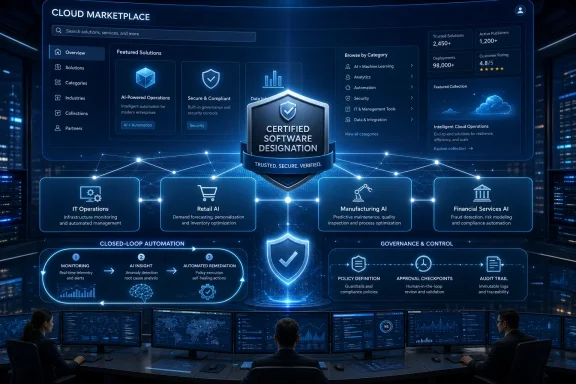 Microsoft Turns Partner Badges Into Enterprise Risk Filters
For years, cloud marketplaces were treated as storefronts: useful for procurement, licensing consolidation, and the occasional private offer, but not always central to architectural decision-making. That is changing. As AI systems move closer to production workflows, especially in IT operations, finance, retail, and manufacturing, the marketplace listing is no longer just where a deal gets transacted. It is where trust gets pre-negotiated.Digitate’s new Microsoft designations matter because they sit at the intersection of three enterprise anxieties: whether AI systems can be trusted, whether they integrate cleanly into existing cloud estates, and whether the vendor has proof beyond a polished demo. Microsoft’s certified software designations are designed to answer those anxieties in Microsoft’s own language: interoperability, marketplace readiness, technical criteria, and customer success.
That does not make the certification a blanket endorsement of every ignio deployment or a guarantee of business outcomes. Microsoft’s own program language is careful on that point, emphasizing that designations are tied to review criteria and interoperability at the time of assessment. But in enterprise technology, signals do not need to be absolute to be useful. They need to reduce uncertainty enough for a buyer, architect, or procurement committee to keep the conversation moving.
That is the practical significance for Digitate. In a market crowded with AIOps, observability, automation, and now agentic AI claims, a Microsoft certification gives ignio a sharper way to stand apart. It moves the product from “another AI operations platform that says it works with Azure” toward “a platform that has passed through Microsoft’s partner validation machinery.”
The Scarcity Claim Is the Real Marketing Weapon
The strongest line in the announcement is not that Digitate has achieved a Microsoft designation. It is the claim that fewer than 0.1 percent of Azure Marketplace solutions have received this status, roughly 50 out of 41,000. If accurate, that turns the certification from a routine ecosystem badge into a scarcity asset.Scarcity matters in enterprise software because buyers are exhausted by sameness. Every vendor says it is AI-powered. Every vendor claims it reduces incidents, lowers cost, improves resilience, and accelerates transformation. A designation held by only a tiny fraction of marketplace listings gives sales teams a cleaner opening: this is not merely listed on Azure Marketplace; it has cleared a higher bar.
That distinction is especially useful in the AI operations market, where the vocabulary has become slippery. AIOps once described machine-learning-assisted event correlation and anomaly detection. Now it overlaps with observability, automation, service management, SRE tooling, business process monitoring, and agentic orchestration. The result is a category where customers often struggle to compare offerings cleanly.
Microsoft’s certified software program does not solve that category confusion by itself. It does, however, give buyers a structured proxy for maturity. For Digitate, that proxy is commercially valuable because ignio is being positioned not simply as a monitoring tool, but as an autonomous operations platform that can observe, reason, automate, and close the loop across complex enterprise environments.
Ignio Is Selling Fewer Tickets, Not Better Dashboards
The most important thing to understand about ignio is that Digitate is not primarily selling another dashboard. It is selling the reduction, prevention, and automation of operational work. That is a different argument from the one made by traditional monitoring tools, and it carries a different burden of proof.Most IT teams already have too many dashboards. They have cloud-native telemetry, application performance monitoring, log analytics, security tooling, infrastructure monitoring, IT service management queues, and business process alerts. The problem is rarely a lack of signals. The problem is that signals do not reliably turn into decisions, and decisions do not reliably turn into safe action.
Ignio’s pitch is that it can connect observability, AI-powered insight, and closed-loop automation to move enterprise operations from reactive firefighting toward self-healing systems. That includes IT operations, cloud operations, business service-level agreements, ERP processes, and end-user digital workspace issues. In Digitate’s preferred framing, the destination is the “ticketless” enterprise: fewer incidents opened by humans, fewer repetitive problems routed through service desks, and more automated remediation before business users feel the pain.
This is where the Azure certifications have strategic weight. Autonomous operations platforms must sit close to sensitive systems. They need visibility into workloads, dependencies, events, processes, and sometimes business-critical transactions. A customer evaluating this kind of platform is not just asking whether it can detect a problem. The customer is asking whether it can be allowed near the machinery.
That is why Microsoft interoperability matters. Azure is not merely a hosting location for many enterprises; it is an identity plane, a data plane, a management plane, and increasingly an AI platform. If ignio can more credibly claim that it works cleanly across Azure and Microsoft Cloud scenarios, Digitate reduces one of the biggest frictions in autonomous IT adoption: the fear that automation will become another integration project.
Industry AI Badges Show Where Microsoft Thinks the Buyers Are
The designations Digitate received are revealing. Alongside Technical – Azure, ignio was certified for Retail AI, Manufacturing AI, and Financial Services AI. That is not an arbitrary trio. These are industries where downtime, process failure, and operational latency have immediate economic consequences.Retail runs on thin margins, high transaction volumes, seasonal spikes, and supply chain coordination. Manufacturing depends on uptime, predictable processes, and increasingly connected production environments. Financial services lives under regulatory pressure, high availability expectations, and an unforgiving tolerance for operational failure. In each of these sectors, IT operations are not a back-office concern. They are part of the business model.
This is the larger bet behind industry AI certifications. Generic AI is interesting, but industry AI is where procurement budgets become more concrete. A retailer does not merely want an agent that summarizes alerts. It wants systems that help keep replenishment, point-of-sale, inventory, and order workflows stable. A manufacturer wants fewer disruptions to production and planning. A bank wants resilience, auditability, and incident reduction without inviting new operational risk.
Digitate’s Woolworths example is a useful illustration because it ties the story to a business process rather than an abstract AI claim. According to the announcement, Woolworths used ignio AI.ERPOps to shift order replenishment from reactive to proactive operations, saving around AUD 0.25 million annually and reducing order incidents by ten per day. Those are the kinds of metrics enterprise buyers understand because they translate IT automation into operational throughput and cost.
The challenge, of course, is that case studies are selective by nature. Vendors tell the stories that work. But the existence of customer-success evidence as part of Microsoft’s certification framework raises the floor. It does not prove every deployment will replicate Woolworths’ results, but it pushes the conversation toward demonstrated outcomes rather than theoretical capability.
Agentic AI Needs Governance More Than Hype
The timing of Digitate’s recognition is important because 2026 enterprise AI is deep into its second phase. The first phase was experimentation: copilots, chat interfaces, internal pilots, and broad executive enthusiasm. The second phase is operationalization, and it is much less forgiving.Agentic AI sounds powerful because it implies systems that can plan, act, and adapt with less human intervention. In IT operations, that promise is especially seductive. Nobody wants engineers manually clearing repetitive alerts at 2 a.m. Nobody wants recurring incidents to bounce between teams because ownership is unclear. Nobody wants cloud cost spikes, ERP failures, batch job delays, or service degradation to be discovered only after users complain.
But the same autonomy that makes agentic systems attractive also makes them risky. An AI assistant that recommends a remediation step is one thing. An AI-driven system that initiates a workflow, changes a configuration, restarts a service, suppresses an alert, or resolves an incident is another. The closer automation gets to production systems, the more governance becomes the product.
That is where Digitate’s positioning has to be judged. The language of “closed-loop automation” is compelling, but buyers will want to know how loops are constrained. They will ask about approval flows, audit trails, rollback paths, integration boundaries, identity controls, model behavior, and failure modes. They will also ask how the system distinguishes between routine remediation and situations that require human judgment.
Microsoft’s certification cannot answer all of those questions. It can, however, give customers a starting point for due diligence inside a familiar ecosystem. For Azure-heavy enterprises, that matters. The decision is rarely “Do we trust AI?” in the abstract. It is “Can this vendor operate within the controls, contracts, and cloud architecture we already use?”
Marketplace Trust Is Becoming Part of the Windows Enterprise Stack
For WindowsForum readers, the Microsoft angle is not incidental. The Microsoft Cloud ecosystem now stretches across Azure, Microsoft 365, Entra ID, Defender, Intune, Power Platform, Dynamics, Fabric, and Copilot-era AI services. Enterprise IT teams increasingly experience Microsoft not as a set of products, but as an operating environment for identity, productivity, security, data, devices, and cloud infrastructure.That changes the role of partner software. A third-party tool that plugs into a Microsoft estate is no longer just an add-on. It becomes part of the operational fabric. If it touches Azure Monitor, service health, endpoint experience, ERP workflows, or identity-adjacent processes, it participates in the reliability story of the whole environment.
This is why certified software designations are strategically useful to Microsoft as well as partners. Microsoft cannot build every vertical AI workflow, every AIOps capability, or every industry-specific automation layer. But it can shape the ecosystem by creating a hierarchy of partner trust. Marketplace listings are the base layer; co-sell motions, partner designations, and certified software badges create the upper layers.
For administrators and architects, this is both helpful and complicated. Helpful, because validation reduces the burden of sorting through thousands of marketplace offerings. Complicated, because Microsoft’s ecosystem incentives are not identical to a customer’s architectural needs. A Microsoft-recognized partner may be easier to buy, easier to justify, and easier to integrate, but that does not automatically make it the best fit for every environment.
This distinction matters in heterogeneous enterprises. Many large organizations run Azure alongside AWS, Google Cloud, private infrastructure, SaaS applications, legacy ERP systems, and industry-specific platforms. Digitate itself has emphasized broad operational coverage across public cloud, on-premises, and business systems. The Azure certification strengthens its Microsoft story, but customers still need to evaluate how ignio behaves across the full sprawl of their estate.
The Certification Helps Digitate Fight the AIOps Credibility Problem
AIOps has suffered from a credibility problem because the term became broad before the outcomes became consistent. Some tools improved alert correlation. Some added anomaly detection. Some promised root-cause analysis but delivered another layer of dashboards. Some automation platforms worked well only after extensive professional services and brittle workflow design.Digitate has long tried to differentiate ignio by emphasizing autonomous operations and closed-loop remediation rather than visibility alone. The company’s more recent agentic AI positioning extends that message into the current market language. But buyers have learned to be skeptical of every vendor that says “agent,” “autonomous,” or “self-healing.”
That is why external validation matters. Industry analyst recognition, customer examples, marketplace availability, and partner certifications all function as credibility scaffolding. None of them is decisive alone, but together they make it easier for a buyer to believe that a product has moved beyond prototype theater.
The Microsoft certifications are particularly valuable because they align with procurement mechanics. AIOps tools often face cross-functional scrutiny: infrastructure teams care about monitoring and remediation, application teams care about service behavior, security teams care about access and control, finance teams care about cloud cost, and business owners care about process continuity. A Microsoft designation gives each stakeholder a slightly different reassurance.
For the CIO, it says the vendor is aligned with a major strategic platform. For the cloud architect, it says interoperability has been reviewed. For procurement, it says the vendor is easier to place within Microsoft commercial channels. For operations teams, it says the product has at least some external validation in scenarios that resemble their own.
The Fine Print Still Belongs in the Buying Process
It would be a mistake to treat the certification as a substitute for technical evaluation. Microsoft’s partner language is careful because software changes, cloud architectures vary, and customer environments are messy. A designation reflects qualification criteria; it does not eliminate the need for a proof of concept, security review, operational design, and financial analysis.That caution is especially important for autonomous IT operations. The highest-value automations are often the most sensitive. Restarting a noncritical service is one thing; intervening in ERP-related order processing, batch scheduling, cloud resource scaling, or financial services workflows is another. The more valuable the use case, the more carefully the enterprise must define permissions, thresholds, approvals, and exception handling.
Customers should also distinguish between marketplace readiness and deployment readiness. A solution can be available through Microsoft Marketplace and still require significant integration work. It can be certified for interoperability and still need careful mapping to local processes, data models, monitoring taxonomies, and service management workflows. The hard part of enterprise automation is rarely installing the software. It is teaching the software enough about the organization to act safely.
That is where Digitate’s domain-specific approach may help. If ignio brings prebuilt knowledge for IT operations, ERP operations, cloud management, workload automation, and business SLA prediction, it can shorten the path from telemetry to action. But every enterprise still needs to validate whether those models and workflows match its own operating reality.
This is also where the “agentic AI” label should be handled with discipline. Agents are not magic workers. They are systems operating inside defined boundaries, with tools, context, policies, and objectives. The winners in enterprise agentic AI will not be the vendors with the flashiest demos. They will be the vendors that make autonomy governable enough for conservative organizations to deploy.
Microsoft Gains When Partners Make Azure Feel Safer
There is a platform story underneath Digitate’s announcement. Microsoft is competing not only to host workloads, but to become the safest place for enterprises to industrialize AI. That requires more than Azure OpenAI, Copilot, Fabric, and security tooling. It requires an ecosystem of partner applications that make Microsoft Cloud feel like the default environment for serious enterprise AI.Certified software designations support that strategy. They create a way for Microsoft to tell customers that the marketplace contains not only quantity, but quality tiers. They also give partners a reason to align more deeply with Microsoft technical requirements, marketplace mechanics, and co-selling pathways.
For Digitate, this can translate into greater visibility with Microsoft sellers and customers. For Microsoft, it increases the value of the marketplace and reinforces Azure as a credible base for industry-specific AI systems. For customers, it simplifies discovery, though not decision-making.
The more interesting question is whether these designations will become table stakes. If only a tiny fraction of marketplace solutions have them today, they are differentiating. But if Microsoft successfully turns certified software into a standard enterprise filter, vendors without designations may find themselves explaining the absence. That would make the badge less of a trophy and more of a passport.
The Autonomous Operations Market Is Moving From Promise to Procurement
The Digitate announcement is part of a broader shift from AI excitement to AI purchasing discipline. Enterprises are no longer asking only what AI can do. They are asking who has proven it, where it runs, how it integrates, what controls exist, and how quickly it can show value without adding operational chaos.That shift favors vendors that can speak the language of outcomes. Digitate’s emphasis on reduced incidents, proactive operations, business SLA support, and measurable cost savings fits the moment. The company is not pitching ignio as a general-purpose AI assistant. It is pitching it as operational machinery for enterprises that already know their IT complexity is unsustainable.
Still, the market will not reward ambition alone. Buyers will compare ignio against cloud-native tooling, observability vendors, service management platforms, automation frameworks, and newer AI-agent startups. They will ask whether Digitate’s platform can coexist with existing investments or whether it requires another layer of operational consolidation. They will also ask whether the economics work once licensing, implementation, governance, and change management are included.
The certification gives Digitate a stronger answer at the start of that process, not the end. It opens doors, strengthens credibility, and gives Microsoft-aligned customers a reason to put ignio on a shortlist. The real test remains what happens after deployment, when the platform must reduce noise, prevent incidents, automate safely, and prove that autonomy is not just a branding exercise.
The Badge Matters Most Where Automation Touches Revenue
Digitate’s Microsoft recognition is best understood as a procurement accelerant for high-stakes operational AI. It does not remove the need for due diligence, but it gives enterprise buyers a stronger reason to believe ignio belongs in serious Azure-centered evaluations.- Digitate has received Microsoft certified software designations for Azure, Retail AI, Manufacturing AI, and Financial Services AI.
- The designations strengthen ignio’s credibility in Microsoft-heavy enterprise environments where interoperability and marketplace validation influence buying decisions.
- The reported scarcity of the designation makes it a stronger differentiator than a routine partner badge.
- Customers should treat the certification as a trust signal, not as a guarantee of implementation success or business outcome.
- The most important test for ignio will be whether it can deliver safe, governed automation in production environments where downtime and process failures have direct business cost.
References
- Primary source: Enterprise Times
Published: Tue, 19 May 2026 13:53:56 GMT
- Related coverage: digitate.com
Partners
Join Elevate Partner Program for enhanced business outcomes. Digitate prioritizes Partner success, ensuring value. digitate.com
- Related coverage: businesswire.com
- Related coverage: streetinsider.com
Digitate Named a Leader in the IDC MarketScape: Worldwide AIOps 2026 Vendor Assessment
SANTA CLARA, Calif.--(BUSINESS...www.streetinsider.com - Official source: azuremarketplace.microsoft.com
- Related coverage: catalogartifact.azureedge.net
