

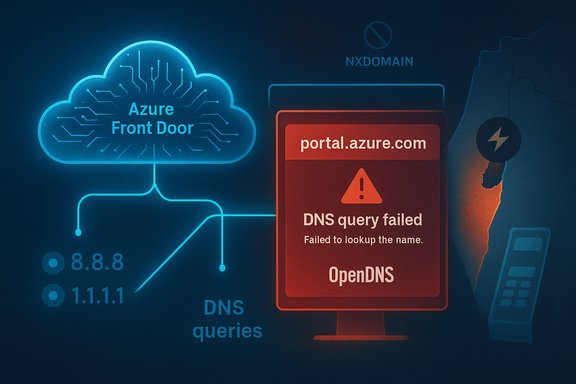
Microsoft’s cloud controls and the internet’s DNS plumbing both showed real fragility on December 30, 2025, when a short but disruptive DNS-related incident that Microsoft labelled an “ACTIVE — DNS Resolution Issues for Azure Domains via OpenDNS” left customers around the world struggling to reach the Azure Portal and Microsoft 365 management surfaces, while a concurrent and separate telecom blackout in Israel — affecting major providers Partner and Hot — produced a national-scale disruption to internet, mobile and payment services that authorities say is under investigation. The combined picture — an authoritative Azure status advisory plus intense social-media and outage-tracker noise, local telecom failures and unrelated regional transport and retail outages — exposed three hard truths: shared DNS/edge dependencies can turn into systemic single points of failure; localized infrastructure incidents can be mistaken for global cyberattacks; and organizations must treat identity, DNS and edge fabrics as mission‑critical components in their resilience planning.
In cloud-era operations the visible symptoms of a provider incident are often shaped more by how the cloud is fronted than by whether a back-end server is healthy. Microsoft runs a globally shared edge and identity stack — most notably Azure Front Door (AFD) for Layer‑7 ingress and Microsoft Entra ID (formerly Azure AD) for centralized identity — which many Microsoft first‑party services and thousands of customer workloads depend upon. When that shared surface or the internet glue (DNS and DNS resolvers) misbehaves, the result is a characteristic symptom set: failed sign‑ins, blank admin blades, 502/504 gateway responses and intermittent timeouts for third‑party sites fronted by the same fabric. That architecture explains why portal or edge faults can look like a total outage even when core compute or storage remains healthy. This is the same failure mode seen in prior high‑visibility incidents in 2025 and documented in incident reconstructions and platform analyses.
The December 30 event had two concurrent threads in public reporting. First, Microsoft’s official status page recorded a global, provider‑facing advisory focused on DNS resolution failures for Azure domains when clients used the OpenDNS/Cisco Umbrella recursive resolvers; the advisory listed 12:23 UTC as the impact start time and recommended temporary workarounds such as switching to alternate DNS resolvers. Second, Israeli media and regional reporting described a near‑simultaneous nationwide communications blackout that hit multiple ISPs (Partner and Hot among them), mobile service and card‑payment acceptance — a failure being investigated domestically as a possible cyber incident. The two phenomena were widely discussed together on social channels as some users experienced both sets of failures simultaneously; however, whether the events were causally linked remained unproven in the immediate aftermath.
Key mechanisms that make a DNS‑resolver fault high‑impact:
Microsoft’s quick public advisory made the proximate technical vector — DNS resolution when using OpenDNS/Cisco Umbrella — visible and actionable, and many customers recovered quickly by changing resolvers or using alternative management channels. At the same time, the parallel Israeli telecom blackout underlines how local infrastructure faults or malicious intrusions can compound an already noisy day; investigators and operators must be methodical in teasing apart causality, and policymakers must ensure critical services have robust, tested failovers.
For administrators, the immediate checklist is simple: verify resolver fallbacks, test programmatic admin access, and run blackout drills. For cloud providers and national operators, the obligation is heavier: provide timely, technical transparency and reduce the systemic single points of failure that turn routine configuration or resolver faults into headline‑grabbing outages. The internet’s plumbing is powerful — and on December 30 it briefly reminded many of us that that plumbing matters as much as the services that ride on top of it.
Source: www.israelhayom.com פרטנר walmart app down Microsoft's Azure cloud down for hundreds of users
 Background / Overview
In cloud-era operations the visible symptoms of a provider incident are often shaped more by how the cloud is fronted than by whether a back-end server is healthy. Microsoft runs a globally shared edge and identity stack — most notably Azure Front Door (AFD) for Layer‑7 ingress and Microsoft Entra ID (formerly Azure AD) for centralized identity — which many Microsoft first‑party services and thousands of customer workloads depend upon. When that shared surface or the internet glue (DNS and DNS resolvers) misbehaves, the result is a characteristic symptom set: failed sign‑ins, blank admin blades, 502/504 gateway responses and intermittent timeouts for third‑party sites fronted by the same fabric. That architecture explains why portal or edge faults can look like a total outage even when core compute or storage remains healthy. This is the same failure mode seen in prior high‑visibility incidents in 2025 and documented in incident reconstructions and platform analyses.The December 30 event had two concurrent threads in public reporting. First, Microsoft’s official status page recorded a global, provider‑facing advisory focused on DNS resolution failures for Azure domains when clients used the OpenDNS/Cisco Umbrella recursive resolvers; the advisory listed 12:23 UTC as the impact start time and recommended temporary workarounds such as switching to alternate DNS resolvers. Second, Israeli media and regional reporting described a near‑simultaneous nationwide communications blackout that hit multiple ISPs (Partner and Hot among them), mobile service and card‑payment acceptance — a failure being investigated domestically as a possible cyber incident. The two phenomena were widely discussed together on social channels as some users experienced both sets of failures simultaneously; however, whether the events were causally linked remained unproven in the immediate aftermath.
What happened on December 30 — an evidence‑checked timeline
1. Early detection and the Azure advisory
- At 12:23 UTC on December 30 Microsoft posted an “ACTIVE — DNS Resolution Issues for Azure Domains via OpenDNS” advisory on the Azure service‑status page, describing that customers using OpenDNS (including Cisco Umbrella deployments that forward to OpenDNS) were experiencing DNS resolution failures for portal.azure.com and other Azure services, and that engineering teams were investigating. The advisory explicitly recommended alternates (such as Google or Cloudflare recursive resolvers) as a temporary workaround. That advisory is the definitive operator telemetry for the incident and establishes the technical locus as a DNS/recursive‑resolver interaction rather than an internal compute failure.
- Community telemetry and large‑scale user reports mirrored Azure’s advisory: corporate operators and cloud engineers posted that switching resolver paths (for example to 8.8.8.8 or 1.1.1.1) restored connectivity, while customers that relied on Cisco Umbrella/OpenDNS observed continued failures. Multiple independent community threads and a Windows Forum thread captured those field fixes in real time.
2. The Israeli telecom blackout
- Separately, Israeli outlets and regional wire services reported a near‑simultaneous nationwide disruption that affected internet access, mobile calls, and card terminals. Israel Hayom and other local outlets described millions of customers losing connectivity for roughly an hour in a disruption that impacted major providers Partner and Hot and knocked out payment acceptance at some banks. Authorities said they had launched an investigation and described a cyberattack as their working assumption, while also noting that no public attribution had been made. Those statements were provisional — investigations were ongoing and specific evidence was not publicly disclosed at the time of reporting.
3. Collateral or coincidental outages (Eurostar, Walmart app)
- The busy travel day saw an unrelated Channel Tunnel power‑supply incident that forced Eurostar to suspend services between London and mainland Europe; that disruption affected holiday travel plans but was a transport infrastructure failure, not a cloud‑service incident. Reporting from major outlets confirmed the Channel Tunnel power supply issue and consequent cancellations.
- Retail digital services also felt pressure: Downdetector recorded a spike in Walmart app complaints on the morning of December 30 (US time), peaking according to outage aggregation around the same early hours, and the Wall Street Journal and other outlets reported a brief Walmart mobile‑app outage that was quickly resolved. Aggregated complaint spikes at merchants often reflect independent platform or CDN stress during high‑traffic windows and are not automatically evidence of a single upstream failure.
4. Recovery
- Microsoft’s Azure advisory showed signs of resolution as engineering teams traced the problem to an external DNS provider interaction; public guidance and community observations indicate that switching resolvers restored access for many organizations and that the Azure portal access disruption abated as routing and DNS caches converged. At the same time in Israel, services began to recover over the following hour as telco engineers restored routing and payment services; investigators continued to review logs and packet captures to determine cause and whether malicious actors were involved.
Technical anatomy — why a DNS resolver issue can feel like a full‑cloud outage
DNS is the internet’s address book. Most enterprise and ISP networks forward DNS queries from internal resolvers to a set of upstream recursive resolvers (for example, Google’s 8.8.8.8, Cloudflare’s 1.1.1.1 or Cisco Umbrella/OpenDNS). When a widely used recursive resolver experiences systemic problems — whether due to misconfiguration, software faults, peering failures, or rate‑limiting — a large population of client queries can fail to resolve authoritative names for critical services like portal.azure.com or login.microsoftonline.com. Because Microsoft fronts many control‑plane services behind a small set of hostnames and a shared edge fabric, failure to resolve those hostnames is functionally equivalent to the services being unreachable.Key mechanisms that make a DNS‑resolver fault high‑impact:
- Recursive resolver outages or misbehavior cause clients to receive NXDOMAIN, SERVFAIL, or timeouts — effectively preventing TLS handshakes and token issuance. That knocks out sign‑in flows even when the backend is operational.
- Enterprise security stacks (secure web gateways, DNS‑based content filters like Cisco Umbrella) often mask resolver selection from application owners — many orgs do not control which recursive service their DNS uses, turning a resolver event into a multi‑tenant outage. Community reporting on December 30 pointed to Cisco Umbrella/OpenDNS integrations as the common factor for many affected networks; switching resolvers to a working upstream restored access.
- Global CDN/edge fabrics use DNS and anycast‑based routing; DNS failures can push traffic to degenerate paths or prevent customers’ traffic from reaching the nearest healthy PoP. When edge routing and identity issuance intersect, many independent services appear to “drop” at the same time. This interplay is the reason an AFD or Entra ID fault — or a DNS resolver failure affecting those hostnames — produces a blast radius far greater than a single product outage.
What we can verify — and what remains unverified
Verified, operator-level facts:- Microsoft posted an “ACTIVE — DNS Resolution Issues for Azure Domains via OpenDNS” advisory with start time 12:23 UTC on December 30, 2025; the advisory named OpenDNS as the resolver vector and suggested using alternate recursive resolvers as a workaround. This is operator telemetry and the authoritative record of the provider’s immediate diagnosis.
- Community telemetry (engineers, forum threads, outage trackers) reported that changing DNS resolvers restored access for many customers and that the symptom set matched DNS‑resolution failures rather than widespread platform compute faults.
- Israeli media and regional outlets reported a near‑simultaneous nationwide communications disruption affecting Partner and Hot that impacted internet, mobile and payment services, and local authorities announced an investigation and said a cyberattack was under consideration without publicly presenting forensic evidence at the time of reporting. These remain investigative statements from authorities and provisional journalistic reports.
- Any direct causal link between Microsoft’s OpenDNS‑related advisory and the Israeli telecom blackout. Multiple reputable local outlets reported the Israeli outage and separate Microsoft DNS advisory, but public evidence tying them together (for example, BGP anomalies connecting Microsoft prefixes to ISP outages, or shared attacker indicators) was not published at the time. Authorities described a cyberattack as a working assumption, but that is an investigative posture rather than verified attribution. Treat those linkage claims cautiously until forensic artefacts are released.
- Specific actor attribution — no credible, independently verified public evidence tied the incident to a named actor in the immediate reporting window. Attribution requires forensic artifacts and cross‑correlation by national teams; uncorroborated social claims should be treated as unverified.
Wider real‑world impact and examples from this event
- Israel: reported nationwide outages affected mobile calls, fixed broadband, and card terminals at retail points of sale; the scale and speed of the disruption prompted emergency coordination inside telcos and at the Ministry level. Local journalism and regional wire services documented a roughly one‑hour blackout that halted many workplaces. Authorities immediately began a formal investigation, citing cyberattack as a working assumption while acknowledging that evidence-gathering was ongoing.
- Global cloud customers: portal access for Azure and Microsoft 365 management surfaces was disrupted for customers using affected resolver chains; many organizations switched to alternate resolvers, used programmatic management interfaces, or relied on pre‑provisioned offline runbooks to continue critical operations. The incident again illustrated that administrative access — not just application traffic — can be the primary casualty.
- Transport and retail: Eurostar suspended services after a Channel Tunnel power supply failure, illustrating that heavy‑holiday‑season travel systems remain vulnerable to infrastructure faults that are independent of cloud‑service incidents. At the same time, retailers including Walmart recorded app and site complaint spikes around the same window; these consumer impacts underline how distributed retail tech stacks can suffer in a high‑noise operational day. Each event had its own root cause and operational response.
Practical, actionable guidance for administrators and IT teams
The December 30 sequence reinforces a practical checklist that organizations should adopt now. The short list below distills technical mitigations, operational changes and governance items that materially reduce blast radius and speed recovery.- Validate resolver dependencies and implement fallbacks
- Inventory which recursive resolvers your estate uses (including corporate forwarders and security products that forward to OpenDNS/Umbrella).
- Configure local resolvers with multiple upstreams (e.g., Cloudflare 1.1.1.1, Google 8.8.8.8) and test failover behavior regularly.
- Document resolver‑switch procedures that your helpdesk can execute quickly under pressure.
- Treat management surfaces as high‑risk dependencies
- Maintain programmatic admin access (Azure CLI, PowerShell scripts) and test them in degraded‑portal scenarios.
- Pre‑staged service principals, emergency support contracts and phone escalations should be periodically validated.
- Harden identity and token fallbacks
- Adopt token‑caching or delegated offline paths for critical automation where possible.
- Where acceptable, decentralize login paths for mission‑critical services to reduce single‑token‑issuer dependencies.
- Exercise and document blackout runbooks
- Run table‑top and live blackout drills that assume portals and GUIs are inaccessible — require teams to perform essential tasks via CLI, API or pre-authorized out‑of‑band channels.
- Keep lists of emergency contacts for cloud provider support and escalate channels for Severity‑1 incidents.
- Preserve forensic artifacts and log telemetry
- If a suspected cyber incident is involved, preserve recursive resolver logs, BGP flow records, router/switch config snapshots and packet captures. Those artefacts are essential for attribution and regulatory reporting.
- Coordinate with ISPs promptly; in national incidents the telco’s router and peering logs are crucial.
- Consider architectural diversification strategically
- For truly mission‑critical front‑ends, evaluate multi‑region and multi‑cloud strategies or at least multi‑path ingress (Traffic Manager, failover A records, secondary CDN fronting).
- Remember that multi‑cloud introduces complexity; weigh costs and resilience benefits honestly.
National and regulatory implications: what governments and critical‑service operators should consider
- National detection and collaboration
- National Computer Emergency Response Teams (CERTs) and telco regulators should maintain joint playbooks for incidents that span cloud providers and ISP infrastructure. When outages affect payments or emergency services, rapid cross‑sector coordination reduces downstream harm.
- Procurement and SLA scrutiny
- Governments and critical infrastructure operators should demand higher post‑incident transparency, including detailed post‑incident reports with root cause analyses, mitigation steps and timelines for corrective action.
- Payment rails and offline modes
- Banks and payment networks must have robust contingency modes (store‑and‑forward terminals, offline token validation) that can process transactions securely during internet disruptions. The observed card‑payment interruptions in Israel show these protections can be the difference between manageable disruption and major economic friction.
- Attribution and public communication
- Authorities must avoid premature public attribution of cyberattacks without forensic confidence; while early statements may cite cyber‑intrusion as a working assumption, credible attribution must be grounded in logs, indicators and correlation across independent telemetry. Public messaging should balance transparency with caution to avoid misdirecting response efforts.
Critical appraisal — strengths and risks exposed by the incident
Strengths revealed- Microsoft’s status page and public advisory model delivered immediate, operator‑level telemetry that identified the problem vector (OpenDNS resolver interaction) and suggested practical workarounds — an example of useful, actionable provider communication. That advisory materially helped operators and customers restore operations fast by switching resolvers or using alternative management channels.
- Customer operational workarounds — especially switching DNS resolvers and relying on programmatic admin access — demonstrated that simple technical fallbacks can dramatically reduce downtime. Community sharing of those workarounds accelerated recovery for many customers.
- The event reiterates concentrated risk: shared DNS and shared edge/identity fabrics amplify failure modes. When many customers implicitly use the same recursive resolvers or when a control plane fronts multiple services, a single operational fault multiplies into many downstream failures. Past incidents in 2025 documented the same architectural fragility in Azure Front Door and identity‑fronting components; December 30 shows similar systemic exposure, albeit with a different proximate cause (resolver behavior).
- For national operators, the potential for noisy coincident events (cloud advisory + local ISP outage) to be conflated with coordinated attacks increases political and operational risk. Premature public conclusions can complicate international cyber diplomacy or trigger unnecessary escalation. Investigations must therefore be methodical and evidence‑based.
- Transparency and slow forensic disclosure: post‑incident public reporting often lacks the technical depth that enterprise reliability engineers need to improve designs. Vendors should provide deeper post‑incident reports when possible to help customers re‑architect appropriately; customers should insist on post‑incident root cause documents during contract negotiation.
Clear recommendations for WindowsForum readers and IT leaders (short checklist)
- Check your DNS forwarding: ensure multiple upstreams, validate failover behavior and reduce blind dependence on a single commercial resolver chain.
- Ensure programmatic and out‑of‑band admin methods are tested and available for all critical cloud tenants.
- Practice blackout drills that assume portal GUI unavailability and require teams to recover services via CLI/automation.
- Coordinate with ISPs: preserve peering/BGP logs and agree escalation channels for national‑scale incidents.
- Demand post‑incident reports and remediation commitments from cloud providers when your SLAs are materially breached.
Conclusion
December 30, 2025 was a reminder that modern cloud reliability is as much about the internet’s supporting systems — DNS resolvers, edge fabrics and peering — as it is about virtual machines and storage blocks. The event’s immediate lesson is operational: know your DNS, politicize your administrative access pathways, and rehearse blackout scenarios until they become muscle memory. The broader lesson is strategic: centralized, shared fabrics offer scale and efficiency, but they concentrate risk; resilience requires both vendor diligence and customer preparedness.Microsoft’s quick public advisory made the proximate technical vector — DNS resolution when using OpenDNS/Cisco Umbrella — visible and actionable, and many customers recovered quickly by changing resolvers or using alternative management channels. At the same time, the parallel Israeli telecom blackout underlines how local infrastructure faults or malicious intrusions can compound an already noisy day; investigators and operators must be methodical in teasing apart causality, and policymakers must ensure critical services have robust, tested failovers.
For administrators, the immediate checklist is simple: verify resolver fallbacks, test programmatic admin access, and run blackout drills. For cloud providers and national operators, the obligation is heavier: provide timely, technical transparency and reduce the systemic single points of failure that turn routine configuration or resolver faults into headline‑grabbing outages. The internet’s plumbing is powerful — and on December 30 it briefly reminded many of us that that plumbing matters as much as the services that ride on top of it.
Source: www.israelhayom.com פרטנר walmart app down Microsoft's Azure cloud down for hundreds of users
