

DocuSign used its recent Momentum London conference to put Iris, customizable AI agents, and deeper Microsoft Copilot, Salesforce, SAP, and legal-AI integrations at the center of its Intelligent Agreement Management platform, with many pieces described as rolling out in phases through 2027. The investing bottom line is straightforward: the bull case changed because DocuSign is no longer asking investors to value it only as a mature eSignature company. It is asking them to believe IAM can become a larger agreement-workflow platform embedded inside the systems where enterprises already sell, buy, hire, approve, and govern.
What did not change is the execution burden. DocuSign still has to prove that agreement AI can drive measurable adoption, upsell, retention, and margin expansion rather than becoming a set of helpful but commoditized features. Microsoft, Salesforce, SAP, legal AI vendors, and CLM competitors all have reasons to capture pieces of the same workflow.
For the next one to two quarters, readers should watch three things: whether management provides clearer evidence of IAM monetization, whether enterprise customers expand beyond pilots into production deployments, and whether AI and platform investments pressure margins or translate into higher-value contracts. The announcement strengthens the strategic story; it does not yet settle the investment case.
DocuSign’s old superpower was making the final step of a business process feel painless. A PDF arrived, a recipient clicked through highlighted fields, and the company took a toll at the moment of signature. That model made DocuSign synonymous with eSignature, but it also confined the company to a narrow slice of the agreement lifecycle.
The Intelligent Agreement Management platform is DocuSign’s attempt to widen that slice into the whole workflow. The company’s argument is that a contract is not just a document to be signed, stored, and forgotten; it is a container full of obligations, dates, renewal triggers, pricing terms, approval requirements, and business risk. If those fields can be extracted, searched, summarized, and acted upon, the contract becomes a live system of record.
Iris is the AI engine attached to that claim. According to DocuSign’s product materials and recent announcements, Iris is positioned as agreement-specific AI rather than a general-purpose model pasted onto a document repository. That distinction matters because the enterprise AI market is already crowded with tools that can summarize PDFs. DocuSign’s claim is that contract context, workflow context, and historical agreement data make the automation more useful.
The Momentum London message, as described in the source material, is that Iris is moving from passive analysis toward action. The AI assistant can surface terms and answer natural-language questions. Agents can help review agreements against company standards, suggest edits, request approvals, monitor obligations, and trigger follow-up work. Agent Studio extends that concept by letting organizations customize agents around their own business logic.
That is the meaningful shift. A summarizer tells a user what a contract says. An agent, if governed properly, changes what happens next.
That is why DocuSign’s push to bring agreement AI into tools like Microsoft Copilot is strategically important. If a sales manager can ask which customer contracts have nonstandard renewal terms, or a legal operations team can review risk flags without leaving Microsoft’s productivity environment, DocuSign becomes part of the enterprise AI workflow rather than only a destination app. The value shifts from “go to DocuSign to sign” to “agreement data is available at the point of decision.”
The same logic applies to Salesforce and SAP. Sales contracts originate around CRM opportunities. Procurement terms and supplier obligations often live around ERP workflows. HR agreements touch workforce systems. Legal teams increasingly want AI tools that understand negotiation history and approved playbooks. DocuSign’s ambition is to connect those silos without forcing every user back into a separate contract application.
That connection will not be simple to administer. Once agreement data is exposed to Copilot-like interfaces and agentic workflows, IT teams must think about permissions, identity, audit trails, data residency, retention policies, and least-privilege access in a new way. A contract repository that was once searched by a small legal team may become queryable through an assistant used by hundreds or thousands of employees.
The practical risk is not that Copilot will suddenly “know contracts.” The risk is that organizations will underestimate how much sensitive contract data becomes newly usable once it is connected to AI interfaces.
This is why the AI story has teeth. A company may know, in theory, that it has renewal exposure, indemnity obligations, pricing exceptions, privacy commitments, and service-level terms across thousands of agreements. In practice, those details are often trapped in documents that require manual review or specialist systems to interpret. The operational cost shows up as delayed deals, missed renewals, inconsistent terms, and legal teams stuck doing repetitive review.
DocuSign’s pitch is that IAM and Iris can turn those buried terms into structured workflow objects. That means not merely finding a clause, but routing a nonstandard clause to the right approver; not merely summarizing a contract, but checking it against a legal playbook; not merely storing a signed agreement, but monitoring obligations after signature.
Other outlets covering DocuSign’s contract AI push have emphasized speed: faster review, faster approvals, faster time to signature. That is fair, but speed is only the surface story. The deeper prize is operational control. If DocuSign can persuade enterprises that it is the safest place to structure agreement data and the most convenient place to automate against it, the platform becomes harder to replace.
The danger is that every major enterprise vendor sees the same opportunity. Microsoft wants Copilot to be the interface to work. Salesforce wants Agentforce and CRM data to drive sales workflows. SAP wants enterprise processes to remain anchored in its systems of record. Legal AI vendors want contract review and legal reasoning to remain their specialty. DocuSign is trying to sit between all of them without being swallowed by any one of them.
The table exposes both the appeal and the complexity. DocuSign is not simply announcing a smarter search box. It is proposing cross-system automation for agreements, and that means the hard problems are less about demos than deployment.
A proof-of-concept can show an AI assistant summarizing a master services agreement in seconds. A production deployment has to decide which subsidiaries’ contracts are in scope, which employees can see pricing terms, how negotiated exceptions are labeled, whether external counsel materials are included, how redlines are handled, and what happens when an agent recommends an edit that contradicts current policy.
The product vision also raises a data-quality problem. AI is only as useful as the agreement corpus behind it. Enterprises with inconsistent templates, duplicate records, missing metadata, and contracts spread across old repositories will not magically become agent-ready because Iris exists. The companies most likely to benefit first are the ones that already have disciplined legal operations, clean contract repositories, and clear approval rules.
That does not make the product less important. It makes implementation maturity the dividing line between an AI assistant that saves time and an automation layer that creates risk.
Simply Wall St’s narrative projects $4.0 billion in revenue and $482.3 million in earnings by 2029. That scenario requires 7.5% yearly revenue growth and about a $173 million earnings increase from $309.1 million today, producing a stated 27% upside to the current price. The more optimistic analyst camp cited in the same material assumes revenue of about US$4.2 billion and earnings near US$633.6 million by 2029.
Those numbers are not just spreadsheet assumptions. They encode a product thesis. Revenue growth at that level implies IAM adoption, upsell, and enterprise penetration strong enough to offset the slowing-growth concerns that have dogged DocuSign since the pandemic-era eSignature boom faded. Earnings expansion implies the company can do that without letting AI infrastructure costs, sales investment, and platform buildout consume the upside.
That is a high bar. AI features are expensive to build and support. Enterprise platform sales are slower and more complex than transactional eSignature adoption. Integrations with Microsoft, Salesforce, SAP, and legal AI platforms may help distribution, but they also create dependencies on ecosystems that have their own AI ambitions.
The bearish counterpoint in the source material is captured by the reference to why the stock might be worth just $46.89. That figure is a reminder that investors can accept the product excitement and still reject the valuation. If IAM becomes a useful attach feature rather than a must-have platform, or if customers delay purchases while Microsoft and other vendors expand native capabilities, the growth narrative weakens quickly.
DocuSign’s addition to the Russell 2500 Growth, Value, and core indexes may help visibility and liquidity, as the source material notes, but index inclusion does not solve the operating question. It can put the story in front of more institutional portfolios. It cannot prove that Iris turns agreement data into a new category of enterprise software spending.
But Russell inclusion does not validate IAM. It does not demonstrate that customers will standardize agreement workflows on DocuSign. It does not prove that Copilot integrations will be widely adopted. It does not remove competitive pressure. It does not answer whether AI agents will be trusted with legal and commercial workflows.
The more realistic interpretation is that index inclusion gives DocuSign a better stage at a time when it needs one. The company is trying to explain a transition from eSignature utility to agreement intelligence platform. More institutional visibility can amplify that message, especially while DocuSign is rolling out deeper integrations and trying to show that IAM has enterprise momentum.
That stage cuts both ways. As more investors watch the IAM story, quarterly execution becomes more important. Guidance softness, slower expansion, or weak evidence of IAM monetization will be harder to dismiss as transitional noise. The same spotlight that helps the narrative travel can punish it if the product proof lags the promise.
Microsoft has the user interface layer through Windows, Microsoft 365, Teams, Outlook, SharePoint, and Copilot. Salesforce has the customer and opportunity layer. SAP has the operational and financial process layer. Legal AI startups and established CLM vendors have domain-specific review and drafting capabilities. Enterprise content management systems already hold many documents. Identity, compliance, and governance vendors control adjacent trust layers.
DocuSign’s opportunity is to be neutral and agreement-native across those systems. Its risk is becoming a feature inside someone else’s workflow. If Microsoft Copilot becomes the primary user experience, if Salesforce owns the sales process, and if SAP owns the procurement and finance process, DocuSign has to prove that agreement intelligence is differentiated enough to command platform economics.
The Iris argument is designed to answer that. DocuSign can say it has deep agreement history, domain-tuned AI, workflow knowledge, and a massive installed base. It can argue that general-purpose AI does not understand contracts well enough, and that point solutions do not span the full agreement lifecycle. It can position IAM as connective tissue rather than another silo.
Still, enterprise buyers are wary of adding platforms. Every CIO has seen “single source of truth” claims multiply into yet another dashboard. Every legal department has seen automation projects stall because exceptions overwhelm workflows. Every security team has learned that AI integrations turn permission mistakes into data-exposure events.
For DocuSign, the sales motion has to prove consolidation, not complexity. IAM must replace fragmented processes or make existing systems more useful. If it merely adds another administrative layer, the platform story will struggle.
The cleaner takeaway is that DocuSign is in the middle of a staged IAM buildout. The exact sequencing of every assistant, agent, connector, and beta feature matters less than whether customers start using the system as part of daily agreement work. For investors, the key question is monetization. For admins, the key question is controlled deployment.
Admins should therefore resist the urge to treat DocuSign’s AI integrations as a routine SaaS add-on. The moment agreement data flows into Copilot, CRM, ERP, or legal AI tools, access control becomes multi-system. A user who cannot open a contract in DocuSign should not be able to infer its terms through an assistant. A sales user may need renewal dates but not legal negotiation notes. HR teams may need employment agreements but not supplier pricing. Legal may need full context but only within privileged workspaces.
The governance model has to cover both human and agent activity. If an AI agent can suggest edits, route approvals, or trigger workflow steps, then its permissions matter as much as a user account’s permissions. Organizations need to know who created the agent, what policy it follows, what systems it can access, what actions it can take, and how those actions are logged.
There is also a lifecycle problem. Contract rules change. Legal playbooks evolve. Approval thresholds shift. Regulatory requirements vary by region. A custom agent that was correct six months ago may become risky if its underlying instructions or allowed actions are not reviewed. Agent governance must therefore include versioning, testing, approval, and retirement.
For Microsoft-heavy environments, Copilot integration adds another layer of complexity. Microsoft 365 already has its own sensitivity labels, retention settings, audit logs, conditional access policies, data-loss-prevention rules, and identity controls. DocuSign agreement data entering that world should be mapped deliberately, not assumed to inherit perfect protections by default.
A well-governed assistant can help business teams understand what an agreement says without waiting days for a lawyer to answer a routine question. An agent can check whether an NDA matches approved language. A contract review tool can suggest edits based on a playbook. These are valuable uses, especially for overburdened in-house teams.
But legal teams will need to decide where automation stops. Summarizing a renewal clause is different from advising whether to accept it. Flagging a liability cap is different from approving a deviation. Routing a contract for review is different from concluding that review is unnecessary. The more capable agents become, the more explicit those boundaries must be.
This is where DocuSign’s agreement-focused framing is both useful and dangerous. It is useful because legal teams do not want generic AI guessing about contract obligations. It is dangerous because “agreement-specific” can sound safer than it is. Even a domain-tuned system must be checked against company policy, jurisdictional differences, and the facts of the deal.
The organizations that do this well will not ask AI to replace legal judgment. They will use it to remove repetitive retrieval, comparison, routing, and status-tracking work so lawyers can spend more time on actual judgment.
The $4.0 billion revenue and $482.3 million earnings projection by 2029 depends on sustained expansion. The optimistic analyst scenario of about US$4.2 billion in revenue and earnings near US$633.6 million by 2029 depends on an even stronger version of the same story. Both require customers to buy into IAM as a platform, not merely sample a few AI features.
That is why the integrations matter. A contract platform that requires users to leave their normal tools fights daily behavior. Agreement intelligence embedded into Copilot, Salesforce, SAP, and legal AI workflows has a better chance of becoming routine. The less visible DocuSign becomes as a separate destination, the more valuable it may become as infrastructure.
There is a paradox there. DocuSign’s best product outcome may be one in which users do not think, “I need to go to DocuSign.” They think, “I need to know what our agreement allows,” and DocuSign supplies the answer or action through the tool already open in front of them. That is platform relevance in the agentic AI era.
But investors should not confuse integration announcements with monetization. Many software companies can announce connectors. Fewer can turn connectors into durable pricing power. The market will eventually ask how much IAM is adding to average contract value, how quickly customers expand, whether AI features improve retention, and whether margins hold as usage grows.
DocuSign’s Momentum London story therefore strengthens the bull case by making the IAM strategy more concrete. It gives investors a clearer reason to believe the company can move beyond eSignature. It also gives skeptics a clearer checklist for what must be proven.
The bull case now rests on three claims. First, agreements are valuable enough as enterprise data to support a broader software platform. Second, DocuSign has enough domain advantage to remain relevant even as Microsoft, Salesforce, SAP, and legal AI vendors build their own AI layers. Third, customers will pay for that relevance in a way that shows up in growth and earnings, not just product demos.
The bear case is equally clear. If IAM adoption is slow, if Copilot and CRM-native experiences reduce DocuSign’s leverage, if AI costs pressure margins, or if enterprise buyers treat agreement AI as a feature rather than a budget category, the valuation argument becomes harder. The $46.89 downside scenario cited in the source material exists because strategic promise does not always become financial performance.
That is why the next one to two quarters matter. Watch for management commentary on IAM attach rates, enterprise pipeline quality, customer expansion, renewal behavior, AI usage, and integration adoption. Watch whether DocuSign talks about IAM as a driver of larger deals rather than only as a product vision. Watch whether gross margin, operating margin, and sales efficiency remain healthy as AI capabilities expand.
For Windows and Microsoft 365 admins, watch the product details rather than the slogans. The important questions are practical: how permissions map, how audit logs work, how Copilot access is constrained, how agents are approved, how data is retained, and how quickly a risky workflow can be disabled. If those controls are strong, agreement AI can become a useful productivity layer. If they are vague, the deployment risk rises.
DocuSign has a credible reason to argue that contracts should become active enterprise data. The company also has a credible problem: every major software platform wants to be where work happens. Momentum London made the strategy easier to understand, but it did not make the outcome inevitable. The investment case improves if IAM becomes a habit inside enterprise workflows. Until then, the right stance is constructive but demanding: the vision is stronger, the proof still has to arrive.
What did not change is the execution burden. DocuSign still has to prove that agreement AI can drive measurable adoption, upsell, retention, and margin expansion rather than becoming a set of helpful but commoditized features. Microsoft, Salesforce, SAP, legal AI vendors, and CLM competitors all have reasons to capture pieces of the same workflow.
For the next one to two quarters, readers should watch three things: whether management provides clearer evidence of IAM monetization, whether enterprise customers expand beyond pilots into production deployments, and whether AI and platform investments pressure margins or translate into higher-value contracts. The announcement strengthens the strategic story; it does not yet settle the investment case.
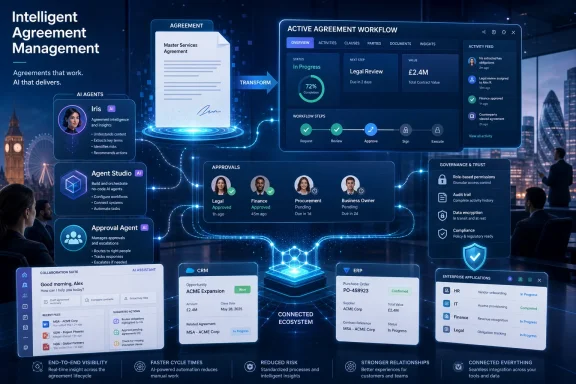 DocuSign Is Trying to Move From Signature Capture to Agreement Control
DocuSign’s old superpower was making the final step of a business process feel painless. A PDF arrived, a recipient clicked through highlighted fields, and the company took a toll at the moment of signature. That model made DocuSign synonymous with eSignature, but it also confined the company to a narrow slice of the agreement lifecycle.The Intelligent Agreement Management platform is DocuSign’s attempt to widen that slice into the whole workflow. The company’s argument is that a contract is not just a document to be signed, stored, and forgotten; it is a container full of obligations, dates, renewal triggers, pricing terms, approval requirements, and business risk. If those fields can be extracted, searched, summarized, and acted upon, the contract becomes a live system of record.
Iris is the AI engine attached to that claim. According to DocuSign’s product materials and recent announcements, Iris is positioned as agreement-specific AI rather than a general-purpose model pasted onto a document repository. That distinction matters because the enterprise AI market is already crowded with tools that can summarize PDFs. DocuSign’s claim is that contract context, workflow context, and historical agreement data make the automation more useful.
The Momentum London message, as described in the source material, is that Iris is moving from passive analysis toward action. The AI assistant can surface terms and answer natural-language questions. Agents can help review agreements against company standards, suggest edits, request approvals, monitor obligations, and trigger follow-up work. Agent Studio extends that concept by letting organizations customize agents around their own business logic.
That is the meaningful shift. A summarizer tells a user what a contract says. An agent, if governed properly, changes what happens next.
The Copilot Angle Is the Real Windows Story
For WindowsForum readers, the Microsoft Copilot integration is not a decorative partner logo. It points to where enterprise AI is headed: workers will not open a dozen separate AI assistants if their daily work already happens in Microsoft 365, Teams, Outlook, Edge, Dynamics, and Windows. Agreement intelligence has to appear where business users already live.That is why DocuSign’s push to bring agreement AI into tools like Microsoft Copilot is strategically important. If a sales manager can ask which customer contracts have nonstandard renewal terms, or a legal operations team can review risk flags without leaving Microsoft’s productivity environment, DocuSign becomes part of the enterprise AI workflow rather than only a destination app. The value shifts from “go to DocuSign to sign” to “agreement data is available at the point of decision.”
The same logic applies to Salesforce and SAP. Sales contracts originate around CRM opportunities. Procurement terms and supplier obligations often live around ERP workflows. HR agreements touch workforce systems. Legal teams increasingly want AI tools that understand negotiation history and approved playbooks. DocuSign’s ambition is to connect those silos without forcing every user back into a separate contract application.
That connection will not be simple to administer. Once agreement data is exposed to Copilot-like interfaces and agentic workflows, IT teams must think about permissions, identity, audit trails, data residency, retention policies, and least-privilege access in a new way. A contract repository that was once searched by a small legal team may become queryable through an assistant used by hundreds or thousands of employees.
The practical risk is not that Copilot will suddenly “know contracts.” The risk is that organizations will underestimate how much sensitive contract data becomes newly usable once it is connected to AI interfaces.
Agreement AI Is Useful Because Contracts Are Terrible Enterprise Data
DocuSign is leaning into a real enterprise problem. Contracts are among the most important documents a company produces, yet they are often among the least usable as data. They arrive as PDFs, Word files, scanned documents, email attachments, clause libraries, redlines, templates, and archived records scattered across departments.This is why the AI story has teeth. A company may know, in theory, that it has renewal exposure, indemnity obligations, pricing exceptions, privacy commitments, and service-level terms across thousands of agreements. In practice, those details are often trapped in documents that require manual review or specialist systems to interpret. The operational cost shows up as delayed deals, missed renewals, inconsistent terms, and legal teams stuck doing repetitive review.
DocuSign’s pitch is that IAM and Iris can turn those buried terms into structured workflow objects. That means not merely finding a clause, but routing a nonstandard clause to the right approver; not merely summarizing a contract, but checking it against a legal playbook; not merely storing a signed agreement, but monitoring obligations after signature.
Other outlets covering DocuSign’s contract AI push have emphasized speed: faster review, faster approvals, faster time to signature. That is fair, but speed is only the surface story. The deeper prize is operational control. If DocuSign can persuade enterprises that it is the safest place to structure agreement data and the most convenient place to automate against it, the platform becomes harder to replace.
The danger is that every major enterprise vendor sees the same opportunity. Microsoft wants Copilot to be the interface to work. Salesforce wants Agentforce and CRM data to drive sales workflows. SAP wants enterprise processes to remain anchored in its systems of record. Legal AI vendors want contract review and legal reasoning to remain their specialty. DocuSign is trying to sit between all of them without being swallowed by any one of them.
The Product Map Shows a Platform Strategy, Not a Feature Drop
The announced capabilities make more sense when viewed as a stack. Iris provides agreement AI. IAM supplies workflow and repository functions. Connectors bring agreement data into other systems. Agents perform repeatable work. Agent Studio gives customers a way to customize those agents. Integrations with Microsoft Copilot, Salesforce, SAP, and legal AI platforms move the output into daily work.| Capability or integration target | What DocuSign is trying to make possible | Why enterprises may care | Main IT governance question |
|---|---|---|---|
| Iris AI engine | Agreement-specific search, analysis, summaries, and actions | Turns contract language into usable business context | What contract data is used, retained, and exposed? |
| Customizable AI agents | Automated review, approvals, obligations tracking, and workflow steps | Reduces repetitive legal and business process work | Who can create, approve, and change agents? |
| Microsoft Copilot | Agreement intelligence inside Microsoft work surfaces | Lets users query and act on contracts without switching tools | How do Microsoft 365 permissions map to contract access? |
| Salesforce and SAP | Agreement workflows tied to CRM and ERP records | Connects contracts to sales, procurement, finance, and operations | Which system is authoritative when records conflict? |
| Leading legal AI platforms | Contract workflows linked to specialist legal AI tools | Gives legal teams AI assistance without isolating agreement data | How are privileged and sensitive materials separated? |
A proof-of-concept can show an AI assistant summarizing a master services agreement in seconds. A production deployment has to decide which subsidiaries’ contracts are in scope, which employees can see pricing terms, how negotiated exceptions are labeled, whether external counsel materials are included, how redlines are handled, and what happens when an agent recommends an edit that contradicts current policy.
The product vision also raises a data-quality problem. AI is only as useful as the agreement corpus behind it. Enterprises with inconsistent templates, duplicate records, missing metadata, and contracts spread across old repositories will not magically become agent-ready because Iris exists. The companies most likely to benefit first are the ones that already have disciplined legal operations, clean contract repositories, and clear approval rules.
That does not make the product less important. It makes implementation maturity the dividing line between an AI assistant that saves time and an automation layer that creates risk.
Investors Are Being Asked to Believe IAM Can Outgrow eSignature Gravity
The financial narrative in the source material is blunt: to own DocuSign today, investors have to believe Intelligent Agreement Management can meaningfully extend the company beyond core eSignature. That is the right framing. The market already understands the eSignature business; the question is whether IAM can restart durable growth without crushing margins or being commoditized by larger platforms.Simply Wall St’s narrative projects $4.0 billion in revenue and $482.3 million in earnings by 2029. That scenario requires 7.5% yearly revenue growth and about a $173 million earnings increase from $309.1 million today, producing a stated 27% upside to the current price. The more optimistic analyst camp cited in the same material assumes revenue of about US$4.2 billion and earnings near US$633.6 million by 2029.
Those numbers are not just spreadsheet assumptions. They encode a product thesis. Revenue growth at that level implies IAM adoption, upsell, and enterprise penetration strong enough to offset the slowing-growth concerns that have dogged DocuSign since the pandemic-era eSignature boom faded. Earnings expansion implies the company can do that without letting AI infrastructure costs, sales investment, and platform buildout consume the upside.
That is a high bar. AI features are expensive to build and support. Enterprise platform sales are slower and more complex than transactional eSignature adoption. Integrations with Microsoft, Salesforce, SAP, and legal AI platforms may help distribution, but they also create dependencies on ecosystems that have their own AI ambitions.
The bearish counterpoint in the source material is captured by the reference to why the stock might be worth just $46.89. That figure is a reminder that investors can accept the product excitement and still reject the valuation. If IAM becomes a useful attach feature rather than a must-have platform, or if customers delay purchases while Microsoft and other vendors expand native capabilities, the growth narrative weakens quickly.
DocuSign’s addition to the Russell 2500 Growth, Value, and core indexes may help visibility and liquidity, as the source material notes, but index inclusion does not solve the operating question. It can put the story in front of more institutional portfolios. It cannot prove that Iris turns agreement data into a new category of enterprise software spending.
Russell Index Inclusion Helps Visibility, Not Product-Market Fit
Index inclusion is easy to overstate. Being added to the Russell 2500 Growth, Value, and core indexes can create mechanical demand from funds and portfolios that track or benchmark against those indexes. It can also make a company harder for institutions to ignore. For a mid-cap software name trying to tell a platform reinvention story, that matters at the margins.But Russell inclusion does not validate IAM. It does not demonstrate that customers will standardize agreement workflows on DocuSign. It does not prove that Copilot integrations will be widely adopted. It does not remove competitive pressure. It does not answer whether AI agents will be trusted with legal and commercial workflows.
The more realistic interpretation is that index inclusion gives DocuSign a better stage at a time when it needs one. The company is trying to explain a transition from eSignature utility to agreement intelligence platform. More institutional visibility can amplify that message, especially while DocuSign is rolling out deeper integrations and trying to show that IAM has enterprise momentum.
That stage cuts both ways. As more investors watch the IAM story, quarterly execution becomes more important. Guidance softness, slower expansion, or weak evidence of IAM monetization will be harder to dismiss as transitional noise. The same spotlight that helps the narrative travel can punish it if the product proof lags the promise.
The Competitive Risk Is Platform Consolidation
DocuSign’s core strategic challenge is that agreement work touches every major enterprise platform. That makes IAM valuable, but it also makes it contested.Microsoft has the user interface layer through Windows, Microsoft 365, Teams, Outlook, SharePoint, and Copilot. Salesforce has the customer and opportunity layer. SAP has the operational and financial process layer. Legal AI startups and established CLM vendors have domain-specific review and drafting capabilities. Enterprise content management systems already hold many documents. Identity, compliance, and governance vendors control adjacent trust layers.
DocuSign’s opportunity is to be neutral and agreement-native across those systems. Its risk is becoming a feature inside someone else’s workflow. If Microsoft Copilot becomes the primary user experience, if Salesforce owns the sales process, and if SAP owns the procurement and finance process, DocuSign has to prove that agreement intelligence is differentiated enough to command platform economics.
The Iris argument is designed to answer that. DocuSign can say it has deep agreement history, domain-tuned AI, workflow knowledge, and a massive installed base. It can argue that general-purpose AI does not understand contracts well enough, and that point solutions do not span the full agreement lifecycle. It can position IAM as connective tissue rather than another silo.
Still, enterprise buyers are wary of adding platforms. Every CIO has seen “single source of truth” claims multiply into yet another dashboard. Every legal department has seen automation projects stall because exceptions overwhelm workflows. Every security team has learned that AI integrations turn permission mistakes into data-exposure events.
For DocuSign, the sales motion has to prove consolidation, not complexity. IAM must replace fragmented processes or make existing systems more useful. If it merely adds another administrative layer, the platform story will struggle.
Timeline
The verified timeline is less about a set of precise dated milestones and more about a phased product transition. The unsupported specific dates previously attached to individual product announcements should not be treated as established facts unless separately confirmed by DocuSign’s own release materials or other primary documentation.| Phase | What is supported by the source material | Why it matters |
|---|---|---|
| Recent Momentum London announcement | DocuSign highlighted Iris, AI assistant and agent capabilities, Agent Studio, and deeper integrations with Microsoft Copilot, Salesforce, SAP, and legal AI platforms. | This is the core event behind the current IAM investment discussion. |
| Current IAM push | DocuSign is positioning Intelligent Agreement Management as a broader platform around agreement creation, review, signature, storage, search, and post-signature action. | This reframes the company beyond eSignature and gives investors a new growth thesis to evaluate. |
| Phased rollout through 2027 | The source material describes many capabilities and integrations as rolling out in stages through 2027. | The platform transition should be judged over multiple quarters, not as a single product drop. |
| Next one to two quarters | Investors and admins should watch for customer adoption signals, integration details, permission models, and evidence that IAM is moving from pilots into production. | Near-term execution will determine whether the announcement becomes a durable catalyst or remains a strategic promise. |
Admins Should Treat Agreement AI Like a New Data Plane
The most important IT implication is that agreement AI creates a new data plane. Contracts are not ordinary documents. They contain pricing, commercial strategy, employee data, customer commitments, supplier obligations, security terms, merger discussions, geographic restrictions, and sometimes privileged legal material. Making that data searchable and actionable through assistants changes its blast radius.Admins should therefore resist the urge to treat DocuSign’s AI integrations as a routine SaaS add-on. The moment agreement data flows into Copilot, CRM, ERP, or legal AI tools, access control becomes multi-system. A user who cannot open a contract in DocuSign should not be able to infer its terms through an assistant. A sales user may need renewal dates but not legal negotiation notes. HR teams may need employment agreements but not supplier pricing. Legal may need full context but only within privileged workspaces.
The governance model has to cover both human and agent activity. If an AI agent can suggest edits, route approvals, or trigger workflow steps, then its permissions matter as much as a user account’s permissions. Organizations need to know who created the agent, what policy it follows, what systems it can access, what actions it can take, and how those actions are logged.
There is also a lifecycle problem. Contract rules change. Legal playbooks evolve. Approval thresholds shift. Regulatory requirements vary by region. A custom agent that was correct six months ago may become risky if its underlying instructions or allowed actions are not reviewed. Agent governance must therefore include versioning, testing, approval, and retirement.
For Microsoft-heavy environments, Copilot integration adds another layer of complexity. Microsoft 365 already has its own sensitivity labels, retention settings, audit logs, conditional access policies, data-loss-prevention rules, and identity controls. DocuSign agreement data entering that world should be mapped deliberately, not assumed to inherit perfect protections by default.
Action checklist for admins
- Start with Entra ID groups, not individual exceptions. Create dedicated Microsoft Entra ID security groups for DocuSign IAM pilot users, Copilot-enabled agreement users, legal reviewers, finance approvers, and admin roles. Avoid broad “all employees” access until the permission model has been tested.
- Use least-privilege access in DocuSign and Microsoft 365. Map DocuSign roles to Microsoft 365 groups before enabling AI-assisted search. Confirm that users can only query agreement classes they are already allowed to access.
- Apply Microsoft Purview sensitivity labels to agreement content where appropriate. Separate customer contracts, supplier agreements, HR documents, board materials, privileged legal content, and high-value pricing files. Use label-based encryption or access restrictions for the most sensitive categories where the organization already supports that model.
- Review SharePoint and OneDrive sharing before connecting data. If signed agreements, drafts, or redlines are stored in Microsoft 365, check for overshared sites, anonymous links, stale guest access, and inherited permissions that could leak data through search or Copilot experiences.
- Use Microsoft Purview Data Loss Prevention policies for contract data. Tune DLP rules around financial terms, personal data, customer identifiers, regulated information, and confidential deal language. Start in audit or test mode if the environment is complex, then enforce once false positives are understood.
- Turn on audit logging and review events. Use Microsoft Purview Audit and DocuSign audit capabilities where available to track assistant queries, document access, agent actions, approval routing, permission changes, and connector activity.
- Pilot with a narrow agreement class. Begin with a controlled set such as NDAs or standard sales agreements before expanding to supplier contracts, employment agreements, regulated customer commitments, or privileged legal files.
- Require agent registration and approval. Every custom agent should have a named owner, business purpose, allowed data sources, permitted actions, test cases, approval date, review cadence, and retirement plan.
- Test with known edge cases. Include nonstandard clauses, regional addenda, unusual renewal terms, liability exceptions, special pricing terms, and contracts with restricted access. The pilot should prove that the AI respects both document meaning and permissions.
- Define human-in-the-loop thresholds. Agents may summarize, flag, compare, or route, but legal and business owners should decide which actions require human approval before edits are accepted, obligations are changed, or approvals are recorded.
- Document data residency and retention assumptions. Confirm where agreement data, prompts, generated outputs, logs, and connector metadata are stored and how long they are retained. Align those settings with Microsoft 365 retention labels and existing records-management policies where practical.
- Review Conditional Access and device posture. For users who can query sensitive agreements through Microsoft 365 or connected tools, consider requiring multifactor authentication, compliant devices, managed browsers, or location-based controls.
- Create a rollback plan. Before expanding the pilot, define how to disable a connector, suspend an agent, revoke a group, remove a data source, or preserve logs for investigation.
Legal Teams Get Leverage, but They Also Lose Informal Control
Legal departments may be the biggest early beneficiaries of Iris and agents, but they also face the hardest cultural adjustment. Much legal work depends on controlled interpretation: knowing which clauses matter, when exceptions are acceptable, and when a business stakeholder is about to turn a small wording change into a large liability. AI can accelerate that work, but it also distributes parts of it to non-lawyers.A well-governed assistant can help business teams understand what an agreement says without waiting days for a lawyer to answer a routine question. An agent can check whether an NDA matches approved language. A contract review tool can suggest edits based on a playbook. These are valuable uses, especially for overburdened in-house teams.
But legal teams will need to decide where automation stops. Summarizing a renewal clause is different from advising whether to accept it. Flagging a liability cap is different from approving a deviation. Routing a contract for review is different from concluding that review is unnecessary. The more capable agents become, the more explicit those boundaries must be.
This is where DocuSign’s agreement-focused framing is both useful and dangerous. It is useful because legal teams do not want generic AI guessing about contract obligations. It is dangerous because “agreement-specific” can sound safer than it is. Even a domain-tuned system must be checked against company policy, jurisdictional differences, and the facts of the deal.
The organizations that do this well will not ask AI to replace legal judgment. They will use it to remove repetitive retrieval, comparison, routing, and status-tracking work so lawyers can spend more time on actual judgment.
The 2029 Math Depends on Whether IAM Becomes Habit
The difference between a compelling DocuSign thesis and a weak one is habit formation. If IAM becomes the place where enterprises routinely create, review, approve, sign, store, query, and act on agreements, the revenue and earnings scenarios cited in the investment narrative become easier to understand. If IAM remains an upsell attached to eSignature, the numbers look much more demanding.The $4.0 billion revenue and $482.3 million earnings projection by 2029 depends on sustained expansion. The optimistic analyst scenario of about US$4.2 billion in revenue and earnings near US$633.6 million by 2029 depends on an even stronger version of the same story. Both require customers to buy into IAM as a platform, not merely sample a few AI features.
That is why the integrations matter. A contract platform that requires users to leave their normal tools fights daily behavior. Agreement intelligence embedded into Copilot, Salesforce, SAP, and legal AI workflows has a better chance of becoming routine. The less visible DocuSign becomes as a separate destination, the more valuable it may become as infrastructure.
There is a paradox there. DocuSign’s best product outcome may be one in which users do not think, “I need to go to DocuSign.” They think, “I need to know what our agreement allows,” and DocuSign supplies the answer or action through the tool already open in front of them. That is platform relevance in the agentic AI era.
But investors should not confuse integration announcements with monetization. Many software companies can announce connectors. Fewer can turn connectors into durable pricing power. The market will eventually ask how much IAM is adding to average contract value, how quickly customers expand, whether AI features improve retention, and whether margins hold as usage grows.
DocuSign’s Momentum London story therefore strengthens the bull case by making the IAM strategy more concrete. It gives investors a clearer reason to believe the company can move beyond eSignature. It also gives skeptics a clearer checklist for what must be proven.
The bull case now rests on three claims. First, agreements are valuable enough as enterprise data to support a broader software platform. Second, DocuSign has enough domain advantage to remain relevant even as Microsoft, Salesforce, SAP, and legal AI vendors build their own AI layers. Third, customers will pay for that relevance in a way that shows up in growth and earnings, not just product demos.
The bear case is equally clear. If IAM adoption is slow, if Copilot and CRM-native experiences reduce DocuSign’s leverage, if AI costs pressure margins, or if enterprise buyers treat agreement AI as a feature rather than a budget category, the valuation argument becomes harder. The $46.89 downside scenario cited in the source material exists because strategic promise does not always become financial performance.
That is why the next one to two quarters matter. Watch for management commentary on IAM attach rates, enterprise pipeline quality, customer expansion, renewal behavior, AI usage, and integration adoption. Watch whether DocuSign talks about IAM as a driver of larger deals rather than only as a product vision. Watch whether gross margin, operating margin, and sales efficiency remain healthy as AI capabilities expand.
For Windows and Microsoft 365 admins, watch the product details rather than the slogans. The important questions are practical: how permissions map, how audit logs work, how Copilot access is constrained, how agents are approved, how data is retained, and how quickly a risky workflow can be disabled. If those controls are strong, agreement AI can become a useful productivity layer. If they are vague, the deployment risk rises.
DocuSign has a credible reason to argue that contracts should become active enterprise data. The company also has a credible problem: every major software platform wants to be where work happens. Momentum London made the strategy easier to understand, but it did not make the outcome inevitable. The investment case improves if IAM becomes a habit inside enterprise workflows. Until then, the right stance is constructive but demanding: the vision is stronger, the proof still has to arrive.
References
- Primary source: simplywall.st
Published: 2026-07-09T09:48:17.262592
Loading…
simplywall.st - Related coverage: docusign.com
Loading…
www.docusign.com - Related coverage: ecom.docusign.com
Loading…
ecom.docusign.com - Related coverage: dxe-demo.docusign.com
Loading…
dxe-demo.docusign.com - Related coverage: momentum.docusign.com
Loading…
momentum.docusign.com - Related coverage: esign.docusign.com
Loading…
esign.docusign.com
- Related coverage: investor.docusign.com
Loading…
investor.docusign.com - Related coverage: community.docusign.com
Loading…
community.docusign.com - Related coverage: zonebourse.com
Loading…
www.zonebourse.com - Related coverage: s21.q4cdn.com
Loading…
s21.q4cdn.com - Related coverage: assets.ctfassets.net
Loading…
assets.ctfassets.net - Related coverage: insight.com
Loading…
www.insight.com - Related coverage: techradar.com
Loading…
www.techradar.com - Related coverage: windowscentral.com
Loading…
www.windowscentral.com - Related coverage: itpro.com
Loading…
www.itpro.com - Related coverage: wallstreet-online.de
Loading…
www.wallstreet-online.de