

Pacific Northwest National Laboratory researchers used the May 7–9, 2026, AI+ Expo in Washington, D.C., to present DOE-backed work on the Genesis Mission, a federal push to combine artificial intelligence, supercomputing, scientific datasets, and laboratory automation for faster discovery. The headline version is simple: the national labs want AI to become infrastructure, not a novelty demo. The more consequential version is that DOE is trying to turn decades of taxpayer-funded instruments, data, and computing capacity into a coordinated scientific platform. If it works, the result will not look like a chatbot answering lab questions; it will look like a new layer of operating logic for American science.
The AI+ Expo was built for spectacle: thousands of attendees, hundreds of speakers, scores of exhibitors, and a Washington audience primed to hear that artificial intelligence is now a matter of competitiveness, security, and industrial strategy. That setting is useful, but it can also flatten the conversation. AI becomes a banner word, attached equally to defense systems, office software, robotics, biotech, and procurement slides.
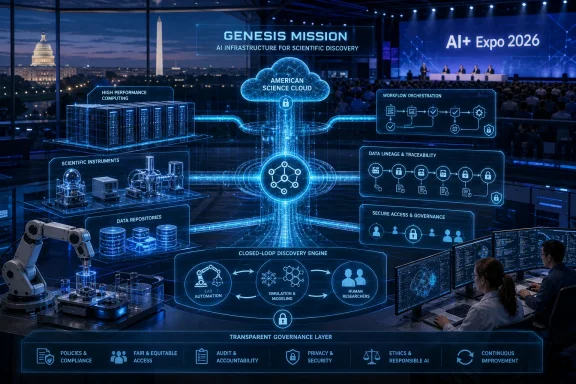
PNNL’s contribution cut in a different direction. Court Corley, the laboratory’s chief scientist for artificial intelligence, framed DOE’s Genesis Mission as something closer to a scientific operating system: an integrated stack of models, data, workflows, computing resources, and experimental capability. That is a more ambitious claim than “AI will help researchers work faster,” and also a more testable one.
The key distinction is between AI as a tool and AI as infrastructure. A tool helps a scientist summarize literature, write code, classify images, or search a dataset. Infrastructure changes how research is planned, executed, validated, and repeated across institutions. Genesis is aimed at the second category.
That matters because scientific AI has spent the last few years trapped between hype and fragmentation. Individual teams have produced impressive models and workflows, but the surrounding plumbing remains uneven: inaccessible data, incompatible metadata, brittle scripts, limited provenance, and security concerns that become sharper as research touches national security or critical energy systems. DOE’s bet is that the national lab complex can impose enough structure to make AI-driven science repeatable at scale.
That language can sound inflated, but DOE has a particular advantage in this race. The department sits on a rare combination of assets: world-class supercomputing, specialized experimental facilities, classified and unclassified mission work, and long-running scientific datasets that private AI firms cannot simply scrape from the public internet. If frontier AI companies have scale in consumer and enterprise text, DOE has scale in instruments, simulations, physics, chemistry, and national lab expertise.
The Genesis pitch is that those assets should no longer operate as loosely connected islands. Scientific discovery increasingly depends on moving among simulation, experiment, analysis, and iteration. In the ideal Genesis workflow, AI agents do not merely recommend a paper to read; they help acquire data, prepare it, run models, suggest experiments, compare results, and document what happened.
That is where the phrase closed loop becomes important. In ordinary software discourse, automation often means removing repetitive human work. In laboratory science, automation can mean creating a feedback cycle in which instruments, models, and researchers interact fast enough to explore a design space that would otherwise be unreachable. The human scientist remains central, but the tempo changes.
There is an obvious national competitiveness frame here. China, Europe, and the United States are all trying to bind AI capability to industrial policy and scientific advantage. The Genesis Mission is Washington’s answer to the idea that whoever best connects data, compute, models, and automated experimentation will gain an edge not only in AI, but in the physical sciences that underpin energy systems, chips, defense technology, and medicine.
That is the right emphasis. The public version of AI progress is often model-centric: a larger model, a better benchmark score, a more fluent interface. Scientific AI cannot live on that alone. A model trained on poorly governed data, dropped into a workflow nobody can reproduce, and evaluated with shallow benchmarks may look impressive in a demo and fail when it meets a real experimental campaign.
The Transformational AI Models Consortium, or ModCon, is meant to address that gap. Its role is not simply to build another foundation model, but to coordinate foundational AI capability across the DOE laboratory system. That includes the unglamorous but essential discipline of deciding how scientific workflows should be represented, how data should be brokered, and how models should be evaluated when the cost of being wrong is not merely a bad search result but a wasted experiment or a missed safety signal.
For WindowsForum readers, this is the part that should sound familiar. Enterprise IT has learned repeatedly that productivity claims collapse when identity, governance, logging, interoperability, and lifecycle management are treated as afterthoughts. Scientific AI is having the same realization at a larger and more expensive scale. The model is the visible artifact; the platform determines whether it survives contact with real work.
PNNL’s framing also suggests that DOE understands the difference between research AI and production AI. A clever notebook can prove a method. It cannot, by itself, support a multi-lab scientific mission with security constraints, provenance requirements, changing datasets, and researchers from different domains. Genesis will succeed or fail on whether it can make that transition without burying scientists under bureaucracy.
AI systems are only as useful as the environments in which they can safely reach data and compute. In ordinary enterprise settings, that means permissions, connectors, storage tiers, compliance, and observability. In DOE science, it means all of that plus instrument data, simulation outputs, classified boundaries, user facility policies, export controls, and the practical reality that scientific datasets are often too large, too specialized, or too messy to move casually.
A scientific cloud is not just a place to dump files. It is a governed substrate for collaboration. If Genesis is supposed to allow researchers at different labs to build on shared models and datasets, then the cloud layer has to answer basic but difficult questions: who can see which data, under what conditions, with what audit trail, and with what guarantees that downstream results can be traced back to their inputs?
This is where the analogy to Windows and enterprise platforms becomes useful. Users tend to notice the application. Administrators know the real story is identity, policy, updates, telemetry, and integration. Genesis is being sold in terms of breakthroughs; its durability will depend on platform engineering.
The risk is that “cloud” becomes a slogan while every lab continues to maintain its own habits. The opportunity is that DOE can create common patterns for scientific data and AI workflows without forcing every domain into the same rigid mold. That balance will be difficult. Too little standardization, and Genesis fragments; too much, and scientists route around it.
PNNL’s described projects span materials science, atmospheric science, grid modernization, autonomous experimentation, predictive phenomics, nuclear security, cybersecurity, and Earth system modeling. That range is notable because it rejects the idea that generative AI is one product category with one deployment pattern. The same family of techniques may support literature triage in one domain, model setup in another, cyber analysis in a third, and robotic lab planning in a fourth.
The ocean-modeling example from PNNL Earth scientist Preston Spicer is particularly instructive. Agentic systems reportedly assisted with data acquisition, preprocessing, model execution, post-processing, and visualization, producing a more user-friendly tool for oceanographers and supporting Earth system modeling and marine energy applications. That is not AI replacing science. It is AI reducing the friction around the work scientists already need to do.
This is the more realistic near-term impact of generative AI in research. The breakthrough may not be a machine proposing a Nobel-worthy theory. It may be a machine that makes a complicated modeling workflow usable by more people, with fewer hand-built scripts and less institutional knowledge trapped in one expert’s head. That is less cinematic, but potentially transformative.
It also raises the bar for engineering discipline. An AI assistant that helps set up an ocean model must be correct in ways that a consumer chatbot does not have to be. It needs to preserve assumptions, expose uncertainty, respect domain constraints, and leave behind a record that another scientist can inspect. In science, convenience without provenance is not productivity; it is a liability.
Scientific workflows are one of the few places where agentic systems could genuinely matter. A model that can fetch data, transform it, call simulation tools, evaluate results, and prepare visualizations is materially different from a chat interface. If connected to experimental systems, that model becomes part of a loop that can guide future measurements.
But this is also where the hazards compound. An agent that can make bad decisions faster is not an improvement. A system that silently changes preprocessing steps, misinterprets instrument metadata, or selects an invalid parameter range can contaminate results in ways that are hard to detect later. The more capable the agent, the more important its boundaries become.
DOE’s national lab culture may be an advantage here. These institutions are accustomed to safety cases, peer review, controlled access, and long-lived mission programs. They are not immune to hype, but they are less likely than a startup demo stage to treat “the agent did it” as an acceptable explanation. Genesis will need that culture if it is going to put autonomous or semi-autonomous workflows near consequential science.
The governance question should not be reduced to whether AI is “trusted.” Trust is not a mood. It is a system of constraints, tests, audits, fallbacks, and human accountability. PNNL’s attention to workflows, standards, and governance frameworks suggests that at least some of the right people are worrying about the right failure modes.
Scientific discovery often requires knowing why a model behaves the way it does, how it was trained, what data shaped its behavior, and how it can be adapted for domain-specific workloads. A black-box model may be useful for summarization or coding assistance, but it is a harder fit for high-stakes scientific inference. Researchers do not merely want answers; they want mechanisms, uncertainty estimates, and reproducible pathways.
At the same time, open models do not magically solve trust. A model can be open and still poorly evaluated, vulnerable, biased toward weak training data, or unsuitable for a domain. The real distinction is not open versus closed in the abstract, but whether the model can be governed, inspected, adapted, secured, and validated for a specific scientific mission.
DOE is likely to use a mix of approaches. Some workloads will fit commercial platforms. Others will demand custom models trained or fine-tuned on DOE data, running in controlled environments, with evaluation regimes built around scientific validity rather than consumer satisfaction. Genesis may become one of the most consequential proving grounds for that hybrid model.
For enterprise IT leaders watching from outside the lab world, this debate should feel familiar. The future is unlikely to be one model vendor blessed for every task. It will be a portfolio of models, deployment environments, policies, and risk tiers. The difference is that DOE’s use cases are a preview of what regulated industries will increasingly demand.
This is why the expo setting matters. AI+ Expo was not a purely academic conference. It was a national competitiveness event, built around the premise that AI, compute, biotechnology, energy, networks, manufacturing, and defense are now part of the same strategic conversation. PNNL’s presence there placed scientific AI squarely inside that policy frame.
That creates both funding momentum and political risk. When AI for science is sold as a competitiveness weapon, it can attract resources that ordinary research infrastructure struggles to obtain. It can also become vulnerable to inflated timelines, shifting priorities, and pressure to produce headline wins before the underlying systems are mature.
The national labs are well suited to long-horizon work, but they are not outside politics. Genesis will need to show progress quickly enough to justify itself while resisting the temptation to equate announcements with outcomes. The most valuable results may be boring at first: better metadata, more reliable workflows, reusable AI components, standardized evaluations, and stronger collaboration between labs.
Those are not the things that dominate keynote reels. They are the things that make later breakthroughs possible.
Scientific productivity is constrained by more than cognition. It is constrained by access to instruments, availability of clean data, simulation costs, experimental failure, review cycles, compliance requirements, and the coordination overhead of multidisciplinary teams. AI can help with many of those constraints, but it cannot wish them away.
The most credible Genesis use cases are therefore not magical. They are workflow-level interventions: automating setup, reducing data wrangling, improving search across specialized repositories, helping design experiments, comparing simulation and measurement, and making results easier to reproduce. Each one can shave time from a process that currently depends on human persistence and local expertise.
The less credible claims are the ones that imply discovery can be reduced to letting agents roam across datasets until breakthroughs fall out. Science is not just pattern recognition. It is a disciplined argument with nature, mediated by instruments, theory, statistics, and skepticism. AI can accelerate that argument, but it cannot replace the need to understand what is being asked.
PNNL’s examples are encouraging precisely because they focus on applied friction. A model that helps oceanographers set up workflows faster is not pretending to be an oceanographer. It is making oceanography less bottlenecked by software complexity. That is the kind of AI win that can accumulate.
The Windows world has spent decades living at the boundary between personal productivity and managed infrastructure. AI is collapsing that boundary further. Researchers, engineers, analysts, and administrators increasingly expect AI assistance on their endpoints, in their development environments, in cloud services, and inside specialized applications. The result is not one AI product, but a distributed computing fabric.
Genesis is an extreme version of that trend. It joins supercomputers, cloud systems, datasets, and edge-like experimental facilities into a platform for specialized work. Enterprises will not replicate DOE’s scale, but they will face smaller versions of the same problems: where models run, what data they can reach, how actions are logged, how outputs are validated, and how users are trained not to overtrust fluent systems.
Microsoft’s own AI strategy, from Copilot-branded productivity tools to Azure AI infrastructure, sits in the same broad movement. The difference is that business users often encounter AI first as an assistant in a document or chat window. Scientists encounter it as a potential participant in workflows where errors can corrupt experiments, not just prose. That higher bar is instructive.
The PC is not disappearing in this story. It is becoming one node in a larger AI workflow. Local devices, workstations, remote clusters, cloud APIs, and secure data environments will all matter. The old separation between “desktop computing” and “high-performance computing” is becoming less clean as AI moves across both.
Genesis is still early enough that much of its public identity is aspirational. That is normal for a major federal technology effort. The danger is that aspiration hardens into branding before engineering has caught up. The national labs should be judged less by how often they say “AI for science” and more by whether they can produce reusable components, credible evaluations, and workflows that independent teams can adopt.
PNNL’s role appears to be deliberately practical. The laboratory is showing up not only with claims about AI leadership, but with lessons from dozens of generative AI projects and with work on coordination, data standards, and workflow design. That is the posture Genesis needs more of. The project’s future will be built by people willing to argue about schemas, provenance, model validation, and security boundaries while everyone else is still staring at the keynote screen.
There is also a workforce dimension that should not be underestimated. If AI changes how science is done, it changes what scientists, engineers, and technicians need to know. The next generation of lab workers will need fluency across domain science, data engineering, AI evaluation, and automation. That does not mean every physicist becomes a machine learning researcher. It means the boundary between scientific expertise and computational practice gets thinner.
The best version of Genesis would not centralize intelligence in a model. It would distribute capability across people and platforms, making it easier for domain experts to use advanced computing without surrendering scientific judgment. That is a subtler goal than “AI discovers everything,” and a better one.
For IT professionals, that is the familiar pattern of a technology becoming real. First comes the demo. Then comes the integration debt. Then come the policies, logs, permissions, budgets, support tickets, and hard conversations about reliability. Scientific AI is entering that second and third phase.
A few practical conclusions stand out from PNNL’s appearance in Washington:
The AI+ Expo gave PNNL and DOE a national stage, but the real test will happen away from the banners: in laboratories, data repositories, workflow engines, security reviews, and the daily work of scientists trying to get reliable answers faster. Genesis is ambitious enough to deserve scrutiny and practical enough to deserve attention. If DOE can make AI infrastructure as disciplined as its best scientific facilities, the payoff will not be a single dazzling machine intelligence moment; it will be a gradual acceleration of discovery that future researchers may come to treat as normal.
 The National Labs Are Trying to Move AI Out of the Demo Booth
The AI+ Expo was built for spectacle: thousands of attendees, hundreds of speakers, scores of exhibitors, and a Washington audience primed to hear that artificial intelligence is now a matter of competitiveness, security, and industrial strategy. That setting is useful, but it can also flatten the conversation. AI becomes a banner word, attached equally to defense systems, office software, robotics, biotech, and procurement slides.PNNL’s contribution cut in a different direction. Court Corley, the laboratory’s chief scientist for artificial intelligence, framed DOE’s Genesis Mission as something closer to a scientific operating system: an integrated stack of models, data, workflows, computing resources, and experimental capability. That is a more ambitious claim than “AI will help researchers work faster,” and also a more testable one.
The key distinction is between AI as a tool and AI as infrastructure. A tool helps a scientist summarize literature, write code, classify images, or search a dataset. Infrastructure changes how research is planned, executed, validated, and repeated across institutions. Genesis is aimed at the second category.
That matters because scientific AI has spent the last few years trapped between hype and fragmentation. Individual teams have produced impressive models and workflows, but the surrounding plumbing remains uneven: inaccessible data, incompatible metadata, brittle scripts, limited provenance, and security concerns that become sharper as research touches national security or critical energy systems. DOE’s bet is that the national lab complex can impose enough structure to make AI-driven science repeatable at scale.
Genesis Is Washington’s Attempt to Industrialize Discovery
The Genesis Mission is not just another grant program with an AI label. DOE has described it as a coordinated effort that draws together national laboratories, industry, academia, high-performance computing, cloud resources, scientific user facilities, and large federal datasets. Its stated targets are suitably grand: energy, biotechnology, materials, computing, manufacturing, national security, and other areas where scientific progress has direct geopolitical weight.That language can sound inflated, but DOE has a particular advantage in this race. The department sits on a rare combination of assets: world-class supercomputing, specialized experimental facilities, classified and unclassified mission work, and long-running scientific datasets that private AI firms cannot simply scrape from the public internet. If frontier AI companies have scale in consumer and enterprise text, DOE has scale in instruments, simulations, physics, chemistry, and national lab expertise.
The Genesis pitch is that those assets should no longer operate as loosely connected islands. Scientific discovery increasingly depends on moving among simulation, experiment, analysis, and iteration. In the ideal Genesis workflow, AI agents do not merely recommend a paper to read; they help acquire data, prepare it, run models, suggest experiments, compare results, and document what happened.
That is where the phrase closed loop becomes important. In ordinary software discourse, automation often means removing repetitive human work. In laboratory science, automation can mean creating a feedback cycle in which instruments, models, and researchers interact fast enough to explore a design space that would otherwise be unreachable. The human scientist remains central, but the tempo changes.
There is an obvious national competitiveness frame here. China, Europe, and the United States are all trying to bind AI capability to industrial policy and scientific advantage. The Genesis Mission is Washington’s answer to the idea that whoever best connects data, compute, models, and automated experimentation will gain an edge not only in AI, but in the physical sciences that underpin energy systems, chips, defense technology, and medicine.
PNNL’s Message Was Less Glamorous and More Important Than the Slogan
PNNL’s presentations at the expo were not just institutional chest-thumping. Corley’s session on “ModCon, Building Transformational AI & Data for Science” focused on the less glamorous work required before scientific AI can be trusted across a lab complex: baseline research and development, data brokers, standards, workflows, and coordination among laboratories.That is the right emphasis. The public version of AI progress is often model-centric: a larger model, a better benchmark score, a more fluent interface. Scientific AI cannot live on that alone. A model trained on poorly governed data, dropped into a workflow nobody can reproduce, and evaluated with shallow benchmarks may look impressive in a demo and fail when it meets a real experimental campaign.
The Transformational AI Models Consortium, or ModCon, is meant to address that gap. Its role is not simply to build another foundation model, but to coordinate foundational AI capability across the DOE laboratory system. That includes the unglamorous but essential discipline of deciding how scientific workflows should be represented, how data should be brokered, and how models should be evaluated when the cost of being wrong is not merely a bad search result but a wasted experiment or a missed safety signal.
For WindowsForum readers, this is the part that should sound familiar. Enterprise IT has learned repeatedly that productivity claims collapse when identity, governance, logging, interoperability, and lifecycle management are treated as afterthoughts. Scientific AI is having the same realization at a larger and more expensive scale. The model is the visible artifact; the platform determines whether it survives contact with real work.
PNNL’s framing also suggests that DOE understands the difference between research AI and production AI. A clever notebook can prove a method. It cannot, by itself, support a multi-lab scientific mission with security constraints, provenance requirements, changing datasets, and researchers from different domains. Genesis will succeed or fail on whether it can make that transition without burying scientists under bureaucracy.
The American Science Cloud Is the Part Everyone Will Underestimate
The Genesis Mission’s public language includes the American Science Cloud, a collaborative cloud ecosystem for scientific research, data sharing, and analysis. That may sound less exciting than autonomous labs or self-improving AI models, but it may be the most important layer of the whole project.AI systems are only as useful as the environments in which they can safely reach data and compute. In ordinary enterprise settings, that means permissions, connectors, storage tiers, compliance, and observability. In DOE science, it means all of that plus instrument data, simulation outputs, classified boundaries, user facility policies, export controls, and the practical reality that scientific datasets are often too large, too specialized, or too messy to move casually.
A scientific cloud is not just a place to dump files. It is a governed substrate for collaboration. If Genesis is supposed to allow researchers at different labs to build on shared models and datasets, then the cloud layer has to answer basic but difficult questions: who can see which data, under what conditions, with what audit trail, and with what guarantees that downstream results can be traced back to their inputs?
This is where the analogy to Windows and enterprise platforms becomes useful. Users tend to notice the application. Administrators know the real story is identity, policy, updates, telemetry, and integration. Genesis is being sold in terms of breakthroughs; its durability will depend on platform engineering.
The risk is that “cloud” becomes a slogan while every lab continues to maintain its own habits. The opportunity is that DOE can create common patterns for scientific data and AI workflows without forcing every domain into the same rigid mold. That balance will be difficult. Too little standardization, and Genesis fragments; too much, and scientists route around it.
Generative AI Looks Different When the Customer Is a Scientist
Tom Grimes, senior data scientist and chief scientist of PNNL’s Generative AI Initiative, brought the conversation closer to implementation. His presentation, “So You Have a Model… Now What? Lessons from 50+ Generative AI Projects,” is the sort of title that should be taped above every enterprise AI pilot. The problem is rarely whether someone can get a model to produce an impressive first answer. The problem is what happens after the demo.PNNL’s described projects span materials science, atmospheric science, grid modernization, autonomous experimentation, predictive phenomics, nuclear security, cybersecurity, and Earth system modeling. That range is notable because it rejects the idea that generative AI is one product category with one deployment pattern. The same family of techniques may support literature triage in one domain, model setup in another, cyber analysis in a third, and robotic lab planning in a fourth.
The ocean-modeling example from PNNL Earth scientist Preston Spicer is particularly instructive. Agentic systems reportedly assisted with data acquisition, preprocessing, model execution, post-processing, and visualization, producing a more user-friendly tool for oceanographers and supporting Earth system modeling and marine energy applications. That is not AI replacing science. It is AI reducing the friction around the work scientists already need to do.
This is the more realistic near-term impact of generative AI in research. The breakthrough may not be a machine proposing a Nobel-worthy theory. It may be a machine that makes a complicated modeling workflow usable by more people, with fewer hand-built scripts and less institutional knowledge trapped in one expert’s head. That is less cinematic, but potentially transformative.
It also raises the bar for engineering discipline. An AI assistant that helps set up an ocean model must be correct in ways that a consumer chatbot does not have to be. It needs to preserve assumptions, expose uncertainty, respect domain constraints, and leave behind a record that another scientist can inspect. In science, convenience without provenance is not productivity; it is a liability.
The Agentic Science Story Needs Guardrails, Not Applause
The phrase agentic AI has become one of the most abused terms in the industry. In its most useful form, it describes software that can plan and execute multi-step tasks using tools, feedback, and some degree of autonomy. In its least useful form, it is marketing foam sprayed over ordinary automation.Scientific workflows are one of the few places where agentic systems could genuinely matter. A model that can fetch data, transform it, call simulation tools, evaluate results, and prepare visualizations is materially different from a chat interface. If connected to experimental systems, that model becomes part of a loop that can guide future measurements.
But this is also where the hazards compound. An agent that can make bad decisions faster is not an improvement. A system that silently changes preprocessing steps, misinterprets instrument metadata, or selects an invalid parameter range can contaminate results in ways that are hard to detect later. The more capable the agent, the more important its boundaries become.
DOE’s national lab culture may be an advantage here. These institutions are accustomed to safety cases, peer review, controlled access, and long-lived mission programs. They are not immune to hype, but they are less likely than a startup demo stage to treat “the agent did it” as an acceptable explanation. Genesis will need that culture if it is going to put autonomous or semi-autonomous workflows near consequential science.
The governance question should not be reduced to whether AI is “trusted.” Trust is not a mood. It is a system of constraints, tests, audits, fallbacks, and human accountability. PNNL’s attention to workflows, standards, and governance frameworks suggests that at least some of the right people are worrying about the right failure modes.
The Open Model Debate Comes to the Laboratory Door
Genesis also arrives amid a broader fight over open and closed AI models. Commercial AI firms have built powerful closed systems with tightly controlled weights and APIs. Open-weight model companies argue that scientific users need inspectability, customizability, and the ability to run models close to sensitive data. DOE’s needs make that debate less ideological and more operational.Scientific discovery often requires knowing why a model behaves the way it does, how it was trained, what data shaped its behavior, and how it can be adapted for domain-specific workloads. A black-box model may be useful for summarization or coding assistance, but it is a harder fit for high-stakes scientific inference. Researchers do not merely want answers; they want mechanisms, uncertainty estimates, and reproducible pathways.
At the same time, open models do not magically solve trust. A model can be open and still poorly evaluated, vulnerable, biased toward weak training data, or unsuitable for a domain. The real distinction is not open versus closed in the abstract, but whether the model can be governed, inspected, adapted, secured, and validated for a specific scientific mission.
DOE is likely to use a mix of approaches. Some workloads will fit commercial platforms. Others will demand custom models trained or fine-tuned on DOE data, running in controlled environments, with evaluation regimes built around scientific validity rather than consumer satisfaction. Genesis may become one of the most consequential proving grounds for that hybrid model.
For enterprise IT leaders watching from outside the lab world, this debate should feel familiar. The future is unlikely to be one model vendor blessed for every task. It will be a portfolio of models, deployment environments, policies, and risk tiers. The difference is that DOE’s use cases are a preview of what regulated industries will increasingly demand.
National Security Is Not a Side Channel
The Genesis Mission is often described in terms of scientific discovery, but national security is not incidental to the project. DOE’s laboratory system has deep responsibilities in nuclear security, grid resilience, cybersecurity, critical materials, and other domains where scientific capability and strategic power overlap. AI that accelerates discovery in those areas also accelerates the stakes.This is why the expo setting matters. AI+ Expo was not a purely academic conference. It was a national competitiveness event, built around the premise that AI, compute, biotechnology, energy, networks, manufacturing, and defense are now part of the same strategic conversation. PNNL’s presence there placed scientific AI squarely inside that policy frame.
That creates both funding momentum and political risk. When AI for science is sold as a competitiveness weapon, it can attract resources that ordinary research infrastructure struggles to obtain. It can also become vulnerable to inflated timelines, shifting priorities, and pressure to produce headline wins before the underlying systems are mature.
The national labs are well suited to long-horizon work, but they are not outside politics. Genesis will need to show progress quickly enough to justify itself while resisting the temptation to equate announcements with outcomes. The most valuable results may be boring at first: better metadata, more reliable workflows, reusable AI components, standardized evaluations, and stronger collaboration between labs.
Those are not the things that dominate keynote reels. They are the things that make later breakthroughs possible.
The Productivity Claim Will Be Won or Lost in the Workflow
Every AI era has its productivity story. In offices, the claim is that AI will draft documents, summarize meetings, write code, and automate routine tasks. In science, the claim is larger: AI will compress the time between hypothesis and result. That is plausible, but only if the workflow changes around the model.Scientific productivity is constrained by more than cognition. It is constrained by access to instruments, availability of clean data, simulation costs, experimental failure, review cycles, compliance requirements, and the coordination overhead of multidisciplinary teams. AI can help with many of those constraints, but it cannot wish them away.
The most credible Genesis use cases are therefore not magical. They are workflow-level interventions: automating setup, reducing data wrangling, improving search across specialized repositories, helping design experiments, comparing simulation and measurement, and making results easier to reproduce. Each one can shave time from a process that currently depends on human persistence and local expertise.
The less credible claims are the ones that imply discovery can be reduced to letting agents roam across datasets until breakthroughs fall out. Science is not just pattern recognition. It is a disciplined argument with nature, mediated by instruments, theory, statistics, and skepticism. AI can accelerate that argument, but it cannot replace the need to understand what is being asked.
PNNL’s examples are encouraging precisely because they focus on applied friction. A model that helps oceanographers set up workflows faster is not pretending to be an oceanographer. It is making oceanography less bottlenecked by software complexity. That is the kind of AI win that can accumulate.
Windows, Workstations, and the Quiet Return of Serious Computing
At first glance, a DOE scientific AI initiative may seem far removed from the everyday concerns of Windows enthusiasts and IT administrators. It is not. The same forces reshaping national labs are already moving through enterprise computing: AI workloads are becoming local, hybrid, governed, and deeply dependent on hardware, identity, and data architecture.The Windows world has spent decades living at the boundary between personal productivity and managed infrastructure. AI is collapsing that boundary further. Researchers, engineers, analysts, and administrators increasingly expect AI assistance on their endpoints, in their development environments, in cloud services, and inside specialized applications. The result is not one AI product, but a distributed computing fabric.
Genesis is an extreme version of that trend. It joins supercomputers, cloud systems, datasets, and edge-like experimental facilities into a platform for specialized work. Enterprises will not replicate DOE’s scale, but they will face smaller versions of the same problems: where models run, what data they can reach, how actions are logged, how outputs are validated, and how users are trained not to overtrust fluent systems.
Microsoft’s own AI strategy, from Copilot-branded productivity tools to Azure AI infrastructure, sits in the same broad movement. The difference is that business users often encounter AI first as an assistant in a document or chat window. Scientists encounter it as a potential participant in workflows where errors can corrupt experiments, not just prose. That higher bar is instructive.
The PC is not disappearing in this story. It is becoming one node in a larger AI workflow. Local devices, workstations, remote clusters, cloud APIs, and secure data environments will all matter. The old separation between “desktop computing” and “high-performance computing” is becoming less clean as AI moves across both.
The Hard Part Is Making the Platform Boring
The most successful infrastructure eventually becomes boring. Nobody applauds when authentication works, when data lineage is preserved, when a job scheduler behaves, or when a model evaluation pipeline catches a regression. But those are the conditions under which ambitious science can safely accelerate.Genesis is still early enough that much of its public identity is aspirational. That is normal for a major federal technology effort. The danger is that aspiration hardens into branding before engineering has caught up. The national labs should be judged less by how often they say “AI for science” and more by whether they can produce reusable components, credible evaluations, and workflows that independent teams can adopt.
PNNL’s role appears to be deliberately practical. The laboratory is showing up not only with claims about AI leadership, but with lessons from dozens of generative AI projects and with work on coordination, data standards, and workflow design. That is the posture Genesis needs more of. The project’s future will be built by people willing to argue about schemas, provenance, model validation, and security boundaries while everyone else is still staring at the keynote screen.
There is also a workforce dimension that should not be underestimated. If AI changes how science is done, it changes what scientists, engineers, and technicians need to know. The next generation of lab workers will need fluency across domain science, data engineering, AI evaluation, and automation. That does not mean every physicist becomes a machine learning researcher. It means the boundary between scientific expertise and computational practice gets thinner.
The best version of Genesis would not centralize intelligence in a model. It would distribute capability across people and platforms, making it easier for domain experts to use advanced computing without surrendering scientific judgment. That is a subtler goal than “AI discovers everything,” and a better one.
The PNNL Story Is Really a Platform Story
PNNL’s AI+ Expo showcase should be read as a signal of where federal scientific computing is going, not just as a laboratory news item. The concrete details matter because they show how far the conversation has moved beyond generic AI enthusiasm. Genesis is about model development, yes, but also about clouds, brokers, standards, workflows, agents, evaluation, and governance.For IT professionals, that is the familiar pattern of a technology becoming real. First comes the demo. Then comes the integration debt. Then come the policies, logs, permissions, budgets, support tickets, and hard conversations about reliability. Scientific AI is entering that second and third phase.
A few practical conclusions stand out from PNNL’s appearance in Washington:
- The Genesis Mission is positioning AI as shared scientific infrastructure rather than a collection of isolated lab experiments.
- PNNL’s ModCon work points to the importance of data standards, workflow design, and model evaluation before AI can be trusted across the DOE lab complex.
- Generative AI’s near-term scientific value may come less from autonomous discovery and more from reducing friction in complex modeling and analysis workflows.
- Agentic systems could meaningfully accelerate science only if their actions are auditable, bounded, and reproducible.
- The American Science Cloud may become the decisive layer because scientific AI needs governed access to data, compute, and collaboration environments.
- The same governance problems facing DOE will increasingly face enterprises as AI moves from chat interfaces into real operational workflows.
The AI+ Expo gave PNNL and DOE a national stage, but the real test will happen away from the banners: in laboratories, data repositories, workflow engines, security reviews, and the daily work of scientists trying to get reliable answers faster. Genesis is ambitious enough to deserve scrutiny and practical enough to deserve attention. If DOE can make AI infrastructure as disciplined as its best scientific facilities, the payoff will not be a single dazzling machine intelligence moment; it will be a gradual acceleration of discovery that future researchers may come to treat as normal.
References
- Primary source: HPCwire
Published: 2026-05-29T22:40:36.463204
BigDATAwire - Data Science • AI • Advanced Analytics
Advancing DOE’s Genesis Mission for scientific discovery and national competitiveness RICHLAND, Wash., May 29, 2026 — Beneath the glow of exhibit hall banners and the hum of thousands of conversations […]www.hpcwire.com - Related coverage: pnnl.gov
PNNL Researchers Showcase AI Leadership at AI+ Expo
PNNL researchers highlighted advances in AI for scientific discovery at the AI+ Expo, showcasing generative AI, autonomous research workflows, and scalable AI systems supporting energy, security, and national competitiveness.www.pnnl.gov - Related coverage: catalyst-magazine.com
The Catalyst Reviews — STEM Book Reviews | The Catalyst Magazine
The Catalyst Reviews: honest STEM book reviews from The Catalyst Magazine. Astronomy, biology, chemistry, climate, computer science, math, physics & memoir.www.catalyst-magazine.com - Related coverage: wicys.org
WiCyS | AI+ Expo | WiCyS - Women in Cybersecurity
 www.wicys.org
- Related coverage: eventsdc.com
AI+ Expo: 250 Years of American Innovation | Events DC
On May 7-9, SCSP is hosting its third AI+ Expo – alongside The Exchange – at the Walter E. Washington Convention Center. The AI+ Expo is the place to convene and build relationships around AI, technology, and U.S. and allied competitiveness. The powerful purpose behind this one of a kind event...eventsdc.com - Related coverage: energy.gov
Savannah River National Laboratory Makes Strong Showing at 2026 AI+ Expo
Savannah River National Laboratory showcased how it’s advancing the U.S. Department of Energy’s Genesis Mission through applied artificial intelligence and machine learning research and innovation at the 2026 AI+ Expo in Washington, D.C. May 19, 2026www.energy.gov
- Related coverage: createwith.com
AI+ Expo 2026: America's Largest AI Innovation Showcase | Washington | Create With
The [AI+ Expo 2026](https://expo.scsp.ai/register/) arrives in [Washington](https://www.createwith.com/cities/washington) this May as the capital's...www.createwith.com - Related coverage: cantonfair.net
AI Expo for National Competitiveness
The AI+ Expo, held May 7‑9, 2026 in Washington, D.C., gathered about 15,000 government, academic, and industry leaders to showcase and discuss cutting‑edge artificial‑intelligence and emerging‑technology solutions. Exhibitors displayed innovations [...]www.cantonfair.net - Related coverage: expo.scsp.ai
