

China’s AI Compute Problem Is Becoming an Architecture Problem
The American export-control regime was designed to make China’s AI ambitions bottleneck on hardware. Washington has restricted access to the most capable GPUs, the tools needed to manufacture the densest chips, and the supply-chain layers that make advanced AI accelerators viable at scale. That does not stop Chinese companies from designing chips, but it does force them to answer a harsher question: how much performance can be extracted from manufacturing nodes and supply chains that are not at the global frontier?
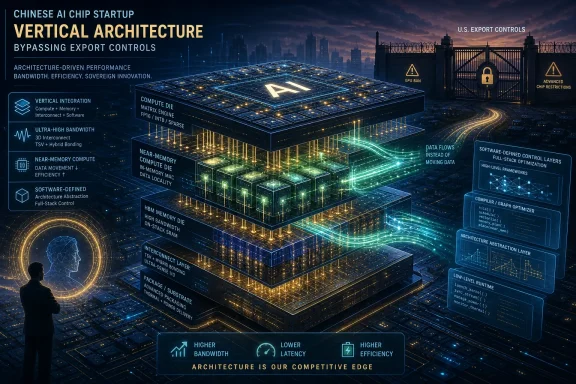
Dongfang Suanxin’s answer, according to the South China Morning Post, is to combine “software-defined chips” with “3D stacked near-memory computing.” That phrase sounds like the sort of corporate abstraction that usually evaporates under scrutiny, but in this case it points to a real technical pressure point. Modern AI workloads are not limited only by arithmetic; they are limited by how quickly enormous quantities of data can move between memory and compute.
That is why near-memory computing has become more than an academic curiosity. If data movement consumes power, adds latency, and constrains throughput, then pushing computation closer to memory can improve efficiency even when the underlying process node is not world-leading. In AI inference and training, where memory bandwidth can be the difference between a useful accelerator and an expensive space heater, the appeal is obvious.
But the catch is just as obvious. Architecture can compensate for manufacturing disadvantage only up to a point. A clever layout, a shorter interconnect, or a denser package does not magically create the yield, thermal headroom, software ecosystem, or high-bandwidth memory supply that Nvidia, TSMC, SK hynix, Samsung, and their partners have spent years industrializing.
Dongfang Suanxin Is Selling a Workaround, Not a Miracle
Wei Shaojun is not a random founder attaching himself to the AI boom. He is a well-known figure in China’s chip industry, vice-president of the China Semiconductor Industry Association, and a long-time academic and industry voice on semiconductor self-reliance. That gives Dongfang Suanxin’s emergence more weight than the typical stealth-mode reveal.
The company’s public positioning is also carefully tuned to China’s current industrial mood. The South China Morning Post reported that Dongfang Suanxin says its technology relies entirely on a domestic supply chain. In 2026, that is not just a procurement detail. It is a political and commercial claim aimed at customers who fear that a promising accelerator could become unusable if one imported substrate, EDA dependency, memory component, or packaging step is cut off.
Still, “domestic supply chain” can mean many things. It may mean the company avoids directly restricted foreign technology in its current design. It may mean it has a roadmap to localize components over time. Or it may mean the phrase is doing strategic work before volume production proves the point. The important distinction is between a demonstrator that can be announced and a production platform that can be purchased, deployed, supported, and scaled.
That gap is where many AI-chip start-ups have gone to die. The chip itself is only the beginning. AI accelerators need compilers, kernels, frameworks, developer tools, model-optimization pathways, board-level integration, cluster networking, and enough customer patience to rewrite workloads that already run well on Nvidia’s CUDA stack. China has a strong incentive to make that leap, but incentive is not the same as maturity.
The Vertical Turn Is Bigger Than One Start-Up
Dongfang Suanxin’s timing is not accidental. In late May 2026, Huawei used the IEEE International Symposium on Circuits and Systems in Shanghai to present what it calls the Tau Scaling Law, a framework intended to shift attention from transistor shrinkage to signal and data movement across chips and systems. Reuters reported that Huawei expects to design high-end chips by 2031 with transistor density equivalent to 1.4-nanometer processes, even under sanctions that limit access to advanced chipmaking equipment.
That claim should be treated with caution. “Equivalent” density is not the same as mass-producing a 1.4-nanometer-class chip with the cost, yield, power, and reliability characteristics of a native leading-edge process. Huawei’s argument is that 3D architectural innovation, including what it calls LogicFolding, can deliver performance and density gains by shortening signal paths and using vertical integration more aggressively.
The broader point is that Huawei has given China’s chip industry a language for turning constraint into strategy. If China cannot count on EUV lithography at the frontier, it can emphasize 3D stacking, chiplets, near-memory compute, and system-level optimization. That does not make sanctions irrelevant. It changes the battlefield.
The semiconductor industry was already moving this way. Advanced packaging, high-bandwidth memory, chiplet integration, and 2.5D interposers are central to the AI hardware boom everywhere, not just in China. Nvidia’s highest-end platforms are as much feats of packaging and memory integration as they are GPU design. AMD, Intel, TSMC, Samsung, and others have all bet heavily on heterogeneous integration because traditional Moore’s Law scaling has become slower, more expensive, and more complicated.
China’s twist is that it is treating this industry-wide transition as a sanctions escape route. That is both logical and risky. Logical, because 3D integration attacks real bottlenecks. Risky, because the most advanced packaging ecosystem is itself difficult to build and can be subject to its own chokepoints.
Moore’s Law Did Not End; It Became More Expensive
The rhetoric around post-Moore computing often makes it sound as if the old semiconductor order has collapsed. It has not. TSMC, Samsung, and Intel are still pushing advanced nodes, and the customers who can afford them still gain real advantages from smaller transistors. What has changed is that scaling is no longer a simple, universal bargain.
For decades, the industry could count on smaller transistors to deliver better density, power, and performance on a roughly predictable cadence. That certainty has eroded. Each new node demands more complex manufacturing, more expensive tools, more design effort, and more selective benefits. The result is not the death of Moore’s Law so much as its transformation into an elite sport.
That is why 3D stacking has become attractive. Instead of only shrinking features on a flat plane, engineers can stack logic, memory, or cache vertically, shorten interconnects, and increase bandwidth. High-bandwidth memory is the most familiar example: stack DRAM dies, connect them through advanced packaging, and feed accelerators with the bandwidth they need.
Near-memory computing pushes the idea further. Rather than treating memory as a distant warehouse that must be constantly shuttled to and from compute units, the architecture tries to reduce that distance. For AI workloads, where the movement of weights and activations can dominate energy and latency, this is not a cosmetic improvement. It attacks one of the central inefficiencies of modern computing.
But 3D stacking also creates new enemies. Heat becomes harder to remove. Testing becomes more complicated. Yield losses can compound when multiple dies are integrated. Design tools must understand vertical structures, not merely flat layouts. Manufacturing defects that would be tolerable in separate components can become catastrophic in a tightly bonded stack.
The Sanctions Workaround Still Runs Through Industrial Reality
It is tempting to describe Dongfang Suanxin and Huawei as proof that export controls are failing. That would be premature. Export controls were never likely to freeze China’s chip industry in place; they were meant to slow it, raise costs, and deny access to the most powerful combinations of tools and components. On that measure, the controls have clearly shaped Chinese strategy.
The turn toward 3D stacking is itself evidence of pressure. If Chinese firms had unrestricted access to the same manufacturing and accelerator supply chains as their U.S. and Taiwanese competitors, they would not need to market architectural detours as national breakthroughs. They would simply buy, build, and iterate on the frontier.
Yet the reverse mistake is also common: assuming that because China lacks some leading-edge tools, it cannot innovate around the bottleneck. Semiconductor history is full of architectural substitutions, packaging breakthroughs, and system-level optimizations that changed what counted as “advanced.” The frontier is not one line; it is a stack of trade-offs.
For enterprise buyers, the question is not whether Dongfang Suanxin can defeat Nvidia in a benchmark slide. The question is whether domestic accelerators can become good enough for enough workloads inside China’s constrained market. Inference, government workloads, research clusters, telecom AI, industrial vision, and sovereign cloud deployments do not all require the same hardware profile. A chip that is not globally best-in-class can still be strategically important if it is available, supportable, and politically safe.
That is the lesson Huawei has already tried to teach with its Ascend ecosystem. The software gap remains significant, but customers under geopolitical pressure may tolerate more friction than customers in an open global market. Sanctions do not need to create parity to create a protected market for alternatives.
Software-Defined Chips Are a Promise to Developers as Much as Buyers
Dongfang Suanxin’s use of the phrase “software-defined chips” deserves attention because it acknowledges the real center of gravity in AI hardware: programmability. A fixed-function accelerator can look beautiful on paper and still fail if developers cannot map models onto it efficiently. Flexibility after fabrication is especially important when AI model architectures change quickly.
Software-defined chip architecture generally suggests a design that can be reconfigured or controlled through software to support different computation patterns. In the context of near-memory computing, that could mean dynamically mapping workloads across memory-adjacent compute resources, optimizing data placement, or allowing compilers to make hardware-aware scheduling decisions. The idea is to recover some of the generality that specialized AI chips often sacrifice.
That is an appealing pitch in China’s AI market, where customers want domestic alternatives but do not want to strand themselves on brittle hardware. If Dongfang Suanxin can offer performance gains without forcing every customer into a narrow programming model, it will have a more credible path. If its software layer is weak, the hardware novelty will not matter.
This is where the WindowsForum audience should recognize a familiar pattern. Hardware platforms win when the developer experience becomes boring. CUDA’s power is not merely that Nvidia makes fast GPUs; it is that the software stack, libraries, tools, documentation, and community knowledge make those GPUs the default target for AI work. Any challenger must fight the ecosystem, not just the silicon.
China can partially compensate by directing state-backed demand toward domestic platforms. But even inside a managed market, developers are ruthless about time. If porting a model takes weeks, if operators are missing, if performance tuning requires vendor engineers, or if debugging tools are immature, adoption slows.
Packaging Is Now Geopolitics by Other Means
For years, the public conversation about semiconductor competition focused on lithography. EUV machines became the symbol of technological sovereignty because they sit at the heart of leading-edge manufacturing. But the AI boom has made packaging just as strategically visible.
The highest-performance AI systems depend on advanced packaging to connect compute dies, memory stacks, and interconnect fabrics at enormous bandwidth. The package is no longer a passive container. It is part of the computer. That shift gives countries and companies a new set of levers to pull, but it also creates new dependencies.
If China wants to use 3D stacking to bypass U.S. controls, it must master more than vertical design concepts. It needs hybrid bonding, thermal solutions, precision substrates, inspection tools, test methodologies, EDA flows, materials, and volume manufacturing discipline. It also needs enough memory capacity and quality to feed the accelerators it builds.
That is why Huawei’s Tau Scaling narrative and Dongfang Suanxin’s near-memory pitch should be read as roadmaps, not completed victories. They describe where the industry wants to go under constraint. They do not prove that Chinese firms can already manufacture at the scale, yield, and reliability required to erase the gap with global leaders.
The most likely outcome is uneven progress. Some workloads will migrate to domestic accelerators. Some systems will achieve impressive efficiency through tightly integrated memory and compute. Some announcements will overpromise. Some customers will buy for strategic reasons before the technology is fully competitive. That messy middle is how industrial transitions usually look.
The Nvidia Comparison Is Both Inevitable and Misleading
Every AI accelerator story eventually gets compared with Nvidia. That is understandable because Nvidia defines the market, sets the performance expectation, and owns the software ecosystem everyone else must answer. But the comparison can obscure what Chinese firms are actually trying to do.
Dongfang Suanxin does not need to beat Nvidia’s latest data-center GPU in a neutral global procurement contest to matter. It needs to give Chinese customers a domestic path for AI compute that is less exposed to U.S. policy. If it can do that for a meaningful subset of workloads, it becomes strategically relevant even if it remains technically behind.
The same is true for Huawei. Its Tau Scaling Law is not just an engineering proposal; it is a geopolitical story about continuity. Huawei is telling customers, regulators, and engineers that the performance road does not end at the export-control wall. Whether the specific 2031 density targets are achieved is less important in the near term than whether the narrative mobilizes investment, talent, and procurement.
Nvidia’s advantage remains formidable. It has leading silicon, advanced packaging access, high-bandwidth memory partnerships, networking, systems, software, and developer mindshare. Its competitors are not chasing a chip; they are chasing an industrial platform.
That is why the strongest version of China’s strategy is not “build a better Nvidia GPU.” It is “build a different stack that is good enough, domestically controlled, and optimized for local constraints.” Dongfang Suanxin’s public debut fits that strategy neatly.
The Risk Is That Vertical Scaling Becomes a Slogan Before It Becomes a Supply Chain
There is a danger in every post-Moore announcement: the language can outrun the engineering. “3D stacking” is a real and important direction, but it is not a spell. It does not automatically solve transistor density, memory bandwidth, power delivery, thermal dissipation, or software portability.
The chip industry has seen this before. New architectures are often presented as clean breaks from old limitations. In practice, they move the bottleneck. A design that reduces data movement may run into heat. A package that increases bandwidth may reduce yield. A reconfigurable architecture may complicate compilers. A domestic supply chain may work at prototype scale but struggle under volume pressure.
Dongfang Suanxin’s credibility will therefore depend on evidence that has not yet arrived publicly: shipped silicon, customer deployments, benchmark transparency, power figures, yield maturity, software tooling, and production capacity. A website and social media account mark a debut, not a validation.
That does not make the company unimportant. Quite the opposite. The fact that a founder with Wei’s profile is building around near-memory 3D integration shows where serious Chinese semiconductor thinking is moving. The bet is not that one start-up can repeal physics. The bet is that enough architectural ingenuity, domestic coordination, and protected demand can narrow the practical AI-compute gap.
The Real Story Is the Shape of the Next Chip Race
The next semiconductor race will be less legible than the last one. It will not be measured only by nanometers, because nanometers themselves have become marketing shorthand as much as physical description. It will be measured by bandwidth, latency, energy per token, package density, interconnect topology, software maturity, and supply-chain resilience.
That shift complicates export controls. Restricting a specific GPU or lithography tool is one thing. Restricting architectural know-how, domestic packaging development, and system-level optimization is much harder. The more performance comes from integration rather than a single imported component, the more policy becomes a game of slowing ecosystems rather than blocking products.
For Windows users and IT professionals outside China, this may feel distant. It is not. AI hardware availability shapes cloud pricing, model deployment options, enterprise procurement, and the geography of AI services. If China builds a parallel accelerator ecosystem, even an imperfect one, it changes the competitive map for software vendors, cloud operators, and multinational companies deciding where and how to run AI workloads.
It also changes the security conversation. More domestic AI hardware means more domestic firmware, drivers, management tools, and cloud stacks. Enterprises operating across jurisdictions will have to understand not only model governance but hardware provenance. The AI supply chain is becoming an IT risk category in its own right.
Wei’s Bet Turns Sanctions Into a Design Constraint
Dongfang Suanxin’s emergence is best understood as a design response to a political constraint. U.S. policy has made the straight-line path harder: buy the best accelerators, use the best foundries, and scale AI clusters with global supply chains. China’s answer is increasingly to bend the line upward, into stacked silicon, near-memory computing, and architecture-led density claims.
That answer is not guaranteed to work. It may produce useful domestic accelerators without catching Nvidia. It may create pockets of excellence and broad software frustration. It may also generate real breakthroughs because constraints often force engineers to revisit assumptions that abundance lets others ignore.
The immediate test is whether Dongfang Suanxin can move from national-strategy language to product reality. The medium-term test is whether China can build the packaging, memory, EDA, compiler, and systems ecosystem around companies like it. The long-term test is whether vertical integration can become more than a workaround and turn into a durable competitive advantage.
The Stacked-Silicon Bet Now Has a Public Face
The concrete lesson from Dongfang Suanxin’s debut is not that China has solved AI compute under sanctions. It is that China’s chip industry is converging on a coherent workaround, and that workaround is technical enough to be taken seriously while still immature enough to demand skepticism.
- Dongfang Suanxin publicly emerged in early July 2026 with a pitch built around software-defined chips and 3D stacked near-memory computing.
- The company is led by Wei Shaojun, a prominent Chinese semiconductor figure whose involvement gives the start-up unusual political and industry significance.
- Huawei’s May 2026 Tau Scaling Law announcement helped popularize the idea that China can pursue performance gains through 3D architecture rather than only advanced lithography.
- 3D stacking and near-memory computing address real AI bottlenecks, especially memory bandwidth, data movement, and energy efficiency.
- The hardest problems remain manufacturing yield, thermal control, software maturity, high-bandwidth memory access, and customer adoption at scale.
- The strategic goal is not necessarily to beat Nvidia in the open market, but to build domestic AI compute that is available, controllable, and good enough for Chinese deployment needs.
The chip war is entering a less theatrical but more consequential phase. The old contest was about who could reach the smallest node first; the new one is about who can assemble the most capable computing system under the harshest constraints. Dongfang Suanxin may or may not become a major AI-chip supplier, but its arrival shows that China’s semiconductor response is no longer just to chase the frontier from behind. It is trying to redraw the frontier vertically, one stacked layer at a time.
References
- Chinese AI chip start-up bets on 3D stacking to bypass US controls - South China Morning Post South China Morning Post · Sun, 05 Jul 2026 04:00:11 GMT