

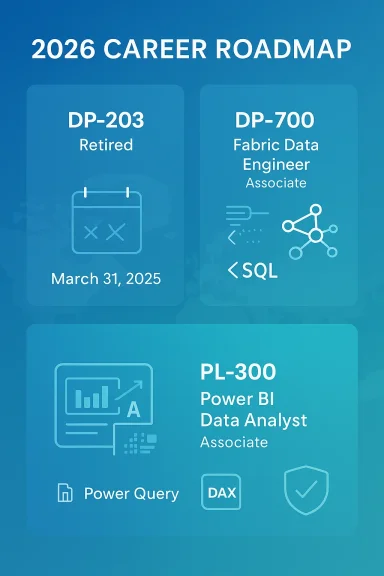
Microsoft’s data career ladder has changed, and the difference matters. DP-203 is no longer an active certification exam: Microsoft retired the Azure Data Engineer Associate exam on March 31, 2025, and now points candidates toward DP-700, Fabric Data Engineer Associate, for the modern data-engineering track. PL-300, by contrast, remains active as Microsoft Certified: Power BI Data Analyst Associate and continues to be updated, with Microsoft’s current exam page showing a January 15, 2026 refresh.
That means any article still pitching DP-203 as a current credential is already out of date, and the distinction is more than a naming tweak. For job seekers, career changers, and hiring managers, the real story is that Microsoft Fabric has absorbed much of the old Azure data-engineering narrative, while Power BI continues to anchor the analytics and reporting layer. The smart career move in 2026 is to understand that shift, not repeat yesterday’s certification map.
For years, the Microsoft data stack has been one of the most practical routes into cloud analytics careers. Azure Data Factory, Synapse, Data Lake, and Power BI became familiar names for teams building modern data platforms, and certifications gave those skills a recognizable market signal. The attraction was straightforward: learn the platform, prove the skill, and translate that into a role that sat closer to the center of business decision-making.
But the platform itself has evolved. Microsoft has been pushing Fabric as a unifying analytics experience, and the certification portfolio has shifted with it. That is why DP-203’s retirement is so important: it reflects a broader product transition, not just an exam sunset. The old “Azure data engineer” identity has not vanished, but it has been reframed around newer tooling, newer orchestration patterns, and a more integrated analytics stack.
PL-300 occupies a different lane. It remains one of Microsoft’s most recognizable role-based certifications because the business need behind it is enduring. Organizations still need people who can clean, model, visualize, and secure data in a way that business users can trust. Microsoft’s current PL-300 page emphasizes Power BI preparation, modeling, visualization, analysis, and governance, which keeps the credential squarely focused on day-to-day analytical work.
The bigger lesson for professionals is that certification value is increasingly tied to how closely the exam aligns with live product strategy. In a market that now prizes practical fluency over paper credentials, certifications that reflect the current ecosystem carry more weight than those tied to a retired product generation. That does not make older study paths useless, but it does mean candidates should be careful about which exam they are preparing for and why.
That retirement has practical consequences. Candidates can no longer treat DP-203 as a current market signal, and employers should not assume it maps to today’s Microsoft certification portfolio. The tooling has moved forward, and so has Microsoft’s product story, with Fabric now occupying the center of the data-engineering narrative.
The old exam still offers historical value as a curriculum reference. It shows what Microsoft considered foundational in Azure data engineering: ingestion, transformation, monitoring, security, and performance optimization. Those concepts remain useful, but they now show up through a different lens, and that lens is much more Fabric-centric than it was even a year ago.
The reason it remains valuable is simple: organizations still struggle with the gap between data and decision-making. A dashboard is not just a visualization exercise; it is a communication layer that shapes how leaders allocate budget, prioritize work, and spot risk. PL-300 validates the ability to do that work credibly, not just technically.
Microsoft also keeps PL-300 operationally relevant by updating the exam content. The current page notes a January 15, 2026 update, which is a reminder that the certification is being maintained in step with the product. That matters because Power BI changes quickly, and certifications that lag too far behind the platform become less useful over time.
This matters because professionals often chase certifications as if the code itself is the prize. In reality, employers care about the underlying capability: can you ingest data reliably, transform it cleanly, secure it properly, and communicate it effectively? The certification is only a proxy, and a useful one only if it matches the current tools and current business needs.
The shift also reflects a broader industry truth. Data engineers and analysts are no longer neatly separated by department boundaries. Many organizations want hybrid professionals who understand pipelines, semantic models, governance, and reporting, even if they specialize in one layer more than another.
Microsoft’s own exam pages point candidates toward study guides, practice assessments, sandboxes, and prep videos. That is a healthier preparation model because it aligns with the actual skills measured and the current product versions. It also reduces the risk of studying for a retired exam blueprint or memorizing outdated interface behavior.
For PL-300, the structure is especially transparent. Microsoft lists the assessed areas directly and provides a 100-minute exam window, language options, and practice tools. For DP-700, Microsoft similarly outlines the focus areas and positions the exam as a hands-on data-engineering assessment within Fabric.
For individual professionals, the impact is more personal and more immediate. A data analyst with PL-300 can signal readiness for business-facing work, while a data engineer should be aligning with the current Microsoft data-engineering path rather than an obsolete exam code. The market still rewards specialization, but it now rewards currency as much as specialization.
This also affects salary expectations and role mobility. People who can move from data movement to insight delivery often have broader career options, because they can support both technical and non-technical stakeholders. In practice, that means a better chance of moving into lead analyst, BI developer, analytics engineer, or cloud data platform roles.
They are also useful because they create a shared language. When someone says they are Power BI certified, or Fabric Data Engineer certified, a manager can infer something concrete about the person’s exposure to data prep, transformation, modeling, and solution management. That common vocabulary is particularly useful in large organizations where teams are spread across functions and geographies.
Still, certifications are not magic. They are strongest when backed by lab work, project experience, and a portfolio of solved problems. Paper alone rarely changes a career; paper plus practice often does.
For now, the safest interpretation is also the simplest one: PL-300 remains a live, useful certification, while DP-203 has been retired and effectively replaced in Microsoft’s current narrative by DP-700. If you are planning a study roadmap, that distinction should shape every decision you make, from course selection to practice-test purchases to resume wording. The wrong code can send a candidate in the wrong direction, and in a fast-moving Microsoft ecosystem, that is time you cannot afford to waste.
Source: ocnjdaily.com Building a High-Impact IT Career with Microsoft Data Engineering and Analytics Certifications (DP-203 & PL-300) | OCNJ Daily
That means any article still pitching DP-203 as a current credential is already out of date, and the distinction is more than a naming tweak. For job seekers, career changers, and hiring managers, the real story is that Microsoft Fabric has absorbed much of the old Azure data-engineering narrative, while Power BI continues to anchor the analytics and reporting layer. The smart career move in 2026 is to understand that shift, not repeat yesterday’s certification map.
 Overview
For years, the Microsoft data stack has been one of the most practical routes into cloud analytics careers. Azure Data Factory, Synapse, Data Lake, and Power BI became familiar names for teams building modern data platforms, and certifications gave those skills a recognizable market signal. The attraction was straightforward: learn the platform, prove the skill, and translate that into a role that sat closer to the center of business decision-making.But the platform itself has evolved. Microsoft has been pushing Fabric as a unifying analytics experience, and the certification portfolio has shifted with it. That is why DP-203’s retirement is so important: it reflects a broader product transition, not just an exam sunset. The old “Azure data engineer” identity has not vanished, but it has been reframed around newer tooling, newer orchestration patterns, and a more integrated analytics stack.
PL-300 occupies a different lane. It remains one of Microsoft’s most recognizable role-based certifications because the business need behind it is enduring. Organizations still need people who can clean, model, visualize, and secure data in a way that business users can trust. Microsoft’s current PL-300 page emphasizes Power BI preparation, modeling, visualization, analysis, and governance, which keeps the credential squarely focused on day-to-day analytical work.
The bigger lesson for professionals is that certification value is increasingly tied to how closely the exam aligns with live product strategy. In a market that now prizes practical fluency over paper credentials, certifications that reflect the current ecosystem carry more weight than those tied to a retired product generation. That does not make older study paths useless, but it does mean candidates should be careful about which exam they are preparing for and why.
Why the Retirement Matters
DP-203’s retirement is not a footnote; it changes the certification calculus. Anyone building a career plan around the old exam code should recognize that Microsoft no longer treats it as a live testing path. The company’s own retirement notices and support guidance make clear that the replacement mindshare belongs to Fabric Data Engineer Associate (DP-700), not the retired Azure Data Engineer exam.Why PL-300 Still Matters
PL-300 continues to matter because Power BI remains one of the most widely used self-service analytics platforms in enterprise environments. The exam still centers on preparing data, modeling data, visualizing and analyzing data, and managing and securing Power BI. That combination makes it useful not only for dedicated analysts, but also for operations, finance, sales, and product teams that increasingly live inside dashboards.The Real State of DP-203
DP-203 once served as the Microsoft badge for cloud data engineers who worked with Azure-native pipelines and storage. Its study guide described a candidate who integrated, transformed, and consolidated data across structured, unstructured, and streaming systems to build analytics solutions. Those responsibilities are still relevant, but the exam itself is not currently available because Microsoft retired it on March 31, 2025.That retirement has practical consequences. Candidates can no longer treat DP-203 as a current market signal, and employers should not assume it maps to today’s Microsoft certification portfolio. The tooling has moved forward, and so has Microsoft’s product story, with Fabric now occupying the center of the data-engineering narrative.
The old exam still offers historical value as a curriculum reference. It shows what Microsoft considered foundational in Azure data engineering: ingestion, transformation, monitoring, security, and performance optimization. Those concepts remain useful, but they now show up through a different lens, and that lens is much more Fabric-centric than it was even a year ago.
What Replaced It
Microsoft’s current replacement path is DP-700: Microsoft Certified: Fabric Data Engineer Associate. The exam focuses on ingesting and transforming data, securing and managing analytics solutions, and monitoring and optimizing those solutions. It also expects familiarity with SQL, PySpark, and KQL, which signals a more modern, hybrid analytics stack than the one associated with the retired DP-203 exam.Career Signal vs Exam Code
The career signal has not disappeared, but the code has changed. A hiring manager who once looked for DP-203 should now think in terms of the broader data-engineering skill set and the newer Fabric ecosystem. That subtle shift matters because certification searches, training plans, and resume keywords all need to reflect the current market.- DP-203 is retired
- DP-700 is the current Microsoft data-engineering certification
- Fabric is the product direction Microsoft is emphasizing
- Azure data-engineering skills still matter, but under a newer certification frame
Why PL-300 Still Has Strong Market Value
Unlike DP-203, PL-300 remains active and continues to serve a clear job-market purpose. Microsoft positions it as the certification for professionals who deliver actionable insights with Power BI, and the exam page is explicit about the skill areas tested. That makes PL-300 one of the cleaner certification stories in Microsoft’s current analytics lineup.The reason it remains valuable is simple: organizations still struggle with the gap between data and decision-making. A dashboard is not just a visualization exercise; it is a communication layer that shapes how leaders allocate budget, prioritize work, and spot risk. PL-300 validates the ability to do that work credibly, not just technically.
Microsoft also keeps PL-300 operationally relevant by updating the exam content. The current page notes a January 15, 2026 update, which is a reminder that the certification is being maintained in step with the product. That matters because Power BI changes quickly, and certifications that lag too far behind the platform become less useful over time.
The Power BI Skill Stack
PL-300 is not just about clicking through charts. Microsoft’s own exam overview highlights Power Query and DAX proficiency, along with preparing, modeling, visualizing, and securing data. Those are the same skills that separate a casual dashboard user from a genuine data analyst.Enterprise Impact
In enterprise settings, PL-300 is especially useful because it maps to day-to-day collaboration. Analysts need to work with stakeholders, data engineers, and analytics engineers, and the exam reflects that reality. This is why the certification reads as practical rather than academic: it measures whether you can turn data into decisions, not whether you can recite a product manual.- Power BI remains central to self-service analytics
- PL-300 validates business-facing analytical work
- The certification is regularly refreshed
- It is useful across finance, sales, operations, and product teams
How the Microsoft Data Career Path Has Shifted
The old narrative was fairly linear: learn Azure data engineering, get DP-203, then add Power BI and perhaps move into analytics leadership. That path still makes sense conceptually, but Microsoft’s product strategy has made it more layered and less strictly Azure-centric. The career ladder now looks more like data platform + analytics + governance + visualization than a single exam sequence.This matters because professionals often chase certifications as if the code itself is the prize. In reality, employers care about the underlying capability: can you ingest data reliably, transform it cleanly, secure it properly, and communicate it effectively? The certification is only a proxy, and a useful one only if it matches the current tools and current business needs.
The shift also reflects a broader industry truth. Data engineers and analysts are no longer neatly separated by department boundaries. Many organizations want hybrid professionals who understand pipelines, semantic models, governance, and reporting, even if they specialize in one layer more than another.
From Azure-Centric to Fabric-Centric
Fabric consolidates a lot of what used to live across separate services. That consolidation changes how data professionals think about architecture, because the platform is increasingly designed around fewer seams and more integrated experiences. For certification seekers, that means the new baseline is not just “can I use Azure services?” but “can I operate across the Fabric analytics stack?”Why Dual-Skill Candidates Stand Out
Professionals who understand both data engineering and analytics have an advantage because they can bridge the pipeline-to-dashboard gap. Businesses do not want insight trapped in raw tables, and they do not want polished reports fed by unreliable data. Candidates who can work on both sides of that divide are often more valuable than specialists who only see one half of the problem.- Platform shifts can change certification value quickly
- Hybrid data professionals are increasingly attractive to employers
- End-to-end thinking beats siloed tool knowledge
- Certification strategy should follow product strategy
Exam Preparation in the Real World
The article you supplied emphasizes practice tests and study material platforms, and that reflects a common reality in certification prep: people want repetition, question familiarity, and confidence. That instinct is understandable, but candidates should be careful to rely on legitimate study resources and official learning paths rather than material that may be incomplete, outdated, or misleading.Microsoft’s own exam pages point candidates toward study guides, practice assessments, sandboxes, and prep videos. That is a healthier preparation model because it aligns with the actual skills measured and the current product versions. It also reduces the risk of studying for a retired exam blueprint or memorizing outdated interface behavior.
For PL-300, the structure is especially transparent. Microsoft lists the assessed areas directly and provides a 100-minute exam window, language options, and practice tools. For DP-700, Microsoft similarly outlines the focus areas and positions the exam as a hands-on data-engineering assessment within Fabric.
A Smarter Study Sequence
A good preparation plan should be sequential, not random. Candidates should first understand the skills measured, then build hands-on familiarity, then test themselves with timed practice, and finally review weak areas with targeted labs or documentation. That approach is slower than cramming, but far more durable.- Read the current official exam guide.
- Build hands-on experience in the product.
- Take practice assessments under time pressure.
- Review missed topics and repeat the cycle.
- Confirm the exam code is still active before scheduling.
What Not to Do
The biggest mistake is assuming that a popular blog post or old prep kit is still current. Microsoft certification content changes, retired exams disappear, and product names evolve. If your study materials reference a retired code, that is a warning sign, not a shortcut.- Use current official study guides
- Prioritize labs and product familiarity
- Treat practice exams as diagnostic tools
- Verify exam status before booking anything
Enterprise and Consumer Career Impact
For enterprise employers, the significance of this certification story is tactical. They need workers who can maintain data quality, reduce reporting chaos, and produce trusted analytics in a cloud environment that keeps shifting. That is why the difference between DP-203 and DP-700 matters so much: it tells the employer whether a candidate is anchored in a retired Azure-era schema or a current Fabric-era workflow.For individual professionals, the impact is more personal and more immediate. A data analyst with PL-300 can signal readiness for business-facing work, while a data engineer should be aligning with the current Microsoft data-engineering path rather than an obsolete exam code. The market still rewards specialization, but it now rewards currency as much as specialization.
This also affects salary expectations and role mobility. People who can move from data movement to insight delivery often have broader career options, because they can support both technical and non-technical stakeholders. In practice, that means a better chance of moving into lead analyst, BI developer, analytics engineer, or cloud data platform roles.
Consumer-Like Self-Service Analytics
A lot of Power BI’s value comes from enabling non-specialists to create useful analysis. That self-service element is why PL-300 remains relevant even outside traditional BI teams. The more business users rely on governed dashboards instead of spreadsheets, the more the certification’s skills become mainstream rather than niche.Enterprise Governance Concerns
Enterprises also care about security, governance, and lifecycle management. A dashboard that is easy to build but hard to govern can create compliance risk, data leakage, or inconsistent reporting. Microsoft’s PL-300 focus on managing and securing Power BI is therefore not just administrative; it is operational risk management.- Employers want current Microsoft platform knowledge
- Professionals need to track certification retirement notices
- Power BI skills support both technical and business roles
- Governance matters as much as visualization
What Makes Microsoft Certifications Worth It
Microsoft certifications are valuable when they match real work. That sounds obvious, but it is the core reason why PL-300 remains useful and why the retirement of DP-203 should be taken seriously rather than ignored. A good certification tells hiring managers that you have learned a skill set that is current, tested, and relevant to the platform they use.They are also useful because they create a shared language. When someone says they are Power BI certified, or Fabric Data Engineer certified, a manager can infer something concrete about the person’s exposure to data prep, transformation, modeling, and solution management. That common vocabulary is particularly useful in large organizations where teams are spread across functions and geographies.
Still, certifications are not magic. They are strongest when backed by lab work, project experience, and a portfolio of solved problems. Paper alone rarely changes a career; paper plus practice often does.
The Hiring Manager’s Perspective
Hiring managers usually want evidence of three things: tool fluency, business relevance, and problem-solving judgment. Certifications can support all three, but only if they are current and tied to the stack the company actually uses. That is why outdated exam codes can mislead candidates into thinking they are more marketable than they really are.The Candidate’s Perspective
From the candidate side, the right certification can focus study and build confidence. It can also serve as a signal when changing careers or entering a crowded applicant pool. But the smartest candidates treat the exam as a milestone, not a finish line.- Current certifications help employers map skills quickly
- Hands-on experience still matters
- Certification value depends on alignment with the live product stack
- Outdated prep paths can waste time and money
Strengths and Opportunities
The strongest opportunity here is for professionals to build a modern, credible Microsoft data profile without chasing legacy credentials. The combination of Fabric-oriented engineering knowledge and Power BI analytics capability is especially attractive because it maps to how companies actually build and consume data products today. That mix is broader than a single exam and more durable than a single product release cycle.- PL-300 is still active and market-relevant
- Fabric is the current Microsoft direction for data engineering
- Cross-functional data skills improve employability
- Analysts who understand pipelines have an edge
- Engineers who understand visualization create more business value
- Official Microsoft learning paths are increasingly practical
- Certification can help structure career transitions
Risks and Concerns
The biggest risk is confusion, especially from outdated articles and third-party prep sites that still talk as if DP-203 were current. That kind of mismatch can lead candidates to study the wrong blueprint, buy the wrong practice materials, or schedule for an exam that no longer exists. The second risk is overvaluing exam prep content that promises shortcuts rather than genuine skill development.- DP-203 is retired, so old guidance is misleading
- Third-party materials may not reflect current exam scope
- Credential inflation can make certifications less meaningful if not paired with experience
- Product transitions can invalidate study plans quickly
- Overreliance on dumps or memorization weakens long-term competence
- Power BI governance and security are often underestimated
- Candidates may ignore Fabric if they only follow legacy Azure guidance
Looking Ahead
Microsoft’s data certification story is likely to keep evolving in the direction of integrated analytics, not isolated tools. That means the most career-resilient professionals will be the ones who can connect ingestion, modeling, governance, and delivery inside a modern platform stack. The data engineer of 2026 is expected to understand more than pipelines, and the analyst is expected to understand more than charts.For now, the safest interpretation is also the simplest one: PL-300 remains a live, useful certification, while DP-203 has been retired and effectively replaced in Microsoft’s current narrative by DP-700. If you are planning a study roadmap, that distinction should shape every decision you make, from course selection to practice-test purchases to resume wording. The wrong code can send a candidate in the wrong direction, and in a fast-moving Microsoft ecosystem, that is time you cannot afford to waste.
- Check Microsoft’s official certification pages before studying
- Align data-engineering prep with Fabric, not retired DP-203 content
- Treat PL-300 as a current analytics credential
- Build hands-on project experience alongside certification prep
- Use certifications to support a broader portfolio strategy
Source: ocnjdaily.com Building a High-Impact IT Career with Microsoft Data Engineering and Analytics Certifications (DP-203 & PL-300) | OCNJ Daily
