

NTT DATA has signed a definitive agreement to acquire WinWire, a Santa Clara-based Microsoft partner with delivery centers in India, to expand its Azure, data engineering, cloud-native development, and agentic AI capabilities for enterprise customers. The transaction, still subject to closing conditions and regulatory approvals, is less a conventional services tuck-in than a signal about where the Microsoft partner economy is moving. The race is no longer about who can demo the best chatbot; it is about who can industrialize AI across messy data estates, regulated workflows, and production cloud environments. NTT DATA is buying capacity, credibility, and Microsoft-native muscle at the moment enterprises are discovering that AI pilots do not scale themselves.
The easiest way to misunderstand this deal is to file it under “AI acquisition” and move on. That phrase now covers everything from model labs to prompt-tool startups to consultancies with a few Copilot workshops in their sales deck. WinWire sits in a more practical and arguably more valuable lane: the unglamorous engineering layer between enterprise ambition and production deployment.
That layer is where many AI strategies currently stall. Companies have experimented with generative AI, often enthusiastically, but the move from proof of concept to enterprise-grade system is difficult. It demands identity controls, data pipelines, application modernization, security reviews, governance, observability, cost discipline, and business-process redesign. In other words, it demands the same things cloud transformation always demanded, only now under the harsher spotlight of AI risk and executive urgency.
NTT DATA’s acquisition of WinWire is therefore best read as an acknowledgment that AI adoption has become a systems-integration problem. The model is only one ingredient. The enterprise value comes from connecting it to trustworthy data, business applications, workflow automation, and managed operations.
That is where Microsoft’s cloud stack becomes strategically important. Azure is not merely infrastructure in this story; it is the operating environment for Microsoft Fabric, Azure AI Foundry, data engineering, modern applications, security tooling, and the broader enterprise software estate. By adding more than 1,000 Azure engineers and AI specialists, NTT DATA is not just expanding headcount. It is trying to deepen its ability to deliver Microsoft-centered AI transformation at scale.
That breadth creates opportunity, but it also creates complexity. The Microsoft pitch is strongest when customers already live inside Microsoft 365, Entra ID, Power Platform, Dynamics, Windows, SQL Server, and Azure. But breadth is not the same as simplicity. The more Microsoft positions its stack as the enterprise AI control plane, the more customers need partners who can navigate the seams.
Those seams are precisely where systems integrators compete. The difference between a sales promise and a working deployment often comes down to whether a partner can understand a customer’s data architecture, modernize applications without breaking operations, map AI use cases to governance policies, and keep the solution maintainable after the first executive demo. The vendor may provide the platform, but the partner turns it into something a finance department, hospital network, manufacturer, or public-sector agency can trust.
NTT DATA’s Microsoft ambitions were already visible before the WinWire deal. The company has emphasized its Global Business Unit for Microsoft Cloud, its operations across more than 50 countries, and a certification base reportedly exceeding 24,000 Microsoft credentials. Its recognition as Microsoft’s 2025 Global System Integrator Growth Champion Partner of the Year gave it external validation inside Microsoft’s partner orbit.
WinWire adds a more specialized Microsoft services engine. Its focus on Azure, data engineering, AI, modern applications, Microsoft Fabric, and agentic AI gives NTT DATA more depth in areas Microsoft itself is pushing hard. For customers, the pitch will be obvious: global delivery scale from NTT DATA, Microsoft-native specialization from WinWire, and a route from AI experimentation to governed production deployment.
That shift changes the role of cloud integrators. A chatbot can be built by a small team with access to an API. An agent that performs meaningful enterprise work needs permissions, connectors, auditability, fallback behavior, policy enforcement, and an understanding of how business processes actually function. It must know not only what it can do, but what it is allowed to do.
Microsoft has been pushing this direction across its platform strategy. Foundry-style tooling, Fabric-linked data access, Copilot extensibility, and security governance all point toward an enterprise environment where AI agents become part of the application estate. But that environment is only useful if customers can implement it without creating a new class of uncontrolled automation risk.
This is where WinWire’s profile becomes attractive. A partner with experience in data engineering, Azure AI, cloud-native development, and Microsoft Fabric can plausibly help customers build agents that are grounded in enterprise data and embedded in operational systems. That is very different from building a standalone demo with synthetic data and a friendly prompt.
NTT DATA’s framing is also telling. The company is not positioning the acquisition as a bet on consumer AI or frontier model development. It is positioning it as a way to help enterprises “operationalize AI at scale.” That phrase is bland, but the underlying problem is real. The enterprise market is moving from wonder to implementation, and implementation is where consulting firms make their money.
Acquiring WinWire gives NTT DATA a shortcut. The company gains more than 1,000 Azure engineers and AI specialists in one move, along with a customer base, delivery processes, Microsoft relationship capital, and experience across the parts of the Microsoft cloud stack that are currently most strategically relevant. In a services market where expertise is the product, this is a capacity acquisition as much as a capability acquisition.
The India delivery-center component is also important. Global systems integration depends on the ability to combine onshore consulting, nearshore coordination, and offshore engineering at scale. WinWire’s footprint gives NTT DATA more delivery leverage for Microsoft cloud and AI projects, particularly when customers want aggressive timelines but remain cost-conscious.
There is also a cultural fit in the kind of work being acquired. WinWire is not described as a speculative AI lab; it is a Microsoft partner built around enterprise transformation. That makes integration into a global services organization more plausible than acquiring a research-heavy startup whose value depends on a small founding team and a fragile technology edge.
Still, services acquisitions succeed or fail in the details. Retaining technical leaders, keeping delivery quality high, preserving customer relationships, and integrating sales motions are never automatic. The larger the acquiring organization, the greater the risk that the acquired company’s agility gets absorbed into process. NTT DATA will need WinWire’s specialization to survive the integration, not merely its headcount to show up in a slide deck.
Microsoft Fabric is central to Microsoft’s answer to that problem. Its promise is to bring data engineering, analytics, warehousing, real-time processing, data science, and business intelligence into a more unified platform. Whether customers experience it as simplification or as another layer of Microsoft abstraction depends heavily on implementation quality.
That is why data engineering appears so prominently in the WinWire rationale. AI without data engineering is a demo. AI with poor data engineering is a liability. AI connected to curated, governed, well-modeled enterprise data has a chance to become useful.
For WindowsForum.com readers in IT and administration roles, this is the practical takeaway behind the corporate language. The value of the acquisition is not that NTT DATA can now say “agentic AI” more often. It is that the combined company may be better positioned to do the plumbing required for Microsoft AI projects to function in production environments.
That plumbing includes identity integration, role-based access, data classification, lifecycle management, network architecture, monitoring, incident response, cost controls, and application modernization. It is the work nobody puts on an AI keynote slide, but it is the work that determines whether enterprises trust the system enough to use it.
That makes systems integrators an increasingly important part of the AI supply chain. They translate vendor roadmaps into industry deployments. They bring consultants into the executive suite, architects into the platform decisions, and engineers into the backlog. They also absorb a significant amount of customer frustration when platforms evolve quickly, documentation lags, or product boundaries shift.
For Microsoft, partner depth matters because AI adoption is no longer a single-product sale. A meaningful Azure AI engagement may touch Fabric, Entra ID, Defender, Purview, Power Platform, Teams, GitHub, Visual Studio, SQL, Kubernetes, and third-party systems. The commercial prize is not only AI services revenue, but deeper entrenchment of the Microsoft cloud estate.
NTT DATA’s move fits this ecosystem logic. By acquiring a Microsoft specialist, it strengthens its ability to win transformation programs where the customer has already chosen Microsoft as the strategic platform. It also gives Microsoft another scaled partner able to push customers beyond pilots and into production workloads.
The deal also reflects a consolidation pattern likely to continue. Specialized AI and cloud boutiques have become attractive targets for larger integrators that need credibility and delivery capacity faster than they can build it. The winners will not necessarily be the firms with the flashiest AI branding. They will be the ones that can repeatedly deliver secure, maintainable systems in real enterprise conditions.
That shift raises the bar for vendors and partners. A pilot can survive with hand-picked data, limited users, and informal governance. A production AI system must survive audits, outages, adversarial prompts, privacy obligations, integration constraints, and skeptical employees. It also has to justify its cost, especially as AI compute and licensing expenses become more visible.
NTT DATA is leaning into precisely that transition. The company’s statement about helping clients move from experimentation to enterprise-wide deployment captures the mood of the market. Customers are not abandoning AI enthusiasm; they are becoming more demanding about execution.
This is also why Microsoft-centered AI work is increasingly tied to modernization. Many enterprises cannot simply bolt agents onto old systems and expect magic. Legacy application estates, brittle integrations, inconsistent data models, and weak governance can turn AI projects into expensive theater. Cloud-native development and modern application engineering are not side dishes here; they are prerequisites.
WinWire’s mix of AI, Azure, data, and application modernization therefore maps neatly to the next stage of enterprise demand. If NTT DATA can combine that specialization with its global reach, the acquisition could help it compete more aggressively against Accenture, Capgemini, Cognizant, Infosys, TCS, Wipro, Deloitte, and other firms fighting for the same Microsoft transformation budgets.
For administrators, this means identity and access design become central to AI architecture. An agent connected to enterprise data should not become a privileged backdoor. A workflow automation system should not bypass approval chains. A natural-language interface should not make sensitive information easier to exfiltrate.
Microsoft has been trying to position its security, compliance, and identity stack as a reason enterprises should build AI on Azure rather than assemble a looser collection of tools. That pitch resonates with organizations already standardized on Entra ID, Microsoft 365, Defender, and Purview. But again, the platform does not configure itself.
A partner delivering AI at scale must be able to design least-privilege access, map data sensitivity, enforce retention policies, monitor agent behavior, and document controls for auditors. It must also understand the tradeoffs between speed and safety, because business units will often push for faster deployment than security teams are comfortable accepting.
This is where a larger NTT DATA-Microsoft practice could become useful to customers that lack internal AI governance maturity. The risk is that “secure AI” becomes another checkbox in a transformation package. The opportunity is to make security architecture part of the delivery model from day one rather than a late-stage review that slows everything down.
Many organizations have pockets of expertise. A data team may understand the warehouse. A platform team may understand Azure. A security team may understand identity and compliance. A development team may understand the application stack. AI projects force those groups into the same room, often before their processes, tooling, and incentives are ready.
That is why integrators continue to matter despite years of cloud self-service rhetoric. Enterprises can buy platforms directly, but they often need help turning those platforms into operating models. The shortage is not merely in people who can write prompts or call APIs. It is in people who can translate business processes into secure, observable, maintainable AI-enabled systems.
NTT DATA is effectively buying a concentration of that talent. The question is whether it can deploy those specialists without diluting their effectiveness. In large consulting organizations, the best experts can become bottlenecks, spread across too many sales pursuits, escalations, and executive briefings. Scaling expertise is harder than scaling headcount.
For customers, this means the acquisition should be viewed with cautious interest. A bigger partner bench can help, but buyers should still demand clarity about who will actually staff the work, what experience they have with similar deployments, and how the partner will transfer knowledge to internal teams. AI transformation that leaves the customer permanently dependent on outside consultants is not transformation; it is outsourcing with better branding.
Microsoft’s Stephen Boyle framed the transaction around the need for skilled partners as enterprises seek to unlock AI value on Azure. That is more than ceremonial partner-speak. Microsoft’s AI growth depends on a channel capable of turning product announcements into customer deployments at global scale.
The partner ecosystem also helps Microsoft defend against competing cloud and data platforms. AWS, Google Cloud, Snowflake, Databricks, ServiceNow, Salesforce, Oracle, and others are all trying to own parts of the enterprise AI workflow. The more Microsoft can surround Azure and Fabric with capable implementation partners, the harder it becomes for customers to treat Microsoft AI as an isolated experiment.
NTT DATA benefits from the same dynamic. A stronger Microsoft practice makes it more relevant in accounts where the strategic platform decision is already tilted toward Azure. It also gives the company more reason to enter conversations earlier, when customers are still shaping AI roadmaps rather than merely sourcing implementation help.
The competitive question is whether NTT DATA can turn this into differentiated offerings rather than simply more delivery capacity. Every major integrator now claims AI expertise. The firms that stand out will bring reusable frameworks, industry accelerators, governance patterns, migration playbooks, and measurable business outcomes. WinWire may help NTT DATA build that portfolio, but the acquisition itself is only the starting point.
NTT DATA will need to preserve what made WinWire valuable while connecting it to a much larger global machine. That means aligning sales teams without confusing customers, integrating methodologies without slowing delivery, and giving WinWire’s technical specialists access to larger opportunities without turning them into generic resources.
There is also a branding challenge. WinWire’s identity as a focused Microsoft partner has likely been part of its appeal. Inside NTT DATA, that focus must remain visible enough for Microsoft account teams and enterprise buyers to understand what changed. If WinWire simply disappears into a broad services catalog, some of the acquisition’s market signal could fade.
The regulatory and closing process is another reminder that the deal is not finished yet. The announcement says the transaction remains subject to customary closing conditions and regulatory approvals. That is standard language, but it matters because customers and employees will operate in an interim period where the strategic direction is clear but the organizational details may not be.
Assuming the transaction closes, the first year will matter. Customers will watch whether delivery improves, whether teams remain stable, and whether the combined company can bring more compelling Microsoft AI offerings to market. Microsoft will watch whether the partnership translates into consumption and successful deployments. Competitors will watch for talent leakage and integration friction.
If your organization is already invested in Microsoft 365, Windows endpoints, Entra ID, Defender, Azure, Power Platform, and SQL, then AI adoption will likely arrive through that stack whether or not anyone calls it a “transformation program.” Copilot extensions, internal agents, Fabric analytics, AI-assisted support workflows, and automated business processes will all pressure IT teams to connect more systems and expose more data.
That creates practical questions. Who owns AI identity policies? Which data sources are safe to ground agents on? How are prompts, outputs, and actions logged? What happens when an AI system makes a recommendation based on stale or incomplete data? How does the help desk support a workflow that spans Teams, Power Platform, Azure Functions, and a line-of-business application?
Large integrators like NTT DATA want to answer those questions for enterprises, or at least monetize the process of answering them. The WinWire acquisition strengthens NTT DATA’s claim that it can do so in Microsoft-heavy environments. But internal IT teams should not mistake partner involvement for abdication.
The best outcomes will come when external partners accelerate internal capability rather than replace it. Administrators and architects should insist on documentation, knowledge transfer, governance models, and operational handoff. AI systems will become part of the production estate, and production estates eventually land in the lap of IT.
Most organizations will not build frontier models. They will adapt platforms, integrate data, modernize applications, govern access, and redesign workflows. They will need consultants, engineers, architects, security specialists, and managed services teams. The winners will be the companies that make AI operationally boring enough to trust.
That does not mean the market is risk-free. Overpromising remains rampant. Agentic AI is still maturing. Microsoft’s own platform naming, packaging, and feature velocity can be difficult for customers to track. Enterprises may underestimate the data work required, while integrators may oversell reusable accelerators that still require heavy customization.
But the direction is clear. AI is becoming another layer of enterprise infrastructure, and infrastructure rewards scale, process, trust, and ecosystem alignment. NTT DATA’s acquisition of WinWire is a bet that the Microsoft cloud will be one of the main places that layer gets built.
NTT DATA’s planned acquisition of WinWire will not, by itself, determine the future of Microsoft’s AI ecosystem. But it captures the moment neatly: the hype cycle is giving way to the integration cycle, and the hard work is moving from demos to deployment. For enterprises building on Microsoft cloud, the next advantage will belong less to those who talk most fluently about agents and more to those who can make them secure, governed, useful, and durable in production.
Source: Pulse 2.0 NTT DATA To Acquire WinWire To Scale AI Adoption And Microsoft Cloud Transformation
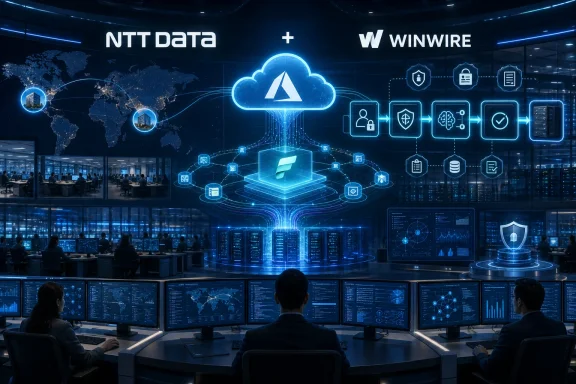 NTT DATA Buys the Part of AI That Enterprises Actually Need
The easiest way to misunderstand this deal is to file it under “AI acquisition” and move on. That phrase now covers everything from model labs to prompt-tool startups to consultancies with a few Copilot workshops in their sales deck. WinWire sits in a more practical and arguably more valuable lane: the unglamorous engineering layer between enterprise ambition and production deployment.That layer is where many AI strategies currently stall. Companies have experimented with generative AI, often enthusiastically, but the move from proof of concept to enterprise-grade system is difficult. It demands identity controls, data pipelines, application modernization, security reviews, governance, observability, cost discipline, and business-process redesign. In other words, it demands the same things cloud transformation always demanded, only now under the harsher spotlight of AI risk and executive urgency.
NTT DATA’s acquisition of WinWire is therefore best read as an acknowledgment that AI adoption has become a systems-integration problem. The model is only one ingredient. The enterprise value comes from connecting it to trustworthy data, business applications, workflow automation, and managed operations.
That is where Microsoft’s cloud stack becomes strategically important. Azure is not merely infrastructure in this story; it is the operating environment for Microsoft Fabric, Azure AI Foundry, data engineering, modern applications, security tooling, and the broader enterprise software estate. By adding more than 1,000 Azure engineers and AI specialists, NTT DATA is not just expanding headcount. It is trying to deepen its ability to deliver Microsoft-centered AI transformation at scale.
Microsoft’s AI Stack Has Become a Partner Battlefield
Microsoft has spent the past several years turning AI into a full-stack enterprise proposition. Azure supplies the compute and platform services. Microsoft Fabric aims to unify analytics, data movement, engineering, warehousing, real-time intelligence, and business intelligence under one roof. Azure AI Foundry gives organizations a way to build, evaluate, deploy, and manage AI applications and agents. Copilot, meanwhile, has pushed AI into the daily vocabulary of business users.That breadth creates opportunity, but it also creates complexity. The Microsoft pitch is strongest when customers already live inside Microsoft 365, Entra ID, Power Platform, Dynamics, Windows, SQL Server, and Azure. But breadth is not the same as simplicity. The more Microsoft positions its stack as the enterprise AI control plane, the more customers need partners who can navigate the seams.
Those seams are precisely where systems integrators compete. The difference between a sales promise and a working deployment often comes down to whether a partner can understand a customer’s data architecture, modernize applications without breaking operations, map AI use cases to governance policies, and keep the solution maintainable after the first executive demo. The vendor may provide the platform, but the partner turns it into something a finance department, hospital network, manufacturer, or public-sector agency can trust.
NTT DATA’s Microsoft ambitions were already visible before the WinWire deal. The company has emphasized its Global Business Unit for Microsoft Cloud, its operations across more than 50 countries, and a certification base reportedly exceeding 24,000 Microsoft credentials. Its recognition as Microsoft’s 2025 Global System Integrator Growth Champion Partner of the Year gave it external validation inside Microsoft’s partner orbit.
WinWire adds a more specialized Microsoft services engine. Its focus on Azure, data engineering, AI, modern applications, Microsoft Fabric, and agentic AI gives NTT DATA more depth in areas Microsoft itself is pushing hard. For customers, the pitch will be obvious: global delivery scale from NTT DATA, Microsoft-native specialization from WinWire, and a route from AI experimentation to governed production deployment.
The Agentic AI Label Is Doing Real Work Here
The term agentic AI is already in danger of becoming another industry slogan, but in this acquisition it matters. Enterprises are not merely asking whether a model can generate text, summarize documents, or answer questions. They are asking whether AI systems can take actions across applications, orchestrate workflows, retrieve and reason over enterprise data, and operate within controlled boundaries.That shift changes the role of cloud integrators. A chatbot can be built by a small team with access to an API. An agent that performs meaningful enterprise work needs permissions, connectors, auditability, fallback behavior, policy enforcement, and an understanding of how business processes actually function. It must know not only what it can do, but what it is allowed to do.
Microsoft has been pushing this direction across its platform strategy. Foundry-style tooling, Fabric-linked data access, Copilot extensibility, and security governance all point toward an enterprise environment where AI agents become part of the application estate. But that environment is only useful if customers can implement it without creating a new class of uncontrolled automation risk.
This is where WinWire’s profile becomes attractive. A partner with experience in data engineering, Azure AI, cloud-native development, and Microsoft Fabric can plausibly help customers build agents that are grounded in enterprise data and embedded in operational systems. That is very different from building a standalone demo with synthetic data and a friendly prompt.
NTT DATA’s framing is also telling. The company is not positioning the acquisition as a bet on consumer AI or frontier model development. It is positioning it as a way to help enterprises “operationalize AI at scale.” That phrase is bland, but the underlying problem is real. The enterprise market is moving from wonder to implementation, and implementation is where consulting firms make their money.
WinWire Gives NTT DATA a Microsoft-Native Delivery Shortcut
Large integrators can build practices organically, but hiring, training, certifying, and battle-testing cloud engineers takes time. AI has compressed the timeline. Boardrooms want answers now, Microsoft wants partners who can accelerate consumption now, and enterprise customers want production systems that do not collapse after the pilot phase.Acquiring WinWire gives NTT DATA a shortcut. The company gains more than 1,000 Azure engineers and AI specialists in one move, along with a customer base, delivery processes, Microsoft relationship capital, and experience across the parts of the Microsoft cloud stack that are currently most strategically relevant. In a services market where expertise is the product, this is a capacity acquisition as much as a capability acquisition.
The India delivery-center component is also important. Global systems integration depends on the ability to combine onshore consulting, nearshore coordination, and offshore engineering at scale. WinWire’s footprint gives NTT DATA more delivery leverage for Microsoft cloud and AI projects, particularly when customers want aggressive timelines but remain cost-conscious.
There is also a cultural fit in the kind of work being acquired. WinWire is not described as a speculative AI lab; it is a Microsoft partner built around enterprise transformation. That makes integration into a global services organization more plausible than acquiring a research-heavy startup whose value depends on a small founding team and a fragile technology edge.
Still, services acquisitions succeed or fail in the details. Retaining technical leaders, keeping delivery quality high, preserving customer relationships, and integrating sales motions are never automatic. The larger the acquiring organization, the greater the risk that the acquired company’s agility gets absorbed into process. NTT DATA will need WinWire’s specialization to survive the integration, not merely its headcount to show up in a slide deck.
The Real Prize Is the Data Estate Beneath the Model
The enterprise AI conversation often begins with models, but the real bottleneck is data. Businesses want AI systems that understand contracts, claims, tickets, purchase orders, telemetry, customer histories, supply chains, medical records, compliance policies, and internal knowledge. Those assets are fragmented across legacy systems, SaaS platforms, databases, file shares, lakes, warehouses, and departments with conflicting governance rules.Microsoft Fabric is central to Microsoft’s answer to that problem. Its promise is to bring data engineering, analytics, warehousing, real-time processing, data science, and business intelligence into a more unified platform. Whether customers experience it as simplification or as another layer of Microsoft abstraction depends heavily on implementation quality.
That is why data engineering appears so prominently in the WinWire rationale. AI without data engineering is a demo. AI with poor data engineering is a liability. AI connected to curated, governed, well-modeled enterprise data has a chance to become useful.
For WindowsForum.com readers in IT and administration roles, this is the practical takeaway behind the corporate language. The value of the acquisition is not that NTT DATA can now say “agentic AI” more often. It is that the combined company may be better positioned to do the plumbing required for Microsoft AI projects to function in production environments.
That plumbing includes identity integration, role-based access, data classification, lifecycle management, network architecture, monitoring, incident response, cost controls, and application modernization. It is the work nobody puts on an AI keynote slide, but it is the work that determines whether enterprises trust the system enough to use it.
Microsoft Partners Are Becoming the AI Supply Chain
The acquisition also says something larger about Microsoft’s ecosystem. Microsoft can build the platform, but it cannot personally refactor every legacy application, rationalize every data estate, or redesign every workflow for every customer. Its AI strategy depends on partners converting platform potential into customer consumption.That makes systems integrators an increasingly important part of the AI supply chain. They translate vendor roadmaps into industry deployments. They bring consultants into the executive suite, architects into the platform decisions, and engineers into the backlog. They also absorb a significant amount of customer frustration when platforms evolve quickly, documentation lags, or product boundaries shift.
For Microsoft, partner depth matters because AI adoption is no longer a single-product sale. A meaningful Azure AI engagement may touch Fabric, Entra ID, Defender, Purview, Power Platform, Teams, GitHub, Visual Studio, SQL, Kubernetes, and third-party systems. The commercial prize is not only AI services revenue, but deeper entrenchment of the Microsoft cloud estate.
NTT DATA’s move fits this ecosystem logic. By acquiring a Microsoft specialist, it strengthens its ability to win transformation programs where the customer has already chosen Microsoft as the strategic platform. It also gives Microsoft another scaled partner able to push customers beyond pilots and into production workloads.
The deal also reflects a consolidation pattern likely to continue. Specialized AI and cloud boutiques have become attractive targets for larger integrators that need credibility and delivery capacity faster than they can build it. The winners will not necessarily be the firms with the flashiest AI branding. They will be the ones that can repeatedly deliver secure, maintainable systems in real enterprise conditions.
The Enterprise AI Market Is Leaving the Lab
A year or two ago, many enterprise AI conversations were exploratory. Executives wanted innovation days, internal hackathons, copilots for productivity, and proof-of-concept prototypes. That phase is not over, but it is no longer enough. Organizations now want AI tied to measurable outcomes: faster claims processing, better customer support, lower software maintenance costs, improved forecasting, automated compliance review, and more resilient operations.That shift raises the bar for vendors and partners. A pilot can survive with hand-picked data, limited users, and informal governance. A production AI system must survive audits, outages, adversarial prompts, privacy obligations, integration constraints, and skeptical employees. It also has to justify its cost, especially as AI compute and licensing expenses become more visible.
NTT DATA is leaning into precisely that transition. The company’s statement about helping clients move from experimentation to enterprise-wide deployment captures the mood of the market. Customers are not abandoning AI enthusiasm; they are becoming more demanding about execution.
This is also why Microsoft-centered AI work is increasingly tied to modernization. Many enterprises cannot simply bolt agents onto old systems and expect magic. Legacy application estates, brittle integrations, inconsistent data models, and weak governance can turn AI projects into expensive theater. Cloud-native development and modern application engineering are not side dishes here; they are prerequisites.
WinWire’s mix of AI, Azure, data, and application modernization therefore maps neatly to the next stage of enterprise demand. If NTT DATA can combine that specialization with its global reach, the acquisition could help it compete more aggressively against Accenture, Capgemini, Cognizant, Infosys, TCS, Wipro, Deloitte, and other firms fighting for the same Microsoft transformation budgets.
The Security Story Is Bigger Than the Press Release
The announcement emphasizes secure and efficient deployment, which is expected in any enterprise AI deal. But the security implications deserve more attention than the usual corporate phrasing allows. Agentic AI changes the risk model because systems that can retrieve information, make decisions, and trigger actions are more dangerous than systems that merely generate text.For administrators, this means identity and access design become central to AI architecture. An agent connected to enterprise data should not become a privileged backdoor. A workflow automation system should not bypass approval chains. A natural-language interface should not make sensitive information easier to exfiltrate.
Microsoft has been trying to position its security, compliance, and identity stack as a reason enterprises should build AI on Azure rather than assemble a looser collection of tools. That pitch resonates with organizations already standardized on Entra ID, Microsoft 365, Defender, and Purview. But again, the platform does not configure itself.
A partner delivering AI at scale must be able to design least-privilege access, map data sensitivity, enforce retention policies, monitor agent behavior, and document controls for auditors. It must also understand the tradeoffs between speed and safety, because business units will often push for faster deployment than security teams are comfortable accepting.
This is where a larger NTT DATA-Microsoft practice could become useful to customers that lack internal AI governance maturity. The risk is that “secure AI” becomes another checkbox in a transformation package. The opportunity is to make security architecture part of the delivery model from day one rather than a late-stage review that slows everything down.
The Deal Also Exposes the Skills Gap
The figure of more than 1,000 Azure engineers and AI specialists is not just a staffing detail. It points to one of the most stubborn constraints in enterprise AI adoption: there are not enough people who understand cloud architecture, data engineering, security, application modernization, and AI implementation well enough to combine them in production.Many organizations have pockets of expertise. A data team may understand the warehouse. A platform team may understand Azure. A security team may understand identity and compliance. A development team may understand the application stack. AI projects force those groups into the same room, often before their processes, tooling, and incentives are ready.
That is why integrators continue to matter despite years of cloud self-service rhetoric. Enterprises can buy platforms directly, but they often need help turning those platforms into operating models. The shortage is not merely in people who can write prompts or call APIs. It is in people who can translate business processes into secure, observable, maintainable AI-enabled systems.
NTT DATA is effectively buying a concentration of that talent. The question is whether it can deploy those specialists without diluting their effectiveness. In large consulting organizations, the best experts can become bottlenecks, spread across too many sales pursuits, escalations, and executive briefings. Scaling expertise is harder than scaling headcount.
For customers, this means the acquisition should be viewed with cautious interest. A bigger partner bench can help, but buyers should still demand clarity about who will actually staff the work, what experience they have with similar deployments, and how the partner will transfer knowledge to internal teams. AI transformation that leaves the customer permanently dependent on outside consultants is not transformation; it is outsourcing with better branding.
The Microsoft Ecosystem Gains Another Scaled Champion
For Microsoft, the deal is convenient. It strengthens a partner that has already been recognized for growth in Microsoft’s global system integrator channel, and it does so in exactly the areas Microsoft wants to accelerate: Azure AI, Fabric, agentic systems, cloud-native apps, and enterprise data modernization.Microsoft’s Stephen Boyle framed the transaction around the need for skilled partners as enterprises seek to unlock AI value on Azure. That is more than ceremonial partner-speak. Microsoft’s AI growth depends on a channel capable of turning product announcements into customer deployments at global scale.
The partner ecosystem also helps Microsoft defend against competing cloud and data platforms. AWS, Google Cloud, Snowflake, Databricks, ServiceNow, Salesforce, Oracle, and others are all trying to own parts of the enterprise AI workflow. The more Microsoft can surround Azure and Fabric with capable implementation partners, the harder it becomes for customers to treat Microsoft AI as an isolated experiment.
NTT DATA benefits from the same dynamic. A stronger Microsoft practice makes it more relevant in accounts where the strategic platform decision is already tilted toward Azure. It also gives the company more reason to enter conversations earlier, when customers are still shaping AI roadmaps rather than merely sourcing implementation help.
The competitive question is whether NTT DATA can turn this into differentiated offerings rather than simply more delivery capacity. Every major integrator now claims AI expertise. The firms that stand out will bring reusable frameworks, industry accelerators, governance patterns, migration playbooks, and measurable business outcomes. WinWire may help NTT DATA build that portfolio, but the acquisition itself is only the starting point.
The Integration Test Comes After the Announcement
Acquisitions in professional services are easy to announce and hard to operationalize. The asset being purchased walks out of the building every evening. Customer trust lives in relationships. Delivery quality depends on teams, not logos. Culture matters because consultants and engineers can leave if the new structure buries them under bureaucracy.NTT DATA will need to preserve what made WinWire valuable while connecting it to a much larger global machine. That means aligning sales teams without confusing customers, integrating methodologies without slowing delivery, and giving WinWire’s technical specialists access to larger opportunities without turning them into generic resources.
There is also a branding challenge. WinWire’s identity as a focused Microsoft partner has likely been part of its appeal. Inside NTT DATA, that focus must remain visible enough for Microsoft account teams and enterprise buyers to understand what changed. If WinWire simply disappears into a broad services catalog, some of the acquisition’s market signal could fade.
The regulatory and closing process is another reminder that the deal is not finished yet. The announcement says the transaction remains subject to customary closing conditions and regulatory approvals. That is standard language, but it matters because customers and employees will operate in an interim period where the strategic direction is clear but the organizational details may not be.
Assuming the transaction closes, the first year will matter. Customers will watch whether delivery improves, whether teams remain stable, and whether the combined company can bring more compelling Microsoft AI offerings to market. Microsoft will watch whether the partnership translates into consumption and successful deployments. Competitors will watch for talent leakage and integration friction.
For Windows Shops, This Is an Azure Governance Story
WindowsForum.com readers may reasonably ask what a services acquisition has to do with them. The answer depends on where they sit. For home users, not much changes. For IT pros, sysadmins, cloud architects, and enterprise developers, the deal is part of a broader shift in which Microsoft’s AI future is becoming inseparable from Azure governance and data-platform architecture.If your organization is already invested in Microsoft 365, Windows endpoints, Entra ID, Defender, Azure, Power Platform, and SQL, then AI adoption will likely arrive through that stack whether or not anyone calls it a “transformation program.” Copilot extensions, internal agents, Fabric analytics, AI-assisted support workflows, and automated business processes will all pressure IT teams to connect more systems and expose more data.
That creates practical questions. Who owns AI identity policies? Which data sources are safe to ground agents on? How are prompts, outputs, and actions logged? What happens when an AI system makes a recommendation based on stale or incomplete data? How does the help desk support a workflow that spans Teams, Power Platform, Azure Functions, and a line-of-business application?
Large integrators like NTT DATA want to answer those questions for enterprises, or at least monetize the process of answering them. The WinWire acquisition strengthens NTT DATA’s claim that it can do so in Microsoft-heavy environments. But internal IT teams should not mistake partner involvement for abdication.
The best outcomes will come when external partners accelerate internal capability rather than replace it. Administrators and architects should insist on documentation, knowledge transfer, governance models, and operational handoff. AI systems will become part of the production estate, and production estates eventually land in the lap of IT.
The AI Services Market Is Getting Less Romantic
There is a useful sobriety in this acquisition. It is not about a moonshot model, a consumer app, or a founder promising to reinvent work with a browser extension. It is about a global services firm buying a Microsoft-focused engineering partner so it can deliver AI and cloud transformation more effectively. That may sound less exciting, but it is probably closer to how enterprise AI will actually spread.Most organizations will not build frontier models. They will adapt platforms, integrate data, modernize applications, govern access, and redesign workflows. They will need consultants, engineers, architects, security specialists, and managed services teams. The winners will be the companies that make AI operationally boring enough to trust.
That does not mean the market is risk-free. Overpromising remains rampant. Agentic AI is still maturing. Microsoft’s own platform naming, packaging, and feature velocity can be difficult for customers to track. Enterprises may underestimate the data work required, while integrators may oversell reusable accelerators that still require heavy customization.
But the direction is clear. AI is becoming another layer of enterprise infrastructure, and infrastructure rewards scale, process, trust, and ecosystem alignment. NTT DATA’s acquisition of WinWire is a bet that the Microsoft cloud will be one of the main places that layer gets built.
The WinWire Deal Turns AI Ambition Into an Execution Problem
The most concrete lessons from the acquisition are not about corporate strategy decks. They are about the practical shape of enterprise AI over the next several years.- NTT DATA is using the WinWire acquisition to deepen its Microsoft Azure, AI, data engineering, and cloud-native development capabilities rather than to enter a new market from scratch.
- WinWire’s more than 1,000 Azure engineers and AI specialists give NTT DATA immediate delivery capacity in a market where skilled Microsoft cloud talent is scarce.
- The transaction reinforces the idea that enterprise AI adoption depends on data engineering, governance, security, and application modernization as much as on model selection.
- Microsoft benefits when global systems integrators can turn Azure AI, Fabric, and agentic AI tooling into production deployments for large customers.
- Customers should evaluate the combined company not by the announcement language, but by delivery quality, staffing continuity, security architecture, and measurable business outcomes.
NTT DATA’s planned acquisition of WinWire will not, by itself, determine the future of Microsoft’s AI ecosystem. But it captures the moment neatly: the hype cycle is giving way to the integration cycle, and the hard work is moving from demos to deployment. For enterprises building on Microsoft cloud, the next advantage will belong less to those who talk most fluently about agents and more to those who can make them secure, governed, useful, and durable in production.
Source: Pulse 2.0 NTT DATA To Acquire WinWire To Scale AI Adoption And Microsoft Cloud Transformation
